政策性金融工具

Search documents
广西五洲交通股份有限公司第十届董事会第三十一次会议(临时)决议公告
Shang Hai Zheng Quan Bao· 2025-09-22 18:51
Meeting Details - The meeting was convened in accordance with the Company Law and the Articles of Association [2] - Meeting notice and materials were sent via email on September 16, 2025 [3] - The meeting took place on September 22, 2025, in a telecommunication voting format [4] - All 11 directors attended the meeting, including both independent and non-independent directors [5] Resolutions Passed - The board approved a proposal for the company to apply for a new policy financial tool loan from the National Development Bank and other policy banks, with a total amount not exceeding 600 million yuan, for a term of 20 years, and an interest rate not exceeding the five-year LPR [6] - The funds will be used to increase the registered capital of Guangxi Tanbai Expressway Co., Ltd. for the G80 Guangkun Expressway Nanning to Baise section expansion project [6] - The proposal received unanimous support with 11 votes in favor, and no votes against or abstentions [7]

宏观点评:广义财政盼增量-20250922
CAITONG SECURITIES· 2025-09-22 10:15
Revenue and Expenditure Overview - From January to August 2025, general public budget revenue totaled CNY 14.82 trillion, a year-on-year increase of 0.3%[2] - General public budget expenditure for the same period reached CNY 17.93 trillion, with a year-on-year growth of 3.1%[2] - In August 2025, general public budget revenue was CNY 1.24 trillion, up 2.0% year-on-year, while expenditure was CNY 1.86 trillion, reflecting a 0.8% increase[4] Tax Revenue Insights - Tax revenue continues to outperform non-tax revenue, with August tax revenue growing by 3.4% year-on-year, marking five consecutive months of positive growth[5] - Manufacturing accounted for over 30% of total tax revenue, with a growth rate exceeding 5% in the first eight months of 2025[5] - Securities transaction stamp duty surged by 226% in August, driven by increased market activity, contributing significantly to tax revenue growth[8] Fiscal Pressure and Challenges - The fiscal data for August indicates mounting pressure, with weakened consumption impacting tax revenue and a declining real estate sector exacerbating fiscal income challenges[23] - Government fund revenue fell by 5.7% year-on-year in August, primarily due to a 5.8% drop in land transfer income[18] - Infrastructure spending remains weak, with related expenditures showing a significant decline of 13.2% when combined[13] Future Outlook and Policy Implications - The necessity for incremental policy measures is rising due to anticipated economic pressures and the nearing end of government bond issuance in the fourth quarter[23] - The potential for early utilization of next year's debt quota and the timing of policy financial tools will be critical in supporting economic stability[23]
中信证券:预计“十五五”阶段我国政策导向仍然以财政货币双宽为主
Sou Hu Cai Jing· 2025-09-20 01:53
Core Viewpoint - The report from CITIC Securities indicates that the resolution of local government hidden debts may be achieved by the end of the 14th Five-Year Plan or the beginning of the 15th Five-Year Plan, but local government leverage remains high, necessitating the central bank to maintain low interest rates in an uncertain revenue environment [1] Group 1: Economic Outlook - The focus of new policy financial tools will be on eight key areas: digital economy, artificial intelligence, low-altitude economy, infrastructure in consumer sectors, green and low-carbon transition, agriculture and rural development, transportation and logistics, as well as municipal and industrial parks [1] - There is a high demand for incremental fiscal support, suggesting that the dual expansion of fiscal and monetary policies will continue in the future [1]

2025年8月财政数据点评:税收累计同比转正
HTSC· 2025-09-19 11:01
1. Report Industry Investment Rating No industry investment rating is provided in the report. 2. Core View of the Report In August 2025, fiscal revenue and expenditure performance was relatively stable. Tax revenue's cumulative year - on - year growth turned positive for the first time, possibly an early sign of improved economic vitality, but land transfer revenue still had a large drag, reflecting the inertia of the "old economy." The general budget target for this year is not difficult to achieve, while the government - funded budget may face a certain gap, but policy - based financial instruments may form a certain hedge [8]. 3. Summary by Relevant Catalogs 3.1 General Budget Revenue - **Overall Growth and Composition**: In August, the national general budget revenue increased by 2.0% year - on - year, slightly lower than July. Tax revenue increased by 3.4% (previous value 5.0%), and non - tax revenue's year - on - year decline narrowed from - 12.9% to - 3.8%. From January to August, tax revenue's cumulative year - on - year growth was 0.02%, the first positive growth this year, and non - tax revenue's cumulative year - on - year growth was 1.5% [1]. - **Total Progress and Regional Differences**: From January to August, the cumulative year - on - year growth of general budget revenue was 0.3%, 0.1% higher than the annual budget target, and about 67% of the annual budget was completed, slightly faster than the same period last year. In August, the year - on - year growth of central and local fiscal revenues was both 2.0%, with a slight decline from the previous value. Considering the convergence of economic data in recent months, there may still be some pressure on revenue growth in the future [2]. 3.2 Tax Structure - **High - growth Taxes**: In August, value - added tax, personal income tax, and corporate income tax continued to grow rapidly. Value - added tax increased by 4.4% year - on - year, personal income tax and corporate income tax increased by 9.7% and 33.4% respectively, mainly related to strengthened tax supervision, active capital markets, and improved corporate profitability [3]. - **Slowing - growth Taxes**: The year - on - year growth rate of consumption tax slowed down to 0.9% (previous value 5.4%). Low consumer enthusiasm and high - base pressure in the fourth quarter may affect consumption tax revenue [3]. - **Declining Taxes**: The decline of real - estate - related taxes widened, with a 11.6% year - on - year decrease in August. Real - estate policies had limited impact on sales, and investment and construction indicators continued to decline [4]. - **Increasing Taxes**: The year - on - year growth of stamp duty further increased, with the year - on - year growth of stamp duty rising from 24% in July to 154%, and the year - on - year growth of securities trading stamp duty rising from 125% to 226%, due to the strong rise of the stock market [4]. 3.3 General Budget Expenditure - **Overall Growth**: In August, general public budget expenditure increased by 0.8% year - on - year, slower than the previous value of 3.0%. The cumulative year - on - year growth in the first eight months was 3.1%, lower than the annual budget target of 4.4% [5]. - **Expenditure Areas**: The main driving force was still people's livelihood expenditure, such as social security and employment, health, and education. Infrastructure - related expenditure was still weak, and the growth rate of generalized and narrow - sense infrastructure investment declined [5]. 3.4 Government - Funded Revenue - **Overall Growth**: In August, government - funded revenue decreased by 5.7% year - on - year, turning negative from positive. From January to August, the cumulative year - on - year growth was - 1.4%, lower than the annual budget target of 0.7%. Land transfer revenue's cumulative year - on - year decline was 4.7% [6]. - **Completion Progress and Forecast**: By August, government - funded revenue had completed about 42% of the annual budget. Assuming the current real - estate demand trend continues, the annual revenue growth of the second - account budget is expected to be around - 5%, resulting in a revenue gap of 300 - 500 billion yuan [6]. 3.5 Government - Funded Expenditure - **Growth and Reasons**: In August, government - funded expenditure increased by 19.8% year - on - year, still maintaining high growth. The cumulative year - on - year growth in the first eight months was 30.0%, above the annual budget target of 23.1%. The high - intensity expenditure was mainly due to the front - loaded issuance of local bonds and the injection of special treasury bonds [7]. - **Combined Fiscal Deficit**: The combined broad - fiscal deficit of the two accounts in the first eight months was 6.7 trillion yuan, nearly 2 trillion yuan higher than the same period last year. After excluding the 500 - billion - yuan special treasury bond for capital injection, the broad - fiscal deficit was 6.2 trillion yuan, comparable to the same period in 2022 [7]. 3.6 Future Fiscal Concerns - **Rhythm**: In the third quarter, replacement bonds and special treasury bonds were completed successively. In the fourth quarter, government bond supply will enter a low - season, and the fiscal support for the economy will decline year - on - year, but there is still room for the expenditure of existing funds, mainly in the general budget [9]. - **Tools**: In August, core economic indicators weakened, and the market expected pro - growth policies. However, considering the small gap in the annual target, the possibility of additional fiscal deficits in the fourth quarter is low. Policy - based financial instruments are the core focus, and attention should also be paid to whether there is incremental support for implicit debt resolution [9]. - **Investment Direction**: This year, fiscal focus is not only on infrastructure, but also on child - rearing subsidies, urban renewal, consumer loan interest subsidies, and enterprise arrears. These will still be the focus of future efforts, and attention should be paid to whether there is incremental capital support [9].
国泰海通|宏观:收支有待提振——2025年8月财政数据点评
国泰海通证券研究· 2025-09-18 15:09
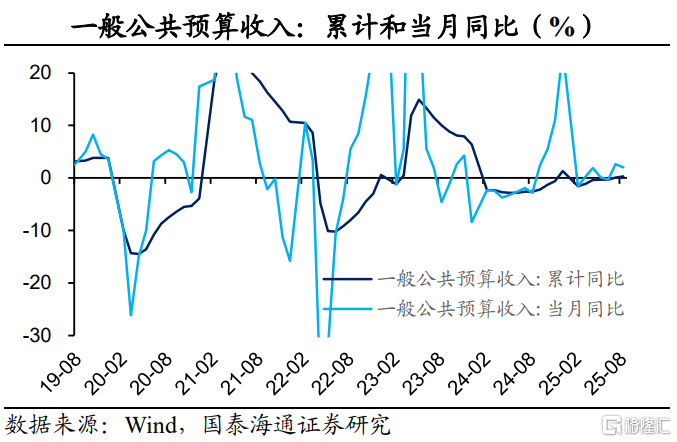
Core Viewpoint - The fiscal data for August 2025 indicates a slowdown in both revenue and expenditure growth, reflecting a need to boost domestic demand. Attention should be paid to the release of "quasi-fiscal" functions following the implementation of policy financial tools and the early allocation of new special bond quotas [1][3]. Revenue Summary - In the first eight months of 2025, national general public budget revenue grew by 0.3% year-on-year, with August's growth at 2%, down from 2.6% in July. The narrowing decline in PPI has alleviated the drag on tax revenue, while the income from securities transaction stamp duty has provided notable support. The internal growth momentum of the economy still needs enhancement, and macro policies require further strengthening [1]. - Corporate income tax revenue saw a significant rebound, primarily due to a low base from the previous year. Personal income tax and consumption tax revenue growth slowed, although personal income tax still performed well, while consumption tax remained at a low level. The high growth in securities transaction stamp duty revenue is linked to recent stock market activity. Additionally, vehicle purchase tax and land value-added tax revenues showed significant declines, while export tax rebate revenue growth rebounded, indicating a need to boost domestic demand [1]. Expenditure Summary - In the first eight months of 2025, national general public budget expenditure increased by 3.1% year-on-year, with August's growth at 0.8%, down from 3% in July, likely constrained by revenue. Expenditure in the livelihood sector continued to grow significantly, while infrastructure spending remained low. Social security, employment, and education expenditures maintained high growth rates, while spending on energy conservation, environmental protection, and transportation saw a substantial rebound, mainly due to a low base from the previous year. Expenditures in urban and rural communities, as well as agriculture, forestry, and water resources, experienced a widening decline [2]. Government Fund Summary - In the first eight months of 2025, national government fund budget revenue decreased by 1.4%, with August's growth at -5.7%, down from 8.9% in July. This decline is attributed to the pressure on the land market due to adjustments in the real estate market. Conversely, government fund budget expenditure grew by 30.0% year-on-year, driven by accelerated issuance and utilization of bond funds by various levels of government. In August, government fund budget expenditure increased by 19.8%, down from 42.4% in July, but still showed strong performance [2]. Policy Focus - Moving forward, it is essential for fiscal policy to continue to strengthen. The implementation of policy financial tools is expected to release "quasi-fiscal" functions, which may support the expansion of domestic demand. Additionally, the Ministry of Finance has indicated the early allocation of part of the new local government debt limit for 2026, aiming to utilize debt capacity proactively and address existing hidden debt [3].


国泰海通:收支有待提振
Ge Long Hui· 2025-09-18 03:51
Group 1: Narrow Income - National general public budget revenue grew by 0.3% year-on-year from January to August 2025, with August's growth at 2%, down from 2.6% in July [1][4] - The decline in PPI has eased the drag on tax revenue, and the securities transaction stamp duty has provided significant support to tax revenue [1][4] - Corporate income tax revenue saw a substantial rebound, mainly due to a low base last year, while personal income tax and consumption tax revenue growth slowed [1][6] Group 2: Narrow Expenditure - National general public budget expenditure increased by 3.1% year-on-year from January to August 2025, with August's growth at 0.8%, down from 3% in July [1][8] - Expenditure in the social welfare sector continued to grow significantly, while infrastructure spending remained low [1][10] - Central government expenditure grew by 8.0%, significantly higher than local government expenditure growth of 2.3% [1][8] Group 3: Government Fund - National government fund budget revenue decreased by 1.4% year-on-year from January to August 2025, with a notable decline in land use rights transfer revenue [2][13] - Government fund budget expenditure grew by 30.0% year-on-year, driven by accelerated bond issuance by various levels of government [2][13] - The implementation of policy financial tools is expected to support domestic demand expansion [2][13]

兼评8月经济数据:内需续弱,政策加码窗口临近
KAIYUAN SECURITIES· 2025-09-15 14:42
Consumption - Retail sales growth continued to slow, with August year-on-year growth down 0.3 percentage points to 3.4%[2] - The multiplier effect of the "trade-in" policy for consumer goods may decline by 23%-32%, from 8.7 times to 5.9-6.7 times[2][18] Production - Industrial production in August increased by 5.2% year-on-year, a decrease of 0.5 percentage points from the previous value[3] - Service sector production weakened slightly, down 0.2 percentage points to 5.6% year-on-year in August[3][21] Fixed Asset Investment - Real estate investment fell by 12.9% year-on-year in August, with a monthly decline of 19.5%[4][22] - Manufacturing investment decreased by 1.1 percentage points to 5.1%, marking five consecutive months of slowdown[4][27] Economic Outlook - Internal demand pressure is increasing, with expectations of policy support in Q4 to counteract economic slowdown[5][35] - Potential policy measures may include interest rate cuts, a 500 billion yuan policy financial tool, and support for service consumption and real estate[5][35] Risks - Risks include potential policy changes that may be less than expected and the possibility of an unexpected recession in the U.S. economy[6][36]
内需动能进一步修复需要“反内卷”政策强力出手
Sou Hu Cai Jing· 2025-09-02 05:26
Core Viewpoint - Insufficient effective demand, weak terminal consumption, and low corporate investment willingness continue to suppress the price recovery space, indicating a significant gap from the annual inflation target of 2% [1] Group 1: Economic Conditions - The persistent low level of prices reflects the current weakness in domestic demand recovery, suggesting that policy measures need to further enhance counter-cyclical adjustments to boost overall demand [1] - The implementation of "anti-involution" policies in the second half of the year is expected to increase fiscal support, underpin investment, and enhance consumption policies [1] Group 2: Policy Measures - The National Development and Reform Commission has announced the arrangement of over 300 billion yuan to support the third batch of "two heavy" project lists within the year, indicating a proactive fiscal policy stance [1] - The potential expansion of policy financial tools may positively impact manufacturing investment, while moderately loose monetary policy also has room for adjustment, with interest rate cuts and reserve requirement ratio reductions becoming feasible [1] Group 3: Future Expectations - The further issuance of "national subsidies" is anticipated to boost retail growth rates, with expected reserve increment policies including government debt limits, central bank profit remittances, and the introduction of quasi-fiscal tools [1]
2025年8月PMI数据点评:PMI略升:PMI略升
Haitong Securities International· 2025-09-01 08:22
Manufacturing PMI Insights - In August 2025, the Manufacturing PMI slightly increased to 49.4%, up by 0.1 percentage points from the previous month[8] - The production index rose to 50.8%, marking a 0.3 percentage point increase, remaining above the critical point for four consecutive months[14] - New orders index slightly increased to 49.5%, up by 0.1 percentage points, but still in the contraction zone[14] Sector Performance - Large enterprises' PMI rose to 50.8%, up by 0.5 percentage points, while medium and small enterprises' PMIs were 48.9% and 46.6%, respectively[13] - High-tech manufacturing and equipment manufacturing PMIs were 51.9% and 50.5%, respectively, indicating relative strength in these sectors[13] Price and Inventory Trends - The main raw materials purchase price index rose to 53.3%, up by 1.8 percentage points, indicating expansion, while the factory price index was at 49.1%, up by 0.8 percentage points[20] - The procurement volume index increased to 50.4%, up by 0.9 percentage points, while the finished goods inventory index decreased by 0.6 percentage points, reflecting improved production-sales coordination[23] Service and Construction Sector Analysis - The service sector business activity index reached 50.5%, up by 0.5 percentage points, driven by summer travel and active capital markets[24] - The construction sector's business activity index fell to 49.1%, down by 1.5 percentage points, with new orders index at 40.6%, down by 2.1 percentage points, indicating a significant seasonal decline[27] Risk Considerations - Real estate demand remains weak, posing a risk to overall economic recovery[4][29]
张智刚董事长与进出口银行董事长陈怀宇举行会谈
Sou Hu Cai Jing· 2025-08-29 12:41
Group 1 - The meeting between the chairman of State Grid Corporation and the chairman of China Export-Import Bank focused on enhancing cooperation in policy financial tools, overseas project financing, financial services, and strategic collaboration [1][3] - Both parties expressed their intention to deepen practical cooperation based on their previous successful collaboration, aiming for mutual benefits [1]