新消费

Search documents
外资机构看好中国资产 科技板块引力突显
Xin Lang Cai Jing· 2026-01-23 15:50
Group 1 - The core viewpoint of the articles is that China's financial capital market is expected to regain global attention in 2026, with foreign institutions expressing confidence in the long-term investment value of Chinese assets [1][2] - The technology sector, particularly AI, semiconductors, and biomedicine, is highlighted as having strong appeal for investment [1][5] - The consumption sector, especially in new consumption areas, is also seen as presenting more investment opportunities [1][8] Group 2 - Factors contributing to the attractiveness of Chinese assets include a favorable economic outlook and a stable policy environment, which are expected to support a structural recovery in the market [2] - The expectation of a rebound in fixed asset investment, supported by government funding and new projects, is anticipated to solidify growth foundations and benefit related industries [2] - The valuation of A-shares and H-shares remains attractive compared to developed markets, with foreign capital expected to increase its allocation to Chinese assets [2][4] Group 3 - The influx of overseas funds into the A-share market is anticipated due to the decline of the "dollar siphon" effect and subsequent interest rate cuts [3] - There are already signs of foreign capital accelerating its allocation to Chinese assets, with significant recovery noted in Hong Kong stock issuance [4] - The current foreign investment in China is below 10%, indicating substantial room for growth as governance structures improve [4] Group 4 - The AI sector is viewed as a core investment theme, with expectations for significant growth in applications and market potential in 2026 [5][6] - The differentiation between Chinese and U.S. AI companies is noted, with Chinese firms focusing on algorithmic advantages, which may mitigate concerns about investment bubbles [7] - Long-term improvements in profitability and operational efficiency in Chinese tech firms are expected to support their valuations [7] Group 5 - The new consumption sector is undergoing profound changes, driven by younger consumers who prioritize experience and emotional value in their purchasing decisions [8] - The characteristics of "light spending and high feedback" are emerging, leading to more diversified market demands [8] - The consumer sector is projected to experience a "K" shaped recovery, with essential and high-end consumer goods expected to rebound [8]
艾媒咨询:2026年中国新消费趋势白皮书
Sou Hu Cai Jing· 2026-01-23 12:47
Core Insights - The report highlights the structural upgrade of China's new consumption market driven by demographic changes, income levels, policy guidance, and technological innovation, transitioning from scale expansion to structural adaptation [1][3]. Group 1: Market Characteristics - The new consumption market is characterized by three core tracks: emotional economy, quality of life, and smart technology, reflecting profound changes in consumption logic and market structure [2][3]. - The emotional economy focuses on fulfilling emotional needs, with market size expected to reach 23,077.7 billion yuan by 2024 and double by 2029 [2]. - The quality of life track emphasizes health, comfort, and spiritual satisfaction, with the silver economy shifting from "elderly care" to "enjoying old age" [2][3]. - The smart technology track leverages AI and big data, with applications in AI terminals, service robots, and smart connected vehicles, becoming a key engine for consumption upgrade [2][3]. Group 2: Consumption Trends - Five major trends are anticipated for 2026: the shift from population dividends to value dividends in lower-tier markets, the integration of "AI+" services for personalized living, the acceleration of virtual and physical integration, sustainable consumption throughout the supply chain, and the globalization of brand ecosystems [3][9]. - Consumer motivations are evolving from functional satisfaction to emotional resonance and value recognition, with a dual decision-making logic of "extreme practicality" and "emotional premium" [2][9]. - The market structure is becoming more layered, with vertical communities emerging as the core soil for brand growth [2][9]. Group 3: Policy and Economic Context - The transition from "scale expansion" to "structural adaptation" is marked by a new policy framework aimed at enhancing the adaptability of consumer goods supply and demand, promoting consumption's contribution to economic growth [17][19]. - The government has set quantitative targets for optimizing supply structures, including three trillion-level fields and ten hundred-billion-level hotspots, to foster a healthy interaction between supply and demand [18][19].


“五十万亿元”展现的中国大市场(和音)
Sou Hu Cai Jing· 2026-01-22 22:48
Core Viewpoint - China aims to transition from being the "world's factory" to becoming the "world's market," accelerating its development as a major consumer economy, which will inject strong new momentum into mutually beneficial cooperation with countries worldwide [1][3]. Group 1: Domestic Demand and Economic Growth - Domestic demand has become the main driving force and stabilizing anchor for China's economic growth, contributing an average of 93.1% to economic growth from 2013 to 2024 [2]. - In 2025, final consumption expenditure is expected to contribute 52% to economic growth, an increase of 5 percentage points from the previous year [2]. - The share of service consumption expenditure in per capita consumption is projected to reach 46.1% in 2025, indicating a structural optimization in consumption [2]. Group 2: Investment Opportunities and Market Potential - China's market is characterized by its large scale, diverse levels, and significant potential, with substantial investment opportunities in new urbanization, technology industries, and improving livelihoods [3]. - The current consumer rate in China is about 40%, with a potential increase of 10-20 percentage points compared to developed countries, indicating room for growth [3]. - The policy of replacing old consumer goods is expected to benefit over 360 million people, showcasing market size and policy effectiveness [3]. Group 3: Global Economic Impact - Over the past five years, China has imported goods and services worth over $15 trillion, establishing itself as the world's second-largest consumer market [3]. - As income levels rise, the demand for a better quality of life will drive new consumption and supply, creating vast investment opportunities [3]. - China's commitment to expanding domestic demand will provide new opportunities for global cooperation, enhancing its role as a major consumer market [4].
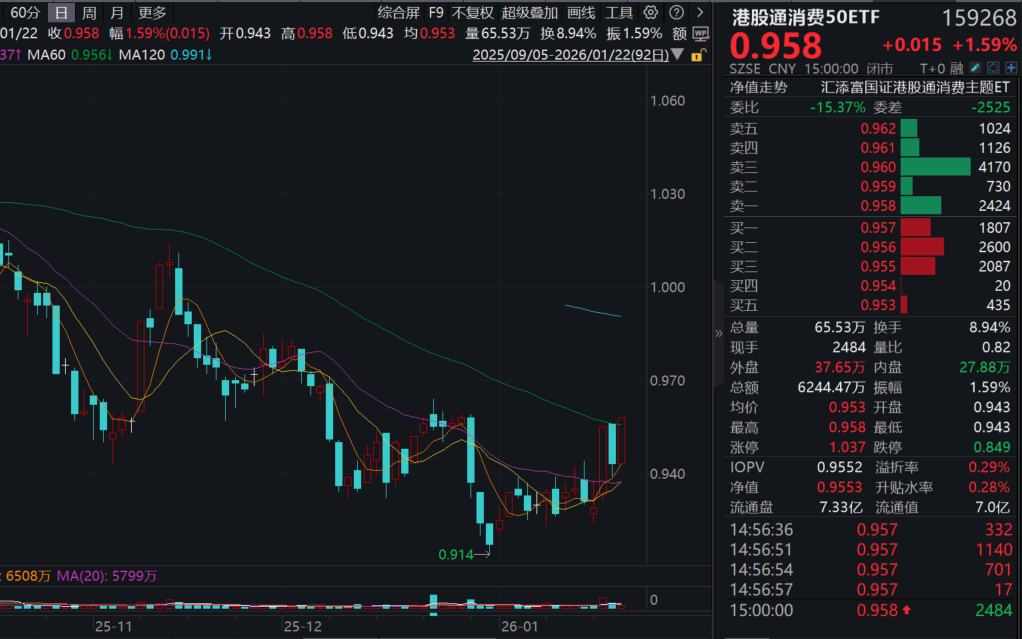
泡泡玛特再度大涨近6%,已大举回购3.5亿!港股通消费50ETF(159268)收涨1.59%,消费ETF(159928)昨日大举净流入超4亿元!
Xin Lang Cai Jing· 2026-01-22 09:59
Group 1 - Hong Kong stocks in the consumer sector experienced a significant rise, with the Hong Kong Stock Connect Consumer 50 ETF (159268) increasing by 1.59% and a total trading volume exceeding 62 million HKD, highlighting strong investor interest [1] - Pop Mart repurchased 500,000 shares for 96.49 million HKD, marking its second buyback within the week, with a total repurchase amount nearing 350 million HKD [1] - The A-share market showed a slight correction, with the Consumer ETF (159928) declining by 0.39% and a trading volume surpassing 500 million HKD, indicating a mixed sentiment in the market [2] Group 2 - Bohai Securities noted that high-level meetings are focusing on accelerating the cultivation of new growth points in service consumption, with policies being introduced to support new business models and scenarios, particularly in sports events and IP-related consumption [3] - Galaxy Securities highlighted that the optimization of holiday arrangements in 2026 is expected to significantly boost service consumption, with an increase in holiday days likely to enhance demand in tourism and dining sectors [4] - The Consumer ETF (159928) is characterized by its resilience across economic cycles, with the top ten constituent stocks accounting for over 68.55% of its weight, including major players in the liquor and agriculture sectors [5] Group 3 - The top holdings in the Consumer ETF include leading liquor companies such as Kweichow Moutai and Wuliangye, which together represent a significant portion of the ETF's weight, indicating a strong focus on essential consumer goods [6] - The Consumer 50 ETF (159268) is positioned as an efficient investment choice for the Hong Kong consumer sector, supporting T+0 trading and not occupying QDII quotas, appealing to investors targeting the new consumption trends among Generation Z [6]

四川双马:目前公司在保持原有建材生产制造业务经营的同时正在着力发展生物医药研发生产业务
Zheng Quan Ri Bao Wang· 2026-01-22 09:47
Core Viewpoint - Sichuan Shuangma is focusing on developing its biopharmaceutical research and production business while maintaining its existing building materials manufacturing operations [1] Group 1: Company Operations - Sichuan Shuangma is engaged in industrial investment and management as well as private equity fund management [1] - The company is managing and participating in investments in multiple private equity funds across various sectors including smart manufacturing, semiconductors, new energy, new consumption, health care, and biotechnology [1] Group 2: Investment Philosophy - The company adheres to the philosophy of promoting industry through capital, supporting the development of the real economy [1]

国联水产旗下品牌小霸龙获“2025年新消费卓越品牌奖”
Zheng Quan Ri Bao Zhi Sheng· 2026-01-22 09:40
Group 1 - The core viewpoint of the news highlights the recognition of Guolian Aquatic Products Co., Ltd. and its brand Xiaobalong, which won the "2025 New Consumption Excellence Brand Award" at the annual iMedia New Consumption Gala [1] - Guolian Aquatic has over 20 years of experience in the aquatic industry, establishing a complete industrial chain from breeding to trade, and is known as the "King of Shrimp" in China due to its leading export volume of shrimp [1] - The company has strategically focused on deep processing of aquatic food and high-value product development, leveraging an international supply chain that spans over 40 countries, enhancing its core advantages in processing technology, product development, and brand building [1] Group 2 - Looking ahead, Guolian Aquatic plans to continue its development path of "global resources, Chinese market, Guolian intelligent manufacturing," further enriching its product matrix in the deep processing of aquatic food, including ready-to-cook pre-prepared dishes [2] - The brand aims to increase investment in research and intelligent manufacturing to meet the evolving consumer demands with more diverse and higher-quality products, while also fulfilling corporate social responsibility by enhancing the added value of products like tilapia, black fish, and shrimp [2]

港股收评:恒指涨0.17%、科指涨0.28%,新消费概念股及军工股走高,有色金属概念股调整,半导体芯片股走低
Jin Rong Jie· 2026-01-22 08:22
Market Overview - The Hong Kong stock index opened high but closed lower, with the Hang Seng Index up 0.17% at 26,629.96 points, the Hang Seng Tech Index up 0.28% at 5,762.44 points, the National Enterprises Index down 0.09% at 9,114.3 points, and the Red Chip Index up 0.48% at 4,223.84 points [1] Company News - Shanghai Electric (02727.HK) expects a net profit of RMB 1.1 billion to RMB 1.32 billion for 2025, an increase of approximately 47% to 76% year-on-year [2] - Kingdee International (00268.HK) anticipates total revenue of RMB 6.95 billion to RMB 7.05 billion for 2025, a year-on-year growth of about 11.1% to 12.7%, with net profit expected between RMB 60 million and RMB 100 million [2] - JD Health saw a significant decline, with shares dropping over 2% [1] - Xiaomi Group (01810.HK) repurchased 7 million shares for HKD 248 million at prices between HKD 35.22 and HKD 35.48 [3] - Bubble Mart (09992.HK) repurchased 500,000 shares for HKD 96.49 million at prices between HKD 191.1 and HKD 194.9 [3] Sector Performance - Major tech stocks showed mixed performance, with Alibaba up 0.98% and Tencent down 0.83% [1] - Semiconductor stocks faced declines, with Zhaoyi Innovation down over 8% [1] - Military stocks strengthened, with China Shipbuilding Defense up over 3% [1] - Internet healthcare stocks were among the biggest losers, with JD Health down over 2% [1] Analyst Insights - Dongwu Securities noted that the Hong Kong market is in a long-term upward trend but faces short-term challenges, with strong consensus on domestic fundamentals but mixed views on overseas factors [5] - Guolian Minsheng Securities expressed optimism about the revaluation of Chinese AI, citing a solid industry catalyst timeline [6] - Morgan Stanley predicted that the upward trend in A-shares and Hong Kong stocks will continue until the Lunar New Year, with earnings expectations being revised upward, particularly in materials and communication services [6] - Guojin Securities highlighted that the valuation advantages of the Hong Kong market will become more pronounced as the domestic economy recovers and overseas monetary policies turn accommodative [7]
春天花荟开丨完美(中国)2026年业务启动大会圆满举办
Di Yi Cai Jing Zi Xun· 2026-01-22 04:44
Core Insights - The Perfect (China) Co., Ltd. held its 2026 business launch conference in Shanghai, themed "Spring Blossoms," gathering nearly 4,000 guests to summarize past achievements and outline future directions [1] Group 1: Leadership and Vision - Chairman Gu Runjin emphasized the importance of mutual growth between individuals and enterprises, advocating for contributions to both national and global progress [6] - Vice Chairman Xu Guowei highlighted the trend of new consumption and entrepreneurship, stressing the need for personalized solutions in health and beauty [8] - CEO Peng Zhihong presented five key themes for 2025, focusing on strategic evolution and resilience in the face of changing external environments [10] Group 2: Initiatives and Collaborations - The "Perfect Youth Light Entrepreneurship Plan" was officially launched, aiming to create a platform for young entrepreneurs to transform ideas into business [15] - The "International Longevity Medical Research Institute Perfect Branch" was inaugurated, aiming to integrate scientific research with health products [24] - The company announced six major advantages for 2026, including brand expansion and new product development in the anti-aging sector [26] Group 3: Community and Recognition - The "Perfect Entrepreneurship Pioneer Award" recognized partners who have successfully navigated their entrepreneurial journeys, sharing their growth stories [17] - The fourth session of the Perfect China Business Development Committee was inaugurated, emphasizing collaboration and unity among partners [29] Group 4: Market Trends and Insights - The conference featured discussions on the resilience of the Chinese economy and the strategic importance of health consumption in the current global economic context [12] - The company is committed to promoting healthy lifestyles and has been actively involved in micro-ecological research to enhance product effectiveness [18][20]

私募股票策略2025年度10强出炉!幻方居第4!远信、喜世润、北京禧悦分别夺魁!
私募排排网· 2026-01-21 07:00
Core Viewpoint - In 2025, major stock markets including A-shares, Hong Kong stocks, and US stocks experienced significant fluctuations but ultimately recorded impressive cumulative gains, with the Shanghai Composite Index rising over 18% and the ChiNext Index increasing by over 49% [3][4]. Group 1: Market Performance - The Shanghai Composite Index increased by 18.41%, while the Shenzhen Component Index rose by 29.87% and the ChiNext Index surged by 49.57% [4]. - Hong Kong's Hang Seng Index and Hang Seng Tech Index saw gains of 27.77% and 23.45%, respectively [4]. - In the US, the Dow Jones Industrial Average increased by 12.97%, and the Nasdaq rose by 20.36% [4]. Group 2: Private Equity Performance - Private equity stock strategies achieved an average return of approximately 29.20% in 2025, comparable to the Shenzhen Component Index [4]. - A total of 373 private equity firms had at least three stock strategy products with performance data available for 2025 [5]. Group 3: Top Private Equity Firms by Size - Among firms with over 100 billion in assets, the top performers included Yuanxin Investment, Lingjun Investment, and Fusheng Asset, with average returns exceeding a certain threshold [6][8]. - In the 50-100 billion category, Xishirun Investment and Shengqi Asset led the rankings [10][12]. - For the 20-50 billion category, Beijing Xiyue Private Equity and Qiantu Investment topped the list [13][16]. - In the 10-20 billion category, Shanghai Hengsui Asset and Fuyuan Capital were the top firms [17][19]. - For firms below 5 billion, Longhui Xiang Investment and Moku Asset were the leading performers [25][27]. Group 4: Investment Strategies and Focus Areas - Yuanxin Investment focuses on long-term value investment based on deep fundamental research, particularly in emerging sectors like technology and new energy [8]. - Fusheng Asset plans to continue focusing on "new consumption" and is also exploring traditional industries and AI technology applications [9]. - Xishirun Investment emphasizes a research-based approach to value investing, adapting to global market changes [12][16].
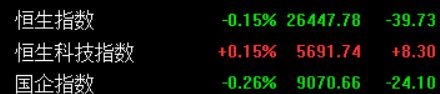
港股午评:恒指跌0.15%,恒生科指涨0.14%,半导体板块涨幅居前,黄金股普涨,内房股普跌
Jin Rong Jie· 2026-01-21 04:18
Market Performance - The Hang Seng Index decreased by 0.15% to 26,449.1 points, while the Hang Seng Tech Index increased by 0.14% to 5,691.65 points [1] - The National Enterprises Index fell by 0.26% to 9,071.33 points, and the Red Chip Index dropped by 0.44% to 4,170.27 points [1] Technology Sector - Among major tech stocks, Alibaba rose by 1.06%, Tencent fell by 0.17%, JD.com increased by 0.27%, Xiaomi dropped by 2.31%, NetEase fell by 3.43%, Meituan decreased by 0.77%, Kuaishou rose by 0.66%, and Bilibili fell by 0.08% [2] - The semiconductor sector saw significant gains, with Hua Hong Semiconductor rising over 4% [2] - Micron Technology indicated that the slow expansion of wafer fabs and complex customer certification processes will likely prolong the current memory shortage until 2028 [2] Gold and Silver Market - Gold stocks experienced a broad increase, with Lingbao Gold rising over 7% due to heightened demand for safe-haven assets amid escalating geopolitical tensions [3] - Spot silver reached a historical high of $95.89 per ounce, while spot gold surpassed $4,830 per ounce, also setting a new record [3] Real Estate Sector - Domestic property stocks generally declined, with Sunac China falling over 3% [3] - CICC's report suggested that despite weak demand, there are signs of positive changes on the supply side in the real estate sector, recommending increased attention to the sector in the short term [3] Consumer Sector - The new consumption concept saw a pullback, with Hu Shang A Yi dropping over 6% [3] - China Galaxy emphasized the importance of the "14th Five-Year Plan" for medium- to long-term consumption goals and the rollout of specific policies by 2026 [3]