大众食品

Search documents
贵州茅台重回1500元上方,有机构提出目标价1860元
Mei Ri Jing Ji Xin Wen· 2026-02-04 06:04
Group 1 - Guizhou Moutai's stock price rose nearly 4%, surpassing 1500 CNY per share for the first time since September 2025, reaching a peak of 1533 CNY per share during trading [1] - The market-oriented reforms of Moutai are showing initial results, with strong sales and price resilience for its core product, Feitian Moutai, which recorded 1.43 million orders in January, exceeding market expectations [1] - The current price of Feitian Moutai is stabilizing around 1500 CNY per bottle, which has become a consensus price among manufacturers, channels, and consumers [1] Group 2 - The target price for Moutai is maintained at 1860 CNY, corresponding to P/E ratios of 25.8 and 25.4 for 2026 and 2027, respectively, indicating a potential upside of 30.34% from the current price [1] - The overall valuation of the food and beverage sector has dropped to a five-year low, with leading companies expected to attract significant incremental capital due to their high barriers and dividends [1] - The Food and Beverage ETF (515170.SH) focuses on leading companies in the sector, excluding lower-tier liquor brands, and is expected to benefit from market consolidation and the trend of "drinking less, drinking better" [1] Group 3 - In addition to liquor, there are opportunities in the mass food sector, with the Food ETF Huaxia (159151.SZ) focusing on dairy, beer, condiments, and soft drinks, featuring strong demand resilience [2] - Key companies in the mass food segment include Yili Group, Haitian Flavoring & Food, COFCO Sugar, Angel Yeast, and Shuanghui Development, with their performance risks largely released [2]

消费论坛交流反馈——食品饮料行业周报(20260112-20260118):传统消费龙头探寻新路,成效初显
Huachuang Securities· 2026-01-19 07:25
Investment Rating - The report maintains a "Recommendation" rating for the food and beverage industry, indicating an expected increase in the industry index exceeding the benchmark index by more than 5% in the next 3-6 months [26]. Core Insights - The traditional consumer leaders in the food and beverage sector are exploring new paths, with initial positive results observed. The report highlights the acceleration of white liquor clearance and the catalyzing effect of the peak season for mass-market products [1][13]. - The liquor industry is currently at the bottom of its cycle, with expectations for sales to stabilize over the next three years. The report notes a significant price drop in high-end whiskey (approximately 50%) and a smaller decline in brandy (10-20%) due to decreased demand and a return to reasonable pricing [10]. - In the mass-market segment, companies are actively adjusting strategies, leading to improved performance. Notable companies include Xianle Health, which is leveraging overseas expansion and AI to drive growth, and West Wheat, which is enhancing its competitive advantage through channel expansion [11][12]. Summary by Sections 1. Meeting Feedback: Liquor at Cycle Bottom, Mass-Market Highlights - Liquor is at a cyclical low, with future sales expected to stabilize. The domestic brandy market remains stable, dominated by three major brands [10]. - The mass-market segment shows a divergence in demand, with companies like Xianle and West Wheat continuing to grow, while traditional companies are adjusting to improve performance [11]. 2. Investment Recommendations: Strengthening White Liquor Bottom, Catalyzing Mass-Market Peak Season - The report recommends Moutai and emphasizes the importance of Gujing, anticipating a recovery in demand as the Spring Festival approaches. The report suggests that companies are transitioning from passive responses to proactive adjustments [13]. - In the mass-market segment, the report highlights Anqi as a key recommendation, along with opportunities in restaurant supply chains and snack sectors as the Spring Festival approaches [13].
中金2026年食品饮料展望:筑底接近尾声 聚焦高质量增长
智通财经网· 2025-12-18 03:02
Group 1 - The food and beverage industry has entered a new normal in 2023, with a weak overall consumption environment and a continued trend towards high quality-price ratio, functionality, health, and emotional consumption [1] - The demand for the liquor industry remains weak, compounded by new regulations leading to significant adjustments on both supply and demand sides, while the performance of mass-market food shows divergence, with beverages and snacks exhibiting better conditions [1] - Looking ahead to next year, the industry is expected to continue a weak recovery with strong differentiation, relying more on product innovation, fragmented channel layouts, and expanding consumer demographics [1] Group 2 - The liquor sector is anticipated to see improvements in financial reports, with a potential turning point in the first half of 2026, as demand-side policy impacts are expected to diminish [2] - Consumer scenarios are projected to gradually recover from significant suppression, with potential consumption policy stimuli driving demand, leading to a year-on-year positive change starting in the first half of the year [2] - The overall demand for mass-market food is stabilizing at low levels, with sub-industry performance showing divergence, and trends towards quality-price ratio, health, and emotional value consumption continuing [2]
券商晨会精华 | L3准入落地将加速智驾产业链价值重构 2026年智驾有望成为AI应用的重要方向
智通财经网· 2025-12-18 00:41
Market Overview - The market experienced a collective rebound yesterday, with the Shanghai and Shenzhen stock exchanges recording a transaction volume of 1.81 trillion yuan, an increase of 87 billion yuan compared to the previous trading day [1] - By the end of the trading session, the Shanghai Composite Index rose by 1.19%, the Shenzhen Component Index increased by 2.4%, and the ChiNext Index surged by 3.39% [1] Express Delivery Sector - CITIC Securities highlighted that the structural opportunity in the express delivery sector remains focused on "full-chain cost reduction" as the market's anti-involution expectations gradually materialize [2] - The strong regulatory push for price anti-involution may seem to delay market clearing in the short term, but it emphasizes the investment value of leading companies undergoing end transformation [2] - Leading companies such as ZTO Express and YTO Express are currently in a profit release phase after surpassing capacity peaks, possessing above-average single-ticket profitability and potential financing capabilities [2] Food and Beverage Industry - CICC stated that the food and beverage industry has entered a new normal since the beginning of the year, with the overall consumption environment remaining weak and a focus on high-quality growth [3] - The demand for the liquor industry continues to show weak prosperity, compounded by new regulations leading to significant adjustments on both supply and demand sides [3] - Looking ahead to next year, CICC anticipates a continuation of weak recovery and strong differentiation in the industry, with growth increasingly reliant on product innovation, fragmented channel layouts, and expanding consumer demographics [3] Autonomous Driving Sector - Huatai Securities reported that the recent approval of L3 vehicle models by the Ministry of Industry and Information Technology marks a significant step towards the practical application of autonomous driving in China [4] - This approval indicates a transition from "pilot application and testing" to "product approval and on-road trial," which is expected to accelerate the value reconstruction of the autonomous driving industry chain [4] - By 2026, autonomous driving is anticipated to become a significant direction for AI applications, with investment opportunities in key areas such as smart vehicles, control chassis, domain control chips, and lidar [4]
中金公司:食品饮料行业筑底接近尾声,聚焦高质量增长
Mei Ri Jing Ji Xin Wen· 2025-12-18 00:14
Core Viewpoint - The report from CICC indicates that the food and beverage industry has entered a new normal, with a weak overall consumption environment persisting since the beginning of the year [1] Group 1: Industry Trends - The demand for the liquor industry has continued to show weak performance, compounded by the introduction of new regulations that have led to significant adjustments on both the supply and demand sides [1] - The performance of consumer goods has shown divergence, with beverages and snacks exhibiting better market conditions [1] Group 2: Future Outlook - Looking ahead to next year, the industry is expected to continue a weak recovery with strong differentiation, where growth will increasingly depend on product innovation efforts, fragmented channel layouts, and expanding consumer demographics [1] - Companies with strong brand power, product innovation capabilities, channel control, and excellent supply chain efficiency are likely to navigate through cycles and achieve high-quality growth [1]

中金公司:食品饮料行业筑底接近尾声 聚焦高质量增长
Di Yi Cai Jing· 2025-12-18 00:04
Core Insights - The food and beverage industry has entered a new normal since the beginning of the year, with an overall weak consumption environment [1] - The industry is focusing on high quality-price ratios, functionality, health, and emotional consumption trends [1] - The demand for the liquor industry continues to show weak prosperity, compounded by new regulations leading to significant adjustments on both supply and demand sides [1] - There is a divergence in performance among consumer goods, with beverages and snacks showing better prosperity [1] - Looking ahead to next year, the industry is expected to continue a weak recovery with strong differentiation, relying more on product innovation, fragmented channel layouts, and expanding consumer demographics [1] - Companies with strong brand power, product innovation capabilities, channel control, and excellent supply chain efficiency will be able to navigate through cycles and achieve high-quality growth [1]
2026年食品饮料行业投资策略:黎明前夕,曙光将至
Shenwan Hongyuan Securities· 2025-11-17 10:12
Summary of Key Points Group 1: Overall Industry Analysis - The report indicates a systemic recovery opportunity for the food and beverage industry in 2026 after a five-year adjustment period from 2021 to 2025, with key external indicators being the Consumer Price Index (CPI) and a focus on cyclical attributes in the liquor and catering supply chain [4][19]. - The liquor sector is expected to see a fundamental turning point in Q3 2026, following a significant decline in sales and prices in Q3 2025, with a projected stabilization and recovery in prices as inventory clears and demand rebounds [4][7][19]. - The report emphasizes that if the fundamentals recover as anticipated, a dual boost in valuation and performance is expected by the end of 2026 and into 2027, marking a strategic allocation period for quality companies [4][7][19]. Group 2: Liquor Investment Strategy - The liquor sector has experienced a significant decline in sales, with Q3 2025 showing a 50% year-on-year drop compared to Q3 2023, and high-end liquor prices continuing to fall as the market seeks a balance between volume and price [4][7][8]. - Key recommended companies in the liquor sector include Luzhou Laojiao, Shanxi Fenjiu, Kweichow Moutai, and Wuliangye, with a focus on strategic positioning for quality firms as the market stabilizes [4][7][8]. - Historical performance analysis from 2012 to 2015 suggests that stock price turning points often precede fundamental turning points, indicating a potential recovery in Q3 2026 [4][7][23]. Group 3: Consumer Goods Investment Strategy - The report identifies systemic opportunities in the consumer goods sector, with CPI as a core observation indicator, predicting gradual improvement in food CPI due to structural demand changes and a shift from price competition to quality competition among companies [4][19]. - Recommended companies in the consumer goods sector include Yili Group, Qingdao Beer, Anjuke Food, and Tianwei Food, with a focus on firms that possess pricing power and are positioned for systematic recovery if CPI continues to improve [4][19]. - The report highlights that if CPI improves consistently, leading companies in various sub-sectors will also experience systematic recovery [4][19].




中金:白酒报表有望出清改善 大众食品整体需求低位企稳
Zhi Tong Cai Jing· 2025-11-06 08:24
Core Insights - The food and beverage industry has entered a new normal since the beginning of 2025, with a weak overall consumption environment and a continued trend towards high cost-performance, functionality, health, and emotional consumption [1][2] - The liquor industry is undergoing channel inventory destocking, with expectations for improved financial statements by 2026, as the upward turning point becomes clearer [3] - The demand for consumer goods is stabilizing at a low level, with a divergence in performance among sub-industries, while leading companies focus on improving efficiency [4] Industry Overview - The overall consumption environment in the food and beverage sector remains weak, with a focus on high quality and cost-effectiveness, functionality, health, and emotional value [2] - Leading companies are concentrating on stable operations and high-quality development, resulting in improved operational quality and shareholder returns [2] - The liquor industry continues to experience weak demand, compounded by new regulations, leading to significant adjustments on both supply and demand sides [2] Liquor Industry Insights - The liquor sector is expected to see a recovery in financial statements by mid-2026, with the first half of the year potentially marking a turning point [3] - The impact of policies is expected to diminish, and consumer scenarios are anticipated to gradually recover, supported by deeper consumption policies [3] - Companies with strong brand power, product innovation, channel control, and excellent supply chain efficiency are likely to achieve high-quality growth [2][3] Consumer Goods Sector Insights - The overall demand for consumer goods is stabilizing at low levels, with a continuation of trends towards cost-performance, health, and emotional value [4] - Sub-industries such as snacks and soft drinks are expected to expand, while leading companies focus on improving operational quality [4] - The traditional consumer goods sector is projected to see a mild recovery in revenue and profit margin improvements following a bottoming out of fundamentals [4]
万联晨会-20250811
Wanlian Securities· 2025-08-11 00:34
Core Insights - The A-share market experienced a narrow consolidation last Friday, with the Shanghai Composite Index falling by 0.12% to 3635.13 points, and the Shenzhen Component Index down by 0.26% [2][7] - The total trading volume in the A-share market was approximately 1.71 trillion RMB, with around 2300 stocks rising [2][7] - In the Shenwan industry sector, the comprehensive and building materials industries led the gains, while the computer industry lagged [2][7] - The Hang Seng Index closed down by 0.89%, and the Hang Seng Technology Index fell by 1.56% [2][7] - The US stock indices all rose, with the Dow Jones up by 0.47%, the S&P 500 up by 0.78%, and the Nasdaq up by 0.98% [2][7] Economic Indicators - The National Bureau of Statistics released July CPI and PPI data, showing that the Consumer Price Index (CPI) rose by 0.4% month-on-month, while the core CPI, excluding food and energy, increased by 0.8% year-on-year [8] - The Producer Price Index (PPI) fell by 0.2% month-on-month and decreased by 3.6% year-on-year, indicating a narrowing decline compared to the previous month [8] - The State Administration of Foreign Exchange reported a current account surplus of 971.5 billion RMB for Q2 2025, with a goods trade surplus of 1.5751 trillion RMB [3][8] Industry Analysis Machinery Equipment Sector - In Q2 2025, the fund's heavy allocation in the machinery equipment sector decreased, with a total market value of 72.996 billion RMB, down by 14.84% quarter-on-quarter [9][10] - The concentration of holdings in the top five, ten, and twenty stocks in the machinery equipment sector showed a decline, with the top five stocks accounting for 42.51% of the total market value [10][12] - The top ten heavy stocks included companies primarily in automation equipment and engineering machinery, with mixed performance among them [10][12] Consumer Sector - The heavy allocation in the consumer sector continued to decline, with the overall heavy allocation ratio dropping to 5.85%, significantly below the historical average of 11.37% [13][14] - The agricultural, forestry, animal husbandry, and beauty care sectors saw a slight increase in heavy allocation ratios, while other sectors experienced declines [13][14] - The top twenty stocks in the market included three from the consumer sector, with notable declines in heavy allocation for major liquor brands [14][19] Food and Beverage Sector - The heavy allocation in the food and beverage sector decreased significantly, with a total market value of 243.716 billion RMB, down by 49.483 billion RMB quarter-on-quarter [17][18] - The liquor sector's heavy allocation ratio fell to 2.90%, while the allocation for other consumer goods, excluding snacks, also declined [18][19] - Investment opportunities exist in the beverage, snack, and health product sectors, with a focus on companies that adapt to consumer trends and preferences [20][21]
白酒顺周期弹性或更大,主要消费ETF(159672)盘中飘红
Sou Hu Cai Jing· 2025-05-06 05:57
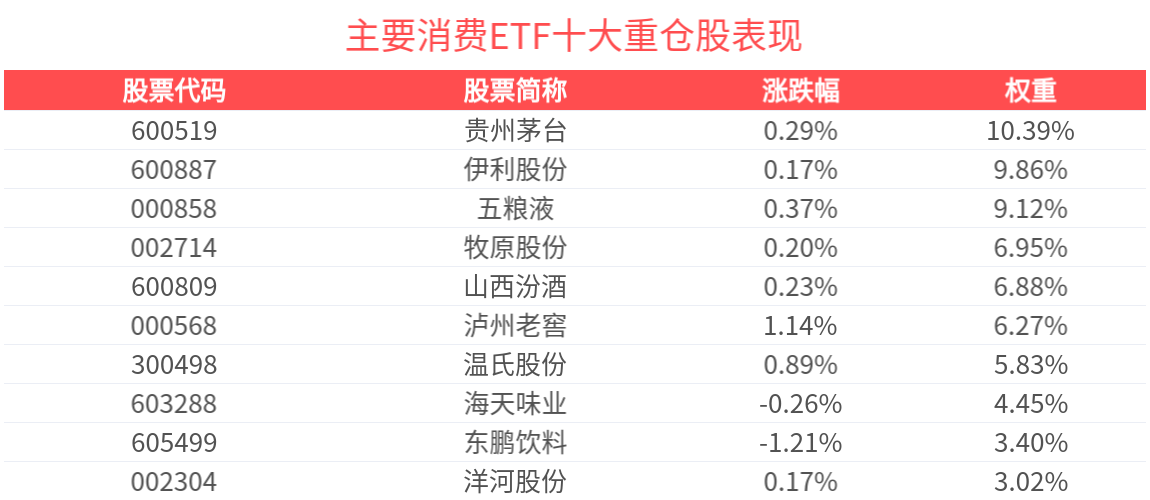
Core Viewpoint - The consumer sector is experiencing a slowdown, particularly in the liquor industry, but high-end and regional leading companies show resilience. Traditional consumer goods are growing slowly, with a concentration in leading firms benefiting from cost advantages and structural growth in segments like snacks, beverages, and low-alcohol drinks [2]. Group 1: Market Performance - As of May 6, 2025, the CSI Major Consumer Index (000932) rose by 0.10%, with notable increases in stocks such as Hainan Rubber (601118) up 2.67% and Andy Su (600299) up 1.46% [1]. - The Major Consumer ETF (159672) increased by 0.26%, with a latest price of 0.78 yuan and a turnover rate of 6.04%, totaling 499.92 million yuan in transactions [1]. Group 2: Sector Analysis - The liquor sector is under pressure, but if economic conditions improve in the second half of 2025, the industry may reach a bottom, leading to potential stock price recovery [2]. - The Major Consumer ETF closely tracks the CSI Major Consumer Index, which categorizes companies into 11 primary and 35 secondary industries, providing a comprehensive analysis tool for investors [2]. Group 3: ETF Performance Metrics - Since its inception, the Major Consumer ETF has achieved a maximum monthly return of 24.35% and an average monthly return of 5.36% [3]. - As of April 30, 2025, the ETF's maximum drawdown this year was 5.57%, with a management fee of 0.50% and a custody fee of 0.10%, making it one of the lowest in its category [3]. - The latest price-to-earnings ratio (PE-TTM) for the CSI Major Consumer Index is 19.82, indicating it is at a historical low compared to the past year [3]. Group 4: Top Holdings - The top ten weighted stocks in the CSI Major Consumer Index account for 67.16% of the index, with leading companies including Yili (600887), Kweichow Moutai (600519), and Wuliangye (000858) [3].