
消费品以旧换新

Search documents
释放消费潜力活力 以高水平开放赢得战略主动
Xin Lang Cai Jing· 2026-01-15 18:26
Group 1: Core Insights - The "14th Five-Year Plan" emphasizes the importance of building a strong domestic market and expanding high-level opening-up, with specific measures to boost consumption and promote trade innovation [1][2] - The Ministry of Commerce aims to achieve a steady growth in the consumption market, projecting a retail sales total of over 50 trillion yuan for the year, with a 4.0% increase in the first eleven months [2][3] Group 2: Consumption Strategies - Focus on cultivating service consumption and optimizing the old-for-new policy for consumer goods, with an emphasis on green and smart products [3][4] - The strategy includes enhancing service consumption in key areas such as transportation, home services, and entertainment, while also promoting local consumption through events like "Service Consumption Season" [3][4] Group 3: Trade Innovation - The Ministry of Commerce identifies three pillars for trade development: goods trade, service trade, and digital trade, aiming to stabilize foreign trade amidst global economic challenges [5][6] - Emphasis on diversifying trade markets and balancing trade development, with initiatives to enhance import trade and support cross-border e-commerce [6][7] Group 4: High-Level Opening-Up - The Ministry plans to expand autonomous opening-up in various service sectors and implement zero-tariff measures for all trading partners in Africa [8][9] - Focus on enhancing the global supply chain and participating in global economic governance through significant events like APEC and WTO meetings [9][10]
中国蓝观察丨“国补”点燃消费市场 浙江多地迎来新年“开门红”
浙江“国补”新政策范围再扩容
Xin Lang Cai Jing· 2026-01-15 14:10
新一轮消费品以旧换新政策落地后,浙江多地消费市场持续升温,迎来新年"开门红"。 增幅达50%以上 嘉兴桐乡各大家电卖场迎来消费热潮 连日来,广大消费者趁着"国补"政策实施这一契机,开启了"买买买"模式,嘉兴桐乡各大家电卖场再次迎来消费热潮。 记者在浙北大厦四楼家电专卖区看到,不少品牌方都将"国补"优惠政策放在显眼位置,导购员边讲解,边向市民推荐合适的家电。据介绍,自1月1日"国 补"实施以来,家电销量明显提升,比去年12月"国补"暂停期间,增幅明显。 同样销售火爆的还有3C家电市场。在该商场一楼的3C数码产品店铺内,各类新款手机、电脑、电视机等数码产品也勾起了不少市民的消费欲望。自"国 补"政策实施一个多星期以来,店内日均销售额增幅明显,其中手机品类销售额翻了一番,家电类增幅也达50%以上。 绿色消费热潮涌动 海宁节能智能产品受青睐 临近中午,海宁建材市场家电销售区已有不少顾客,市民趁着刚刚上新的国补政策,专程赶来选购自己心仪的家电。市民周先生正在装修新房,元旦前就 相中了一款冰箱,今年新的国补政策让他得到了更大的实惠。 "去年年底就是想买,但是又怕价格太贵。"市民周先生表示:"据说今年还有国补,这两天正好过 ...


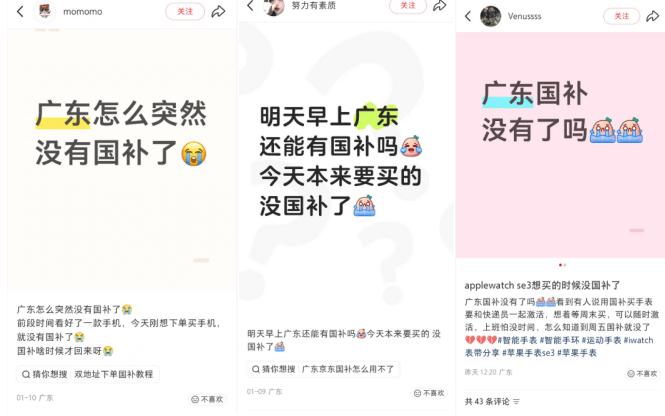
“抢不到”,“突然没有了”,广东以旧换新国补上线即告罄
Sou Hu Cai Jing· 2026-01-14 04:49
Group 1 - The core viewpoint of the article highlights the launch of the 2026 consumer goods trade-in subsidy in Guangdong, which has sparked significant consumer interest and demand for new products [1][3] - The subsidy program covers various categories including home appliances and 3C digital products, with consumers eligible for up to 1,500 yuan for larger items and 500 yuan for smaller electronics [3] - Despite the program's launch, there is a high demand for subsidy qualifications, leading to many consumers struggling to secure them, indicating a strong market potential in Guangdong [5] Group 2 - The article mentions that many consumers are actively trying to obtain subsidy qualifications but are facing challenges due to limited availability, with some expressing frustration on social media [1][3] - The government has set clear guidelines for the subsidy program, which aims to promote consumption and facilitate the upgrade of consumer goods [3] - The immediate exhaustion of subsidy qualifications reflects the urgent demand for equipment updates and quality improvements among consumers in Guangdong [5]
2026年首批625亿元资金已下达 新一轮“国补”落地多地积极部署
Zhong Guo Chan Ye Jing Ji Xin Xi Wang· 2026-01-14 01:08
Core Viewpoint - The 2026 national subsidy program aims to stimulate domestic consumption through a series of financial incentives for consumers purchasing new products, particularly in the electronics and automotive sectors, with a total of 62.5 billion yuan allocated for the first batch of subsidies [1][8]. Subsidy Details - Consumers purchasing eligible digital products such as smartphones, tablets, smartwatches, and smart glasses priced under 6,000 yuan will receive a subsidy of 15% of the product price, capped at 500 yuan per item [2]. - For major home appliances like refrigerators, washing machines, and air conditioners, a similar subsidy of 15% applies, with a maximum of 1,500 yuan per item [2]. - In the automotive sector, scrapping eligible old vehicles for new energy cars will yield a subsidy of 12% of the new car price, up to 20,000 yuan, while scrapping fuel vehicles for smaller fuel cars will provide a 10% subsidy, capped at 15,000 yuan [2]. Regional Implementation - All 21 cities in Guangdong Province launched the 2026 subsidy program on January 1, with the first transactions occurring in Guangzhou, indicating strong local engagement [3]. - Other provinces, such as Yunnan and Zhejiang, have also initiated their own automotive subsidy programs, leading to increased consumer interest and foot traffic in dealerships [3][4]. Process Optimization - Various regions have streamlined the subsidy application process, allowing consumers to apply for automotive subsidies through national systems or mobile apps, while home appliance subsidies are facilitated through major e-commerce platforms [4]. - Cities like Beijing and Shanghai have adopted innovative methods for subsidy distribution, enhancing consumer participation and interest [4]. Market Impact - The expanded subsidy program is expected to create new opportunities in the digital and smart product markets, with significant sales increases observed in smart glasses and AI-enabled home appliances during the New Year holiday [5][7]. - The policy is designed to support small and medium enterprises by lowering investment thresholds for equipment upgrades, thereby enhancing public service and commercial facilities [5]. Economic Outlook - The 2026 subsidy program is viewed as a critical measure for boosting domestic demand and stabilizing economic growth, with long-term benefits anticipated in industrial structure optimization and consumer ecosystem enhancement [8].
央广时评丨开年惠民新政策频出 释放实干为民积极信号
Sou Hu Cai Jing· 2026-01-13 00:41
Group 1 - The core viewpoint of the article emphasizes the introduction of various new policies aimed at enhancing the quality of life and consumer spending for the public, marking a positive start to the new year [1][6] - The "Two New" policy includes a subsidy for the replacement of old consumer goods, expanding to high-tech products like smart glasses and smart home devices, indicating a trend towards intelligent, high-end, and green consumption [3][5] - Statistics show that since the implementation of the "Two New" policy, over 18.3 million vehicles have been replaced, with nearly 60% being new energy vehicles, and over 1.92 billion home appliances have been updated, with over 90% being first-level energy-efficient products [3] Group 2 - The new medical insurance personal account policy allows for cross-province sharing, which reduces the medical burden on families and improves the efficiency of medical insurance fund usage [5] - The government is promoting green consumption through initiatives that encourage recycling and the use of energy-efficient appliances, aiming to lower living costs and make green consumption a natural choice for the public [5] - The State Council is working on providing basic public services to residents regardless of their registered household status, which includes education, housing, and medical insurance, aiming for equal access to public services [5][6]

优化消费品以旧换新政策实施 推动商品消费扩容升级
Xin Lang Cai Jing· 2026-01-12 23:09
Core Viewpoint - The recent national business work conference has prioritized the implementation of consumption promotion actions, specifically focusing on optimizing the "old-for-new" policy for consumer goods to enhance consumption expansion and upgrading by 2026 [1][5]. Group 1: Policy Implementation and Goals - The Ministry of Commerce reports that in 2025, the sales volume of goods related to the "old-for-new" policy exceeded 2.6 trillion yuan, benefiting over 360 million people [1][6]. - Specific targets include the replacement of over 11.5 million vehicles, 129 million home appliances, 9.1 million digital products, 12 million home renovation items, and 1.25 million electric bicycles [1][6]. - A joint notice from the Ministry of Commerce and six other departments outlines the support for the "old-for-new" policy through long-term special government bond funding and local matching funds [1][6]. Group 2: Subsidy Optimization and Consumer Support - The 2026 policy will adjust subsidies from fixed amounts to a percentage of vehicle prices, with different rates for new energy and fuel vehicles [2][7]. - Consumers purchasing energy-efficient appliances will receive a 15% subsidy based on the product's sales price, with an expansion to include new categories like smart glasses [2][7]. - The central government will continue to allocate long-term special bond funds, enhancing the efficiency of subsidy distribution and ensuring that benefits reach consumers directly [2][7]. Group 3: Industry Impact and Future Directions - The "old-for-new" policy has significantly boosted sales and promoted the adoption of high-quality products like new energy vehicles and energy-efficient appliances, laying a foundation for 2026 [3][8]. - Experts suggest expanding consumer categories, optimizing the consumption environment, and innovating consumption models to further stimulate consumption growth [3][8]. - Recommendations include enhancing the supply system, improving consumer experience, and strengthening the recycling system for old products to support a sustainable consumption ecosystem [4][9].
扩大内需 统一大市场建设 优化营商环境多地敲定今年发展改革工作重点
Xin Lang Cai Jing· 2026-01-12 21:04
Group 1 - The core focus of recent development and reform meetings across various provinces in China is to expand effective demand, build a unified national market, and optimize the business environment [1][2] - Local governments are prioritizing the expansion of domestic demand, with Fujian province emphasizing the implementation of strategies to boost consumption and investment in key projects [1][2] - Investment strategies are shifting from a focus on physical assets to a balanced approach that includes human capital, with an emphasis on improving investment efficiency [1][2] Group 2 - The restructuring of local investment logic is moving towards a dual focus on both physical and human capital, which is expected to support stable growth in domestic demand, investment, and consumption [2] - The introduction of policies to stimulate consumption, such as the "old-for-new" program, is a key task for 2026, with various provinces outlining specific measures to enhance service consumption [2] - Deep reforms are being planned alongside the expansion of domestic demand, with a focus on advancing the construction of a unified national market and optimizing the business environment [2][3] Group 3 - Challenges remain in the construction of a unified national market, including local protectionism and market segmentation, which hinder progress [3] - Provinces like Shandong and Fujian are taking steps to improve their integration into the national market by standardizing investment attraction practices and addressing issues in the bidding process [3] - There is a need for fiscal and tax reforms to reshape local government incentives and reduce inappropriate market interventions, which are currently obstructing the development of a unified national market [3]
轻工制造行业动态研究:2025年12月CPI同比提升,积极布局内需消费
Guohai Securities· 2026-01-12 09:31
Investment Rating - The industry investment rating is "Recommended" (maintained) [1] Core Insights - The report highlights that the Consumer Price Index (CPI) increased by 0.8% year-on-year in December 2025, indicating a positive impact from consumption-boosting policies. This marks the highest CPI level since March 2023, with core CPI (excluding food and energy) rising by 1.2% year-on-year [2][3] - The report emphasizes the ongoing effects of consumption policies, particularly the "old-for-new" subsidy program, which aims to stimulate demand in the consumer market. The first batch of 625 billion yuan in long-term special government bond funds was released on January 1, 2026, to support this initiative [2][3] - The report notes structural adjustments in subsidy policies, with a focus on energy-efficient appliances and smart products, which are expected to create opportunities for companies in the light industry sector [3] Summary by Sections Industry Performance - The light manufacturing industry outperformed the CSI 300 index with a 1-month performance of 4.7%, 3-month performance of 10.6%, and a 12-month performance of 28.3% compared to the CSI 300's 3.5%, 1.0%, and 25.9% respectively [1] Consumer Demand - The report indicates that consumer demand has increased due to policy incentives and seasonal factors, leading to a month-on-month CPI increase of 0.2% in December 2025, reversing the previous month's decline [2] Subsidy Program Details - The "old-for-new" subsidy program has been upgraded to provide more funding and clearer direction, focusing on green and smart large consumer goods. The subsidy covers six categories of household appliances and four categories of digital products, with a maximum subsidy of 1,500 yuan for appliances and 500 yuan for digital products [2][3] - The report highlights that the subsidy for energy-efficient appliances has been standardized at 15%, with a significant increase in the threshold for eligibility compared to previous years [3]
汽车家电数码全涵盖!2026郑州以旧换新补贴来了
Xin Lang Cai Jing· 2026-01-12 07:42
Core Viewpoint - Zhengzhou Municipal Bureau of Commerce announced the launch of a subsidy program for the replacement of consumer goods, including automobiles, home appliances, and digital smart products, as part of the 2026 old-for-new policy [1]. Group 1: Automotive Sector - The subsidy for scrapping and updating automobiles will follow the guidelines set by the Ministry of Commerce and other departments, with applications submitted through the national automotive circulation information management system or the "Old-for-New Car" mini-program [1]. - Consumers can retain relevant proof materials for vehicle replacement subsidies until the application system for Henan Province is launched [1]. Group 2: Home Appliances and Digital Smart Products Home Appliances - Consumers purchasing specific home appliances such as refrigerators, washing machines, televisions, air conditioners, computers, and water heaters will receive a subsidy of 15% of the final sales price for energy-efficient products, with a maximum subsidy of 1,500 yuan per item [2]. - Each consumer is eligible for one subsidy per product category [2]. Digital Smart Products - For digital smart products like smartphones, tablets, smartwatches, and smart glasses, consumers will receive a subsidy of 15% of the final sales price, capped at 500 yuan per item, provided the single item price does not exceed 6,000 yuan [3]. - Each consumer can claim one subsidy per product category [3]. Group 3: Participation Method - Consumers can access the subsidy program through the Cloud Flash Payment APP by searching for the "Henan Province Consumer Goods Old-for-New Service Platform" mini-program and completing personal information and real-name authentication [4]. - Subsidy vouchers are valid for the day of issuance and can be reissued if not used [4]. - Necessary information such as delivery address, product serial numbers, and activation evidence must be provided to the merchants [4].
2026年“国补”来了
Xin Lang Cai Jing· 2026-01-11 18:13
Core Insights - The notification regarding the implementation of large-scale equipment updates and consumer goods trade-in policies in 2026 was released on December 30, 2025, outlining the support scope, subsidy standards, and work requirements for the "Two New" policies. Group 1: Equipment Updates - The support scope for equipment updates has been expanded to include the installation of elevators in old residential communities and equipment updates in elderly care institutions, as well as updates for fire rescue and inspection equipment in the safety sector [1]. - The subsidy for updating old residential elevators will be adjusted from a fixed amount to a tiered subsidy based on the number of elevator floors [3]. - Priority will be given to supporting the replacement of old operational trucks with electric trucks in the subsidy program [4]. Group 2: Consumer Goods Trade-in - The focus will be on enhancing the coverage and impact of key consumer goods by improving the "subsidy rate" [2]. - For automobile trade-ins, the subsidy will be adjusted from a fixed amount to a percentage of the vehicle price, maintaining the upper limit for subsidies [5]. - For scrapping eligible old vehicles and purchasing new energy passenger cars, a subsidy of 12% of the new car sales price (up to 20,000 yuan) will be provided [5]. - For scrapping eligible fuel passenger cars and purchasing fuel passenger cars with an engine size of 2.0 liters or less, a subsidy of 10% (up to 15,000 yuan) will be provided [5]. - For purchasing eligible new energy passenger cars, a subsidy of 8% (up to 15,000 yuan) will be provided [6]. - For purchasing eligible fuel passenger cars, a subsidy of 6% (up to 13,000 yuan) will be provided [6]. - The subsidy for home appliances trade-in will be adjusted to 15% of the selling price for products meeting the 1st-level energy efficiency or water efficiency standards, with a maximum subsidy of 1,500 yuan per item [7][10]. - The subsidy standards for digital and smart products will remain unchanged, with a subsidy of 15% for items priced under 6,000 yuan, capped at 500 yuan per item [11][12]. Group 3: Implementation Mechanism - The project application mechanism and review process for equipment updates will be optimized to lower the investment threshold for applications, increasing support for small and medium-sized enterprises [12]. - The funding allocation method will be improved, and detailed implementation rules will be established to combat fraudulent claims and illegal practices such as "price hikes before subsidies" [12].