
直接融资

Search documents
王一鸣:解决创投“退出难”仅靠IPO不够,要大力发展并购
第一财经· 2025-11-13 09:13
Core Viewpoint - The reliance on commercial banks for supporting technological innovation has limitations due to the uncertainty in technology development and the banks' preference for predictable returns [3][4]. Group 1: Financial Support for Technological Innovation - Technological innovation requires long-term funding, while commercial banks typically provide short-term loans, often favoring larger amounts for shorter durations [3]. - Different stages of technological innovation, from seed to decline, require tailored financial services, with government grants and angel investments needed in the seed stage, followed by PE/VC in the startup phase, and commercial bank support in the growth phase [3][4]. Group 2: Role of Direct Financing - Direct financing, primarily through stock markets, is more aligned with the needs of technological innovation compared to bank loans [4]. Group 3: Enhancing Equity Investment - There is a need to improve the service levels of the Sci-Tech Innovation Board and the Growth Enterprise Market for innovative companies, alongside promoting venture capital development [5]. - Recent policies encouraging the establishment of national venture capital guiding funds are beneficial for the entire fundraising process [5]. Group 4: Addressing Exit Challenges for Venture Capital - Sole reliance on IPOs for venture capital exits is insufficient; there is a need to develop the mergers and acquisitions market to facilitate exits [6]. - Establishing market-oriented acquisition funds is essential to address the exit difficulties faced by venture capital [6].


王一鸣:解决创投“退出难”仅靠IPO不够,要大力发展并购
Di Yi Cai Jing· 2025-11-13 06:48
Group 1 - The core viewpoint emphasizes the need for a diversified financial support system for technology innovation, highlighting that relying solely on commercial banks has limitations due to their preference for short-term loans and certainty in returns [1][2] - Wang Yiming suggests that the financial tools required for technology innovation vary across different stages, from seed funding needing government support and angel investment to later stages where private equity and venture capital can play a role [1] - The current banking system is still essential for supporting technology innovation, with many commercial banks exploring new financing models such as credit loans and mixed equity-debt financing [1] Group 2 - Direct financing, particularly through stock markets, is seen as more compatible with technology innovation compared to traditional bank loans, which can hinder the integration of technology and capital [2] - There is a call for enhancing the service levels of the Science and Technology Innovation Board and the Growth Enterprise Market to better support innovative enterprises, alongside a push for the development of venture capital [2] - To address the challenge of exit strategies for venture capital, it is suggested that the merger and acquisition market should be significantly developed, as relying solely on IPOs is insufficient [2]
昨天这个信号出乎意料,货币放水迎来风云突变
Sou Hu Cai Jing· 2025-11-12 07:24
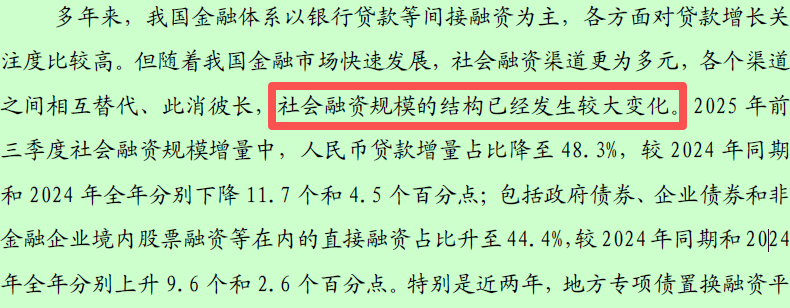
Core Viewpoint - The People's Bank of China (PBOC) has indicated a significant change in the structure of financing in its third-quarter monetary policy report, which is crucial for understanding the dynamics of the housing market and investment strategies. Group 1: Financing Structure Changes - The financing structure in China is shifting from primarily loan-based financing to direct financing through bonds, with loans now accounting for less than 50% of new financing in the third quarter of 2023 [9][14]. - This change implies that the traditional view of using M2 growth as an indicator for housing prices is no longer valid, as the increase in M2 may not correlate with housing market dynamics [13][14]. Group 2: Implications for Housing Market - The report emphasizes that the increase in M2 is largely driven by bond issuance, which does not directly contribute to housing market liquidity, leading to a potential scenario where M2 can grow while housing prices decline [14][18]. - The only reliable indicator for predicting housing market trends remains the growth in household loans, as these directly translate into purchasing power for the housing market [15][18]. Group 3: Economic and Stock Market Analysis - For broader economic and stock market analysis, the focus should be on social financing (社融) and M2, as these metrics provide a comprehensive view of the financial landscape [11]. - The report suggests that the shift towards direct financing will primarily affect economic indicators and stock market performance, rather than the housing market [18].
基础货币≠货币
Jin Rong Shi Bao· 2025-11-12 01:01
Core Viewpoint - The People's Bank of China (PBOC) released the "Monetary Policy Implementation Report for the Third Quarter of 2025," highlighting the relationship between base money and broader money supply, emphasizing that base money is the source of money creation and the foundation of the banking system's asset-liability activities [1] Group 1: Base Money and Broad Money - Base money, also known as "high-powered money," includes cash in circulation and commercial banks' reserves at the central bank, totaling 38.6 trillion yuan as of Q3 2025, while the broad money supply (M2) exceeded 335 trillion yuan [1] - Base money and broader money are distinct concepts; base money is a liability of the central bank, while broader money reflects the disposable funds of residents, enterprises, and governments, primarily representing commercial bank liabilities [1] Group 2: Money Creation Process - The money creation process involves central banks, commercial banks, and the real economy, where commercial banks derive deposits through asset expansion, forming broad money [2] - The ability of commercial banks to create money is influenced by the effective financing demand from the real economy, meaning that money creation occurs when there is a willingness and capacity to lend [2] Group 3: Diversification of Financing Channels - The traditional dominance of bank loans in China's financial system is evolving, with direct financing rapidly developing, allowing banks to diversify their asset expansion methods, including purchasing bonds [3][4] - As of now, bank loans account for approximately 60% of total bank assets, while the proportion of bonds held has increased from about 20% at the end of 2019 to around 25% [4] Group 4: Structural Changes in Monetary Policy - The PBOC is adapting its base money injection methods to support the evolving financing structure, utilizing structural monetary policy tools, with these tools accounting for about 13% of base money as of Q3 2025 [4] - The central bank's re-lending serves as a crucial channel for regulating base money, reflecting the borrowing relationship between the central bank and commercial banks, rather than direct loans to enterprises [4] Group 5: Long-term Financial Market Development - The development of direct financing and changes in the financing structure are expected to have profound impacts on the total money supply and financial regulation [5] - Future monetary policy will focus on transforming the regulatory framework to emphasize price-based controls, enhancing the effectiveness of interest rate adjustments in resource allocation [5]
如何进一步促进民间投资发展
Sou Hu Cai Jing· 2025-11-12 00:09
Core Viewpoint - The State Council has issued measures to promote private investment in China, focusing on expanding access, addressing bottlenecks, and strengthening support for private enterprises [1] Group 1: Expanding Access - Private capital is encouraged to participate in key projects with a shareholding ratio of over 10% in sectors requiring national approval, such as railways and nuclear power [2] - The energy sector is identified as a crucial area for attracting private capital, with plans to enhance policies and mechanisms for private enterprise participation in major projects [2] - Support will be provided for private capital to flow into the productive service industry, aligning with the flexible nature of private enterprises [2] Group 2: Addressing Bottlenecks - Support for private enterprises to build major pilot platforms is emphasized, encouraging integrated layouts in advanced manufacturing clusters [3] - State-owned enterprises, universities, and research institutions are encouraged to offer market-oriented pilot services to private enterprises, fostering a collaborative ecosystem [3] - The digital transformation is highlighted as a significant investment opportunity, with measures to guide private investment in smart and digital networks [3] Group 3: Strengthening Support - Investment policies will leverage central budget investments to support eligible private investment projects, alongside the deployment of new policy financial tools [4] - Government procurement policies will encourage an increase in advance payment ratios for contracts with private enterprises to over 30% [5] - Credit policies will focus on supporting small and micro enterprises, with banks required to set annual service targets for private enterprises [5] - Direct financing will continue to facilitate the listing and merger of technology-driven enterprises through streamlined processes [6]
基础货币≠货币,发放贷款并不是商业银行货币派生的唯一途径!
Jin Rong Shi Bao· 2025-11-11 11:22
Core Viewpoint - The People's Bank of China (PBOC) released the "Monetary Policy Implementation Report for the Third Quarter of 2025," highlighting the relationship between base money and broader money supply, emphasizing that base money is the source of money creation and affects the banking system's asset-liability activities [1] Group 1: Base Money and Broad Money - Base money, also known as "high-powered money," is a liability of the central bank and includes cash in circulation, required reserves, and excess reserves held by commercial banks [1] - As of the end of Q3 2025, China's base money balance reached 38.6 trillion yuan, while the broad money supply (M2) exceeded 335 trillion yuan [1] Group 2: Money Creation Process - The money creation process involves the central bank, commercial banks, and the real economy, where commercial banks derive deposits through asset expansion, forming broad money [2] - The ability of commercial banks to create money is fundamentally influenced by the effective financing demand from the real economy [2] Group 3: Diversification of Financing Channels - The traditional reliance on bank loans for money creation is evolving, with commercial banks increasingly engaging in direct financing through bond purchases, which also generates deposits [3] - The proportion of bank loans in total bank assets remains around 60%, while the share of bonds has increased from approximately 20% at the end of 2019 to about 25% currently [4] Group 4: Structural Changes in Financing - The rapid development of direct financing and changes in the financing structure are leading to a more diversified money creation channel for banks [4] - The PBOC is innovating its base money injection methods and utilizing structural monetary policy tools to guide financial institutions in optimizing credit allocation [4] Group 5: Future Monetary Policy Directions - The development of the financial market and changes in financing structure will have profound impacts on the total money supply and financial regulation [5] - There is a need to continue transforming the monetary policy framework to emphasize price-based regulation and deepen interest rate marketization reforms [5]
中信证券500亿短债获批,券商巨头加速扩张融资渠道
Sou Hu Cai Jing· 2025-11-11 10:33
Core Insights - CITIC Securities has actively engaged in financing initiatives throughout the year, including becoming one of the first brokerages to participate in the company bond renewal issuance pilot program [2] - The issuance of bonds by CITIC Securities aligns with the broader trend in the brokerage industry, where major firms are capitalizing on declining domestic bond issuance rates to bolster their capital [2] - The company's bond issuance strategy reflects a precise alignment of strategic needs and market opportunities, enhancing its operational flexibility [2] Financing Activities - In May, CITIC Securities successfully conducted a renewal issuance of company bonds with a scale of 2 billion yuan [2] - On June 30, the company received approval to issue up to 30 billion yuan in perpetual subordinated bonds [2] - On September 11, CITIC Securities was approved to issue up to 60 billion yuan in company bonds [2] Industry Context - The trend of major brokerages, including Guotai Junan and Huatai Securities, frequently issuing bonds this year is attributed to the favorable market conditions [2] - The issuance of bonds by leading brokerages is seen as a response to national strategic calls to enhance direct financing, thereby supporting the real economy [2] - The emphasis on increasing direct financing in key policy documents indicates a market-driven necessity for brokerages to expand their business scale through bond market financing [2]


国家发改委:打造国家投融资综合服务平台,更加精准向民企投放信贷资源
Sou Hu Cai Jing· 2025-11-11 09:59
Group 1 - The National Development and Reform Commission (NDRC) has introduced measures to promote private investment, focusing on enhancing the coordination of investment, fiscal, and financial policies [1][2] - The NDRC will actively support eligible private investment projects through central budget investments, leveraging government investment to stimulate social investment [1] - A total of 500 billion yuan in new policy financial tools has been fully allocated, with a portion directed towards key areas of private investment [1] Group 2 - Government procurement policies will increase support for small and medium-sized enterprises (SMEs), mandating that over 40% of the budget for engineering procurement projects exceeding 4 million yuan be reserved for SMEs [1][2] - Financial institutions are encouraged to set annual service targets for private enterprises and implement a system of credit tolerance for reasonable credit demands [2] - The NDRC aims to facilitate direct financing for private investment projects through mechanisms like REITs and a "green channel" for technology companies [2]
中信证券总经理邹迎光:居民储蓄向投资转化趋势显著 权益资产配置仍有较大提升空间
Xin Lang Cai Jing· 2025-11-11 02:27
Core Insights - The core viewpoint emphasizes the improvement of the institutional environment in China's capital market, focusing on supporting technological innovation and enhancing wealth effects [1] Group 1: Institutional Environment - The capital market's risk appetite is increasingly compatible with new productive forces, indicating a shift towards direct financing methods such as equity and bonds to support high-quality enterprises in their listings [1] - Future reforms will aim to cultivate a market ecosystem characterized by orderly entry and exit, promoting a competitive environment for high-quality development of listed companies [1] Group 2: Investment Trends - There is a significant trend of converting household savings into investments, with the proportion of equity asset allocation having considerable room for growth compared to developed markets [1] - Future reforms will focus on creating a "long money, long investment" institutional environment, enhancing the supply of quality financial products, and guiding listed companies to strengthen investor returns, thereby promoting a virtuous cycle of financing and investment [1]
“从债券市场视角看“十五五”规划建议
Zhong Cheng Xin Guo Ji· 2025-11-06 05:03
1. Report Industry Investment Rating - No information provided in the content 2. Core Viewpoints of the Report - The "15th Five-Year Plan" proposal emphasizes actively developing direct financing such as equity and bonds, which points out the core direction for the future development of the bond market. The bond market needs to balance "scale growth" and "structural optimization" and deepen its pricing function to support the high - quality development of the real economy [2][5] - The release of the "15th Five - Year Plan" proposal has both short - term and long - term impacts on bond market interest rates. Short - term emotional fluctuations will gradually subside, and credit bond yields may continue to fluctuate within a range [7][9][10] - The bond market should focus on supporting key areas such as science and technology innovation, consumption, rural revitalization, green transformation, and private economy, and promote product innovation and mechanism optimization [11][12][13] - China's bond market will speed up the two - way opening process, expanding the scope of participants and deepening infrastructure construction [17][18][19] - The bond market should continue to strengthen risk prevention in key areas such as real estate, local debt, and small and medium - sized financial institutions, and improve the risk disposal mechanism [20][21][22] - In the credit bond market, a strategy of combining stable allocation and careful bond selection should be adopted, focusing on high - growth industries in line with the "15th Five - Year Plan" direction and paying attention to tail risks [24][25] 3. Summary by Relevant Catalogs 3.1 Question 1: What new requirements does the re - mention of "accelerating the construction of a financial power" in the "15th Five - Year Plan" proposal put forward for the development of the bond market? - The "15th Five - Year Plan" proposal continues the policy tone of "accelerating the construction of a financial power", with more in - depth requirements than the "14th Five - Year Plan". It aims to promote the financial system to a higher - quality development stage [2] - As of October 2025, China's bond market has become the world's second - largest and Asia's largest, with a stock size of about 194.25 trillion yuan and a credit bond stock size of about 39.25 trillion yuan [2] - The bond market needs to balance "scale growth" and "structural optimization" and deepen its pricing function to support the high - quality development of the real economy [5] - Credit rating is an important infrastructure in the bond market. In the future, it needs to strengthen the construction of risk identification and early - warning capabilities to help the high - quality development of the bond market [6] 3.2 Question 2: How to view the interest rate trend of the bond market after the release of the "15th Five - Year Plan" proposal? - Historically, before the release of long - term plans, bond market interest rates may fluctuate greatly due to policy uncertainty. After the policy is clear, market sentiment stabilizes and interest rate fluctuations narrow [8] - Before the 20th Fourth Plenary Session, credit bond yields were volatile. After the release of the "15th Five - Year Plan" draft, market sentiment gradually stabilized, and credit spreads narrowed [9] - In the future, credit bond yields may continue to fluctuate within a range. Short - term emotional fluctuations will gradually subside, and long - term interest rate trends will be affected by the overall economic deployment and policy orientation of the meeting [9][10] 3.3 Question 3: Which key areas of financing development does the "15th Five - Year Plan" proposal support for the bond market? - Science and technology innovation: The "15th Five - Year Plan" emphasizes the core position of science and technology innovation. As of October 28, 2025, the cumulative issuance of science and technology innovation bonds was about 1.7 trillion yuan, and the scale is expected to continue to expand [11][13] - Consumption: The proposal deploys to boost consumption. The bond market has begun to support the consumption field, and consumer - related ABS is expected to expand [12][13] - Rural revitalization: The bond market should support rural development. As of 2025, the issuance of rural revitalization bonds was 818 million yuan, and more policy support is needed [14] - Green transformation: The green bond market has the largest scale in the world. In 2025, the issuance of green bonds was 493.2 billion yuan, and the stock size was about 2.7 trillion yuan. The scale is expected to continue to increase [15] - Private economy: Although policies support the private economy, it still takes time to see the effect. In 2025, the proportion of private enterprise bond issuance in credit bonds was only 2% [15][16] 3.4 Question 4: How will the opening pattern of the bond market evolve under the requirement of high - level opening up? - China's bond market has improved its opening - up level through "bringing in" and "going out". As of September 2025, overseas institutions held 3.78 trillion yuan of inter - bank market bonds, accounting for 2.2% of the total custody volume [17][18] - In the future, the two - way opening of the bond market may be accelerated, including expanding the scope of participants and deepening infrastructure construction [19] 3.5 Question 5: How will bond risk prevention work be carried out under the continuation of the risk - prevention tone? - The "15th Five - Year Plan" proposal emphasizes effectively preventing and resolving various risks, mainly focusing on real estate, local debt, and small and medium - sized financial institutions [20] - As of September 2025, the scale of defaulted bonds in the bond market was 739.406 billion yuan, and the proportion of publicly disclosed completed disposal was 22.8%. The risk disposal mechanism needs to be improved [22] - The "15th Five - Year Plan" mentions the role of the risk - sharing mechanism in supporting venture capital. Currently, the participation of venture capital institutions in the bond market is limited, and more support measures may be introduced in the future [23] 3.6 Question 6: What investment opportunities does the "15th Five - Year Plan" proposal bring to the credit bond market? - A strategy of combining stable allocation and careful bond selection should be adopted, focusing on high - growth industries in line with the "15th Five - Year Plan" direction and paying attention to tail risks [24] - Industries such as science and technology innovation, advanced manufacturing, and green low - carbon have strong bond attractiveness. Some state - owned real estate enterprise bonds and certain urban investment bonds also have certain investment value [25]