算力基础设施

Search documents
催化不断,这一领域掀起涨停潮!融资客大手笔加仓多只海外机构调研股
Zheng Quan Shi Bao Wang· 2025-09-29 05:01
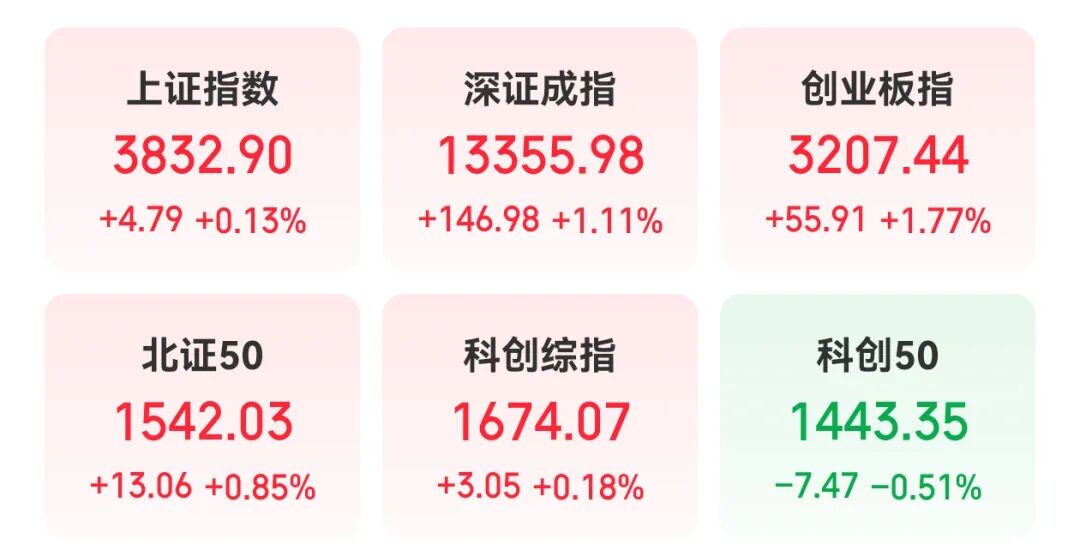
Group 1 - The Shanghai Composite Index showed a slight recovery after a morning dip, with the ChiNext Index rising nearly 3% [1] - The lithium battery sector experienced strong upward momentum, with various sub-sectors such as sodium-ion batteries and solid-state batteries leading the gains [2] - The lithium battery indices reported significant increases, with the lithium battery index up by 4.22% and the power battery index up by 4.52% [3] Group 2 - A total of 421 companies were surveyed by institutions in the past 10 trading days, with 57 companies receiving attention from overseas institutions [4] - Deep South Circuit (002916) was the most focused company, receiving visits from 29 overseas institutions, highlighting its capacity expansion through technology upgrades and new projects [4] - Zhongkong Technology was also notable, with 20 overseas institutions participating in its survey, and it recently won two major projects from Sinopec, expected to generate significant annual output value [4] Group 3 - Stocks that received overseas institutional research saw an average increase of 3.11% over the past 10 trading days, with Demingli (001309) leading with a 56.95% increase [7] - More than half of the surveyed stocks received net purchases from financing clients, with Zhongchuang Zhiling (601717) receiving the highest net buy of 342 million yuan [7] - The storage industry is experiencing a positive outlook due to increased capital expenditures from major tech companies, with expectations for storage prices to maintain an upward trend in the fourth quarter [7]



首个国家长护服务目录发布,特朗普宣布新高额关税丨一周热点回顾
Di Yi Cai Jing· 2025-09-27 02:24
Group 1: Long-term Care Insurance - The National Healthcare Security Administration released the "National Long-term Care Insurance Service Project Directory (Trial)" which defines a standardized payment scope for long-term care insurance funds, providing a clear reimbursement guide for disabled individuals and their families [1][2] - The directory includes 36 service items categorized into 20 living care items and 16 medical care items, covering aspects such as dietary care, hygiene care, and rehabilitation [1] - A dynamic adjustment mechanism for the long-term care service project directory will be explored based on the operational status of the long-term care insurance fund and the evolving needs of disabled individuals [1] Group 2: Service Export Promotion - The Ministry of Commerce and nine other departments issued policies to promote service exports, proposing 13 measures to support service trade, including optimizing tax procedures and enhancing export credit insurance [3] - The policies aim to support new service export models and industries, such as digital services and green services, to cultivate key enterprises and projects in the service export sector [3] Group 3: Steel Industry Growth Targets - The Ministry of Industry and Information Technology announced a plan for the steel industry to achieve an average annual growth of around 4% from 2025 to 2026 [8] - The plan addresses the imbalance between supply and demand in the steel industry and proposes ten measures to enhance quality and reasonable growth [8] Group 4: Cross-Border Trade and Logistics - The reopening of the border between Poland and Belarus allows the resumption of the China-Europe Railway Express, a crucial land trade route connecting China to Europe [9][10] - The railway is vital for logistics, with over 85% of the trains passing through or arriving in Poland, highlighting the importance of this route for EU trade [9] Group 5: Monetary Policy and Market Stability - The People's Bank of China conducted a 600 billion yuan MLF operation, marking the seventh consecutive month of increased liquidity injection to stabilize market expectations [11] - The central bank's actions aim to address significant funding pressures and support government bond issuance while maintaining a stable financial environment [11] Group 6: Cross-Border Brokerage Adjustments - Several cross-border internet brokerages have tightened their account opening requirements for mainland residents, reflecting increased regulatory scrutiny [13][14] - The tightening measures include requiring proof of overseas residency or work, indicating a shift in the operational landscape for cross-border investment services [13][14] Group 7: Nvidia and OpenAI Partnership - Nvidia announced a strategic cooperation with OpenAI, planning to invest up to $100 billion in AI computing systems over the coming years [15] - This partnership aims to enhance computational infrastructure, which is critical for the future economy and supports OpenAI's extensive user base and AI services [15]

“9·24行情”一周年:创业板人工智能指数暴涨174%,牛冠全球之原因何在?
Zheng Quan Shi Bao Wang· 2025-09-26 07:31
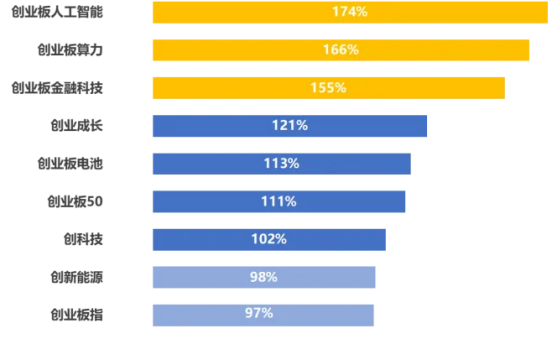
Core Viewpoint - The ChiNext Index has reached a three-year high, with the ChiNext AI sector leading global performance, having increased by 174% over the past year, significantly outperforming other major AI indices in the A-share market [1][4]. Group 1: Index Performance - The ChiNext Index has risen by 97% from September 24, 2023, to September 24, 2024, leading major global indices [1][3]. - The ChiNext AI Index has shown a remarkable increase of 174% during the same period, making it the top performer among various indices [1][4]. Group 2: Industry Drivers - The AI sector is experiencing a surge in demand for computing power, with global cloud capital expenditures expected to reach a historical high of $445 billion in 2025, reflecting a 56% year-on-year growth [8]. - Major cloud service providers like Amazon, Alphabet, Meta Platforms, and Microsoft are projected to contribute significantly to this growth, with their combined capital expenditures reaching $359 billion in 2025, a 57% increase from the previous year [8]. Group 3: Key Components - The top three constituents of the ChiNext AI Index are leading optical module companies: NewEase (20.28% weight), Zhongji Xuchuang (18.79% weight), and Tianfu Communication (6.5% weight), collectively accounting for over 45% of the index [7]. - These companies are primary beneficiaries of increased capital expenditures from global cloud giants, with Zhongji Xuchuang becoming the market leader in optical modules since 2022, holding a 40%-50% share in the global high-speed optical module market [7]. Group 4: Technological Catalysts - The upcoming release of NVIDIA's new B300 chip is expected to drive demand for high-speed optical modules, leading to a significant increase in procurement across the supply chain [9]. - The evolution of large models like GPT-5 is creating unprecedented demands for computing infrastructure, necessitating substantial upgrades in data transmission rates within AI clusters and data centers [9]. Group 5: Policy and Funding Support - Recent government policies have accelerated the integration of AI across various industries, with state-owned enterprises opening numerous AI application scenarios, providing a broad market for technological implementation [10]. - Significant inflows of leveraged funds have been observed in leading optical module companies, with NewEase and Zhongji Xuchuang seeing net purchases of 13.5 billion and 10.4 billion yuan, respectively, since the beginning of the year [10].

计算机ETF(159998)、云计算ETF沪港深(517390)涨超3%,机构:算力基础设施投资保持强劲
2 1 Shi Ji Jing Ji Bao Dao· 2025-09-25 02:59
Group 1: ETF Performance - The Computer ETF (159998) rose by 3% and recorded a trading volume exceeding 99 million yuan, ranking first among similar products [1] - The Computer ETF has seen a net inflow of nearly 40 million yuan over the past two days [2] - The Cloud Computing ETF (517390) increased by 4.32% with a trading volume over 26 million yuan [3] Group 2: ETF Composition and Strategy - The Computer ETF tracks the CSI Computer Theme Index, which includes stocks from companies involved in information technology services, application software, system software, and computer hardware [4] - The Cloud Computing ETF closely follows the CSI Hong Kong-Shanghai Cloud Computing Industry Index and includes internet companies from Hong Kong and computing leaders from A-shares [4] Group 3: Policy and Market Developments - The Ministry of Commerce and other departments issued policies to promote service exports, supporting the establishment of international data service businesses in specific regions [5] - Alibaba Cloud announced a global infrastructure expansion plan, establishing new cloud computing nodes in Brazil, France, and the Netherlands, and expanding data centers in several countries [5] - Hubei Province is developing a multi-layered computing infrastructure system by 2027, integrating space-based computing services [5] Group 4: Industry Outlook - The computer industry is expected to continue its development under a "soft and hard" framework, with strong investment in AI hardware and benefits for domestic AI chip and server manufacturers [6] - The acceleration of enterprise-level AI applications is driving commercialization, although there are concerns about the variability in performance realization [6] - Focus is recommended on hardware infrastructure with strong performance certainty and software applications with practical scenarios, balancing innovation and profitability [6]
长城基金刘疆:中期看好市场行情 关注算力基础设施与AI应用
Xin Lang Ji Jin· 2025-09-24 01:45
Group 1 - The market is experiencing high volatility with increased short-term divergence and accelerated sector rotation, but the long-term upward trend in technology remains intact [1] - After the unexpected rise in August, the market may face short-term fluctuations, yet the overall trend is positive, indicating structural opportunities that should be actively seized [1] Group 2 - Investment focus is on four main areas: 1. Computing infrastructure, which continues to see rising demand, particularly in sectors like computing chips, optical communication, PCB, and liquid cooling [2] 2. The explosive potential of AI applications, with the ongoing improvement of AI infrastructure and technology leading to the emergence of blockbuster products in both edge and cloud applications [2] 3. Embodied intelligence scenarios, including humanoid robots, autonomous vehicles, and drones, which are expected to benefit from advancements in AI capabilities [2] 4. Emerging industries supported by policy, especially those highlighted in the "14th Five-Year Plan," which will be important for medium to long-term investment [2] - Future market dynamics, such as style rebalancing and the performance of small-cap stocks, will be key areas of focus [2]
英伟达OpenAI千亿交易,其他人还剩啥?
Hu Xiu· 2025-09-23 03:05
Core Insights - NVIDIA and OpenAI have signed a strategic cooperation letter, committing to deploy a minimum of 10GW of NVIDIA AI computing systems over the coming years, involving millions of next-generation GPUs [1][2] - NVIDIA will provide up to $100 billion in funding support to OpenAI, with the investment structured to align with the deployment progress of computing infrastructure [1][2] - This partnership marks a shift for NVIDIA from being a hardware supplier to becoming a co-builder of AI infrastructure, sharing risks and rewards with OpenAI [3] Group 1: Transition of Roles - NVIDIA is transitioning from a leading hardware supplier to an industry partner, directly investing in the core business expansion of OpenAI [3] - The $100 billion funding is not a one-time hardware purchase but will be injected in phases as OpenAI's computing capacity is deployed [3] Group 2: Addressing Computing Demand - OpenAI acknowledges that the biggest bottleneck in AI development is computing power, with a significant increase in demand for computational resources due to the rapid growth of AI services [5] - The collaboration aims to strategically secure vast computing resources to ensure uninterrupted model development and commercialization [5] Group 3: Industry Dynamics and Financial Implications - The 10GW commitment translates to approximately 4 to 5 million top-tier GPUs, comparable to NVIDIA's expected annual shipment volume [6] - Building a 1GW AI data center is estimated to cost around $50 to $60 billion, indicating a substantial financial commitment that will impact cloud service providers like Microsoft, Amazon, and Google [6] - This investment also serves as a financial arrangement that allows OpenAI to purchase NVIDIA chips, stabilizing NVIDIA's revenue expectations for the coming years [6] Group 4: Shift in Competitive Focus - The collaboration signals a shift in the AI race from model advancement to infrastructure provision, emphasizing the importance of stable supply chains for GPUs, power, and networks [7][8] - Companies that control the infrastructure will have a significant advantage in commercializing models and scaling services [8] Group 5: Regulatory Considerations - The concentration of capital and computing power between NVIDIA and OpenAI may attract regulatory scrutiny, particularly concerning antitrust and national security issues [6]
东海证券晨会纪要-20250922
Donghai Securities· 2025-09-22 09:06
Key Insights - The Federal Reserve has lowered interest rates by 25 basis points, aligning with market expectations, indicating potential for further rate cuts within the year [7][5] - The Producer Price Index (PPI) has shown a narrowing year-on-year decline, which may impact industrial enterprise profits, while consumer retail sales have increased by 3.4% year-on-year in August [7][10] - The technology sector remains a focal point for investment, particularly in AI applications and infrastructure improvements [7][5] Economic Overview - Global stock markets exhibited mixed performance, with A-shares showing strength, particularly in the technology sector, while major commodities like oil and aluminum saw declines [5][6] - The domestic equity market saw a daily average trading volume of 24,948 billion yuan, with 13 sectors rising and 18 falling, highlighting a preference for growth over cyclical and financial sectors [6][20] Consumer Market Analysis - In August, the total retail sales of consumer goods reached 39,668 billion yuan, reflecting a year-on-year growth of 3.4%, which was below market expectations [10][11] - Online retail continues to accelerate, with significant growth in new consumption formats such as live streaming and instant retail, indicating a shift in consumer behavior [10][11] Inflation and Price Trends - The Consumer Price Index (CPI) fell by 0.4% year-on-year in August, while the PPI decreased by 2.9%, marking the first narrowing of the decline since March [12][12] - The disparity between PPI and CPI has decreased, suggesting potential pressure on profit margins for manufacturers [12] Investment Recommendations - There is a growing potential in the service consumption sector, particularly in cultural tourism and hospitality, as travel and leisure activities are expected to increase during upcoming holidays [13][14] - The cosmetics sector has shown resilience with a year-on-year growth of 5.1%, indicating strong demand for domestic brands [14]

金禄电子(301282) - 2025年9月19日投资者关系活动记录表
2025-09-19 12:46
Group 1: Company Performance - The company achieved nearly 30% growth in both revenue and profit in the first half of the year [3] - The management aims to maintain sustainable growth in the second half of the year [3] - The company is actively seeking two main profit growth points: innovation in battery technology and market opportunities in emerging industries [3][4] Group 2: Investor Relations and Communication - The company participated in the "2025 Guangdong Investor Reception Day" via an online platform [2] - The management is committed to timely disclosures, with annual reports released at least one month ahead of the legal deadline [3] - The company has implemented measures for market value management, including share buybacks and stable cash dividends [6][7] Group 3: Strategic Development and Market Position - The company is open to mergers and acquisitions to strengthen its operational scale [5] - There is a focus on enhancing technical capabilities and talent reserves to keep pace with industry advancements [6] - The company is expanding its customer base in various sectors, including automotive electronics and AI [10] Group 4: Production and Capacity Utilization - The Qingyuan production base has maintained a high capacity utilization rate, while the Hubei base is still ramping up production [9] - The company is actively expanding production capacity to meet growing demand [9] Group 5: Future Outlook and Challenges - The company acknowledges the need for improvement in technology and talent compared to competitors [6] - There is a commitment to continuous improvement in performance and operational efficiency to enhance investor confidence [6][8]
华工科技:智能激光除草机器人2.0预计明年正式批量上市销售
Ju Chao Zi Xun· 2025-09-16 10:03
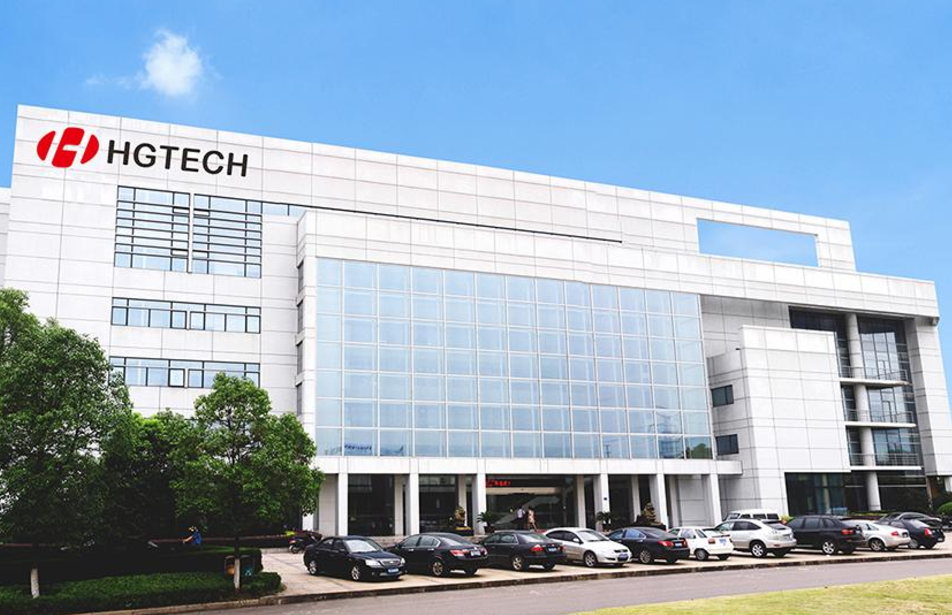
Group 1 - The company is actively responding to the national "Technology Empowering Agriculture" strategy by launching the all-weather intelligent laser weeding robot 2.0, targeting the green agricultural equipment market valued at billions [2] - A subsidiary has been established in Harbin, currently in the pilot testing phase, with plans to complete engineering finalization and preparations for mass production by the end of the year, aiming for official mass market launch in 2026 [2] - In the CPO sector, the company has released the second-generation single-wave 400G optical engine and the industry's first 3.2T CPO optical engine, which will further advance the development of 3.2T solutions [2] Group 2 - The company's optical electronic information industry research and innovation park's first phase of the next-generation ultra-high-speed optical module R&D center and production base has commenced production in August, with a planned monthly capacity of 1 million units for data communication optical modules [3] - The overseas production capacity is also being enhanced, with the Thailand factory expected to reach a monthly capacity of 150,000 to 200,000 units by the end of the year, with adjustments based on customer order demands [3] - The company reports significant growth in export business, with overseas equipment and channel partners already shipping bulk quantities of 400G/800G optical modules [3]

19只基金紧急“刹车”,3只一日售罄!35万亿元公募江湖迎来“抢筹”时刻
Hua Xia Shi Bao· 2025-09-12 11:28
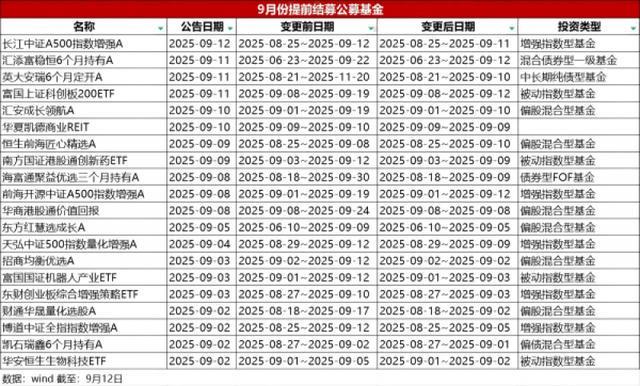
Core Insights - The public fund market in China is experiencing a surge in early fundraising closures, with 19 funds announcing early closures in September, indicating a positive market sentiment and increased investor confidence [2][5][6] - The total net asset value of public funds in China has surpassed 35 trillion yuan, marking a historical high and reflecting the growing demand for wealth management products among residents [6][7] - The trend of "daylight funds" re-emerging, where funds sell out quickly, suggests a robust interest in equity products and a healthy market environment [2][3][5] Fundraising Trends - 19 public funds have announced early closures in September, with some funds selling out within a day, indicating strong demand [2][3] - Specific funds like the Huaxia KaiDe Commercial REIT and Huashang Hong Kong Stock Connect Value Return Fund have seen significant oversubscription, with the former attracting over 300 billion yuan in subscriptions [4] - The rapid fundraising closures are a strategic move by fund managers to protect investor interests and capitalize on market opportunities [3][5] Market Size and Growth - As of July 2025, the total net asset value of public funds in China reached 35.08 trillion yuan, a record high and the tenth time it has surpassed this threshold since 2024 [6][7] - The growth is driven by a combination of factors, including a recovering A-share market and increased investor interest in equity funds [7][8] Investor Sentiment - The increase in early fund closures and the emergence of "daylight funds" reflect a significant rebound in investor confidence and a shift towards equity investments [2][5] - Fund companies are actively responding to market conditions by launching products that align with investor demand, further fueling this trend [5][7] Future Outlook - The A-share market is expected to present structural opportunities, with a focus on technology growth and stable dividend stocks as key investment themes [8] - Investment opportunities are anticipated in sectors such as artificial intelligence, semiconductor technology, and consumer goods, driven by economic transformation [8]