
绿色贸易

Search documents
2025年中国进出口贸易人才需求爆发,哪些岗位缺口大哪些岗位赚得多?
Di Yi Cai Jing· 2025-11-12 08:07
Core Insights - The demand for cross-border data analysts has surged as companies seek specialized talent to navigate the digital transformation and green transition in international trade [1][2] - The report by 51job highlights the urgent need for composite talents skilled in platform operations, AI tools, data analysis, and compliance [1] - The cross-border e-commerce sector is projected to grow significantly, with import and export volumes expected to rise from 19.2 trillion yuan in 2021 to 23.8 trillion yuan in 2024, reflecting an annual growth rate exceeding 7% [1] Talent Demand - Companies are increasingly in need of professionals who can manage the entire lifecycle of carbon management and digital monitoring, particularly in sectors like new energy vehicles and photovoltaics [2] - The tightening of global green trade regulations has made green compliance talent a critical requirement for businesses aiming to enter international markets [2] Salary Trends - The report indicates that salaries for digital trade operation roles vary significantly, with overseas brand managers earning between 450,000 to 800,000 yuan annually, while cross-border data analysts can expect salaries ranging from 250,000 to 500,000 yuan [2][4] - Emerging roles in green compliance, such as ESG sustainability directors, can command salaries between 350,000 to 800,000 yuan, reflecting the high demand for expertise in this area [2][4] Job Roles and Responsibilities - Key positions include overseas brand managers, cross-border e-commerce operation directors, and cross-border data analysts, each requiring specific skills in brand management, data analysis, and compliance with international regulations [4] - The report outlines various job categories, including digital trade operations, supply chain and logistics, and green compliance, detailing the core competencies and salary ranges for each role [4]

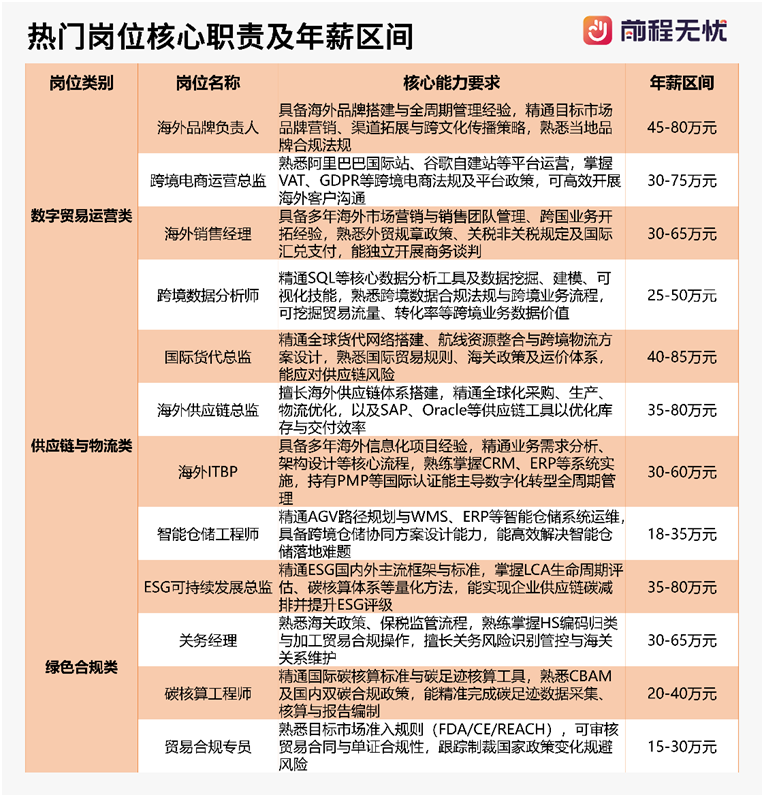
报告:进出口贸易全链条加速数字化重构催生多元化人才需求
Xin Hua Cai Jing· 2025-11-12 07:13
Core Insights - The report by 51job highlights the urgent demand for specialized composite talents in the context of high-quality development in China's import and export trade, driven by deep integration of digital technology and accelerated green transformation [1][2] Group 1: Talent Demand - Enterprises are in urgent need of composite talents who possess skills in platform operations, AI tool applications, data analysis, and compliance management, with a current talent gap in the industry reaching 4 million [2] - The integration of smart customs data systems and international logistics data is making cross-border data analysts a core scarce talent, with salaries significantly higher than traditional positions [2] Group 2: Regional Manufacturing Impact - The activity level of the manufacturing sector, particularly in the Yangtze River Delta and Pearl River Delta regions, directly influences overall trade performance, with these regions dominating talent activity [2] Group 3: Green Compliance - As global green trade regulations tighten, green compliance has become a critical requirement for enterprises entering international markets, creating a strong demand for talents skilled in carbon management and supply chain control [2] Group 4: Salary Trends - Salaries are increasingly favoring technical, compliance, and composite talents, with specific roles such as overseas brand managers earning between 450,000 to 800,000 yuan annually, and ESG sustainability directors earning between 350,000 to 800,000 yuan [3]
《“十五五”规划建议》解读:高水平开放引领贸易业高质量发展
Lian He Zi Xin· 2025-11-11 11:05
Group 1: Trade Industry Development - The trade industry is a crucial link in the national economy, connecting domestic and international markets and ensuring supply chain resilience[4] - The "14th Five-Year Plan" emphasizes expanding high-level openness and creating a win-win cooperation landscape[4] - The plan outlines policies for trade innovation, bilateral investment expansion, and high-quality Belt and Road construction[4] Group 2: Open Economy Framework - The plan proposes to align with international high-standard trade rules and expand market access, particularly in the service sector[5] - China aims to reduce the negative list for foreign investment and enhance the transparency and predictability of the investment environment[6] - The establishment of free trade zones and the Hainan Free Trade Port is part of the strategy to foster institutional innovation[6] Group 3: Trade Innovation and Digital Economy - The plan focuses on enhancing foreign trade quality and efficiency, promoting green trade, and expanding service trade[7] - In 2024, China's exports of new energy vehicles are projected to reach 1.284 million units, with wind turbine exports increasing by 71.9%[9] - Cross-border e-commerce is expected to reach 2.71 trillion yuan in 2024, accounting for 6.2% of total goods trade[9] Group 4: Investment Cooperation and Supply Chain - The plan aims to attract foreign investment by focusing on strategic emerging industries, with actual foreign investment in manufacturing exceeding 220 billion yuan in 2024[10] - China's direct investment in Belt and Road countries accounted for 26.5% of total outbound investment in 2024, amounting to 192.2 billion USD[13] - The establishment of overseas service systems supports orderly outbound investment and enhances global supply chain layout[11] Group 5: Belt and Road Initiative - The initiative aims to strengthen strategic alignment with partner countries and enhance infrastructure connectivity[12] - By 2025, the China-Europe Railway Express is expected to exceed 20,000 trips, reaching 229 cities in 26 European countries[13] - The initiative promotes cooperation in green development, digital economy, and health sectors, creating new collaborative spaces[14]
商务部:十六项举措拓展绿色贸易
Xin Hua Wang· 2025-11-11 03:31
Core Viewpoint - The Ministry of Commerce has issued the "Implementation Opinions on Expanding Green Trade," focusing on addressing shortcomings in enterprises' green and low-carbon development capabilities, the potential for carbon reduction in logistics, and the inadequacy of supporting systems for green trade development in China [1][2]. Group 1: Key Measures - The 16 specific measures proposed in the Opinions are aimed at actively expanding green trade and promoting trade optimization and upgrading [2]. - The measures include enhancing the green and low-carbon development capabilities of foreign trade enterprises, expanding the import and export of green and low-carbon products and technologies, creating a favorable international environment for green trade, and establishing a robust support system for green trade [2]. Group 2: Green Product Export Performance - Green and low-carbon products have become a new driving force for foreign trade development, with significant export growth in recent years [3]. - For instance, in the first three quarters of this year, the export growth rate of wind turbine units and components exceeded 30%, while photovoltaic products have maintained an export value of over 200 billion for four consecutive years [3]. Group 3: Trade Fair Initiatives - Major trade fairs like the Canton Fair and the China International Import Expo have achieved 100% green power supply and 100% compliance with green standards for special exhibition booths [3][4]. - The Ministry of Commerce has introduced green-related indicators in exhibition statistics to monitor energy consumption and emission reduction more accurately [4]. Group 4: Collaborative Efforts for Green Trade - Various government departments are working together to promote green trade, with the Ministry of Industry and Information Technology planning to cultivate 6,430 national green factories and 491 green industrial parks by the end of 2024 [5]. - The State Administration for Market Regulation is advancing the green product certification system to support the green development of foreign trade enterprises [5]. Group 5: Financial Support for Green Initiatives - The People's Bank of China is promoting the application of green finance and transition finance standards, encouraging financial institutions to provide more support for green service trade enterprises [6]. - This includes lowering financing thresholds and costs for light-asset and green service trade companies, as well as supporting the issuance of green financial products in global markets [6].
锐财经|16项举措拓展绿色贸易
Ren Min Ri Bao Hai Wai Ban· 2025-11-11 02:56
Core Viewpoint - The Ministry of Commerce has issued the "Implementation Opinions on Expanding Green Trade," focusing on addressing shortcomings in enterprises' green and low-carbon development capabilities, the potential for carbon reduction in logistics, and the inadequacy of supporting systems in China's green trade development [1][2]. Group 1: Key Measures - The 16 specific measures proposed in the Opinions are aimed at actively expanding green trade and promoting trade optimization and upgrading [2]. - The measures include enhancing the green and low-carbon development capabilities of foreign trade enterprises, expanding the import and export of green and low-carbon products and technologies, creating a favorable international environment for green trade, and establishing a robust support system for green trade [2]. - Encouragement for foreign trade enterprises to adopt renewable energy and reduce carbon emissions through equipment upgrades and process modifications is highlighted [2]. Group 2: Green Trade Growth - Green low-carbon products have emerged as a new driving force for foreign trade development, with significant export growth in sectors such as wind power, photovoltaic products, and electric vehicles [3]. - In the first three quarters of this year, exports of wind turbine units and components increased by over 30%, while photovoltaic products have maintained export values exceeding 200 billion yuan for four consecutive years [3]. - Major trade fairs like the Canton Fair and the China International Import Expo have achieved 100% green power supply and green standards for special exhibition booths [3]. Group 3: International Cooperation - China is committed to an open and cooperative approach, focusing on deep participation in global governance of green trade, enhancing the "green content" of high-standard free trade zones, and aligning domestic reforms with international green standards [4]. - The goal is to strengthen and enhance China's capacity to serve global green trade and share low-carbon achievements with the world [4]. Group 4: Collaborative Efforts - The Ministry of Industry and Information Technology plans to cultivate 6,430 national green factories and 491 green industrial parks by the end of 2024, with green factories accounting for over 20% of total output [5]. - The market regulatory authority aims to advance the green product certification system and expand certification from products to entire supply chains [6]. - The People's Bank of China will promote the application of green finance standards and support innovative financing methods for green service trade enterprises [6].
16项举措拓展绿色贸易
Ren Min Ri Bao Hai Wai Ban· 2025-11-11 00:09
Core Viewpoint - The Chinese Ministry of Commerce has issued 16 targeted measures to promote green trade, addressing existing shortcomings in enterprises' green development capabilities, carbon reduction potential in logistics, and the supporting system for green trade development [2][3]. Group 1: Measures for Green Trade Expansion - The 16 measures focus on enhancing the green low-carbon development capabilities of foreign trade enterprises, expanding the import and export of green low-carbon products and technologies, creating a favorable international environment for green trade, and establishing a robust support system for green trade [3]. - Specific initiatives include encouraging foreign trade enterprises to adopt renewable energy, reduce carbon emissions through equipment upgrades and process modifications, and promote green logistics by shifting long-distance transport from road to rail or water [3]. - The establishment of a carbon footprint database for foreign trade products is also encouraged, along with the development of green product standards and certification systems [3]. Group 2: Performance of Green Products - Green low-carbon products have become a new driving force for foreign trade, with significant export growth in recent years. For instance, wind turbine exports increased by over 30% in the first three quarters of this year, and photovoltaic products have consistently exceeded 200 billion yuan in export value for four consecutive years [4]. - Electric vehicle exports surpassed 2 million units last year, while exports of green transportation tools like electric motorcycles and bicycles have also shown strong growth [4]. - Major trade fairs like the Canton Fair and the China International Import Expo have achieved 100% green power supply and green standards compliance for special exhibition booths [4]. Group 3: International Cooperation and Standards - China aims to enhance its participation in global governance of green trade, improve the "green content" of its high-standard free trade zone network, and align domestic reforms with international green standards [5]. - The Ministry of Industry and Information Technology plans to cultivate 6,430 national green factories and 491 green industrial parks by the end of 2024, with green factories accounting for over 20% of total output [7]. - The State Administration for Market Regulation will advance the green product certification system and expand certification from products to entire supply chains [7]. Group 4: Financial Support for Green Trade - The People's Bank of China will promote the application of green finance and transition finance standards, supporting innovative financing methods for green service trade enterprises [8]. - Financial institutions are encouraged to provide more financing support for production services related to research and design, logistics, carbon emission certification, and recycling [8].
促进贸易优化升级,助力实现碳达峰、碳中和目标——十六项举措拓展绿色贸易
Xin Hua Wang· 2025-11-10 23:39
Core Viewpoint - The Ministry of Commerce has issued the "Implementation Opinions on Expanding Green Trade," focusing on addressing shortcomings in enterprises' green and low-carbon development capabilities, the potential for carbon reduction in logistics, and the inadequacy of supporting systems in China's green trade development [1][2]. Group 1: Key Measures - The 16 specific measures proposed in the Opinions are aimed at actively expanding green trade and promoting trade optimization and upgrading [2]. - The measures include enhancing the green and low-carbon development capabilities of foreign trade enterprises, expanding the import and export of green and low-carbon products and technologies, creating a favorable international environment for green trade development, and establishing a sound support and guarantee system for green trade [2]. Group 2: Green Trade Growth - Green low-carbon products have become a new driving force for foreign trade development, with significant export growth in related products [3]. - For instance, in the first three quarters of this year, the export growth rate of wind turbine units and components exceeded 30%, while photovoltaic products have maintained an export value of over 200 billion for four consecutive years [3]. Group 3: International Cooperation - China is committed to an open and cooperative approach, focusing on deep participation in global governance of green trade, enhancing the "green content" of high-standard free trade zones, and aligning domestic reforms with international green standards [4]. Group 4: Collaborative Efforts - The Ministry of Industry and Information Technology plans to cultivate 6,430 national green factories and 491 green industrial parks by the end of 2024, with green factories accounting for over 20% of total output [5]. - The State Administration for Market Regulation will advance the green product certification system to support the green development of foreign trade enterprises [6].
十六项举措拓展绿色贸易(锐财经)
Ren Min Ri Bao· 2025-11-10 22:10
Core Viewpoint - The Ministry of Commerce has issued the "Implementation Opinions on Expanding Green Trade," focusing on addressing shortcomings in enterprises' green and low-carbon development capabilities, the potential for carbon reduction in logistics, and the inadequacy of supporting systems in China's green trade development [1][2]. Group 1: Key Measures - The 16 specific measures proposed in the Opinions are aimed at actively expanding green trade and promoting trade optimization and upgrading [2]. - The measures are categorized into four main areas: enhancing the green and low-carbon development capabilities of foreign trade enterprises, expanding the import and export of green and low-carbon products and technologies, creating a favorable international environment for green trade, and establishing a robust support system for green trade [2]. - Encouragement for foreign trade enterprises to adopt renewable energy and implement equipment upgrades and process modifications to reduce carbon emissions from foreign trade products [2]. Group 2: Green Trade Performance - Green low-carbon products have become a new driving force for foreign trade development, with significant export growth in recent years [3]. - For instance, in the first three quarters of this year, exports of wind turbine units and components increased by over 30%, while photovoltaic products have maintained export values exceeding 200 billion yuan for four consecutive years [3]. - The export volume of electric vehicles surpassed 2 million units last year, with strong growth in green transportation tools such as electric motorcycles and bicycles [3]. Group 3: International Cooperation and Standards - China is committed to an open and cooperative approach, focusing on deep participation in global governance of green trade, enhancing the "green content" of high-standard free trade zones, and aligning domestic reforms with international green standards [4]. - The Ministry of Industry and Information Technology plans to cultivate a significant number of national green factories and industrial parks, with green factory output accounting for over 20% [5]. Group 4: Certification and Financial Support - The State Administration for Market Regulation will advance the green product certification system to support the green development of foreign trade enterprises, expanding certification from products to entire supply chains [6]. - The People's Bank of China will promote the application of green finance and transition finance standards, encouraging financial institutions to provide more support for green service trade enterprises [6].
欧盟贸易保护延伸效应:东南亚转口贸易体系如何缓解供应链“降低出口风险”?
Sou Hu Cai Jing· 2025-11-10 06:37
Group 1 - The core viewpoint is that the EU's trade protectionism against Chinese products is intensifying, leading to a high-sensitivity global export environment, with measures expanding in scope, duration, and regulatory detail [1][2][3] - As of October 2025, the EU has implemented 56 anti-dumping and countervailing measures against Chinese goods, amounting to over €46 billion, affecting key industries such as rubber, steel, chemicals, and new energy batteries [1] - The average anti-dumping tax rate ranges from 30% to 70%, with some products exceeding 100%, significantly undermining the price advantage of Chinese manufacturing [1] Group 2 - Southeast Asia is emerging as a new trade hub, with re-export trade growth projected at 43% between 2024 and 2025, with Malaysia, Thailand, and Vietnam accounting for 68% of this growth [5][6] - Chinese-manufactured goods represent 39% of Southeast Asia's total re-export value, indicating that the region's re-export system is becoming a structural component of the global supply chain [5] Group 3 - The compliance aspect is becoming crucial in Southeast Asia's re-export system, moving away from gray-area practices to a more institutionalized and transparent framework [7] - The implementation of electronic origin certificate systems in regions like Port Klang, Malaysia, enhances operational legality and allows for tax optimization through compliance [7] Group 4 - The EU's trade protection measures are prompting a shift from concentrated exports to a distributed layout in supply chains, with a notable decrease in direct exports from China to the EU [9][10] - The proportion of Chinese exports to the EU directly has dropped from 17.6% to 12.3%, while re-exports via Southeast Asia have increased to 9.8%, with key products being chemicals (27%), electromechanical products (21%), and rubber and plastic products (19%) [10] Group 5 - Future trade barriers from the EU will likely focus on environmental, traceability, and social responsibility aspects, with digital origin traceability systems expected to be widely adopted [12][13] - Southeast Asian countries are adjusting their trade regulatory frameworks to align with EU green certifications and ESG standards, indicating a shift towards compliance and low-carbon management in re-export operations [12][13] Group 6 - The Southeast Asian re-export trade system is becoming a key hub for global manufacturing to navigate trade barriers, emphasizing the importance of compliance, digitalization, and regional collaboration [15] - The combination of compliant re-exports, digital traceability, and regional cooperation will enable Chinese manufacturing to gradually regain its foothold in the European market despite ongoing EU trade protections [15]
态势稳 韧性强!前10月我国货物贸易进出口总值37.31万亿元
Xin Hua Wang· 2025-11-09 07:55
作者:孔令杭 吴明宪 勉栩坤 岳文婷 李娜 王卫波 配音:王帅龙 新华社音视频部制作 【纠错】 【责任编辑:赵阳】 面对外部冲击,中国外贸展现强大韧性。海关总署11月7日发布数据显示,今年前10月,我国货物贸易 进出口总值37.31万亿元,同比增长3.6%,其中,10月单月进出口总值3.7万亿元,增长0.1%。 外贸产品结构不断优化,出口新动能增势良好。据海关统计,前10个月,中国出口机电产品13.43万亿 元,同比增长8.7%,拉动中国整体出口增长5.2个百分点。 "十五五"规划建议提出"推动市场多元化和内外贸一体化""优化升级货物贸易";中国-东盟自贸区3.0版 升级议定书前不久正式签署;商务部印发绿色贸易领域首个专项政策文件《关于拓展绿色贸易的实施意 见》;国家外汇管理局出台新政进一步促进跨境贸易收支便利化……这些都将大力推动贸易创新和国际 合作,为下一阶段外贸稳定发展提供支撑。 编导:张宝亢、石小妍 ...