轻资产运营

Search documents
金融街:上半年营收46.55亿元,同比降逾五成
Xin Lang Cai Jing· 2025-08-18 12:39
Core Viewpoint - Financial Street reported a significant decline in revenue and net profit for the first half of 2025, indicating ongoing challenges in the real estate market [1][2]. Financial Performance - The company achieved an operating revenue of approximately 4.655 billion yuan, a year-on-year decrease of 51.79% [1]. - The net profit attributable to shareholders was a loss of 1.008 billion yuan, with a year-on-year reduction in losses of 49.2% [1]. - The net profit attributable to shareholders after deducting non-recurring gains and losses was a loss of 880 million yuan, with a year-on-year reduction in losses of 56.02% [1]. - The net cash flow from operating activities decreased by 9.96% to 1.606 billion yuan [1]. Revenue Breakdown - Revenue from real estate development was approximately 3.623 billion yuan, down 57.42% year-on-year, with a gross margin of -5.74% [1]. - Residential products generated revenue of 3.46 billion yuan, while commercial products accounted for 160 million yuan [1]. - Property leasing business revenue was 780 million yuan, a decline of 9.99% year-on-year [1]. - Property management business revenue was 180 million yuan, down 9.61% year-on-year [1]. Sales Performance - In the first half of 2025, the company achieved a sales contract amount of approximately 4.76 billion yuan, with a sales area of about 325,000 square meters [2]. - Residential products accounted for 4.27 billion yuan in sales contracts (249,000 square meters), while commercial products accounted for 490 million yuan (76,000 square meters) [2]. Strategic Focus - The company emphasized cash flow safety and operational stability as core business tasks, aiming to enhance project sales and ensure positive cash flow [2][3]. - Financial Street plans to adjust sales strategies based on market changes, improve sales management, and promote early and multiple collections [3]. - The company aims to implement strict budget management and enhance cash flow monitoring to improve fund utilization efficiency [3]. - Financial Street is exploring a light asset operation model complemented by heavy asset cooperation to cultivate new business growth points [3].

北京南城顶流商场荟聚或将易主险资,商场称“正常经营,未接到通知”
Hua Xia Shi Bao· 2025-08-15 14:25
Core Viewpoint - The Beijing Huiju shopping mall, operated by Ingka Group, is rumored to be sold to a consortium of insurance capital, which includes Taikang Life as a key player, amidst a backdrop of declining performance for Ingka Group [2][3][7]. Group 1: Transaction Details - The sale involves multiple Huiju malls across cities, with the first three being in Wuxi, Beijing, and Wuhan, amounting to a total investment of 16 billion yuan [3]. - The transaction is expected to facilitate a shift towards "light asset operation" for Ingka Group, with no significant changes anticipated in the current management team of the shopping malls post-acquisition [3][7]. - Despite the rumors, the Beijing Huiju mall continues to operate normally, with no official notifications regarding the sale received by the staff [2][4]. Group 2: Market Context - Ingka Group reported a revenue decline of 5.5% year-on-year for 2024, marking the first drop in five years, with net profit down by 46.5% [7]. - The insurance capital's interest in commercial real estate is driven by their strong financial position and the appeal of high-quality assets in prime locations during a period of real estate adjustment [7][9]. - Insurance companies have increasingly become key players in the commercial real estate market, with direct investments reaching 9.3 billion USD from 2022 to 2024, positioning them as leaders in the Asia-Pacific region [8]. Group 3: Implications for the Industry - The trend of insurance capital acquiring commercial real estate is seen as a response to the "asset shortage" and the need to optimize long-term yield structures, as traditional fixed-income assets face declining returns [9]. - The ongoing transactions are expected to continue as real estate firms and foreign operators seek to alleviate cash flow pressures by divesting mature projects [9].

盛业按下AI成长“加速键”:2025年中期净利润增长23%,科技服务收入占比超50%
Jing Ji Guan Cha Wang· 2025-08-15 10:59
Core Viewpoint - Shengye Holdings Group Limited has demonstrated a successful strategic transformation, achieving a net profit increase of approximately 23% despite a slight decline in overall revenue, highlighting the effectiveness of its platform technology services and light-asset strategy [1][3][8]. Financial Performance - For the six months ending June 30, 2025, Shengye reported a main business revenue of 405 million yuan, a year-on-year decrease of 7.1%, while net profit rose to 203 million yuan [1]. - The platform technology service revenue reached 211 million yuan, a significant year-on-year increase of 37%, accounting for over 50% of total revenue [1][3]. - The company has maintained profitability for 11 consecutive years and has committed to a dividend payout ratio of no less than 90% from 2024 to 2026, with an expected total dividend of 950 million yuan for 2025 [2]. Strategic Transformation - The increase in platform technology service revenue is attributed to the continuous expansion of Shengye's platform ecosystem and enhanced technological capabilities, with over 19,100 cumulative clients, a 14.4% year-on-year growth [1][3]. - The light-asset strategy has led to a 33.9% reduction in financing costs, while the average financing cost for clients using the platform has decreased by over 30% [3][4]. Technological Investment - Shengye has invested nearly 270 million yuan in R&D in the first half of 2025, maintaining a high proportion of R&D personnel at 30% [4]. - The company holds 88 national invention patents and software copyrights, with applications in AI, big data, and cloud computing [4][6]. New Industry Layout - Shengye is actively expanding into emerging industries such as e-commerce, robotics, and AI applications, with significant growth in e-commerce partnerships, achieving a funding scale of over 2.8 billion yuan, an increase of nearly 800% year-on-year [5][6]. - The company has established strategic cooperation with leading firms in the robotics sector, positioning itself for growth in the rapidly expanding Chinese robotics market, which exceeds 190 billion yuan [5]. Internationalization and Innovation - Shengye has designated its Singapore subsidiary as its international headquarters and is expanding its presence in Southeast Asia and Turkey, successfully completing its first international funding facilitation [7]. - The company is exploring Web 3.0 and stablecoin applications to reduce cross-border payment costs and mitigate exchange rate risks, with a current operating cash flow of 3.56 billion yuan [7]. Industry Outlook - The supply chain finance industry is experiencing growth driven by national policies, particularly in technology finance, green finance, and digital finance, despite challenges such as information inadequacies and financing difficulties for SMEs [8][9]. - Shengye's performance reflects significant changes in China's supply chain finance and technology service sectors, leveraging AI and big data to enhance efficiency and reduce costs for SMEs [8].
产业园区运营商:向轻资产和多元化服务转型
3 6 Ke· 2025-08-13 02:34
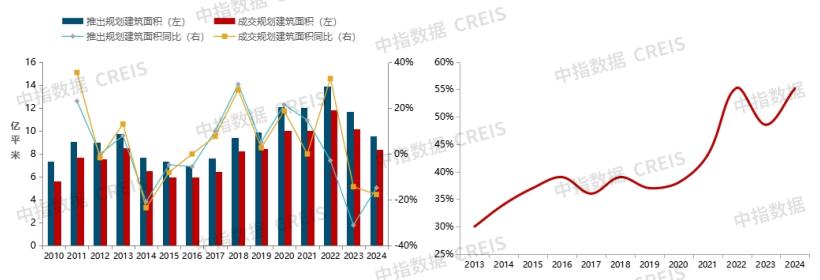
Core Insights - In 2024, 178 national high-tech zones in China achieved a total output value of 19.3 trillion yuan, representing a nominal year-on-year growth of 7.6% [1][2] - The development of industrial parks is characterized by structural optimization and regional differentiation, with high-tech industrial parks focusing on technological innovation, digital transformation, sustainable development, and open cooperation [1][9] Industrial Park Development Status - The industrial added value reached approximately 9.8 trillion yuan, with a nominal year-on-year growth of 5.8% [2] - Profits of large-scale industrial enterprises totaled about 2.4 trillion yuan, accounting for 32.5% of the national total, with a year-on-year growth of 2.2%, outpacing the national average by 5.5 percentage points [2] Land Use Trends - In 2024, the area of industrial land planned for release in 300 cities decreased by 14.8% year-on-year, totaling 9.57 billion square meters [5] - The transaction volume of industrial land also fell by 17.7% year-on-year, amounting to 8.36 billion square meters [5] - The average floor price of industrial land increased by 7.5% year-on-year to 258 yuan per square meter, while the premium rate decreased by 0.16 percentage points to 1.47% [6] Development Trends in High-Tech Industrial Parks - The trends in high-tech industrial parks include a focus on innovation-driven development, ecological system construction, and international cooperation [9][10] - R&D expenditure intensity is increasing, with over 70% of universities establishing targeted cooperation with parks [9] - Digital transformation is being accelerated through the integration of IoT, cloud computing, and AI technologies [9][10] Cultural and Creative Industry Parks - Cultural and creative industry parks are experiencing digital reconstruction and efficiency leaps, cross-industry integration, and brand output [12] - The digital transformation has evolved into a comprehensive intelligent stage, enhancing the integration of cultural and manufacturing sectors [12] Trends in Park Operators - Park operators are transitioning towards digitalization, light asset operations, and diversified services [13][18] - Digital technologies are being integrated into planning, management, and service processes, enhancing operational efficiency [13][14] - The rise of light asset operations is shifting focus from heavy investment to service empowerment, with an increasing number of specialized service providers [17][18]
2.2亿元“一口价”后,苏宁、家乐福纠纷落幕
2 1 Shi Ji Jing Ji Bao Dao· 2025-08-12 12:36
Core Viewpoint - The ongoing conflict between Suning and Carrefour China has reached a resolution, with Suning acquiring 100% control of Carrefour China after settling outstanding debts and disputes for 220 million yuan, marking the end of Carrefour's operations in China [1][4]. Group 1: Acquisition and Financial Implications - Suning International signed a settlement agreement with Carrefour Group, paying 220 million yuan to resolve the remaining 16.67% equity acquisition payment and other claims, allowing Suning to fully control Carrefour China [1][4]. - The settlement allows Suning to eliminate over 1.3 billion yuan in potential debt liabilities and recognize a debt restructuring gain of over 1.1 billion yuan, significantly improving its financial statements [1][4]. - Carrefour's global strategy contraction and ongoing losses in the Chinese market led both parties to prefer a swift resolution to avoid prolonged arbitration and litigation costs [1][2]. Group 2: Historical Context of the Acquisition - The conflict originated from a 2019 agreement where Suning agreed to acquire 80% of Carrefour China for 4.8 billion yuan, with an option to buy the remaining 20% two years later [2]. - Carrefour China, once a strong player with nearly 30 billion yuan in revenue in 2018, faced operational decline, leading to difficulties in completing the remaining equity payment [2][5]. - Legal disputes escalated as Carrefour sought over 1 billion yuan in claims through arbitration in various jurisdictions, including Hong Kong and Paris [2][3]. Group 3: Operational Challenges and Future Outlook - Carrefour China faced significant operational challenges, including asset freezes and supply chain disruptions, leading to a decline in brand value and store closures [3][5]. - The transition of Carrefour stores to Suning's control will involve rebranding and potential restructuring into a self-owned retail brand to generate cash flow [6]. - The future of these stores in a competitive retail environment remains uncertain, as Suning aims to focus on its core business while addressing liquidity pressures [5][6].

中交地产(000736.SZ)轻装上阵,走出“城市运营”新路径
Xin Lang Cai Jing· 2025-08-10 12:27
Core Viewpoint - The company is undergoing a significant asset restructuring to transition into a light asset operation model, focusing on property management and asset operation, which reflects a strategic transformation in response to the deep adjustments in the real estate industry [1] Group 1: Industry Transformation - The central urban work conference emphasizes the governance concept of "People's City," promoting the shift of property services from traditional "community management" to broader "urban operation" [2] - Property companies with scalable management capabilities and standardized service systems are becoming crucial for refined urban governance [2] - The company has expanded its service capabilities to over 60 cities, covering various sectors including residential, commercial, public buildings, airports, ports, and schools, establishing a comprehensive urban operation capability [2] - As of the end of 2024, the managed property service area exceeds 62 million square meters, ranking the company among the top 23 in the industry [2] Group 2: Growth Logic Under State-Owned Enterprise Collaboration - The company benefits from the collaborative support of the China Communications Construction Group's full industrial chain resources, connecting development, construction, and operation [3] - This vertical integration allows the company to undertake its own group projects and provide systematic solutions to government and industrial sectors [3] - An example of successful property operation is the Shenzhen China Communications Technology City, achieving over 90% occupancy with more than a hundred enterprises, including several national high-tech companies [3] Group 3: Transition from Basic Services to Asset Empowerment - The company focuses on "comprehensive urban services" and "full transportation services," aiming to explore refined and technology-driven service models beyond standardization [4] - Plans for future optimization include digital empowerment, standard systems, product services, and talent mechanisms to create a distinctive service brand [4] - The company is also exploring transformation paths in commercial management and asset operation, promoting data-driven development and establishing replicable operational models [4] Group 4: Reconstructing the New Productive Forces - With the business switch, the company will transition from backend support in the development cycle to a more flexible and professional role in managing the entire lifecycle of urban spaces [5] - The strategic positioning of the company represents an important part of the China Communications Construction Group's push towards light asset, market-oriented, and technology-driven transformation [5] - The ability to leverage its state-owned enterprise background and urban resources to reconstruct industrial operational capabilities will be a focal point for market attention [5]

半年报预告(二)!中免少赚6.4亿仍称王,华夏航空赚2亿成黑马
Sou Hu Cai Jing· 2025-08-07 06:01
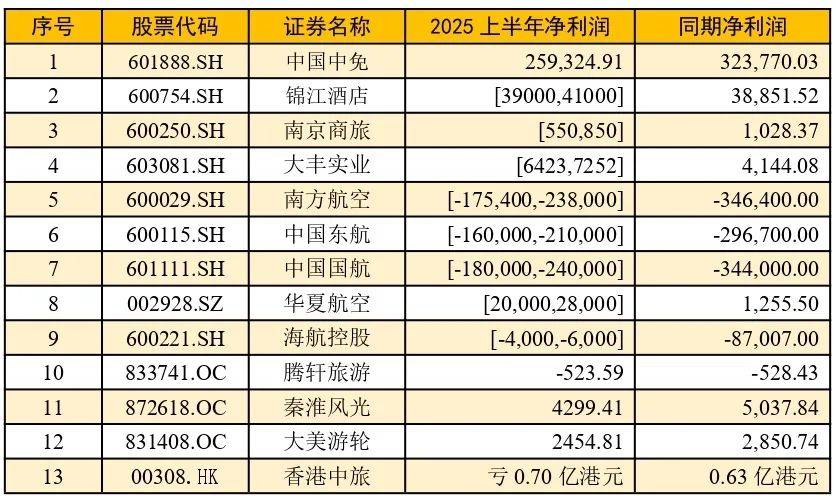
Core Viewpoint - The tourism industry is experiencing a shift from growth to efficiency, where companies must enhance cost, structure, and scenario effectiveness to convert competitors' declines into their own gains [1] Duty-Free Industry - China Duty Free Group (中国中免) reported a net profit of 259,324.91 thousand yuan for the first half of 2025, a significant decrease of 6.4% from 323,770.03 thousand yuan in the same period last year [7] - The decline is attributed to pressures on Hainan's offshore duty-free sales, outbound consumption diversion, and intensified market competition [7] - Despite challenges, China Duty Free's market share increased by nearly 1 percentage point year-on-year, and inventory turnover improved by 10% [7] Hotel Industry - Jin Jiang Hotels (锦江酒店) expects a net profit of 39,000 to 41,000 thousand yuan for the first half of 2025, showing slight growth from 38,851.52 thousand yuan year-on-year [10] - The growth is driven by a light-asset operation model that effectively reduced cost pressures, despite the absence of similar revenue items as in the previous year [10] - In contrast, Nanjing Tourism (南京商旅) anticipates a net profit of 550 to 850 thousand yuan, a notable decline from 1,028.37 thousand yuan, primarily due to underperformance in its tourism service segments [10] Airline Industry - Major state-owned airlines, including China Southern Airlines, China Eastern Airlines, and Air China, are projected to incur losses ranging from 175,400 thousand to 240,000 thousand yuan, 160,000 thousand to 210,000 thousand yuan, and 180,000 thousand to 240,000 thousand yuan respectively, although losses are narrowing compared to the previous year [11] - The losses are attributed to imbalances in market supply, a downward shift in customer demographics, competition from high-speed rail, and uncertainties in the international environment [11] - Conversely, Huaxia Airlines (华夏航空) expects a profit of 20,000 to 28,000 thousand yuan, a significant increase from 1,255.50 thousand yuan, benefiting from improved demand in civil aviation and optimized route structures [11] Regional Tourism - Qinhuai Scenic Area (秦淮风光) reported a net profit of 4,299.41 thousand yuan, down from 5,037.84 thousand yuan, due to decreased consumer spending and visitor numbers [14] - Daming Cruises (大美游轮) achieved a net profit of 2,454.81 thousand yuan, slightly down from 2,850.74 thousand yuan, with operational metrics showing stable performance despite minor declines in average ticket prices and hotel occupancy rates [15] - Tengxuan Tourism (腾轩旅游) reported a loss of 523.59 thousand yuan, nearly unchanged from the previous year's loss, impacted by reduced income from air freight and domestic ticket commissions [15] Hong Kong Tourism - Hong Kong China Travel Service (香港中旅) reported a loss of 0.70 billion HKD, a reversal from a profit of 0.63 billion HKD, primarily due to investment property impairments [16] - Despite a 12% increase in total visitors to Hong Kong, the company faces challenges from reduced group tours and rising operational costs [16] Cultural and Sports Equipment - Dafen Industrial (大丰实业) expects a net profit of 6,423 to 7,252 thousand yuan, a significant increase from 4,144.08 thousand yuan, driven by strong demand for technology solutions in cultural and tourism sectors [17]


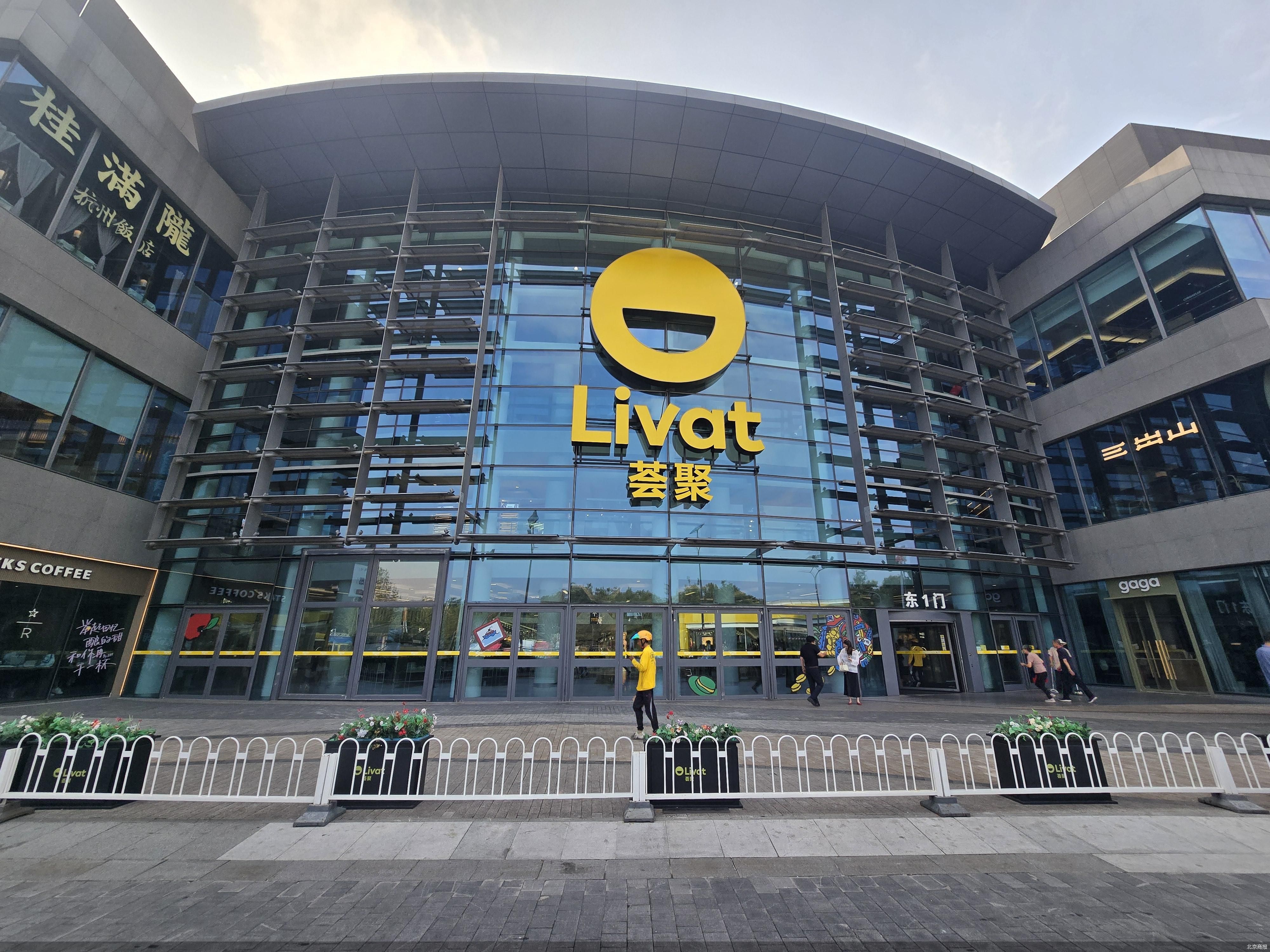
英格卡卖盘风起 十大荟聚或打包出售
Bei Jing Shang Bao· 2025-08-05 13:35
Core Viewpoint - The news indicates that Ingka Group is planning to sell its ten Huiju shopping centers in China as part of a strategic shift towards asset-light operations, driven by increasing competition from local brands and e-commerce, leading to declining market share and financial pressure [1][4][6]. Group 1: Sale of Huiju Shopping Centers - Ingka Group is reportedly packaging ten Huiju shopping centers for sale, with the first three located in Beijing, Wuhan, and Wuxi [4]. - The total investment in the ten Huiju shopping centers is approximately 27.5 billion yuan, with a total leasing area of about 943,000 square meters [4]. - The sale is expected to allow Ingka to reallocate funds to higher-value new projects and optimize its asset structure [1][5]. Group 2: Financial Performance and Market Challenges - Ingka Group's revenue for the fiscal year 2024 is projected to decline by 5.5% to 41.864 billion euros, with net profit plummeting by 46.5% to 0.806 billion euros [6]. - IKEA China’s sales for fiscal year 2024 are estimated at approximately 11.2 billion yuan, down nearly 30% from 15.77 billion yuan in 2019, despite an increase in store count from 29 to 39 [6]. Group 3: Strategic Shift and Market Trends - The sale of shopping centers is part of a broader trend in the retail industry where companies are focusing on core businesses and divesting non-core assets to enhance competitiveness [7]. - Future retail projects are expected to prioritize experiential consumption and personalized services, leveraging technology such as big data and artificial intelligence to improve operational efficiency [7][8]. - The integration of sustainable development principles into retail projects is anticipated to gain traction, with environmentally friendly initiatives becoming more appealing to consumers [8].
【最全】2025年物流地产行业上市公司全方位对比(附业务布局汇总、业绩对比、区域布局、业务规划等)
Qian Zhan Wang· 2025-08-05 05:09
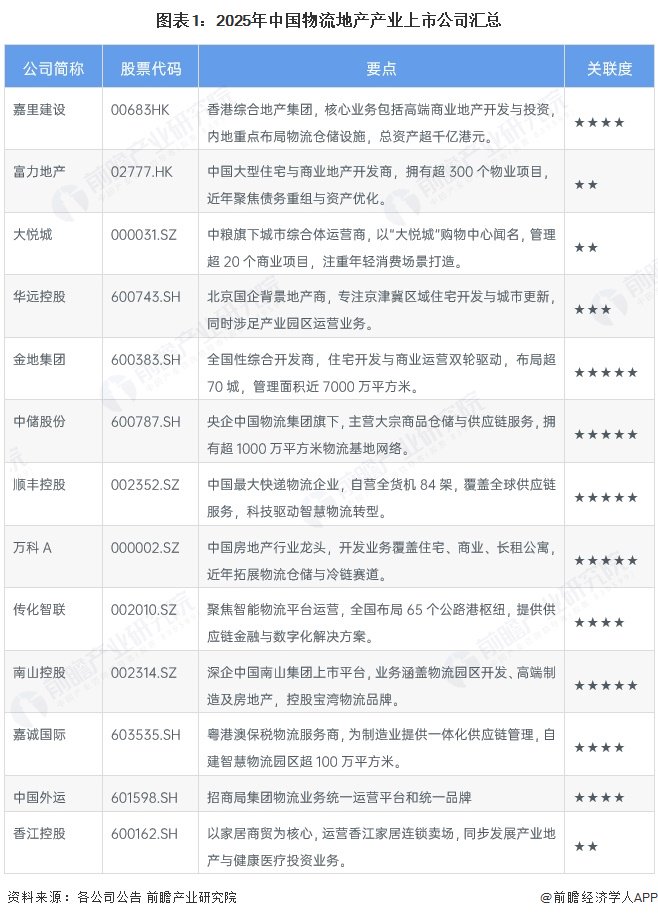
Core Insights - The logistics real estate industry in China has a limited number of listed companies, with most focusing on either real estate or logistics, and many involved in warehousing and light asset operations [1][4] - Companies like Jinke, Zhongchu, and others have a high degree of relevance to logistics real estate, while others like R&F and Joy City have a moderate relevance, primarily focusing on real estate development [1][4] Company Overview - Kerry Properties (00683HK): A comprehensive real estate group in Hong Kong, focusing on high-end commercial real estate development and investment, with total assets exceeding HKD 100 billion [3] - R&F Properties (02777.HK): A major residential and commercial real estate developer in China, managing over 300 property projects, currently focusing on debt restructuring and asset optimization [3] - Joy City (000031.SZ): A subsidiary of COFCO, known for urban complex operations, managing over 20 commercial projects, emphasizing young consumer experiences [3] - China Vanke (000002.SZ): A leading real estate company in China, expanding into logistics and cold chain sectors in recent years [3] - SF Holding (002352.SZ): The largest express logistics company in China, operating 84 self-owned cargo planes and focusing on smart logistics transformation [3] Financial Performance - In 2024, revenue for logistics real estate companies shows significant divergence, with leading companies like Zhongchu and SF Holding generating revenues in the hundreds of billions, while some smaller firms report revenues around tens of millions [4][5] - Most companies maintain a gross margin between 10-30%, indicating an overall improvement in industry profitability [4] Revenue and Profitability Metrics - SF Holding reported a revenue of CNY 2844.2 billion with a gross margin of 13.9% in 2024 [5] - Vanke A achieved a revenue of CNY 3431.8 billion with a gross margin of 10.2% [5] - R&F Properties reported a revenue of CNY 187.7 billion but with a negative gross margin of -4.7% [5] Regional Layout - Companies have varying regional focuses, with Kerry Properties targeting key areas like Shanghai and Beijing, while Zhongchu has established a national network with over 100 warehouses across 20 provinces [9][10] - SF Holding is developing logistics hubs in cities like Ezhou and Jiaxing, enhancing its logistics network [10] Business Development Plans - Companies like Huayuan Holdings and Zhongchu are planning to build new logistics parks, focusing on intelligent technology applications and network enhancements [15][17] - Vanke is concentrating on high-standard warehouses and cold chain logistics, while Jinke is exploring synergies between logistics and other real estate sectors [17][18]



国民女装第一股,靠直播起死回生?
3 6 Ke· 2025-08-04 11:17
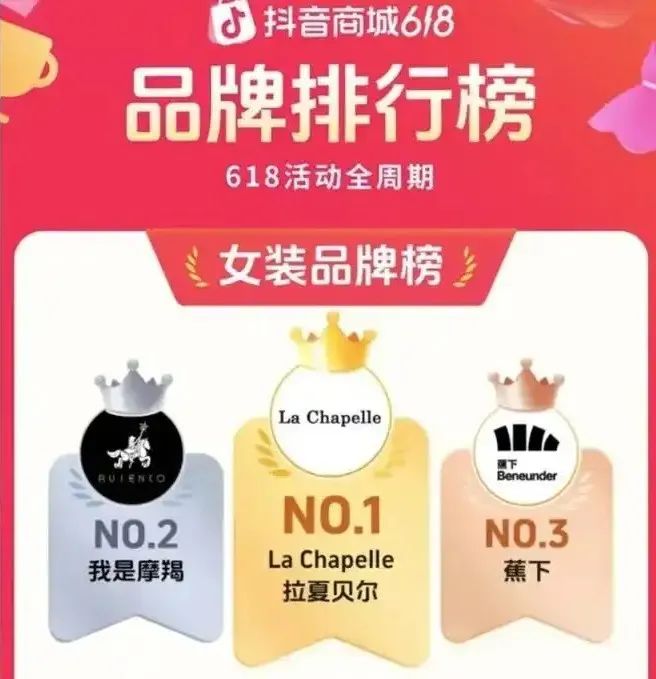
今年618 ,抖音女装品牌榜出现了一个老国货女装品牌:拉夏贝尔。 作为曾经的"国民女装第一股",拉夏贝尔命运跌宕起伏:同时在港交所和A股上市,却因连续6年亏损退市,经破产重整后重回大众视野,还在抖音销售 额破亿、登上女装榜一。 服装行业低迷,亏损和退市的品牌并不少,拉夏贝尔却能重回市场,它是如何逆风翻盘的? 01 老牌国货登顶抖音女装榜 拉夏贝尔的"起死回生",离不开分销网络的广泛布局。 因此,可以看到,除了抖音,淘宝、京东和拼多多等电商平台也有不少拉夏贝尔的关联店铺。 先来看看其在抖音上的布局—— 据第三方平台数据显示,今年抖音618大促期间,拉夏贝尔销售额破亿,其中直播带货贡献了近半业绩(46.31%),商品卡销售占比 41.87%,视频推广 则占 11.82%。 通过与4749名带货达人的合作,打造了 4.4 万场带货直播,实现了可观的销售声量。 价格策略方面,拉夏贝尔的平均客单价在100-150元之间,低于品牌数年前几百元的服饰定价,这与受众人群匹配度高,大促期间拉夏贝尔的消费者画像 为31-40岁的女性,主要位于三四线城市,这类人群比较关注性价比,习惯直播购物。 此外,拉夏贝尔关联的抖音店铺多达35 ...