
碳中和

Search documents
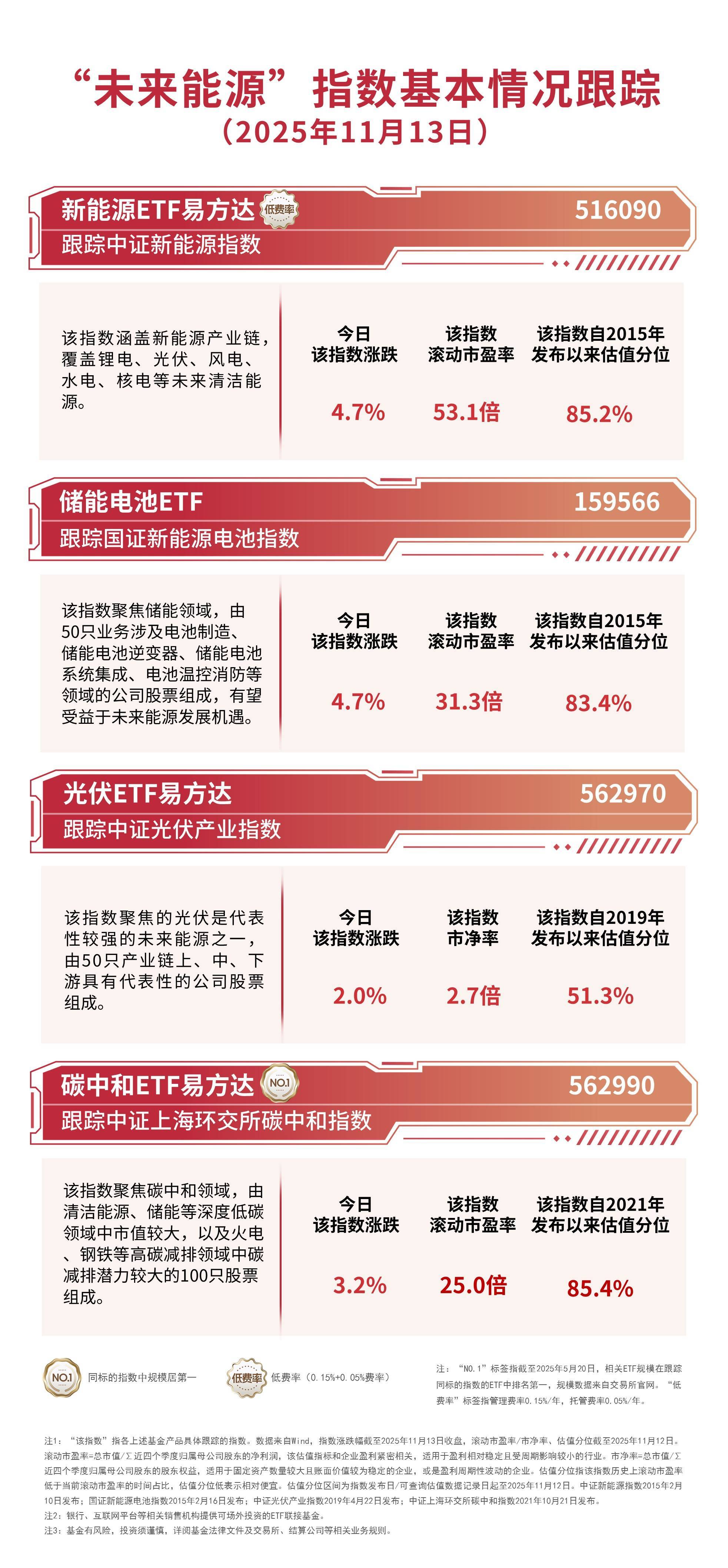
锂电池板块领涨,储能电池ETF(159566)连续10个交易日获资金净流入
Sou Hu Cai Jing· 2025-11-13 11:14
Group 1 - The core indices related to new energy sectors, including the China Securities New Energy Index and the National Securities New Energy Battery Index, have seen significant increases of 4.7% [1]. - The China Securities Photovoltaic Industry Index rose by 2.0%, indicating a positive trend in the photovoltaic sector, which is considered a strong representative of future energy [5][7]. - The China Securities Shanghai Environmental Exchange Carbon Neutrality Index increased by 3.2%, reflecting growing interest in carbon neutrality initiatives [1]. Group 2 - The Energy Storage Battery ETF (159566) has experienced a continuous net inflow of funds for 10 consecutive trading days, totaling over 1 billion yuan [1]. - The index focusing on the energy storage sector comprises 50 companies involved in battery manufacturing, energy storage battery inverters, energy storage system integration, and battery temperature control and fire protection, suggesting potential benefits from future energy development opportunities [3]. - The photovoltaic ETF managed by E Fund tracks the China Securities Photovoltaic Industry Index, which includes 50 representative companies across the upstream, midstream, and downstream of the photovoltaic industry chain [5].

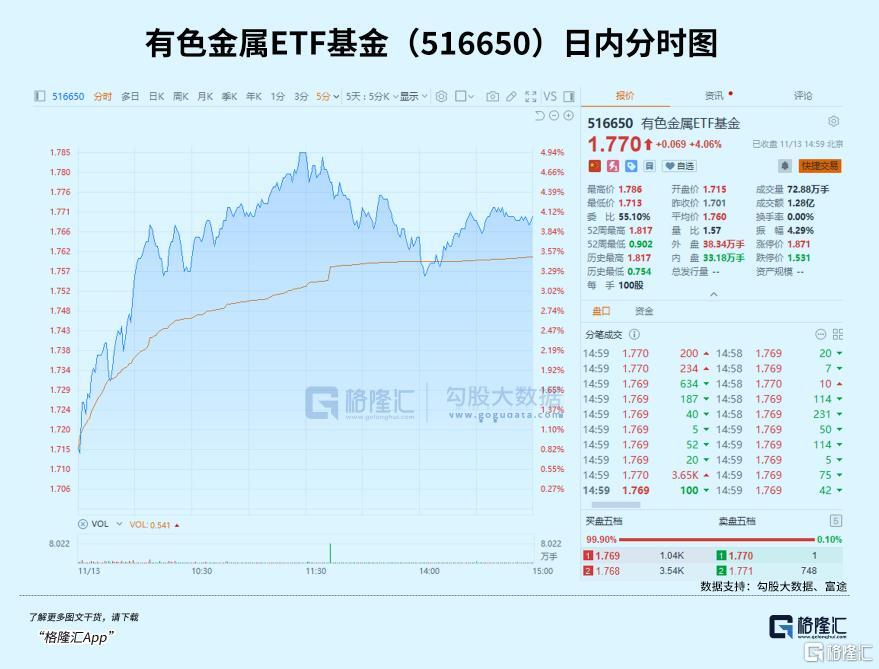
再度飙涨!今年表现最好的板块
Ge Long Hui· 2025-11-13 11:03
Core Viewpoint - The domestic market is increasingly recognizing the valuation of precious metals and non-ferrous resource stocks, with significant inflows of capital driving a strong upward trend in related assets [1][5]. Group 1: Market Performance - On November 13, 2023, the A-share market saw a comprehensive surge in precious metals and non-ferrous metals, with gold stocks ETF (159562) rising by 3.07% and non-ferrous metals ETF (516650) increasing by 4.06%, significantly outperforming the market [1]. - As of the close on November 13, domestic gold and silver futures saw substantial increases of 1.56% and 5.48%, respectively, with silver prices reaching a historical high of 12,588 yuan per kilogram [4]. - The lithium metal sector led the A-share market with a remarkable increase of 7.03%, while other non-ferrous metals like lead, zinc, nickel, and cobalt also saw gains of over 4% [6]. Group 2: Economic Drivers - The recent bullish trend in resource metals is supported by various macroeconomic factors, including the end of the U.S. government shutdown, which has renewed hopes for a Federal Reserve rate cut in December [2][11]. - The ongoing geopolitical tensions, particularly since the onset of the Russia-Ukraine conflict, have heightened global risk aversion, driving investments into gold as a safe-haven asset [11][12]. - Central banks worldwide, including China, are increasing their gold reserves, with China's gold reserves reaching approximately 2,304.457 tons as of the end of October, marking a continuous increase for 12 months [12]. Group 3: Sector Growth - The lithium battery sector has seen explosive growth, with domestic sales of new energy vehicles reaching 11.196 million units in the first three quarters of 2025, a year-on-year increase of 34.55% [16]. - The demand for lithium is further fueled by the rise of energy storage solutions, with domestic lithium battery shipments nearly doubling year-on-year [16]. - The copper market is expected to face a supply shortage by 2025, with demand projected to reach 27.29 million tons, while supply growth lags behind at only 1.1% [17]. Group 4: Investment Opportunities - The non-ferrous metals ETF (516650) has seen significant inflows, with a net inflow of 1.755 billion yuan from August 14 to October 17, 2023, and a year-to-date share increase of 900.76% [24]. - The gold stocks ETF (159562) has also performed well, with a year-to-date increase of 86.98%, benefiting from the rising gold prices and favorable tax policies for virtual gold investments [26]. - Major non-ferrous metal companies, including Zijin Mining and Ganfeng Lithium, have experienced substantial stock price increases, with many achieving over 50% gains this year [19][21].






博盈特焊(301468) - 2025年11月13日投资者关系活动记录表
2025-11-13 10:30
Company Overview - The company focuses on anti-corrosion and wear-resistant welding equipment, specializing in the manufacturing of special equipment and expanding into industrial equipment and high-end structural components [1] - Key technologies include material, process, and equipment, with certifications such as national special equipment production license, US certification, ASME, and EU EN certification [1] - The management team has extensive industry experience and a stable core technical team, contributing to competitive advantages [1] Market Opportunities - The company is strategically positioned in both domestic and international markets, aiming to maintain domestic leadership while expanding overseas [2] - There is a growing demand in the waste incineration market, with downstream upgrades increasing penetration rates [2] - The HRSG (Heat Recovery Steam Generator) and oil-gas composite pipe businesses are being developed, with HRSG already having a certain production capacity [2] Competitive Advantages - The company has significant highlights in core competitiveness, global layout, and long-term growth potential, being a globally recognized manufacturer of energy special equipment [2] - The establishment of a factory in Vietnam has been completed, enhancing overseas revenue growth potential [2] Technology and Innovation - The company employs three welding techniques: MIG, TIG, and laser welding, each suited for different applications [3][4] - Continuous R&D efforts have led to innovations such as digital pulse MIG high-frequency oscillation welding technology, enhancing efficiency and stability [4] Production Capacity and Expansion - The first phase of the Vietnam production base includes four HRSG production lines, with plans for a second phase to add a total of 12 lines [6][7] - The HRSG products produced in Vietnam are primarily compatible with heavy-duty gas turbines [8] Impact of Tariffs - The impact of US tariffs on the company's business is minimal, as the revenue from the US market is currently low [9] - Future US orders will mainly be produced in Vietnam, where tariffs are lower and typically borne by customers [9] Strategic International Expansion - The company is investing in overseas production bases, particularly in Vietnam, to capture gas turbine market opportunities [10] - A joint venture with Wilhelmsen is aimed at expanding into the oil and gas market and establishing overseas manufacturing bases [10] Waste Incineration Market Demand - There is significant market potential for waste incineration overseas, particularly in developing regions facing waste management challenges [11] - Countries like Vietnam, Thailand, and Indonesia are prioritizing waste incineration as a national strategy, supported by government incentives [11]
国泰航空全方位推进国产SAF创新提速与应用落地
Zhong Guo Min Hang Wang· 2025-11-13 08:49
Core Viewpoint - The aviation industry has a significant responsibility in reducing greenhouse gas emissions and achieving low-carbon development, with sustainable aviation fuel (SAF) being a key component in this transition [1][2]. Group 1: Company Initiatives - Cathay Pacific has been a pioneer in sustainable development within the aviation sector, establishing a carbon neutrality timeline and aiming for net-zero carbon emissions by the middle of the 21st century [1]. - The airline is actively implementing SAF refueling at multiple global locations, including Hong Kong, Los Angeles, London, and Singapore [1]. - Cathay Pacific collaborates with partners such as Sinopec, China National Aviation Fuel, Airbus, and academic institutions to accelerate the innovation and application of domestic SAF [1]. Group 2: Industry Context - The aviation sector accounts for 2%-3% of global carbon emissions, and its share is expected to rise as other industries transition to low-carbon practices [2]. - Reducing carbon emissions in aviation is crucial for achieving national carbon neutrality goals, with SAF identified as a vital pathway for the industry [2].

晶科能源涨1.82%,成交额8.22亿元,后市是否有机会?
Xin Lang Cai Jing· 2025-11-13 07:43
Core Viewpoint - JinkoSolar's stock increased by 1.82% on November 13, with a trading volume of 8.22 billion yuan and a market capitalization of 61.732 billion yuan [1] Group 1: Company Operations - JinkoSolar has mass-produced high-efficiency N-type TOPCon batteries and is actively developing new technologies and processes, including IBC and calcium-titanate batteries [2] - The company has a strong technical reserve in the N-type TOPCon field, with clear paths for efficiency improvement and cost reduction, and plans to increase investment to maintain its leadership position in the "N-type era" [2] - JinkoSolar's main business includes the research, production, and sales of solar photovoltaic modules, battery cells, and silicon wafers, providing high-quality solar products globally [2] Group 2: Financial Performance - As of September 30, JinkoSolar reported a revenue of 47.986 billion yuan for the first nine months of 2025, a year-on-year decrease of 33.14%, and a net profit attributable to shareholders of -3.92 billion yuan, a decrease of 422.67% [6] - The company has distributed a total of 3.355 billion yuan in dividends since its A-share listing, with 3.125 billion yuan distributed in the last three years [7] Group 3: Market Activity - The main net inflow of funds today was -15.7419 million yuan, with a continuous reduction in main funds over the past three days [3][4] - The average trading cost of JinkoSolar's shares is 5.94 yuan, with the stock price approaching a resistance level of 6.20 yuan, indicating potential for a price correction if this level is not surpassed [5]

银河期货每日早盘观察-20251113
Yin He Qi Huo· 2025-11-13 07:02
1. Report Industry Investment Ratings No relevant content provided. 2. Core Views of the Report The report presents a comprehensive analysis of various futures markets, including financial derivatives, agricultural products, black metals, and non - ferrous metals. It indicates that most markets will maintain a volatile trend in the short term, influenced by factors such as supply - demand relationships, policy changes, and macro - economic conditions. For example, the stock index futures market will remain volatile due to sector rotation and capital flow; the agricultural product market shows different trends in different varieties, with some facing supply pressure and others having potential price increases; the black metal and non - ferrous metal markets are affected by factors like raw material costs, production capacity, and international policies [19][20][25]. 3. Summaries by Relevant Catalogs Financial Derivatives Stock Index Futures - Core View: The market is volatile due to sector rotation. Large - cap indexes are stronger than small - cap indexes, and the technology sector shows signs of stabilizing. The short - term market will remain volatile [19][20]. - Trading Strategy: High - low trading in a high - level range; IM/IC long 2512 + short ETF cash - and - carry arbitrage; bullish spread options at low prices [20]. Treasury Bond Futures - Core View: The bond market continues to fluctuate with an obvious stock - bond seesaw effect. The yield downward space is limited, and the 30Y Treasury yield may have a top range of 2.20 - 2.25% [22]. - Trading Strategy: Wait and see for single - side trading; hold short positions on the 30Y - 7Y term spread and try to go long on the T - contract inter - delivery spread [23]. Agricultural Products Protein Meal - Core View: The supply pressure is improving, and the domestic near - month price has support, but the far - month has pressure. Rapeseed meal is expected to fluctuate [25][26]. - Trading Strategy: Wait and see for single - side and arbitrage trading; sell wide - straddle options [26]. Sugar - Core View: International sugar production in major regions may be lower than expected, and the international price has a bottom - grinding trend. The domestic market is expected to fluctuate in the short term and may face downward pressure in the long term [30][31]. - Trading Strategy: Trade in the range for the domestic market; wait and see for arbitrage and options [32]. Oilseeds and Oils - Core View: The increase in oil prices is limited, and they will maintain a volatile trend. The palm oil inventory in Malaysia and China shows different trends, and the supply and demand of soybean oil and rapeseed oil also vary [33][34][35]. - Trading Strategy: Wait and see or trade in a high - low range; wait and see for arbitrage and options [35]. Corn/Corn Starch - Core View: The U.S. corn may fluctuate narrowly, and the domestic corn spot price is strong. The 01 contract is expected to fluctuate strongly, but the upward space is limited [37][38]. - Trading Strategy: Go long on the 12 - contract corn on dips; wait and see for the 01 contract; wait for dips for the 05 and 07 contracts [38]. Live Hogs - Core View: The supply pressure increases, and the overall inventory is high. The short - term price may still face pressure [39][40]. - Trading Strategy: Short a small amount; wait and see for arbitrage; sell wide - straddle options [40]. Peanuts - Core View: The peanut spot price is strong, and the short - term market is expected to fluctuate strongly. The new - season peanut quality is lower, and the oil mill's procurement is limited [42][43]. - Trading Strategy: The 01 contract fluctuates at the bottom, and the 05 contract can try to go long lightly; wait and see for arbitrage; sell pk601 - P - 7600 options [43]. Eggs - Core View: The demand improves slightly, and the egg price rebounds slightly. The current inventory of laying hens is high, and the short - term price increase space is limited [44][45][47]. - Trading Strategy: Wait and see in the short term and consider going long at low prices for far - month contracts; wait and see for arbitrage and options [47]. Apples - Core View: The new - season apple production decreases, and the cold - storage inventory is expected to be low. The market may fluctuate greatly when the new inventory data is released [48][49]. - Trading Strategy: Wait and see; wait and see for arbitrage and options [50]. Cotton - Cotton Yarn - Core View: The new cotton supply increases, and the demand enters the off - season. Considering the macro - economic situation, the short - term cotton price is expected to fluctuate slightly stronger [52]. - Trading Strategy: The U.S. cotton is expected to fluctuate, and the Zhengzhou cotton is expected to fluctuate slightly stronger; wait and see for arbitrage and options [53]. Black Metals Steel - Core View: The raw material cost is under pressure, and the steel price fluctuates in a range. The construction steel production decreases more, and the inventory is still decreasing. The hot - rolled coil performs better than the rebar [57]. - Trading Strategy: Maintain a range - bound trend; go long on the coil - rebar spread at low prices; wait and see for options [58]. Coking Coal and Coke - Core View: The market sentiment cools down, and the price fluctuates and adjusts. The short - term driving force is not obvious, and there may be an opportunity to go long after a pullback in the medium term [59][60]. - Trading Strategy: Wait and see in the short term; go long after a pullback in the medium term; hold a reverse spread for coking coal 1/5; wait and see for options [61]. Iron Ore - Core View: Adopt a bearish approach. The supply is at a high level, and the domestic demand is weak, so the ore price is expected to fluctuate bearishly [62][63]. - Trading Strategy: Go short; wait and see for arbitrage and options [63]. Ferroalloys - Core View: The cost provides some support, and the previous short positions can be reduced. The supply and demand of silicon iron and manganese silicon are weakening on the margin [64][65]. - Trading Strategy: Reduce previous short positions at low prices; wait and see for arbitrage; sell out - of - the - money straddle option combinations [65]. Non - Ferrous Metals Precious Metals - Core View: The short - term strong - side volatile pattern continues. The U.S. government is about to restart, and the market is worried about fiscal stimulus and the change of the Fed's dovish camp, increasing the attractiveness of precious metals [66][68][69]. - Trading Strategy: Hold long positions based on the 5 - day moving average; wait and see for arbitrage; hold collar call option strategies [69]. Copper - Core View: The short - term trend is volatile. The macro - economic situation is favorable, but the supply and demand situation is complex. The copper price is expected to fluctuate in a high - level range [70][71][72]. - Trading Strategy: Wait and see; the long - term trend is bullish, and a low - long strategy can be adopted; the ratio may rebound; wait and see for options [72]. Alumina - Core View: Pay attention to production cuts. The supply and demand are significantly surplus, and the price may rebound after substantial production cuts [73][74][76]. - Trading Strategy: The price fluctuates weakly at the bottom; wait and see for arbitrage and options [76]. Electrolytic Aluminum - Core View: The price is strong due to the resonance of macro - economic and micro - economic factors. The overseas supply - demand is tight, and the domestic demand has resilience [77][78][79]. - Trading Strategy: Maintain a strong trend; wait and see for arbitrage and options [79]. Cast Aluminum Alloy - Core View: The price fluctuates at a high level with the aluminum price. The cost provides support, but the demand is affected by the high price [80]. - Trading Strategy: The price moves strongly with the aluminum price; wait and see for arbitrage and options [80]. Zinc - Core View: Pay attention to the export volume. The supply may be eased, and the price fluctuates in a range. The upward space is limited [82][83]. - Trading Strategy: Trade in a range; hold the SHFE long - LME short arbitrage; wait and see for options [84]. Lead - Core View: Pay attention to the change of domestic social inventory. The supply is recovering, and the demand is weakening, so the price is under pressure [86][87]. - Trading Strategy: Try to short lightly at high prices; wait and see for arbitrage; sell out - of - the - money call options [87]. Nickel - Core View: The cost is loosening, and the price fluctuates weakly. The supply is abundant, and the market is pessimistic about the quota adjustment [88][89]. - Trading Strategy: Short on rebounds; wait and see for arbitrage; sell out - of - the - money call options [89]. Stainless Steel - Core View: The supply and demand are both weak, and the raw materials are under pressure. No specific trading strategy is provided in the given text [90].
北大国发院发布《中国可持续航空燃料规模化发展路径》研究报告
Xin Hua Cai Jing· 2025-11-13 06:28
Core Viewpoint - The report released by Peking University's National School of Development emphasizes the importance of Sustainable Aviation Fuel (SAF) for the decarbonization of the aviation industry in China and outlines a policy path for its large-scale development [1][2]. Industry Development Status - The aviation sector accounts for 2%-3% of global carbon emissions, and its share is expected to rise as other industries transition to low-carbon practices. SAF is crucial for achieving carbon reduction targets [2]. - China has achieved regular application of SAF and established an SAF industry alliance, with significant breakthroughs in certain production processes. However, the industry faces challenges such as high costs and the need for coordinated policies, technological advancements, and standardization [2][3]. Economic Potential - If the blending ratio of SAF reaches 5%, it could reduce carbon emissions by 6.7 million tons annually. By 2050, global SAF demand is projected to exceed 360 million tons, with China having abundant resources for SAF production [4]. - Despite having a production capacity of 1 million tons, China's SAF industry is still in its early stages and faces market development bottlenecks, including a lack of effective pricing mechanisms [4]. Policy Recommendations - The report proposes six core policy recommendations to support the SAF industry: 1. Strengthen strategic planning and top-level design to clarify blending targets and stabilize market demand 2. Implement market mechanisms to share the "premium" of SAF 3. Include SAF in mandatory government green procurement lists 4. Establish long-term procurement agreements and market pricing mechanisms 5. Optimize supply chain costs and efficiency 6. Develop SAF standards and certification systems in line with international practices [5]. Short-term and Long-term Outlook - In the short term, clear blending targets and government green procurement will stabilize market demand, while market mechanisms will alleviate cost pressures on airlines, facilitating the transition of SAF from pilot projects to regular use [6]. - In the medium to long term, long-term procurement agreements and pricing mechanisms will stabilize producer expectations, promote capacity expansion, and enhance technological progress, leading to a gradual decrease in SAF costs and increased competitiveness [6].
东岳集团盘中涨超8% 化工反内卷加速供给出清 制冷剂供需格局改善
Zhi Tong Cai Jing· 2025-11-13 06:09
Group 1 - Dongyue Group (00189) saw its stock price increase by over 8% during trading, currently up 6.31% at HKD 11.12, with a trading volume of HKD 425 million [1] - According to Steel Union data, the prices of refrigerants R32 remained stable at high levels, while R134a continued to rise. As of October 31, prices for R32, R125, R410a, and R134a have increased by 46.51%, 8.33%, 27.83%, and 27.06% respectively since the beginning of the year [1] - CITIC Construction Investment released a report indicating that chemical product prices in China have been declining for four consecutive years, with policies aimed at reducing internal competition and self-regulation emerging, suggesting a potential turning point in the cycle. The report highlights the importance of supply and demand improvements, focusing on cyclical sectors related to supply structure and domestic demand, particularly in fluorochemicals like Dongyue Group [1] Group 2 - Kaiyuan Securities noted that with the ongoing implementation of carbon peak and carbon neutrality strategies, the second-generation refrigerant R22 is set to be significantly reduced, which is expected to benefit HFCs as national policies promote rapid penetration [1]
港股异动 | 东岳集团(00189)盘中涨超8% 化工反内卷加速供给出清 制冷剂供需格局改善
智通财经网· 2025-11-13 06:08
Core Viewpoint - Dongyue Group's stock price has seen a significant increase, with a rise of over 8% during trading, currently up 6.31% at HKD 11.12, with a trading volume of HKD 425 million [1] Group 1: Price Trends - R32 refrigerant prices remain stable at high levels, while R134a refrigerant prices continue to rise [1] - As of October 31, prices for R32, R125, R410a, and R134a have increased by 46.51%, 8.33%, 27.83%, and 27.06% respectively since the beginning of the year [1] Group 2: Market Analysis - CITIC Construction Investment reports that chemical product prices in China have been declining for four consecutive years, indicating a potential turning point in the cycle due to anti-involution policies and self-regulatory actions from associations [1] - There is an expectation of marginal improvements in both supply and demand, leading to a focus on supply structure improvements and cyclical sectors related to domestic demand, particularly in the fluorochemical industry with attention on Dongyue Group [1] Group 3: Policy Impact - According to Kaiyuan Securities, the ongoing implementation of carbon peak and carbon neutrality strategies will lead to a large-scale reduction of the second-generation refrigerant R22, which is expected to benefit HFCs through rapid penetration driven by national policies [1]
垒知集团涨2.17%,成交额1.28亿元,主力资金净流入686.14万元
Xin Lang Zheng Quan· 2025-11-13 05:50
Group 1 - The core viewpoint of the news is that Leizhi Group's stock has shown a significant increase in price and trading activity, indicating positive market sentiment and investor interest [1][2] - As of November 13, Leizhi Group's stock price rose by 2.17% to 5.64 CNY per share, with a total market capitalization of 3.937 billion CNY [1] - The company has experienced a year-to-date stock price increase of 30.83%, with notable gains over various trading periods: 4.83% in the last 5 days, 10.81% in the last 20 days, and 3.68% in the last 60 days [1] Group 2 - Leizhi Group, established on April 9, 2004, and listed on May 6, 2010, is based in Xiamen, Fujian Province, and operates in the construction technology services sector [2] - The company's main business segments include: new materials for additives (75.10%), technical services (12.45%), software and hardware sales (5.60%), ready-mixed concrete (5.53%), engineering construction (0.66%), and others [2] - For the period from January to September 2025, Leizhi Group reported a revenue of 1.803 billion CNY, a year-on-year decrease of 2.46%, while the net profit attributable to shareholders increased by 1.69% to 97.5441 million CNY [2]
