
云计算

Search documents
创业板人工智能ETF华夏、云计算50ETF“深V”翻红彰显算力韧性,AI需求持续催化算力板块修复
Xin Lang Cai Jing· 2025-11-24 03:04
创业板人工智能ETF华夏(159381),跟踪创业板人工智能指数(970070.CNI),精准布局创业板人工 智能主业公司。光模块CPO权重占比超54%,同时覆盖国产软件+AI应用企业,具备较高弹性。其中前 三大权重股为中际旭创(24.78%)、新易盛(19.40%)、天孚通信(5.11%)。场内综合费率仅 0.20%,位居同类最低。场外联接(A类:025505;C类:025506) 云计算50ETF(516630)跟踪云计算指数(930851)。该指数的AI算力含量较高,覆盖了光模块&光器 件、算力租赁、数据中心、AI服务器、液冷等热门算力概念。云计算50ETF(516630)为跟踪该指数合 计费率最低的ETF。场外联接(A类:019868;C类:019869) 展望后市,中信证券指出,我们看到Token需求增速持续超预期,谷歌在10月公布每月推理Tokens用量 达到1.3 qn,相比5月翻倍。此外Gemini 3.0基于谷歌自研芯片TPU进行训练,自研芯片的高性价比意味 着同样的Capex下有望获得更高的算力,也对应更高的配套零组件开支。我们继续看好AI PCB板块的高 确定性与成长性,正交背板方案正处 ...

利通电子涨2.04%,成交额9707.67万元,主力资金净流入758.14万元
Xin Lang Cai Jing· 2025-11-24 02:55
Core Viewpoint - Lito Electronics has shown a significant increase in revenue and profit, indicating strong business performance in the consumer electronics sector, particularly in precision metal components and electronic parts [2][3]. Company Overview - Lito Electronics, established on November 25, 1980, is located in Yixing, Jiangsu Province, and was listed on December 24, 2018. The company specializes in the design, production, and sales of precision metal structural components and electronic components used in LCD displays [1]. - The main revenue sources for Lito Electronics are: precision metal stamping structural components (60.39%), computing services (32.02%), electronic components (4.24%), molds (1.49%), other (1.39%), and bases (0.47%) [1]. Financial Performance - For the period from January to September 2025, Lito Electronics achieved a revenue of 2.463 billion yuan, representing a year-on-year growth of 65.18%. The net profit attributable to the parent company was 216 million yuan, showing a remarkable increase of 309.76% year-on-year [2]. - The company has distributed a total of 171 million yuan in dividends since its A-share listing, with 100 million yuan distributed over the past three years [3]. Stock Performance - As of November 24, Lito Electronics' stock price increased by 2.04% to 25.06 yuan per share, with a market capitalization of 6.568 billion yuan. The stock has risen by 26.69% year-to-date but has seen a decline of 8.57% over the past five trading days [1]. - The company has appeared on the trading leaderboard four times this year, with the most recent occurrence on November 3 [1]. Shareholder Information - As of October 31, the number of shareholders for Lito Electronics was 33,900, a decrease of 12.27% from the previous period. The average number of tradable shares per person increased by 13.98% to 7,570 shares [2]. - Among the top ten circulating shareholders, Hong Kong Central Clearing Limited holds 1.409 million shares, an increase of 55,900 shares compared to the previous period [3].
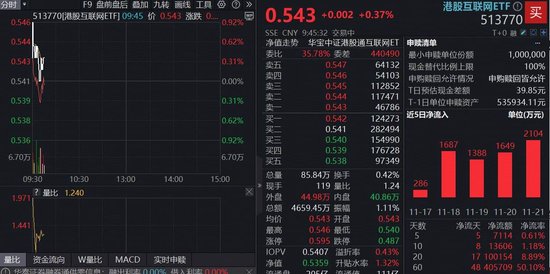
科网龙头回暖,快手涨超2%,百亿港股互联网ETF(513770)再现宽幅溢价,近20日超10亿资金涌入
Xin Lang Ji Jin· 2025-11-24 02:05
Core Viewpoint - The Hong Kong stock market is experiencing a rebound in technology stocks, particularly in the internet sector, with significant inflows into the Hong Kong Internet ETF (513770) indicating strong investor interest [1][3]. Group 1: Market Performance - As of November 24, the Hong Kong stock market opened higher, with major tech stocks like Kuaishou-W rising over 2%, and Tencent, Xiaomi, and Alibaba each increasing by more than 1% [1]. - The Hong Kong Internet ETF (513770) has seen a net inflow of 71.14 million CNY over the past week, with a total inflow exceeding 1 billion CNY in the last 20 days [1][3]. Group 2: Valuation Metrics - The price-to-earnings (P/E) ratio of the index tracked by the Hong Kong Internet ETF is currently at 21.93, which is at a historical low, positioned at the 8.3% percentile over the past decade [2][3]. - The ETF's latest scale exceeds 10.9 billion CNY, with an average daily trading volume of over 600 million CNY this year, indicating good liquidity [4]. Group 3: Key Holdings - The top three holdings in the Hong Kong Internet ETF are Alibaba-W (18.89% weight), Tencent Holdings (17.01% weight), and Xiaomi Group-W (10.05% weight), collectively representing over 73% of the ETF's portfolio [3][4]. - The ETF is designed to passively track the CSI Hong Kong Stock Connect Internet Index, which focuses on leading internet companies [3].


高盛闭门会-亚洲首席策略师展望,2026年亚洲五大投资主题
Goldman Sachs· 2025-11-24 01:46
Investment Rating - The report upgrades the investment rating for the Indian market, indicating a more attractive position compared to other regional markets [6][4]. Core Insights - The global economic growth forecast has been raised, with expectations of nearly 3% growth in 2025-2026, benefiting from policy easing and potential interest rate cuts by the Federal Reserve [1][2]. - Northeast Asian stock markets have shown strong performance, with South Korea, China, and Japan rising by 80%, 35%, and 25% respectively, driven primarily by the technology sector [1][3]. - The technology sector is crucial in Northeast Asia, with approximately 80% of market capitalization linked to AI-related revenues, contributing over 90% of index gains this year [1][7][8]. - The semiconductor industry is expected to see significant profit improvements due to supply-demand imbalances in DRAM and NAND sectors [9][21]. Summary by Sections Macroeconomic Environment - The macroeconomic environment is favorable for stock markets, with good economic growth, declining interest rates, and a weakening dollar [2]. - Global GDP growth is projected to be close to 3% in 2025 and 2026, supported by widespread policy easing [2]. Market Performance - Northeast Asia has outperformed, with notable gains in South Korea, China, and Japan, primarily driven by the technology sector [3][4]. - The Indian market is viewed positively despite high valuations, with a significant growth gap compared to other regions [6]. Currency and Investment Strategies - The Chinese yuan is expected to appreciate by about 3% over the next 12 months, suggesting a favorable environment for stock investments [5]. - Investors are advised to consider down protection strategies in light of potential market corrections [18][19]. Technology Sector Outlook - The global technology sector outlook remains optimistic, particularly in cloud computing and large-scale capital investments, which will benefit the Asian supply chain [9]. - Demand for smartphones, servers, and AI PCs is strong, with significant growth expected in these markets [10]. Geopolitical and Industrial Trends - The U.S. re-industrialization process presents investment opportunities in Asia, particularly in key markets like China, Japan, and Australia [17]. - China is increasing investments in advanced manufacturing to enhance its position in the global supply chain [15][16]. Future Investment Themes - The report highlights the importance of diversification in investment strategies, with a shift in focus from the U.S. to other regions offering attractive opportunities [23].
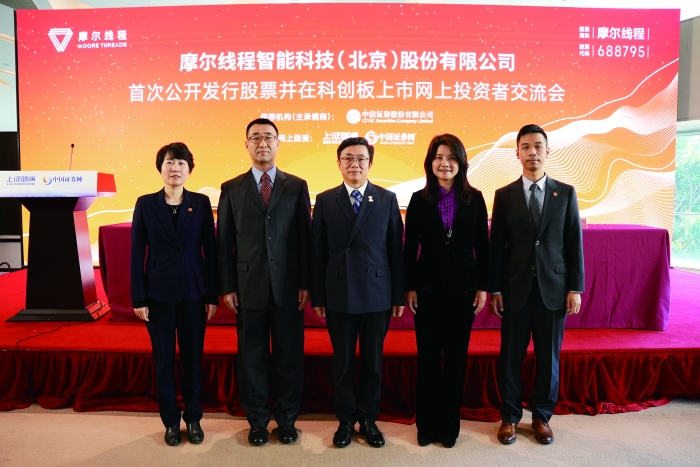
摩尔线程:为美好世界加速 力争成为具备国际竞争力的全功能GPU领军企业——摩尔线程智能科技(北京)股份有限公司首次公开发行股票并在科创板上市网上投资者交流会精彩回放
Shang Hai Zheng Quan Bao· 2025-11-23 18:02
Core Viewpoint - The company aims to become a globally competitive leader in full-function GPU technology, focusing on providing computing acceleration platforms for AI, digital twins, and high-performance computing since its establishment in 2020 [2][12]. Business Operations - The company primarily engages in the research, design, and sales of GPUs and related products, with a focus on high-performance computing applications [2][3]. - The company has successfully launched four generations of GPU architectures, covering various application areas including AI computing, high-performance computing, and graphics rendering [3]. - The company has a diverse product matrix that meets the differentiated needs of government, enterprises, and individual consumers [3]. Technology and Innovation - The company has applied for over 1,000 patents, with 514 patents granted as of June 30, 2025, leading among domestic GPU companies [4][6]. - The company emphasizes continuous R&D investment, with over 75% of its workforce dedicated to R&D, resulting in products that meet or exceed international standards [4]. - The company actively participates in industry standards development, enhancing its technological leadership [5]. Financial Performance - The company's main business revenue for the reporting period (2022 to 2025) shows significant growth: 45.84 million, 121.47 million, 432.32 million, and 701.58 million yuan [7]. - The main business gross margin has improved from -70.45% to 69.17% over the same period, reflecting a shift towards higher-margin products [9]. - R&D expenses have been substantial, with figures of 1,116.49 million, 1,334.43 million, 1,358.69 million, and 556.73 million yuan, indicating a strong commitment to innovation [11]. Development Strategy - The company aims to provide global computing acceleration infrastructure and solutions, focusing on AI computing support for various industries [12]. - The company has identified its core competitive advantages in the domestic GPU sector, including a robust ecosystem, a professional R&D team, and effective commercialization strategies [12][13]. Industry Trends - The Chinese GPU market is experiencing rapid growth driven by increasing demand for computing power, with a notable shift towards domestic production [16][17]. - The application of GPUs is expanding into diverse fields, particularly in AI, where their capabilities are becoming essential [17]. - The industry is witnessing a trend towards technological upgrades and increased localization, providing significant opportunities for growth [16][18]. Competitive Position - The company is positioned in a market dominated by international players like NVIDIA and AMD, but it has gained market share through close customer service and rapid response to needs [18]. - The company’s products have achieved performance metrics that are competitive with international standards, such as the MTT S80 graphics card's performance nearing that of NVIDIA's RTX 3060 [18][19]. Public Offering - The company plans to issue 70 million shares, increasing its total shares to 470.03 million, with the new shares representing 14.89% of the total [20]. - The raised funds, totaling 800 million yuan, will be allocated to the development of new AI and graphics chips, enhancing the company's core competencies and market share [21].
【公告全知道】算力+华为+AI智能体+信创+云计算!公司与华为联合发布大模型一体机
财联社· 2025-11-23 15:19
Group 1 - The article highlights the collaboration between a company and Huawei to launch a large model integrated machine, as well as a technical partnership with Moore Threads [1] - A company has signed a 100 million yuan contract for new energy power batteries, indicating a strong focus on renewable energy and storage solutions [1] - Another company has entered into a strategic cooperation agreement for humanoid robot components with a rolling bearing enterprise, showcasing advancements in humanoid robotics and automotive technology [1]

688051,重大资产重组,周一停牌
Shang Hai Zheng Quan Bao· 2025-11-23 14:51
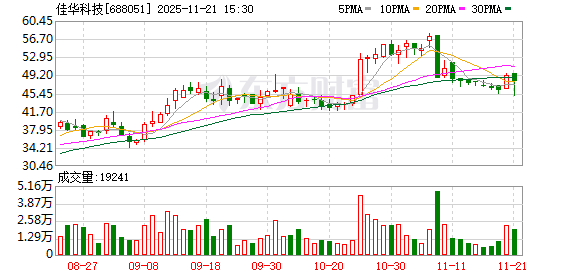
Core Viewpoint - JiaHua Technology (688051) announced plans to acquire a controlling stake in Shudun Information Technology Co., Ltd. through a combination of share issuance and cash payment, which may constitute a significant asset restructuring. The company's stock will be suspended from trading starting November 24, 2025, for a period not exceeding five trading days [2][3]. Group 1: Acquisition Details - JiaHua Technology has signed a preliminary equity acquisition intention agreement with Zhu Yun, a major shareholder of Shudun Technology, to purchase shares held by him. The final price will be determined based on an assessment report from a qualified evaluation agency [3]. - The specific transaction details will be formalized in a subsequent agreement, and the final transaction counterparties will be disclosed in future announcements [3]. - The transaction will not result in a change of the actual controller of JiaHua Technology, and it is currently unclear whether this transaction constitutes a related party transaction [3]. Group 2: Shudun Technology Overview - Shudun Technology, established in 2002, specializes in domestic cryptography technology research, cryptographic information security product development, and overall information security solutions. It is one of the first companies recognized by the National Cryptography Administration for commercial cryptography qualifications [4]. - The company has developed four major systems: cryptographic security products, information security products, compliance services, and cryptographic evaluation services. It holds 23 commercial cryptography product certificates, 30 patents, 41 trademarks, and 90 software copyrights [4]. - Shudun Technology has received significant venture capital support throughout its development, with its latest financing round (D round) completed in October 2023, led by CICC Capital [4][5]. Group 3: Financial Performance of JiaHua Technology - JiaHua Technology has reported losses in the last three years. The total revenue for 2022, 2023, and 2024 was 261 million, 322 million, and 300 million yuan, respectively, with the first three quarters of 2025 reporting 166 million yuan [7]. - The net profit attributable to the parent company for the same periods was -288 million, -208 million, and -103 million yuan, with a loss of -67 million yuan in the first three quarters of 2025 [7]. - As of November 21, 2025, JiaHua Technology's total market capitalization was 3.712 billion yuan [8].

“国产GPU第一股”来了,下周两只新股可申购
Chang Sha Wan Bao· 2025-11-23 11:23
Group 1: Company Overview - Moer Technology is a leading domestic GPU manufacturer and will become the "first domestic GPU stock" upon listing, with an issue price of 114.28 yuan per share, the highest for new stocks this year [1] - The total share capital after the issuance of Moer Technology will be 470 million shares, with a total market value of 53.7 billion yuan at the time of listing [1] - Baiaosaitu is engaged in preclinical CRO and biotechnology, with four technology platforms for various innovative animal models and drug development services [2][3] Group 2: Financial Performance - Moer Technology has not yet achieved profitability, with projected revenues of 46.0883 million yuan in 2022, increasing to 1.24 billion yuan in 2024, and an expected revenue of 1.218 billion to 1.498 billion yuan in 2025, representing a year-on-year growth of 177.79% to 241.65% [2] - Baiaosaitu's revenues for 2022 to 2024 are projected at 534 million yuan, 717 million yuan, and 980 million yuan, with a net profit of 340 million yuan expected in 2025, marking a year-on-year growth of 303.57% [3] Group 3: Market Position and Competition - Major global players like NVIDIA and AMD dominate the integrated circuit market, while Moer Technology and other Chinese companies are gradually gaining market share in their specialized fields, contributing to the self-sufficiency of China's GPU industry [2] - Moer Technology has launched four generations of GPU architectures since its establishment in 2020, focusing on applications in AI, cloud computing, and personal computing [1]
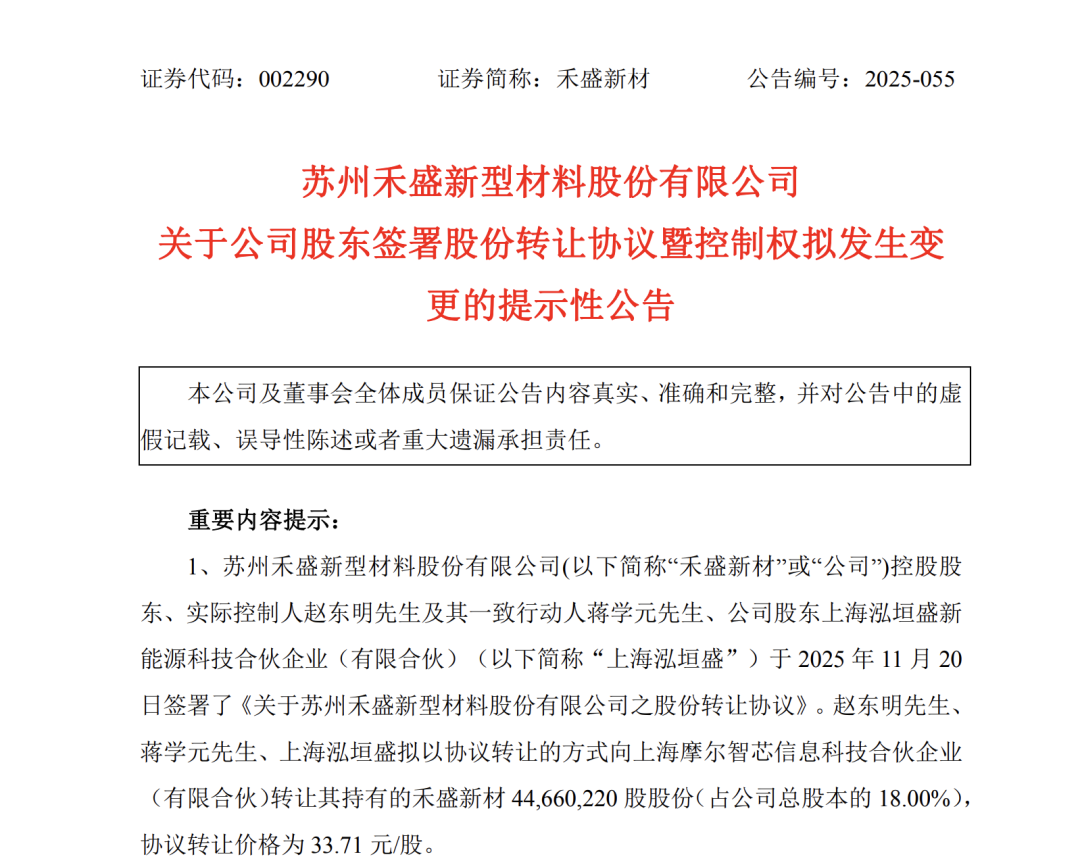
002290,再换实控人
Shang Hai Zheng Quan Bao· 2025-11-23 00:58
Core Viewpoint - He Sheng New Materials is undergoing another change in control, with the major shareholder Zhao Dongming and his associates transferring 18% of the company's shares to Moer Zhixin at a price of 33.71 yuan per share, totaling approximately 1.505 billion yuan [1][3]. Group 1: Share Transfer Details - The share transfer involves 44.66 million shares, representing 18% of He Sheng New Materials' total share capital, with a total transaction value of approximately 1.505 billion yuan [1][3]. - After the transaction, Moer Zhixin will become the controlling shareholder, while Zhao Dongming and his associates will hold 13.72% of the shares and forfeit voting rights on 6% of the shares [3]. - The transfer price represents a discount of about 13% compared to the market price of 38.82 yuan per share as of November 21 [3]. Group 2: Historical Context - He Sheng New Materials has experienced multiple changes in control, initially founded and controlled by Zhao Dongming, then transferred to Zhongke Chuang Asset Management in 2016, and later returned to Zhao Dongming in 2023 after legal issues faced by the previous controller [4]. - The company has a history of control changes, with the most recent shift occurring just over two years after Zhao Dongming regained control [4]. Group 3: New Controlling Entity - Moer Zhixin, the new controlling entity, was established less than three months prior to the acquisition and has a registered capital of 755 million yuan, operating in the software and information technology services sector [5][6]. - The business scope of Moer Zhixin includes various trending areas in the information technology industry, such as information system integration, AI public data platforms, and integrated circuit design and manufacturing [6]. - The actual controller of Moer Zhixin, Xie Haiwen, has a strong background in finance and investment, having held senior positions in various financial institutions [6]. Group 4: Company Performance - He Sheng New Materials has shown a steady increase in revenue and net profit, with a reported revenue of 1.862 billion yuan for the first three quarters of the year, reflecting a year-on-year growth of 1.41%, and a net profit of 144 million yuan, up 67.90% year-on-year [7].

商云智能(昆明)科技有限公司成立 注册资本500万人民币
Sou Hu Cai Jing· 2025-11-22 11:16
Core Insights - A new company named Shangyun Intelligent (Kunming) Technology Co., Ltd. has been established with a registered capital of 5 million RMB [1] Company Overview - The legal representative of the company is Zhu Cong [1] - The company operates in various sectors including computer hardware and software wholesale, integrated circuit design, and software development [1] - The company is involved in artificial intelligence, offering services such as AI software development, AI public service platform technical consulting, and AI application software development [1] Business Scope - The business scope includes general projects such as: - Wholesale and retail of computer hardware and software [1] - Integrated circuit sales and manufacturing [1] - Internet data services and big data services [1] - Technical services, development, consulting, and technology transfer [1] - Cloud computing equipment manufacturing and sales [1] - Environmental consulting and information consulting services [1]