投资

Search documents
彼得·林奇:投资的核心,是要知道你自己在买什么……
聪明投资者· 2025-10-26 02:04
Core Viewpoint - The article discusses the recent commentary by Ray Dalio on the long-term investment value of gold, highlighting a significant price drop following his remarks after a 60% increase in gold prices this year [1][4]. Group 1: Gold Market Analysis - Gold prices have surged over 60% in 2023, but are now facing short-term adjustment pressures [1]. - Since 2000, 2025 is projected to be an exceptionally volatile year for gold, with comparisons drawn to a 28% decline in 2013 [1]. - Dalio's analysis suggests that if one accepts his long-term logic, the current short-term pullback in gold prices could be seen as a positive development [4]. Group 2: Additional Insights - The article references other notable discussions, including a dialogue with "father of margin of safety" Seth Klarman, emphasizing market inefficiencies [5]. - It mentions a rare joint appearance by Warren Buffett, Charlie Munger, and Bill Gates, underscoring the importance of collaboration in achieving cognitive success [5]. - Insights from Chen Guangyan on rare earths and trade balance indicate that over 80% of refined rare earths in the U.S. come from China, with little change expected in the short term [5]. - The article also highlights perspectives from prominent private equity firms and investment strategies across sectors like new energy and smart manufacturing [5].


高频经济周报(2025.10.19-2025.10.25):地产市场回落,出口量价齐升-20251025
Shenwan Hongyuan Securities· 2025-10-25 13:16
1. Report Industry Investment Rating No relevant content provided. 2. Core View of the Report The report analyzes the economic situation from October 19 to October 25, 2025, covering aspects such as industrial production, people and goods flow, consumption, investment, exports, and major asset performance. It shows that industrial production is performing well, people flow continues to rise, freight prices increase slightly, car sales growth slows down, prices are differentiated, construction shows good performance while the real - estate market declines, port throughput rises, and shipping indices are differentiated. Major assets present a mixed performance with bonds showing both gains and losses, stocks generally rising, most commodities rising, and foreign currencies generally falling [3]. 3. Summary According to the Catalog 3.1. Major Assets - This week, bond indices showed mixed performance, stock indices generally rose, most commodities increased, and foreign currencies generally declined. Among bond indices, the AAA and AA+ indices of China Bond corporate bonds rose the most, with a weekly increase of 0.14%, while the 10 - year China Bond treasury bond index fell the most, with a weekly decline of 0.13%. The ChiNext Index rose the most among stock indices, with a weekly increase of 8.05%. Among commodities, the Nanhua Energy and Chemical Index rose the most, with a gain of 3.66%, and the Nanhua Precious Metals Index fell the most, with a decline of 6.69%. Foreign currencies depreciated against the RMB, with the Japanese yen having the largest decline of 2.06% and the US dollar depreciating by 0.05% [3]. 3.2. Industrial Production - Production performed well. From the upstream perspective, the weekly coal consumption in the national power plant sample area decreased by 1.27% week - on - week, the operating rate of petroleum asphalt plants increased by 1.30 pcts to 35.80%, and the blast furnace operating rate increased by 0.48 pcts to 84.73%, while the crude steel output decreased by 0.89% week - on - week. In the real - estate chain, the operating rate of rebar increased by 1.64 pcts to 42.97%, the operating rate of float glass remained flat at 76.65%, and the mill operating rate increased by 0.38 pcts to 38.27%. In the consumer goods chain, the operating rate of polyester filament remained flat at 91.04%, the PTA operating rate increased by 0.42 pcts to 75.98%, and the methanol operating rate decreased by 1.67 pcts to 82.71%. In the automotive chain, the operating rate of automobile semi - steel tires increased by 0.95 pcts to 73.67%, and the operating rate of automobile all - steel tires increased by 1.06 pcts to 65.58% [3]. 3.3. People and Goods Flow - People flow continued to rise, and freight prices increased slightly. The 7 - day moving average (7DMA) of the national migration scale index increased by 6.68% week - on - week. The 7DMA of domestic flight operations increased by 1.53%, while the 7DMA of international flight operations decreased by 0.79%. The subway passenger volumes in Beijing, Shenzhen, and Guangzhou increased, while that in Shanghai decreased. The 4 - week moving average (4WMA) of the road logistics freight rate index increased by 0.01% week - on - week, and the total volume was higher than the same period in previous years [3]. 3.4. Consumption - Car sales growth slowed down, and price performance continued to be differentiated. The previous period's automobile wholesale increased by 1.00% year - on - year, while retail sales decreased by 3.00% year - on - year. Both the 4WMA of wholesale and retail year - on - year growth rates declined. The weekly box office of movies decreased by 39%, and the 7DMA of the number of movie - goers decreased by 41%. Agricultural product prices were differentiated, with pork prices decreasing by 1.66% week - on - week and vegetable prices increasing by 5.65% week - on - week [3]. 3.5. Investment - Construction showed good performance, and the real - estate market declined. The cement inventory ratio increased by 0.2 pcts week - on - week, the cement price index increased by 0.23% week - on - week, and the cement shipping rate increased by 0.6 pcts week - on - week. The rebar inventory decreased by 4.1% week - on - week, the proportion of profitable steel mills nationwide decreased by 7.8 pcts week - on - week, and the apparent demand for rebar increased by 2.8% week - on - week. Overall, the terminal demand for construction was good. The 7DMA of the commercial housing transaction area in 30 large and medium - sized cities decreased by 7.3% week - on - week. By city - tier, the transaction area of first - tier cities increased, while those of second - and third - tier cities decreased. The 7DMA of the second - hand housing transaction area in 16 cities decreased by 4.7% week - on - week, and the national second - hand housing listing price index decreased by 0.2% week - on - week. The land transaction area in 100 large and medium - sized cities increased, and the land transaction premium rate increased week - on - week [3]. 3.6. Exports - Port throughput increased, and shipping indices were differentiated. The weekly port cargo throughput increased by 2.5%, and the container throughput increased by 3.6%. The BDI index decreased by 3.77% week - on - week, while the domestic SCFI and CCFI indices increased by 7.11% and 2.02% week - on - week respectively [3].
高频经济周报:地产市场回落,出口量价齐升-20251025
Shenwan Hongyuan Securities· 2025-10-25 12:50
1. Report Industry Investment Rating No relevant content provided. 2. Core Viewpoints The report provides a weekly economic analysis from October 19 - October 25, 2025, covering various aspects including industrial production, personnel and freight flow, consumption, investment, exports, and performance of major asset classes, along with important policies and events [1]. 3. Summary by Directory 3.1. Major Asset Classes - This week, bond indices showed mixed performance, stock indices generally rose, most commodities increased, and foreign currencies generally fell. Among bond indices, the ChinaBond Corporate Bond AAA and AA+ indices had the highest weekly gains of 0.14%, while the ChinaBond 10 - year Treasury Bond index had the largest weekly decline of 0.13%. The ChiNext index led the stock market with a weekly gain of 8.05%. The Nanhua Energy and Chemicals Index in commodities rose the most, by 3.66%, and the Nanhua Precious Metals Index fell the most, by 6.69%. Foreign currencies depreciated against the RMB, with the Japanese yen having the largest weekly decline of 2.06%, and the US dollar depreciated by 0.05% [1]. 3.2. Industrial Production - Production performed well. In the upstream sector, the weekly coal consumption in the national power plant sample area decreased by 1.27% week - on - week, the petroleum asphalt plant operating rate increased by 1.30 pcts to 35.80%, the blast furnace operating rate increased by 0.48 pcts to 84.73%, and the crude steel output decreased by 0.89%. In the real - estate chain, the rebar operating rate increased by 1.64 pcts to 42.97%, the float glass operating rate remained flat at 76.65%, and the mill operating rate increased by 0.38 pcts to 38.27%. In the consumer goods chain, the polyester filament operating rate remained flat at 91.04%, the PTA operating rate increased by 0.42 pcts to 75.98%, and the methanol operating rate decreased by 1.67 pcts to 82.71%. In the automotive chain, the semi - steel tire operating rate increased by 0.95 pcts to 73.67%, and the full - steel tire operating rate increased by 1.06 pcts to 65.58% [1]. 3.3. Personnel and Freight Flow - Personnel flow continued to rise, and freight prices increased slightly. The 7 - day moving average (7DMA) of the national migration scale index increased by 6.68% week - on - week. The 7DMA of domestic flight operations increased by 1.53%, while that of international flights decreased by 0.79%. The subway passenger volumes in Beijing, Shenzhen, and Guangzhou increased, while that in Shanghai decreased. The 4 - week moving average (4WMA) of the road logistics freight rate index increased by 0.01% week - on - week, and the total volume was higher than the same period in previous years [1]. 3.4. Consumption - The growth rate of automobile sales declined, and price performance continued to diverge. The previous period's automobile wholesale increased by 1.00% year - on - year, while retail sales decreased by 3.00%. Both the 4WMA of the wholesale and retail year - on - year growth rates declined. This period's movie box office decreased by 39% week - on - week, and the 7DMA of the number of moviegoers decreased by 41%. Agricultural product prices showed divergence, with pork prices decreasing by 1.66% week - on - week and vegetable prices increasing by 5.65% [1]. 3.5. Investment - Construction showed good performance, while the commercial housing market declined. The cement inventory - to - capacity ratio increased by 0.2 pcts week - on - week, the cement price index increased by 0.23%, and the cement shipping rate increased by 0.6 pcts. Rebar inventory decreased by 4.1% week - on - week, the proportion of profitable steel mills nationwide decreased by 7.8 pcts, and the apparent demand for rebar increased by 2.8%. Overall, the terminal demand for construction was good. The 7DMA of the commercial housing transaction area in 30 large - and medium - sized cities decreased by 7.3% week - on - week. By city tier, the transaction area in first - tier cities increased, while those in second - and third - tier cities decreased. The 7DMA of the second - hand housing transaction area in 16 cities decreased by 4.7%, and the national second - hand housing listing price index decreased by 0.2%. The land transaction area in 100 large - and medium - sized cities increased, and the land transaction premium rate increased week - on - week [1]. 3.6. Exports - Port throughput increased, and shipping indices showed divergence. Port cargo throughput increased by 2.5% week - on - week, and container throughput increased by 3.6%. The BDI index decreased by 3.77% week - on - week, while the domestic SCFI and CCFI indices increased by 7.11% and 2.02% respectively [1]. 3.7. Important Policies/Events - In the third quarter of 2025, the economic growth rate declined; the October LPR quote remained unchanged; a new round of China - US trade consultations started on the 24th in Malaysia; the Fourth Plenary Session of the 20th Central Committee of the Communist Party of China successfully concluded; the central bank announced a 900 - billion - yuan MLF operation on October 27 [1].
X @𝘁𝗮𝗿𝗲𝘀𝗸𝘆
𝘁𝗮𝗿𝗲𝘀𝗸𝘆· 2025-10-24 03:26
#Crypto结合今天 Stable 的情况,再想想?𝘁𝗮𝗿𝗲𝘀𝗸𝘆 (@taresky):#投资错过(-10)➡️ 事后知道(-1)➡️ 事前知道(1)➡️ 计划(10)➡️ 完美执行(70)➡️ 运气(100)括号后面是赚钱的完成度。所以不必后悔,因为和发财差了十万八千里。 ...
X @Nick Szabo
Nick Szabo· 2025-10-23 05:35
RT Tigris 会讲课教授是好老师 (@tig88411109)如果你第一时间看到这次黄金大跌,你的反应是“清仓”,那么我建议你还是清仓,因为你不适合投资黄金。为什么?今天黄金暴跌 -5.7%,这是一个 4.5个Sigma的事件,按统计学“正常”情况一般这种事二十四万天才会发生一次。现实呢?从1971年以来,已经发生了 34次。更大幅的暴跌(超过6%)也出现了 21次。黄金从来不是“稳”的投资标的,持有体验不好,经常收割恐慌和贪婪。如何不让投资黄金成投机而一次次收割。因为黄金不是像企业那样有内在现金流,它的价值来自“信仰”,来自“恐惧的共识”。如果你无法承受这种信仰的波动,你的投资行为会被情绪牵着走。那么,最重要一点是不要预测,黄金从来不是“低波动”资产。提前写下“当意外发生时我该怎么做”?,因为黄金是典型的事件驱动型的行情,战争/通胀/违约等等非常典型事件重复发生。有时最聪明的选择反而是,“什么也不做”;或者最理性的是“看着不动观察而已”,这要求你能控制情绪,不被极端恐惧或者贪婪趋势,而盲目被市场带情绪。恐惧让你在最低点卖出,贪婪让你在最高点追入。所以,与其和自己的心理较劲,不如承认你不适合玩这个游戏。 ...
4 Ways To Stop Saving Money and Start Building Wealth
Yahoo Finance· 2025-10-22 13:42
Group 1 - The article emphasizes that traditional savings accounts with low interest rates are insufficient for building real wealth, especially in the context of rising inflation and living costs [1] - It suggests that budgeting alone is not enough to achieve financial freedom; instead, investing is necessary for wealth growth [2][3] Group 2 - Moving cash into investments is recommended as a way to build wealth, with a focus on maintaining some liquidity for regular expenses and emergencies [3] - Index funds and exchange-traded funds (ETFs) are highlighted as lower-risk investment options that typically outperform savings accounts over time [4] - Real estate investment trusts (REITs) are presented as an alternative investment avenue, allowing individuals to invest in commercial properties without being landlords, while also providing dividends [5] Group 3 - The article discusses the benefits of using tax-advantaged accounts to optimize savings and minimize tax burdens [6] - Employer-sponsored 401(k) plans are recommended, particularly those with matching contributions, as they provide a way to invest pre-tax income [7] - Individual retirement accounts (IRAs) are also mentioned, with traditional IRAs offering tax deductions on contributions and Roth IRAs allowing for tax-free growth and withdrawals in retirement [8]
国际金价突然跳水 6%,创下近十二年最大跌幅,到底咋了?
Sou Hu Cai Jing· 2025-10-22 01:32
Core Viewpoint - The international gold price experienced a significant drop of 6%, marking the largest decline in nearly twelve years, with prices falling from over $2400 per ounce to around $2250 in just one day [2][3]. Market Dynamics - The primary reason for the gold price drop is the recent statements from the Federal Reserve indicating that interest rate cuts are not imminent and that there may be further rate hikes, leading to a stronger dollar, which inversely affects gold prices [3][4]. - The reduction in market risk appetite has also contributed to the decline, as easing international tensions have led to decreased demand for gold as a safe-haven asset [3][4]. Investment Behavior - Investors previously flocked to gold due to poor performance in stock and bond markets, but as the stock market shows signs of recovery, some funds are shifting back to equities [4]. - Long-term investors are less concerned about the short-term price drop, viewing gold as a hedge against risk rather than a quick profit opportunity [4][5]. - The current lower gold prices present a buying opportunity for those looking to purchase gold jewelry, as prices have become more favorable [4]. Future Outlook - Predictions regarding the future of gold prices are uncertain, with some believing the recent drop is temporary while others anticipate further declines if the Federal Reserve continues to raise interest rates [5]. - Investors are advised to make decisions based on their individual financial situations and risk tolerance, rather than following market trends impulsively [5].

9月经济数据点评:基数上升拖累GDP同比,4季度仍有政策支撑
Western Securities· 2025-10-21 02:30
Economic Growth - Q3 GDP growth slowed to 4.8% YoY, down from 5.2% in Q2, impacted by a high base effect from last year[1] - Nominal GDP growth in Q3 was 3.7%, further declining from 3.9% in Q2, marking a new low for 2023[1] - Q3 GDP deflator decreased by 1%, a smaller decline compared to the 0.2 percentage points drop in Q2[1] Industrial Production - In September, industrial value-added increased by 6.5% YoY, significantly up from 5.2% in August[2] - Seasonally adjusted MoM growth in industrial production reached 0.64%, the highest since March[2] - Automotive manufacturing value-added surged by 16% YoY, improving by 7.6 percentage points from August[2] Retail and Consumption - Retail sales growth fell to 3% YoY in September, down from 3.4% in August[2] - Consumer confidence index rose to 89.2, continuing an upward trend since Q4 of last year[3] - Per capita disposable income grew by 4.5% YoY, while per capita consumption expenditure increased by 3.4%, both lower than Q2 growth rates[3] Investment Trends - Fixed asset investment declined by 7.1% YoY in September, consistent with August's decline[3] - Infrastructure investment dropped by 8%, while real estate development investment fell by 21.3%, widening the decline from the previous month[3] - Cumulative fixed asset investment for the first three quarters showed a 0.5% YoY decrease, indicating negative growth[3] Real Estate Market - In September, the sales area of commercial housing decreased by 10.5% YoY, close to August's decline[3] - New residential prices in 70 large and medium cities fell by 0.4% MoM, a larger drop than in August[3] - Overall, real estate demand remains weak, with sales revenue down by 11.8% YoY[3]
2025年前三季度经济增长数据点评
Ping An Securities· 2025-10-21 01:56
Economic Growth Overview - In the first three quarters of 2025, China's actual GDP grew by 5.2% year-on-year, laying a solid foundation for achieving the annual target[2] - In Q3, the actual GDP growth rate was 4.8%, a decrease of 0.4 percentage points from Q2[2] - Final consumption expenditure contributed 2.7 percentage points to GDP growth in Q3, while net exports contributed 1.2 percentage points, maintaining the same support as in Q2[2] Price and Income Trends - The GDP deflator index in Q3 showed a year-on-year decrease of 1.1%, an improvement of 0.2 percentage points from Q2, with nominal GDP growth at 3.73%[2] - Per capita disposable income and expenditure growth rates for the first three quarters were 5.1% and 4.6%, respectively, both slightly lower than the first half of the year[2] - Per capita wage income increased by 5.4%, while net property income grew by 1.7%[2] Industrial and Service Sector Performance - In September, industrial production value increased by 6.5% year-on-year, up 1.3 percentage points from the previous month[2] - The service sector production index also grew by 5.6% year-on-year in September, consistent with the previous month[2] - Exports showed recovery, with the export delivery value in September increasing by 3.8% year-on-year, up 4.2 percentage points from the previous month[2] Investment and Consumption Insights - Fixed asset investment from January to September decreased by 0.5% year-on-year, a decline of 1 percentage point from the previous month[2] - Equipment investment rose by 14.0% year-on-year, contributing 2.0 percentage points to overall investment growth[2] - Real estate investment fell by 13.9% year-on-year, significantly impacting overall investment growth[2] Future Outlook - The government is expected to enhance fiscal investment efforts, with 500 billion yuan in new policy tools being deployed starting from the end of September[2] - The increase in fiscal support is anticipated to aid in achieving the annual growth target more effectively[2]
市场反复震荡,国债ETF5至10年(511020)低波动价值凸显
Sou Hu Cai Jing· 2025-10-21 01:46
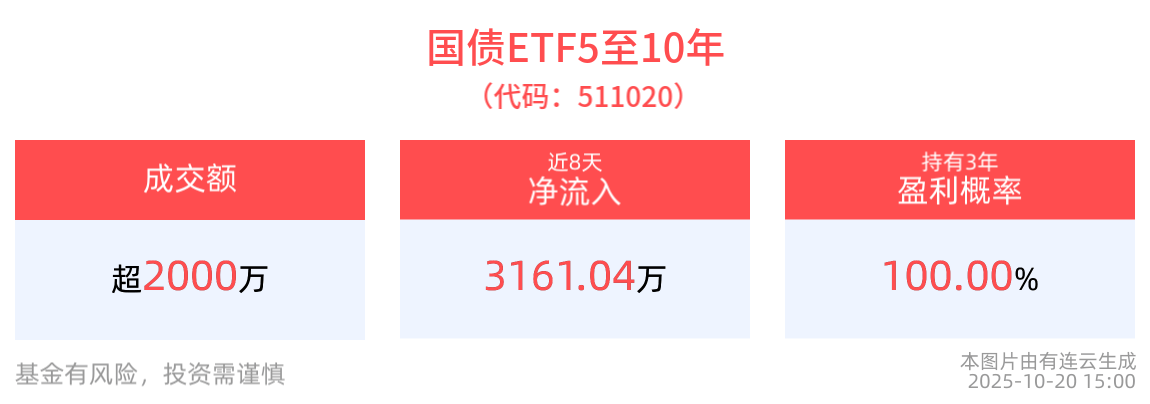
Economic Overview - The macroeconomic environment in September 2025 is characterized by "strong production, slow demand, and low prices" with a GDP growth of 4.8% year-on-year in Q3, indicating a slowdown compared to Q2, but the cumulative growth for the first three quarters stands at 5.2%, suggesting that achieving the annual growth target of around 5% is feasible [1] Production Sector - Industrial production has shown strong performance, exceeding market expectations, with the industrial added value for large-scale enterprises growing by 6.5% year-on-year in September, an increase of 1.3 percentage points from the previous month. The cumulative growth from January to September is 6.2%, driven by the upgrade of the manufacturing sector, particularly in emerging products like 3D printing equipment, industrial robots, and new energy vehicles [1] Demand Sector - Consumer demand continues to slow down, with the retail sales of consumer goods in September reaching 41,971 billion yuan, a year-on-year growth of 3.0%, marking the lowest increase this year, primarily due to the diminishing effects of policy subsidies. Notably, the growth rates for home appliances and furniture, which were supported by policies, have seen significant declines compared to the previous month [2] Investment Sector - Investment growth has broadly declined, remaining at low levels. From January to September, manufacturing investment has increased by 4% year-on-year, indicating weakened growth momentum, although equipment purchases have shown resilience with a 14% year-on-year increase, outpacing overall investment growth by 14.5 percentage points. Infrastructure investment has seen a modest increase of 1.1% year-on-year, but the pace of major traditional infrastructure projects has slowed, partly due to reduced policy support and local government debt pressures affecting funding availability for certain projects [3] Real Estate Investment - Real estate investment has decreased by 13.9% year-on-year, continuing to be the largest drag on fixed asset investment. In September, the decline in the sales area of commercial housing has widened, with sales revenue decreasing at a faster rate than the sales area, indicating that the real estate market is still engaging in "price for volume" strategies [4] Bond Market Overview - As of October 20, 2025, the active bond index for 5-10 year government bonds has decreased by 0.10%. The government bond ETF for this maturity range has seen a recent price of 117.12 yuan, with a cumulative increase of 3.37% over the past year [7] - The latest scale of the government bond ETF for 5-10 years has reached 1.54 billion yuan, with trading liquidity showing a turnover of 1.38% and a transaction volume of 21.24 million yuan on the same date [8][9] - The fund inflow and outflow for the government bond ETF have remained balanced, with a total of 31.61 million yuan raised over the last eight trading days. The net value has increased by 21.56% over the past five years, ranking 33rd out of 179 index bond funds, placing it in the top 18.44% [9] - The maximum drawdown for the government bond ETF over the past six months is 1.09%, with a management fee of 0.15% and a custody fee of 0.05% [10][11]