资产配置

Search documents
螺丝钉精华文章汇总|2025年9月
银行螺丝钉· 2025-10-02 13:42
Core Viewpoint - The article summarizes key investment strategies and insights from various articles published in September, providing valuable information for investors to enhance their decision-making process [2][3]. Group 1: Investment Strategies - The newly launched automatic profit-taking feature allows investors to automatically execute profit-taking strategies when market conditions signal a transition from undervaluation to more stable investment options [5]. - The article discusses the operation of government bond reverse repos, highlighting their utility as a short-term financial management tool for investors with idle cash, especially during specific timeframes like month-end or holiday periods [7]. - Insights on the timing of fund purchases before holidays are provided, clarifying how different fund types may yield returns during holiday periods and the optimal dates for investment to capture these returns [8]. Group 2: Market Analysis - The September market analysis indicates that the current market remains relatively undervalued, suggesting continued investment in actively selected and index-enhanced portfolios [10]. - A new "golden star rating" and bull-bear signal board for gold investments are introduced, offering insights into gold pricing, historical ratings, and its relationship with real interest rates, which can guide investment decisions [11]. - The article presents an index map categorizing various investment indices, including their codes, selection rules, and average market capitalizations, facilitating easier navigation for investors [12]. Group 3: Fund Performance Insights - A summary of fund managers' perspectives from the 2025 semi-annual reports is provided, categorizing them into different investment styles and highlighting their views on past performance and future market trends [12][13]. - The article emphasizes the importance of asset allocation strategies, particularly in the context of a structural bull market in A-shares, advocating for diversified investment across different styles to mitigate risks [16]. - The discussion on profit-taking strategies post-market upturn outlines three methods for investors to consider, including automatic rebalancing features in investment portfolios to optimize returns [17]. Group 4: Earnings Growth and Valuation - The article notes a recovery in earnings growth for A-share listed companies in the first half of 2025, suggesting a potential end to the economic downturn and an opening for market growth [18]. - It emphasizes the relevance of value investing strategies in the A-share market, asserting that patience among investors can lead to successful outcomes despite the market's cyclical nature [20][22]. - The importance of valuation methods in investment decisions is highlighted, advocating for simple approaches that can help ordinary investors identify undervalued assets [23].


金价“狂飙”!还会再涨吗?
Sou Hu Cai Jing· 2025-10-02 12:13
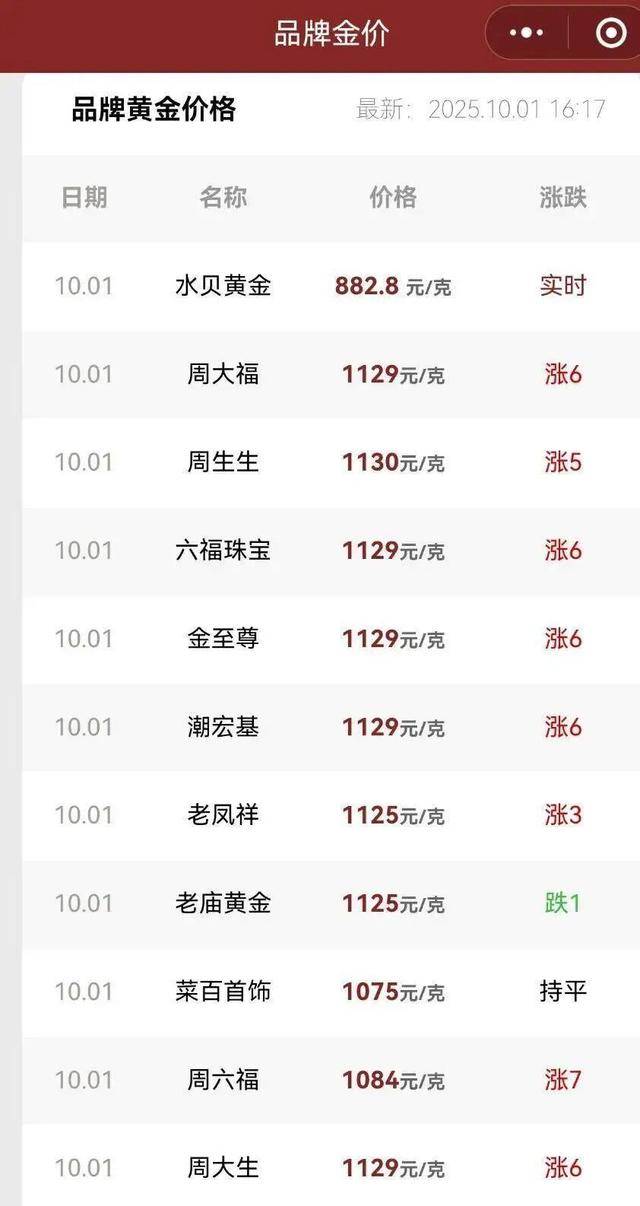
Core Viewpoint - The international gold price has surged significantly, reaching new historical highs, driven by various economic factors including the Federal Reserve's interest rate cuts and concerns over U.S. government debt sustainability [2][9]. Price Movements - As of October 1, spot gold prices rose to over $3,890 per ounce, with London gold reaching a peak of $3,895 per ounce, marking a new historical high [1]. - In September, the international gold price increased by 10.16%, the largest monthly gain since August 2011 [2]. - On October 1, the price of gold jewelry from major brands in China saw increases, with Chow Tai Fook and Chow Sang Sang raising prices by 6 yuan per gram, while Chow Sang Sang's gold jewelry was priced at 1,130 yuan per gram [3][4]. Market Demand - Despite rising gold prices, demand for gold jewelry remains strong, particularly ahead of the upcoming holiday season, with consumers purchasing gold for gifts and celebrations [4]. - The number of financial products linked to gold has increased, with approximately 50 such products available in the market as of September 29 [5]. Future Price Predictions - Analysts from BMO Capital Markets have raised their forecasts for gold prices, predicting an average price of $3,900 per ounce in the last quarter of 2025, an 8% increase from previous estimates, and $4,400 per ounce in 2026, a 26% increase [9]. - UBS has also expressed a bullish outlook on gold, forecasting prices to reach $4,200 per ounce by mid-2026, citing factors such as a weakening dollar and increased central bank purchases [9].
GTC泽汇资本:金价创新高后的技术隐忧
Xin Lang Cai Jing· 2025-10-02 09:32
Core Viewpoint - The precious metals market continues to show resilience amid weak employment data and rising demand for safe-haven assets, reflecting deeper considerations regarding interest rate cycles, asset allocation, and long-term inflation expectations [1][3] Employment Data - The latest ADP employment report indicates a loss of 32,000 jobs in the private sector for September, contrary to market expectations of a gain of 50,000. This marks the first consecutive month of job losses since 2020 and the largest decline since March 2023 [1] - Weakness in the labor market diminishes confidence in economic recovery and strengthens expectations for the Federal Reserve to maintain a rate-cutting path [1] Precious Metals Performance - In a "dollar-neutral" environment, the focus shifts to fundamental and sentiment-driven factors, with gold prices reaching a historical high of $3,922.70 before closing at $3,892.60 [2] - The upward trend has formed a "shooting star" pattern, suggesting a potential short-term market adjustment, but not necessarily a complete trend reversal [2] Investment Strategies - Institutional investors are advised to consider both macroeconomic policies and technical signals when investing in precious metals, utilizing a combination of ETFs and futures to capture price increases while hedging against short-term volatility [3] - The core variables for the precious metals market remain interest rate trends and risk aversion, with a solid long-term upward logic for prices if weak employment data and loose monetary policy persist [3]

晨星中国:普通投资者,如何读懂基金业绩比较基准
Sou Hu Cai Jing· 2025-10-02 06:31
Group 1 - The core viewpoint of the article emphasizes the enhanced role of performance benchmarks in mutual funds, as mandated by the regulatory framework, which aims to improve the quality of fund development [2] - Investors are advised to assess whether a fund aligns with their preferences by examining the benchmark composition, such as whether it is based on broad indices like CSI 300 or sector-specific indices like semiconductor or renewable energy indices [2] - The article highlights the importance of evaluating a fund manager's performance against the benchmark over different time frames (3 years, 5 years) to determine the fund's true management capability and investment value [2] Group 2 - The performance benchmark is not static and may change when the fund's investment scope is adjusted, indicating a shift towards a more focused investment direction, such as Hong Kong stocks [3] - Investors are encouraged to stay updated on any announcements regarding benchmark adjustments to ensure that the fund's investment direction continues to meet their needs [3]
普通人理财秘诀!构建终身投资组合,靠复利悄悄变富
Sou Hu Cai Jing· 2025-10-02 00:32
Group 1 - The article emphasizes the advantages of investing in ETFs as a simpler strategy compared to individual stock picking, highlighting the common struggles of retail investors such as difficulty in stock selection, unstable mindset, and lack of time [1][2] - ETFs provide risk diversification through a basket of stocks, reducing the impact of individual company failures, as exemplified by the CSI 300 ETF covering 300 leading companies [1][2] - The article points out the cost-effectiveness of ETFs, with management fees typically below 0.5%, compared to actively managed funds which average around 1.5% [1][2] Group 2 - The article discusses the compounding effect of ETFs, illustrating that a monthly investment of 1,000 yuan at an annual return of 8% can grow to approximately 1.45 million yuan over 30 years [2] - Historical data shows that the CSI 300 index has achieved an annualized return of 8.2% over the past 15 years, even during market downturns [2] - The CSI 300 ETF includes major companies across various sectors, with the top ten holdings accounting for less than 30% of the index, minimizing the impact of any single company's volatility [2] Group 3 - The Nasdaq 100 ETF focuses on 100 non-financial tech giants in the US, achieving an annualized return of 12% over the past 20 years despite market fluctuations [3] - The low correlation between the Nasdaq 100 and A-shares provides a risk diversification benefit, as evidenced by the Nasdaq's recovery in 2023 after a downturn in 2022 [3] Group 4 - The article mentions that investing in ETFs may involve currency risk, but this has a minimal long-term impact on compounding [4] - It suggests that the allocation to such ETFs should not exceed 30%, positioning them as an aggressive part of an investment portfolio [5] Group 5 - Dividend-focused ETFs are characterized by stable businesses and strong cash flows, providing consistent dividends even during market downturns [6] - The article highlights the valuation advantage of dividend assets, with the CSI Dividend Index trading at a price-to-book ratio of approximately 0.8, compared to 1.3 for the CSI 300 [6] - Reinvesting dividends can significantly enhance compounding, with a 10-year cumulative return potentially exceeding cash dividends by 62% [6] Group 6 - The article recommends a "core-satellite" strategy for asset allocation: 50% in CSI 300 ETF, 30% in Nasdaq 100 ETF, and 20% in CSI Dividend ETF, balancing growth and defensive positions while diversifying geographic risks [6] - It advises against emotional trading behaviors, such as chasing high-performing ETFs during market surges or panic selling during downturns [6] Group 7 - Dollar-cost averaging is presented as a practical method to mitigate volatility, with historical backtesting indicating that investing in the CSI 300 ETF for over 10 years can yield an annualized return close to 8% [7] - The article suggests using a grid strategy for idle funds, adjusting positions based on market fluctuations [7] - Caution is advised during high valuation phases, and investors should avoid illiquid ETFs with low trading volumes [7]
今日金价一夜突变!现在是入手黄金的好时机吗?最残酷的财富博弈开始了
Sou Hu Cai Jing· 2025-09-30 23:52
Core Insights - The gold market is undergoing a significant transformation driven by multiple factors, including geopolitical tensions, economic policy adjustments, and market sentiment, as evidenced by the historic price surge before the National Day holiday [1] Group 1: Central Bank Demand and Geopolitical Factors - The People's Bank of China has increased its gold reserves for ten consecutive months, reaching 74.02 million ounces, while global central bank purchases have exceeded 1,000 tons annually for three years, supporting long-term gold prices [2] - Ongoing geopolitical tensions, such as conflicts in the Middle East and the Russia-Ukraine situation, have heightened global risk aversion, further boosting gold's appeal as a safe-haven asset [2] Group 2: Monetary Policy and Debt Crisis - The Federal Reserve's recent interest rate cut has led to increased expectations for further reductions, diminishing the attractiveness of dollar-denominated assets and prompting investors to seek refuge in gold [3] - The U.S. federal debt has surpassed $34 trillion, exacerbated by large-scale stimulus plans, creating favorable conditions for gold price increases due to liquidity surges [3] Group 3: Market Dynamics and Consumer Choices - The current gold market exhibits a "high-end leading, mid-range concentrated" structure, with significant price differences between premium brands and mass-market options, reflecting brand premiums and consumer demographics [4] - High-end brands are particularly appealing for rigid demand scenarios like weddings, while lower-premium gold bars offer better value for investment purposes [4] Group 4: Investment and Recycling Market Trends - The investment gold and recycling markets are both experiencing significant activity, with recycling prices rising to 8,290 yuan per kilogram, indicating market recognition of gold's long-term value [5] - However, there are concerns about potential scams related to "high-price recycling" offers, which may exploit consumer unfamiliarity with market conditions [5] Group 5: Pricing Strategies and Investment Risks - Brands like Chow Tai Fook and Lao Pu Gold have raised prices for "one-price" products, with some increases reaching 30-300%, leading to actual prices that may far exceed base gold prices [6] - Investment in gold carries risks, as evidenced by the collapse of Zhejiang Yongkun Gold, which left over 2 billion yuan of investor funds unrecoverable, highlighting the importance of choosing compliant trading platforms [6] Group 6: Future Outlook and Investment Considerations - Despite a long-term bullish outlook for gold, potential short-term corrections may arise due to factors like a rebound in the dollar index and rising U.S. Treasury yields [8] - The debate among investors continues regarding gold's role as a "ultimate insurance" in turbulent times versus its lack of interest yield and high storage costs, with some regions recognizing gold as legal tender [8] - Increased foot traffic in jewelry stores, particularly for wedding sets and investment gold bars, reflects the current market's vibrancy, with reports of a 30% increase in customer visits [8]
Ask an Advisor: After Losing 30% of My 401(k) With RMDs 5 Years Away, Should I Rebalance or Stay Aggressive?
Yahoo Finance· 2026-02-25 05:00
Core Insights - The article discusses the considerations for a newly retired individual regarding the management of their 401(k) and potential transfer to a traditional IRA, emphasizing the importance of aligning investment strategies with personal goals and risk tolerance [2][4][5]. Group 1: Financial Position - The individual is in a stable financial position, not requiring withdrawals from their account for another five years, indicating sufficient other income or savings [4]. - The 401(k) was initially invested aggressively with a 90/10 stock to bond split, resulting in a 30% loss, but has since recovered approximately 20% [2]. Group 2: Asset Allocation - A 90% allocation in stocks is considered aggressive for retirees, as most would benefit from a more stable investment mix to facilitate regular withdrawals [5]. - The individual may have a longer investment horizon and the capacity to maintain an aggressive stock allocation if they do not need the funds upon reaching RMD age [6]. Group 3: Risk Tolerance - The individual's decision to hold investments rather than panic-sell during market downturns suggests a high risk tolerance, but stress levels during this period should also be considered [7].
美元存款利率集体下调,高收益时代渐行渐远
Sou Hu Cai Jing· 2025-09-30 17:57
Core Viewpoint - The high-yield allure of USD deposits is fading as the Federal Reserve initiates a rate-cutting cycle, leading to a downward adjustment in deposit rates across banks [1][6]. Group 1: Rate Adjustments by Banks - Foreign banks, particularly HSBC, were the first to lower USD deposit rates following the Fed's announcement, with HSBC reducing its one-year rate to 3% and six-month rate to 3.5% [2]. - Chinese banks, including Huashang Bank and Nanjing Bank, have also begun to adjust their USD deposit rates, with rates for one-month, three-month, and six-month deposits set at 3.75%, 3.85%, and 3.90% respectively [2]. - There are notable differences in USD deposit rate structures among banks, reflecting their expectations of future Fed rate changes, with some banks offering higher rates for shorter terms and others for longer terms [2]. Group 2: Expert Insights on Rate Cuts - Experts indicate that foreign banks typically respond more swiftly to Fed policy changes, while some Chinese banks may lag due to high demand for USD funds and internal pricing mechanisms [3]. - Market expectations suggest that the Fed's rate-cutting cycle is not yet complete, with predictions of two additional 25 basis point cuts by the end of the year and another in early next year [3]. - The median forecast from the Fed's dot plot indicates a potential cumulative rate cut of 50 basis points in the remaining meetings of the year [3]. Group 3: Investor Considerations - Investors are advised to be cautious of the risks associated with USD deposits, including exchange rate fluctuations and opportunity costs compared to higher-yielding assets [4][5]. - With the trend of declining deposit rates, investors should consider diversifying their asset allocation to include higher-yielding and lower-risk options such as bonds and funds [5]. - Current USD investment products, such as those offered by Ningbo Bank, still present attractive yields compared to traditional deposits, suggesting a shift in investment strategy may be beneficial [5]. Group 4: Future Outlook - The downward trend in USD deposit rates is expected to continue, with projections indicating a cumulative reduction of 50 basis points by the end of 2025 [6]. - The average annualized yield for USD investment products has decreased from 4.52% in January to 3.79% recently, signaling a shift away from the "high-yield era" for USD deposits [6].
黄金资产涨幅领先,基于宏观因子的资产配置模型单周涨幅0.04%
GUOTAI HAITONG SECURITIES· 2025-09-30 13:22
- The Black-Litterman (BL) model is an improved version of the mean-variance optimization (MVO) model developed by Fisher Black and Robert Litterman in 1990. It combines Bayesian theory with quantitative asset allocation models, allowing investors to incorporate subjective views into asset return forecasts and optimize portfolio weights. This model addresses MVO's sensitivity to expected returns and provides a more robust framework for efficient asset allocation[12][13][14] - The BL model was implemented for both global and domestic assets. For global assets, it utilized indices such as the S&P 500, Hang Seng Index, and COMEX Gold. For domestic assets, it included indices like CSI 300, CSI 1000, and SHFE Gold. Two variations of the BL model were constructed for each asset category[13][14][18] - The Risk Parity model, introduced by Bridgewater in 2005, aims to equalize risk contributions across asset classes in a portfolio. It calculates initial asset weights based on expected volatility and correlation, then optimizes deviations between actual and expected risk contributions to determine final portfolio weights[17][18][20] - The Risk Parity model was applied to both global and domestic assets. Global assets included indices such as CSI 300, S&P 500, and COMEX Gold, while domestic assets incorporated CSI 300, CSI 1000, and SHFE Gold. The model followed a three-step process: selecting assets, calculating risk contributions, and solving optimization problems for portfolio weights[18][20][21] - The Macro Factor-based Asset Allocation model constructs a framework using six macroeconomic risk factors: growth, inflation, interest rates, credit, exchange rates, and liquidity. It employs Factor Mimicking Portfolio methods to calculate high-frequency macro factors and integrates subjective views on macroeconomic conditions into asset allocation decisions[22][24][25] - The Macro Factor-based model involves four steps: calculating factor exposures for assets, determining benchmark factor exposures using a Risk Parity portfolio, incorporating subjective factor deviations based on macroeconomic forecasts, and solving for asset weights that align with target factor exposures[22][24][25] Model Performance Metrics - Domestic BL Model 1: Weekly return -0.11%, September return -0.14%, 2025 YTD return 3.23%, annualized volatility 2.19%, maximum drawdown 1.31%[14][17] - Domestic BL Model 2: Weekly return -0.11%, September return -0.13%, 2025 YTD return 2.84%, annualized volatility 1.99%, maximum drawdown 1.06%[14][17] - Global BL Model 1: Weekly return 0.04%, September return 0.11%, 2025 YTD return 0.84%, annualized volatility 1.99%, maximum drawdown 1.64%[14][17] - Global BL Model 2: Weekly return 0.00%, September return 0.03%, 2025 YTD return 1.84%, annualized volatility 1.63%, maximum drawdown 1.28%[14][17] - Domestic Risk Parity Model: Weekly return -0.06%, September return 0.05%, 2025 YTD return 2.99%, annualized volatility 1.35%, maximum drawdown 0.76%[20][21] - Global Risk Parity Model: Weekly return -0.07%, September return 0.13%, 2025 YTD return 2.50%, annualized volatility 1.48%, maximum drawdown 1.20%[20][21] - Macro Factor-based Model: Weekly return 0.04%, September return 0.26%, 2025 YTD return 3.29%, annualized volatility 1.32%, maximum drawdown 0.64%[26][27]
8.1%!社保基金2024成绩单有何不同?
券商中国· 2025-09-30 12:22
Core Viewpoint - The National Social Security Fund achieved an investment return rate of 8.1% in 2024, with total investment earnings amounting to 218.42 billion yuan, surpassing historical averages [1][4][3]. Summary by Sections Investment Performance - The fund's average annual investment return since its establishment is 7.39%, with cumulative investment earnings reaching 1,900.998 billion yuan [5]. - The investment return of 8.1% for 2024 is higher than the historical average, with realized earnings of 43.651 billion yuan (realized return rate of 1.64%) and fair value changes of trading assets amounting to 174.767 billion yuan [4][3]. Asset Growth - By the end of 2024, the total asset size of the social security fund increased by 307.901 billion yuan compared to 2023, with both direct and entrusted investments growing [2][6]. - The total assets reached 3,322.462 billion yuan, with direct investment assets at 948.576 billion yuan (28.55% of total assets) and entrusted investment assets at 2,373.886 billion yuan (71.45% of total assets) [5][6]. Domestic and International Investment - Domestic investment assets increased by 216.068 billion yuan, while international investment assets rose by 91.833 billion yuan, leading to a 1.7 percentage point increase in the share of international investments [2][6]. - The fund maintained a stable exposure to stock market risks and increased allocations to fixed-income assets, benefiting from the downward trend in interest rates [6]. Local Pension Fund Performance - The local pension fund achieved an investment return rate of 5.52% in 2024, with total investment earnings of 105.688 billion yuan [8]. - The total assets of the local pension fund reached 28,396.52 billion yuan, with liabilities of 5,046.49 billion yuan and equity totaling 23,350.03 billion yuan [8].