科技自立自强

Search documents
【科技自立·产业自强】英唐智控:MEMS微振镜铸就中国光学新标杆
Zheng Quan Shi Bao Wang· 2025-10-07 07:40
Core Viewpoint - YingTang Intelligent Control has achieved a breakthrough in the optical sector with its self-developed "Chinese chip" MEMS micro-mirror, reshaping the global competitive landscape [1] Group 1: Product Features - The optical MEMS Mirror utilizes electromagnetic drive and dual-axis independent control technology, requiring only 3V voltage to achieve a super wide field of view (FOV) of 30×25° [1] - The mirror has a gold-plated reflectivity of 97%, a low power consumption of 136mW, and crosstalk below 0.1%, with core parameters on par with international top standards [1] - The product is available in multiple specifications including 1mm, 1.6mm, 4mm, and 8mm, covering strategic emerging scenarios such as laser projection, AR/VR, automotive HUD, and LiDAR [1] Group 2: Market Position and Applications - The 4mm specification has successfully entered the supply chain of LiDAR companies, achieving mass delivery in industrial scenarios [1] - The 1mm specification, with low crosstalk and low power consumption (less than 100mW), has created a module smaller than 0.5cm³, breaking the monopoly of American DLP technology and accelerating its application in automotive projection [1] Group 3: Competitive Advantage - YingTang Intelligent Control leverages its IDM full industry chain layout and core patent pool to establish significant cost advantages and improve delivery efficiency, with an annual planned production capacity reaching KK level and a 50% reduction in delivery cycle [1] - The "Chinese chip" is driving competitive advantages in end products such as smart driving, robotics, and laser projection, showcasing a new height of Chinese optics to the world [1]

真正把一级市场困住的,到底是什么
母基金研究中心· 2025-10-06 09:03
Core Viewpoint - The article discusses the current state of the primary market, highlighting that while there are signs of policy improvement, the reality on the ground remains challenging for many investment institutions, leading to a situation described as "pretending to recover" [4][7][10]. Group 1: Market Conditions - The primary market is experiencing a "twisted recovery," with increased project activity and more frequent meetings among limited partners (LPs), but many institutions are still struggling to regain their footing [4][8]. - Despite regulatory encouragement for innovation and a more favorable IPO environment, the actual conditions for fundraising and project exits remain bleak, with many general partners (GPs) feeling pressured to maintain appearances [8][10]. - The investment landscape is characterized by difficulties in fundraising, investment, and exit strategies, with LPs becoming increasingly cautious and preferring safer investments like bonds over venture capital [13][14][24]. Group 2: Taxation Issues - The article emphasizes that taxation is a significant barrier for the primary market, with examples illustrating how misclassification and tax regulations can lead to substantial financial losses for LPs [18][19][21]. - The inability to offset gains and losses across different funds exacerbates the tax burden, discouraging high-net-worth individuals from investing in venture capital [20][24]. - The current tax system creates a disincentive for long-term investments in technology and innovation, as potential returns are heavily taxed, leading to a reluctance among LPs to commit to high-risk projects [24][26]. Group 3: Future Outlook - There is a general sentiment of cautious optimism regarding the potential for a market turnaround, but many industry players remain skeptical about the timing and sustainability of such a recovery [10][11][28]. - The article calls for a more supportive regulatory and tax environment to encourage long-term investment in technology and innovation, suggesting that without such changes, the aspirations for growth may remain unfulfilled [24][28].


《关于推进能源装备高质量发展的指导意见》解读︱以“四三”工程锚定油气装备自立自强
国家能源局· 2025-10-06 07:08
Core Viewpoint - The article discusses the "Four Three" project initiated by China National Petroleum Corporation (CNPC) to enhance self-reliance and strength in oil and gas equipment, aligning with the "Guiding Opinions on Promoting High-Quality Development of Energy Equipment" issued by multiple government departments [3][22]. Group 1: Three Major Reinforcements - The "Three Major Reinforcements" aim to establish a foundation for technological self-reliance and innovation, addressing innovation bottlenecks [4]. - R&D organization reinforcement focuses on creating a collaborative innovation ecosystem by integrating national laboratories and industry technology centers, enhancing the role of enterprises in innovation [5]. - Technology equipment reinforcement emphasizes the development of high-end products and the promotion of original technology, with policies to support the first sets of equipment and materials [6]. - Achievement transformation reinforcement aims to bridge the gap in industrialization by establishing testing and verification platforms, ensuring that R&D aligns with market needs [7]. Group 2: Three Major Transformations - The "Three Major Transformations" focus on upgrading the industry to meet high-quality development requirements, targeting high-end, intelligent, and green development [8]. - High-end transformation involves focusing on core areas such as deep earth and deep sea exploration, developing key equipment for unconventional oil and gas and renewable energy [9][10]. - Intelligent transformation leverages digital technologies and AI to enhance the entire industry chain, promoting smart manufacturing and autonomous operations [11]. - Green transformation integrates low-carbon principles throughout the equipment lifecycle, emphasizing recycling and sustainable practices [12]. Group 3: Three Major Reforms - The "Three Major Reforms" aim to invigorate the system and optimize the development ecosystem, focusing on organizational, business model, and operational mechanism reforms [13]. - Organizational reform seeks to restructure the value creation system, enhancing collaboration across departments and focusing on core technologies [14]. - Business model reform promotes service-oriented manufacturing, integrating equipment leasing with lifecycle services to reduce costs and improve efficiency [15]. - Operational mechanism reform establishes a closed-loop for innovation efficiency, linking R&D investment with outcome incentives [16]. Group 4: Three Major Enhancements - The "Three Major Enhancements" address quality management, market expansion, and international cooperation to support high-quality development [17]. - Quality management enhancement focuses on establishing comprehensive quality control systems and improving equipment reliability [18]. - Market expansion enhancement utilizes technological innovation to tailor solutions for different regional needs, enhancing collaboration with domestic and international partners [19][20]. - International cooperation enhancement aims to integrate into global industrial networks, participating in international standards development and expanding the international presence of high-end products [21]. - The "Four Three" project serves as a practical vehicle for CNPC to implement the guiding opinions, creating a closed loop of policy guidance, project execution, and ecosystem optimization, ultimately aiming for a leap in the oil and gas equipment industry [22].


美巨头终于滚出中国!曾垄断市场长达30年,还扬言“绝不培养中国员工”
Sou Hu Cai Jing· 2025-10-05 13:00
Core Viewpoint - The article highlights the decline of Oracle in the Chinese market, emphasizing that the company, once dominant, has been rejected by Chinese enterprises due to its exploitative practices and refusal to collaborate with local talent [1][3][4]. Group 1: Oracle's Historical Presence in China - Oracle established a strong foothold in the Chinese market during the 1980s and dominated the database sector for over 30 years, leveraging its advanced software technology [1][3]. - The company exploited the Chinese market by imposing high service fees and creating technical barriers that hindered the development of local companies [3]. Group 2: Response from Chinese Tech Giants - Chinese tech giants like Alibaba and Huawei have emerged as formidable competitors, developing their own database solutions such as OceanBase and GaussDB, which have surpassed Oracle in performance and security [3][4]. - The rise of these domestic technologies signifies a shift towards self-reliance in China's tech industry, breaking the long-standing technical monopoly held by foreign companies [4]. Group 3: Implications of Oracle's Withdrawal - Oracle's decision to close its research center in China marks a significant turning point, indicating that the company can no longer sustain its operations in a market that has evolved beyond its control [3][4]. - This event is portrayed as a victory for China's technological independence and a warning to foreign companies that they must respect and collaborate with local markets to succeed [4].


大地风华·多彩的答卷
Ren Min Ri Bao· 2025-10-04 21:50
Group 1 - The article highlights the advancements in China's manned space technology since the "14th Five-Year Plan," showcasing the successful extravehicular activities of astronauts aboard the Shenzhou 13 spacecraft [1] - The Fujian aircraft carrier, as China's first to utilize electromagnetic catapult technology, signifies a new stage in naval equipment technology, with the J-35 fighter jet representing a key component of national defense strength [1] - The transformation and upgrade of Xiamen Port as a crucial node in the 21st Century Maritime Silk Road is emphasized, reflecting the busy and grand scene of the port [2] Group 2 - The application of the BeiDou satellite navigation system across various sectors such as energy transportation, agriculture, and urban construction illustrates its deep integration into national economic development [3] - The Hainan Free Trade Port has accelerated its development over the past five years, showcasing a vibrant scene through artistic representations of its infrastructure [3] - The ecological restoration success of the mangrove wetlands in Zhanjiang is highlighted, emphasizing the harmonious coexistence of humans and nature [4] Group 3 - The artistic representation of the Xiong'an New Area's rapid development over eight years reflects the city's bright future and the ambitious goals of the "14th Five-Year Plan" [6] - The article presents a collection of artworks that embody the spirit of the times and the achievements of the past five years, showcasing the diverse artistic expressions of China's development [6][7] - The depiction of offshore wind power and marine ranching platforms illustrates the progress in clean energy development in Guangdong [7]

将科技报国之志融入强国复兴伟业——习近平总书记给天津大学全体师生的回信激励广大学子和教育科技工作者砥砺前行、奋发有为
Xin Hua She· 2025-10-02 12:53
Core Points - The letter from General Secretary Xi Jinping to Tianjin University on its 130th anniversary emphasizes the importance of cultivating talent and achieving technological self-reliance, inspiring students and faculty to contribute to national development [1][2][3] - The university's commitment to fostering a sense of national responsibility and innovation in education aligns with the broader goal of building a strong educational and technological nation [1][2][3] Group 1 - Tianjin University, founded in 1895, is recognized as China's first modern university, and its history reflects a commitment to national service and education [1] - The university's leadership expresses a determination to enhance talent cultivation and align educational goals with national strategic needs, focusing on producing innovative and globally-minded graduates [1][2] - Faculty and students are motivated to engage in research that supports national goals, such as the "dual carbon" targets and technological advancements [3][4] Group 2 - The response from students and alumni highlights a collective responsibility to uphold the university's legacy and contribute to scientific innovation and national development [2][3] - The emphasis on integrating education with industry and research is seen as crucial for fostering a talent pool that meets the demands of the economy and society [3][4] - The commitment to addressing key technological challenges and enhancing research capabilities is underscored by various academic leaders, reflecting a unified approach to achieving national objectives [3][4]
科技自立自强迈上新台阶
Jing Ji Ri Bao· 2025-10-01 23:05
Group 1 - The core viewpoint emphasizes that the key to China's modernization lies in technological modernization, with a strong focus on self-reliance in technology [1] - The "14th Five-Year Plan" period is highlighted as a milestone for China's technological development, aiming to build a strong technological nation by 2035 [1] - Significant achievements in China's technological sector are noted, including a steady increase in R&D investment and a rise in the number of high-level international research papers and patents [1][2] Group 2 - The number of personnel in basic research has grown from 472,000 in 2021 to 575,000 in 2023, indicating a robust talent pool [2] - China's national innovation index ranking improved from 14th in 2020 to 10th in 2024, reflecting enhanced overall effectiveness of the national innovation system [2] Group 3 - The integration of innovation chains and industrial chains has accelerated, with high-tech manufacturing value-added increasing by 42% compared to the end of the "13th Five-Year Plan" [3] - The contribution of the "three new" economies to GDP reached 18%, with significant advancements in AI, biotechnology, and other frontier fields [3] - The number of high-value invention patents per 10,000 people reached 15.3, and China has 343 unicorn companies, ranking second globally [3] Group 4 - The reform of the technological system has deepened, with pilot programs for technology transfer leading to a cumulative contract amount of 12.09 billion yuan, a 126.5% increase compared to the previous three years [4] Group 5 - The scale of re-loans for technological innovation and technological transformation has increased to 800 billion yuan, with a reduced interest rate of 1.5% [5] - The market capitalization of the A-share technology sector exceeds 25%, with an increase in the number of technology companies among the top 50 by market value [5] Group 6 - The restructuring of the technology management system has highlighted the advantages of a new national system, with enhanced coordination between central and local governments [6] - China has made significant strides in major technological infrastructure and original achievements, such as the discovery of over a thousand pulsars by the "Chinese Sky Eye" [6] Group 7 - The rapid development of international and regional technology innovation centers has strengthened the overall progress of other regions, providing robust support for building a technological powerhouse [7] - The next five years are deemed critical for achieving the goal of becoming a technological powerhouse, with a focus on enhancing investment in scientific research and innovation [7]
政经|地方“十五五”规划创新与投资风向标
Sou Hu Cai Jing· 2025-10-01 13:27
Core Viewpoint - The article discusses the critical juncture of the "14th Five-Year Plan" (15th Five-Year Plan) in the context of global order restructuring, economic transformation, and China's modernization efforts, emphasizing the need for innovative planning and strategic foresight to navigate these challenges [2][38]. International Environment Trends - Trend 1: The acceleration of the "East Rising, West Declining" power structure, with emerging economies gaining influence, necessitating a focus on self-innovation in key areas like chips and energy in the planning process [5]. - Trend 2: The global economy is characterized by low growth, high debt, high inflation, and a shift towards low-carbon transformation, requiring structural reforms to mitigate debt risks and enhance supply chain resilience [6]. - Trend 3: The advent of digital civilization and industrial revolution marks a critical point, with data becoming a core productivity factor, necessitating the establishment of a dual pillar system of "data sovereignty + technology standards" [7]. - Trend 4: The emphasis on security and development, with a shift in global supply chains towards safety, necessitating a focus on domestic production and regional alternatives in strategic sectors [8]. Domestic Environment Dimensions - Dimension 1: The need for deep reforms to drive domestic demand upgrades, focusing on quality and efficiency rather than speed [9]. - Dimension 2: The "carbon peak" initiative driving green and low-carbon growth, positioning the dual carbon goals as a key economic growth driver [10]. - Dimension 3: Addressing "bottleneck" technologies through a new system that combines state-driven and market-driven innovation [12]. - Dimension 4: The digitization of social governance to reshape public service models, leveraging AI and smart city initiatives [13]. Planning Framework Structure - Focus 1: Emphasizing "four-dimensional coordination" to enhance the strategic depth of planning [16]. - Focus 2: Aligning the 15th Five-Year Plan with the 2035 long-term goals, ensuring coherence in development strategies [18]. - Focus 3: Establishing a baseline of safety and resilience across various sectors, including finance and industry [19]. - Focus 4: Integrating digital and physical spaces in urban planning to enhance resource allocation and governance [20][21]. Evaluation and Assessment - Emphasis on conducting six major assessments, including fiscal capacity, industrial competitiveness, population-service matching, resource carrying capacity, policy effectiveness, and risk resilience [22][23][24][25][26]. Strategic Mapping - Development of four key maps: strategic goal orientation, regional spatial planning, industrial upgrade pathways, and resource element layout [27][28][29][30]. Implementation Support - Focus on compiling a list of strategic deployments and conducting specialized research in key areas such as investment attraction and public service enhancement [31][32]. Innovative Planning Methods - The need for multi-level connection mechanisms, integration of big data and AI technologies, and the creation of immersive, interactive planning systems to enhance transparency and effectiveness [35][36][38].

这座桥到底牛在哪儿?
Ren Min Wang· 2025-09-30 13:31
Group 1 - The article emphasizes the importance of popularizing scientific knowledge and promoting the spirit of science to enhance the overall scientific and cultural quality of the population, contributing to the goal of achieving high-level technological self-reliance and strength in China [1] - The initiative "Witnessing the Road of Science and Technology" is a collaborative effort between the China Association for Science and Technology and People's Daily, focusing on national science and technology strategic policies, significant scientific awards, and critical core technologies [1] - The project aims to conduct in-depth interviews and research at the grassroots level, producing a series of vivid and high-quality science popularization works to promote the spirit of scientists and gather substantial strength for building a technologically strong nation [1] Group 2 - The article poses questions about overcoming challenges in transporting large components to remote locations, specifically referencing the engineering solutions applied in the construction of the Huajiang Gorge Bridge [3] - It highlights the innovative approaches taken to transform extreme environmental conditions into feasible transportation methods, showcasing the bridge as a new landmark that connects nature and enhances tourism [3]
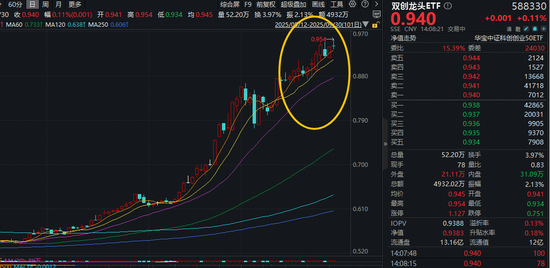
宁德时代创历史新高,总市值超越茅台!硬科技宽基——双创龙头ETF(588330)拉升1.3%,2日连续吸金近4000万元
Xin Lang Ji Jin· 2025-09-30 06:33
Group 1 - The core viewpoint of the articles highlights the significant rise of Ningde Times' market capitalization, surpassing that of Kweichow Moutai, indicating a shift towards a "technology bull market" in the A-share market [1] - Analysts suggest that the current A-share market is showing signs of a "structural bull market" in technology, with potential for a transition to a "full bull market" due to strong trends in the technology sector and a reallocation of market funds [1][3] - The rise of Ningde Times reflects the broader transformation of China's industrial economy, with technology innovation and high-end manufacturing being key areas encouraged by policy [1][3] Group 2 - The Double Innovation Leader ETF (588330) has shown strong performance, with a price increase of over 1.3% on September 30, 2023, and has attracted significant capital inflow of 39.14 million yuan over two days [1][4] - The ETF focuses on high-growth technology leaders from the STAR Market and ChiNext, covering sectors such as new energy, semiconductors, and medical devices, which are considered strategic emerging industries [4] - The ETF is positioned as a low-threshold investment tool, allowing investors to participate in the technology sector with a minimum investment of less than 100 yuan, making it accessible for a broader range of investors [4]