
产业转型

Search documents
福建泉州:爱拼敢赢的“最强大脑”
Xin Lang Cai Jing· 2025-12-24 20:50
Core Insights - The article highlights the successful integration of high-level talent, particularly postdoctoral researchers, into the manufacturing sector in Quanzhou, driving innovation and product development [1][2][3] Group 1: Innovation and Research - Quanzhou's industries are leveraging postdoctoral talent to enhance product efficiency and reduce costs, exemplified by a food company that doubled preservation efficiency while cutting costs by 20% [1] - The establishment of a postdoctoral research station in Jinjiang in 1999 marked the beginning of a collaborative model that connects academic resources with industry needs [2] - The "dual mentor system" implemented in companies like Anta pairs academic mentors with industry veterans to ensure research relevance and market applicability [2] Group 2: Economic Impact - Quanzhou has established 30 national-level and 27 provincial-level postdoctoral research stations, training 320 postdoctoral researchers and generating over 1 billion yuan in economic benefits through patent conversions [2] - The local government provides substantial financial support for new research stations, including 1 million yuan in setup subsidies and additional funding for postdoctoral researchers [3] Group 3: Talent Attraction and Support - The city offers comprehensive support for postdoctoral researchers, including housing subsidies, monthly allowances, and assistance with family integration [3] - The third National Postdoctoral Innovation and Entrepreneurship Competition held in Quanzhou attracted over 1,700 project teams and facilitated 150 project signings, showcasing the city's commitment to fostering innovation [4][5]
四川美丰:公司聚焦成本管控等提质增效重点工作,以增强价值创造能力为核心,努力推动提升企业竞争力
Zheng Quan Ri Bao Zhi Sheng· 2025-12-24 13:11
Core Viewpoint - Sichuan Meifeng is actively responding to market volatility by focusing on cost control, market expansion, capacity release, management optimization, technological upgrades, and industrial transformation to enhance its value creation capability and improve competitiveness [1] Group 1 - The company emphasizes cost control as a key strategy to navigate market challenges [1] - Market expansion is identified as a critical area for growth and resilience [1] - The company is committed to releasing production capacity to meet market demands [1] Group 2 - Management optimization is a focus area to improve operational efficiency [1] - Technological upgrades are being pursued to enhance product offerings and competitiveness [1] - Industrial transformation is part of the company's strategy to adapt to changing market conditions [1]

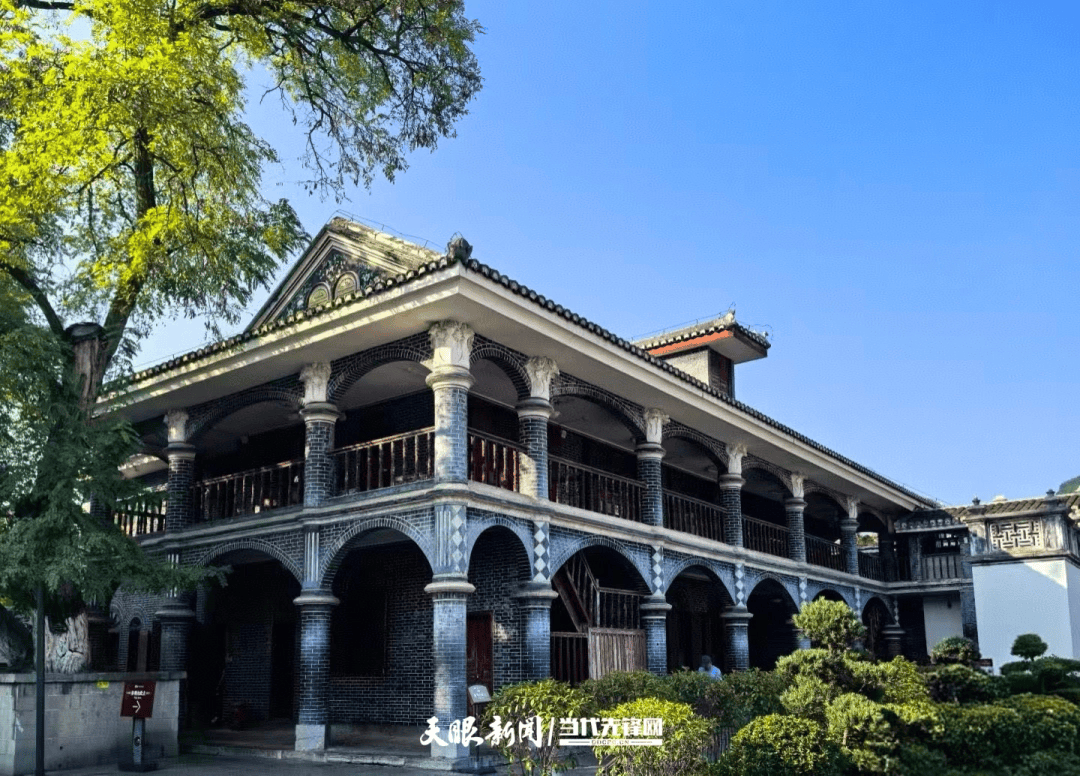
湖北黄石智造引领产业转型 “十四五”以来规上工业总产值年均增长14.4%
Jing Ji Ri Bao· 2025-12-24 07:29
Core Insights - Huangshi City in Hubei Province is focusing on industrial strength and modernizing its industrial system, achieving an average annual growth of 14.4% in industrial output value since the start of the 14th Five-Year Plan [1] Group 1: Traditional and Emerging Industries - The city has transformed traditional industries like steel and copper smelting from "scale expansion" to "quality and efficiency improvement" with nearly 100 billion yuan invested in industrial upgrades [1] - The first fully automated copper smelting factory in China, built by Hongsheng Copper Industry, has improved labor efficiency by 60% compared to industry averages [1] - Huangshi is promoting emerging industries such as new materials and optoelectronic information, shifting from "single-point breakthroughs" to "cluster rises" [1] Group 2: Future Industry Development - Huangshi aims to achieve a future industry output value of 10 billion yuan by 2029, creating new growth opportunities for high-quality urban development [2] - The city is implementing advanced projects like the first "low-altitude + bonded area" smart inspection demonstration project in Central China, enhancing the smart transformation of the comprehensive bonded area [2] - East Bay Group's robotic joint motors are in testing, utilizing industrial internet for remote operation and maintenance [2]
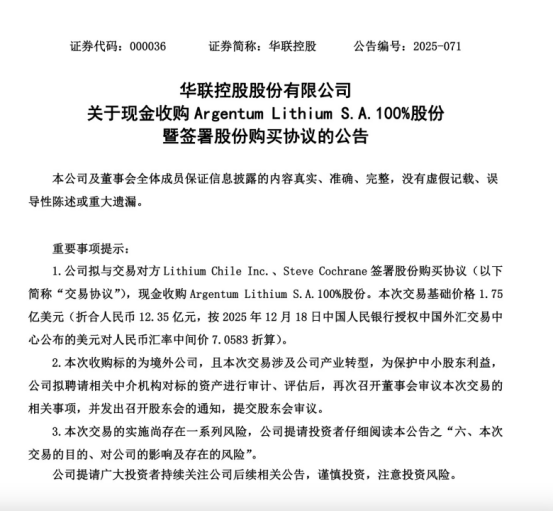
华联控股12.35亿收购阿根廷锂盐湖,天华新能源、赣锋锂业加速全球锂矿布局
Sou Hu Cai Jing· 2025-12-24 05:20
Group 1 - The core point of the article is that Hualian Holdings Co., Ltd. plans to acquire lithium salt lake mining assets in Argentina for $175 million (approximately 1.235 billion RMB) [1][3] - The acquisition involves obtaining 80% equity in Argentum Lithium S.A., which is held by Lithium Chile Inc. and Steve William Cochrane, covering a project area of approximately 1,970 square kilometers in the Arizaro salt lake region of Salta Province, Argentina [1][3] - The transaction includes six mining rights covering an area of about 205 square kilometers, and the project has completed a pre-feasibility study [1][3] Group 2 - Hualian Holdings stated that this transaction is part of its strategy to advance industrial transformation and seek new business growth points [3] - After the acquisition, the company will maintain its existing real estate development and property management business while adding overseas lithium salt lake mining assets and plans to enter the lithium extraction production business [3] - The company has already made investments in the lithium extraction industry chain, holding relevant patented technologies and adsorbent products [3]



经济工作大家谈|遵义市市长黄伟:细化举措 狠抓落实 推动高质量发展
Sou Hu Cai Jing· 2025-12-23 22:26
Group 1 - The core viewpoint of the meeting is to summarize the economic work of Guizhou province for 2025 and analyze the current economic situation to provide direction for next year's economic work [1] - The city of Zunyi aims to expand domestic demand as a key focus, combining benefits for people's livelihoods with consumption and investment in both goods and human resources [3] - Zunyi will implement the "5+3" mechanism to enhance investment attraction, aiming for a steady increase in total investment and continuous optimization of its structure [3] Group 2 - The transformation of industries is crucial to overcoming current development bottlenecks, with the liquor industry being a significant support for Zunyi's economy [4] - Zunyi plans to focus on building a "4+2+N" modern industrial system and will implement a three-year action plan for industrial structure adjustment, while stabilizing and developing the liquor industry [4] - The city will accelerate the development of non-liquor industries such as non-ferrous metals, equipment manufacturing, new comprehensive energy, fluorine-barium chemicals, and green food [4] Group 3 - Zunyi will continue to optimize the business environment and focus on cultivating and expanding business entities as a key driver for economic development [6] - The city will promote the market-oriented transformation of state-owned enterprises and support the high-quality development of private enterprises [6] - There will be an emphasis on enhancing the role of enterprises in innovation, utilizing national key laboratories and increasing financial investment in technology to promote the deep integration of technological and industrial innovation [6]
“十四五”以来规上工业总产值年均增长14.4% 湖北黄石智造引领产业转型
Jing Ji Ri Bao· 2025-12-23 22:09
Group 1 - The core viewpoint is that Huangshi City in Hubei Province is accelerating the construction of a modern industrial system, focusing on industrial strength and achieving an average annual growth of 14.4% in industrial output value since the 14th Five-Year Plan [1] - The city has invested nearly 100 billion yuan in industrial technological transformation to shift traditional industries like steel and copper smelting from "scale expansion" to "quality and efficiency improvement" [1] - Huangshi is focusing on strategic emerging industries such as new materials and optoelectronic information, promoting a transition from "single-point breakthroughs" to "cluster rise" [1] Group 2 - The city has established the world's first automated production line for fiber laser devices, breaking foreign monopolies in high-end wafer regeneration technology [1] - By 2029, Huangshi aims for the future industry output value to reach 10 billion yuan, creating new growth space for high-quality urban development [2] - The East Bay Group's robotic joint motors are in the testing phase, utilizing industrial internet for remote operation and maintenance [2]
山西医药第一股转身,20年老厂区将变身为汽车产业园
Xin Lang Cai Jing· 2025-12-23 12:14
Core Viewpoint - The transfer of 62% equity of Taiyuan Pharmaceutical from Yabao Pharmaceutical to Shanxi Tongxiang Times Technology marks a significant shift in ownership, with the new focus on developing a technology innovation park for automotive sales and smart manufacturing instead of pharmaceutical production [1][3][9]. Group 1: Transaction Details - Yabao Pharmaceutical announced the sale of 62% of its subsidiary Taiyuan Pharmaceutical for 87.1887 million yuan, reducing its stake from 67% to 5% [1][10]. - The transaction was initiated on November 17, 2023, and completed with the registration of changes on December 19, 2023 [1][10]. - Shanxi Tongxiang has previously invested 19.8 million yuan for a 33% stake in Taiyuan Pharmaceutical, bringing its total investment to 107 million yuan for a 95% controlling interest [2][10]. Group 2: Financial Performance of Taiyuan Pharmaceutical - Taiyuan Pharmaceutical reported revenues of 906.71 million yuan in 2024, with a net loss of 1,537.85 million yuan; in the first eight months of 2025, revenues further declined to 39.04 million yuan with a net loss of 614.73 million yuan [3][11]. - The company ceased production entirely in August 2024, highlighting a stark contrast between its designed capacity and actual output [3][11]. - Yabao Pharmaceutical's overall revenue for the first three quarters of 2025 was 1.709 billion yuan, a year-on-year decrease of 19.46%, with a net profit of 215 million yuan, down 8.44% [3][11]. Group 3: New Ownership and Future Plans - Shanxi Tongxiang, established in January 2024, is primarily engaged in scientific research and technology services, with no revenue reported for 2024 and the first eight months of 2025 [4][12]. - The acquisition aims to collaborate with Shanxi Yijia Automotive Sales Service Co., a major player in the second-hand car market, to develop a technology innovation park [4][13]. - The new project, named "Intelligent Manufacturing New City," will focus on smart manufacturing, electronic information, biopharmaceuticals, new materials, and digital economy sectors, with an investment of several billion yuan [5][14]. Group 4: Strategic Adjustments by Yabao Pharmaceutical - Concurrently with the sale, Yabao Pharmaceutical completed a share buyback of 8 million shares, reducing its total shares from 700 million to 692 million, aimed at enhancing per-share earnings and shareholder value [6][15]. - The company faced setbacks in innovative drug development, notably terminating the clinical research of its diabetes drug SY-009, which had incurred a capitalized investment of 55.7933 million yuan [6][16]. - Revenue from key pediatric products, such as the Dinggui Er Qi贴, has significantly declined, with a 16.04% drop in pharmaceutical production revenue in 2024 [6][16]. Group 5: Industry Transformation Insights - This transaction reflects a broader trend in Shanxi's traditional industries, focusing on revitalizing existing assets and exploring cross-industry integration [7][17]. - The shift from a pharmaceutical production base to an automotive-focused technology park illustrates the strategic adjustments of traditional pharmaceutical companies in response to market pressures [7][17]. - The collaboration between Shanxi Tongxiang and Yijia Automotive signifies a move towards integrating traditional service industries with industrial real estate, marking a notable transformation in the region's economic landscape [7][17].

超12亿!房地产上市公司收购锂矿企业!
Xin Lang Cai Jing· 2025-12-23 12:08
Core Viewpoint - Hualian Holdings plans to acquire 100% of Argentum from Chile Lithium and Steve William Cochrane for approximately $175 million (RMB 1.235 billion), gaining an 80% stake in the Arizaro project, marking its entry into the lithium resource development sector [1][7]. Group 1: Transaction Details - The acquisition will allow Hualian Holdings to indirectly hold 80% of the Arizaro salt lake project located in Salta Province, Argentina, which is the largest undeveloped salt lake in South America's "lithium triangle" [3][9]. - The Arizaro project includes six mining rights covering an area of approximately 205 square kilometers within the salt lake region, which spans about 1,970 square kilometers [3][9]. Group 2: Strategic Intent - The company acknowledges the significant changes in the domestic real estate market, facing growth bottlenecks, and aims for sustainable development through a strategy of "stabilizing real estate and promoting transformation" [3][9]. - This acquisition is seen as a crucial step in implementing the company's strategy and facilitating its industrial transformation [3][9]. Group 3: Financial Position - Hualian Holdings asserts that its cash flow exceeds total liabilities, indicating a robust financial position, and believes that the cash expenditure of RMB 1.235 billion will not impact its normal operations or current performance [4][11]. Group 4: Previous Involvement in Lithium Sector - Hualian Holdings has previously entered the lithium sector through investments in Shenzhen Juneng and Zhuhai Juneng, focusing on lithium extraction and related technologies [4][10]. - The existing operations in lithium extraction and production of adsorbents are expected to create synergies with the new acquisition [4][10]. Group 5: Market Context and Challenges - The lithium mining sector is characterized by intense competition, price volatility, and long construction cycles, making return assessments challenging [6][12]. - As a new entrant, Hualian Holdings will face pressures related to technology, costs, and market share, especially given the existing profitability pressures on leading lithium companies [6][12].
年轻人正在离开杭州吗?“杭漂”之变:谁走了,谁又来了
Sou Hu Cai Jing· 2025-12-23 05:32
Core Viewpoint - The discussion surrounding Hangzhou reflects a dichotomy between perceptions of population decline and the city's ongoing attractiveness, highlighting the need for cities to ensure that macroeconomic growth translates into tangible benefits for individuals [1][3][11] Population and Demographics - Hangzhou's resident population reached 12.624 million in 2024, an increase of 102,000 from the previous year, marking a decade of consistent population growth of over 100,000 annually, making it the leading city in the Yangtze River Delta for population increase [3] - During the 2025 Spring Festival travel season, the inter-regional movement of people in Hangzhou reached 142 million, a year-on-year increase of 7.2%, setting a historical record [3] - The influx of young, highly educated individuals is notable, with over 364,000, 390,000, and more than 400,000 university graduates under 35 being introduced annually over the past three years [3] Talent Attraction and Quality of Life - Hangzhou has risen to fourth place in the national ranking for attracting talent born after 1995, surpassing Guangzhou, according to a report by Zhilian Recruitment and Zeping Macro [5] - The city has been recognized as the "most livable city in China" for 19 consecutive years, the only city to receive this honor, indicating a strong reputation for quality of life [5] Structural Changes and Economic Transition - The narrative of population decline is largely driven by the challenges faced in the once-thriving live-streaming e-commerce sector, which has seen a rational adjustment and income fluctuations, leading to anxiety about job opportunities [3][8] - Hangzhou is undergoing a structural transformation in its economy, with the emergence of the "Six Little Dragons" and the establishment of the "296X" advanced manufacturing cluster, focusing on AI and robotics, among other sectors [8][9] Urban Development and Spatial Dynamics - The city is shifting from a single-center model around West Lake to a multi-center, networked urban structure, with new centers like Qianjiang New City and Future Technology City emerging, which has led to increased visitor numbers in surrounding areas [9][11] - This spatial transformation is seen as a positive development for urban capacity, although it has contributed to perceptions of population decline [11] Governance and Community Engagement - Hangzhou's approach to governance emphasizes understanding and addressing the specific needs of various community groups, as demonstrated by initiatives like the "Rider Code" to facilitate delivery for couriers and the installation of elevators in older residential buildings for the elderly [12][14] - The city's ability to translate the concept of being a "people's city" into actionable policies that enhance daily life is crucial for maintaining its status as a livable city [14][15] Conclusion - The ongoing discussions about youth retention and urban challenges should be viewed as an opportunity for cities to recalibrate their focus on enhancing individual experiences and addressing community needs, ultimately fostering a deeper connection between urban development and citizen satisfaction [15][16]

切入盐湖提锂业务,这家公司涨停!
Zheng Quan Ri Bao Zhi Sheng· 2025-12-23 04:24
Group 1 - The core point of the news is that Hualian Holdings plans to acquire 100% of Argentum Lithium S.A. from Lithium Chile Inc. and Steve William Cochrane for approximately $175 million, equivalent to 1.235 billion RMB, to gain an 80% stake in the Arizaro project [1][2] - The Arizaro project is located in the Salta province of Argentina and is the largest undeveloped salt lake in South America's "Lithium Triangle," covering a total area of approximately 1,970 square kilometers [1] - The project includes six mining rights over an area of about 205 square kilometers and has completed a pre-feasibility study, with plans to submit an environmental impact assessment report for the mining phase after completing a feasibility study [1] Group 2 - Following the transaction, Hualian Holdings will maintain its existing real estate development and property management business while adding overseas lithium salt lake mining assets and plans to enter the lithium extraction production business [2] - The purpose of this transaction is to address the significant changes in the domestic real estate market, which has led to growth bottlenecks for the company's real estate business, and to enhance market competitiveness and profitability [2] - The move to enter the lithium resource sector is seen as a proactive measure to respond to market changes, promote industrial transformation, and seek new growth points, benefiting from the rapid development of electric vehicles and energy storage [2]