
产业转移

Search documents
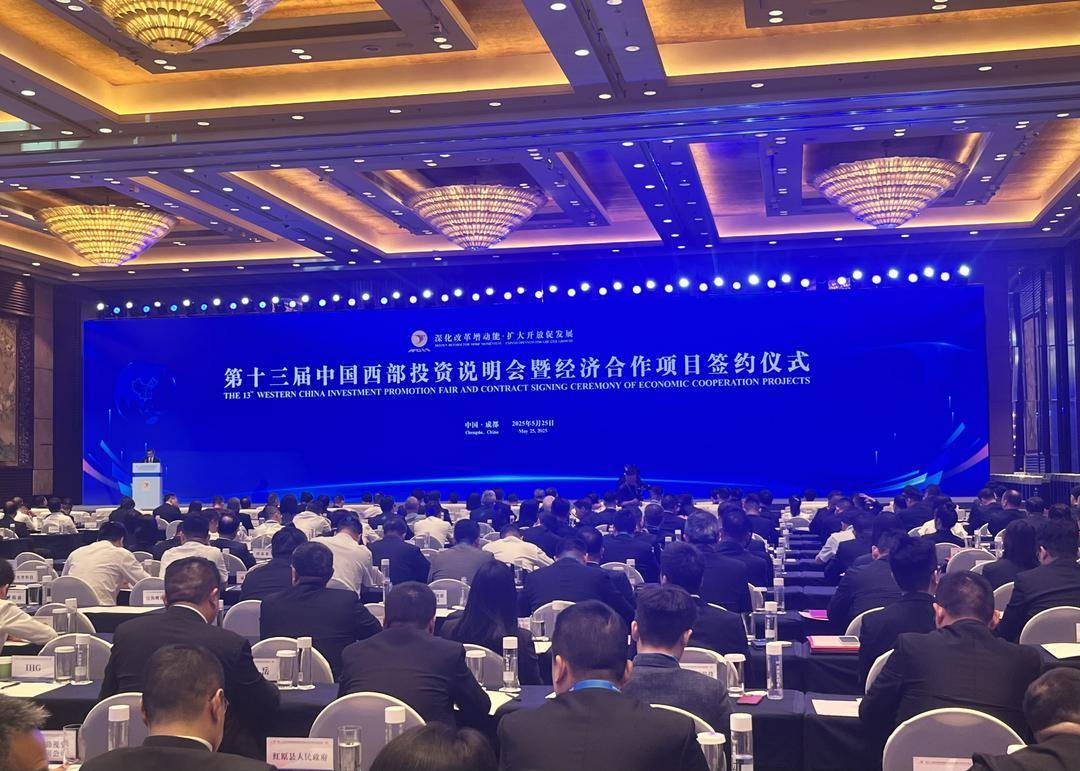
签约项目416个 投资金额3543亿元!第十三届中国西部投资说明会在蓉举行
Sou Hu Cai Jing· 2025-05-25 12:06
Core Viewpoint - The 13th China Western Investment Conference aims to enhance cooperation and investment in the western region of China, showcasing its development potential and market vitality [1][3]. Group 1: Event Overview - The conference was held on May 25 in Chengdu, focusing on the theme "Deepening Reform to Increase Momentum and Expanding Opening Up to Promote Development" [1]. - It was co-hosted by the governments of twelve western provinces and the Xinjiang Production and Construction Corps, with the Governor of Qinghai Province presiding over the meeting [1]. Group 2: Participation and Engagement - The event attracted over 180 enterprises and institutions, with more than 80% being state-owned enterprises, "three categories of 500 strong" companies, and well-known multinational corporations [3]. - Notably, 56% of the participating enterprises were represented by their top executives, indicating a strong interest from high-level decision-makers [3]. Group 3: Investment Projects and Financials - A total of 416 investment cooperation projects were signed during the conference, amounting to an investment of 354.3 billion yuan, with 35 representative projects signed on-site [4]. - Sichuan Province alone signed 352 projects with an investment of 316.9 billion yuan, highlighting a focus on high-tech manufacturing and emerging industries [4]. - Key sectors included 76 high-tech manufacturing projects with nearly 100 billion yuan in investment, and 38 projects in emerging industries like artificial intelligence and commercial aerospace, totaling over 30 billion yuan [4]. - The overall investment cooperation projects launched during the event exceeded 3.7 trillion yuan, with Sichuan Province presenting over 100 projects worth more than 550 billion yuan [4].

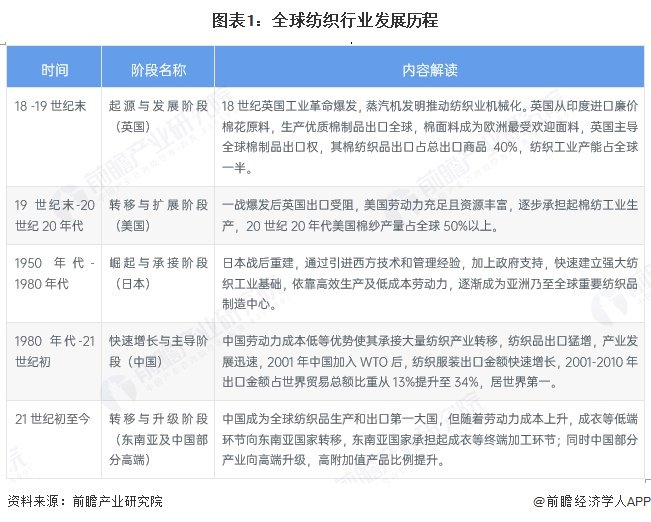
2025年全球纺织发展现状分析:2024年全球纺织行业产值达1.07万亿美元
Qian Zhan Wang· 2025-05-25 05:06
Core Insights - The global textile industry is experiencing a shift towards Southeast Asia, while parts of China's textile sector are upgrading to high-end production [1][4][5] Group 1: Historical Development - The textile industry originated during the 18th century with the British Industrial Revolution, where steam engines significantly increased production efficiency [2] - By the late 19th century, the U.S. began to take over cotton textile production due to labor and resource advantages, with U.S. cotton yarn production exceeding 50% of global output by the 1920s [2] - Japan established a strong textile industry post-World War II through Western technology and government support, becoming a key manufacturing center [2] - China emerged as the world's largest textile producer and exporter in the early 21st century, with textile and apparel exports rising from 13% to 34% of global trade from 2001 to 2010 [2] - Currently, as labor costs rise in China, low-end production is shifting to Southeast Asian countries, while China focuses on high-value products [2][4] Group 2: Market Size and Growth - The global textile industry market value is projected to reach $1.07 trillion in 2024, reflecting a year-on-year growth of approximately 2% [4][5] - The number of companies in the global textile market is estimated at 2.731 million, indicating a significant market presence [5] Group 3: Fiber Production - Global fiber production reached a record high of 124 million tons in 2023, up from 116 million tons in 2022, with polyester fibers accounting for 57% of total fiber production [7] Group 4: Market Structure - The global textile industry exhibits a low concentration level, characterized by a long-tail feature and fragmented competition, with over 3 million registered companies [10] - In the home textile sector, the top three companies hold only 2.31% market share, indicating a highly competitive environment [10] Group 5: Regional Contribution - East Asia dominates the global textile industry, accounting for $717.7 billion, or 66.89% of the total market value [12]


纺织服装行业:2024及2025Q1业绩承压,未来愈加明朗
Dongxing Securities· 2025-05-19 03:31
纺织服装行业:2024 及 2025Q1 业绩承压, 未来愈加明朗 2025 年 5 月 19 日 看好/维持 纺织服装 行业报告 | 分析师 | 刘田田 电话:010-66554038 邮箱:liutt@dxzq.net.cn | 执业证书编号:S1480521010001 | | --- | --- | --- | | 分析师 | 沈逸伦 电话:010-66554044 邮箱:shenyl@dxzq.net.cn | 执业证书编号:S1480523060001 | 投资摘要: 2024 年纺织逐季走弱,服装整体承压。纺织制造板块 2024 年收入 1181 亿元,同比+8.37%,归母净利润 92.91 亿元,同比 +8.6%,其中 Q4 单季度板块收入 285 亿元,同比+2.29%;归母净利润 17.17 亿元,同比-10.80%,24 年是逐季度走弱的情 况,主要系外需走弱。服装家纺板块 2024 年收入约 1528 亿元,同比-2.2%,利润 101.3 亿元,同比-29.95%。其中 Q4 单 季度板块收入 466.9 亿元,同比-2.9%,归母净利润 5.6 亿元,同比-80%。整体上 202 ...


海丰国际20250515
2025-05-15 15:05
Summary of Haifeng International Conference Call Company Overview - Haifeng International has established a cost advantage through counter-cyclical capacity expansion and is benefiting from the upward market cycle. The company maintains a self-owned ship ratio of 85%-90% to enhance its anti-cyclical capability [2][12][3]. Industry Dynamics - The U.S.-China trade friction is accelerating the transfer of industries to Southeast Asia, breaking the original logistics cluster effect and increasing international trade transportation demand. The Twin Star Alliance has adjusted its routing model from a pendulum to a hub-and-spoke system, which increases the demand for small vessel transportation, benefiting Haifeng International [2][4]. - The small container ship market has a better supply structure compared to other shipping markets, with 70% of the capacity in Asia being small vessels under 3,000 TEU, and only 3.6% of orders being for new builds. The aging issue is prominent, limiting future supply growth [2][6]. Financial Projections - Haifeng International's projected net profit for 2025-2027 is $1.048 billion, $860 million, and $790 million, with year-on-year growth rates of 1.3%, -18%, and -8% respectively. If performance expectations recover, valuations could rise from 5-7 times to 10-15 times, with a potential market cap increase of 40%-110% [2][7]. Market Misconceptions - The market underestimates the positive impact of China's industrial transfer on feeder shipping volumes and the potential benefits of uncertainties in the Red Sea route for the container shipping market. Factors such as tariff changes, better-than-expected performance from peers, off-peak season resilience, port congestion, and ongoing Red Sea crises could catalyze stock price increases [2][10][8]. Competitive Advantages - Haifeng International focuses on the Asian market, with 82% of its capacity deployed in this region, making it the largest regional shipping company globally. The company has created a cost advantage superior to its peers through deep market engagement and counter-cyclical shipbuilding [3][4][17]. Demand Highlights - The demand side has two main highlights: the frequent U.S.-China tariff frictions leading to the transfer of Chinese manufacturing to Southeast Asia, and the shift in shipping routes by the Twin Star Alliance, which enhances the demand for small vessel transportation [4][5]. Supply Side Analysis - The supply side for small container ships is favorable, with a strong flexibility advantage. The aging problem is severe, with 24% of small feeder ships being over 20 years old, and 11% over 25 years old. The supply growth for small feeder ships is projected to be limited in the coming years [6][26][28]. Revenue and Cost Structure - The company primarily engages in container shipping, with over 90% of its revenue derived from this segment. Key cost components include transportation costs (22% for voyage costs and 13% for vessel operating costs) [29][30]. Future Growth and Valuation - Effective capacity growth is expected to be 6%, 0.6%, and 4.1% from 2025 to 2027. The company anticipates container trade growth in Asia of 3.2% and 3% for the same period, which will positively impact freight volumes [31][32]. - Historical PE valuation has fluctuated between 10-20 times, with a potential recovery to 10-15 times based on recent performance, suggesting a market cap increase of 20%-60% [35]. Conclusion - Haifeng International is well-positioned to capitalize on the shifting dynamics in the shipping industry, particularly in the Southeast Asian market, with strong financial projections and a favorable supply-demand balance in the small container ship segment. The company’s strategic focus on self-owned vessels and regional specialization enhances its competitive edge in a challenging market environment [2][4][17].

据印度政府消息人士:苹果(AAPL.O)向印度政府保证,将把印度作为其产品的主要制造基地。苹果在印度的投资计划没有改变。此前特朗普称希望苹果停止将iPhone产业转移到印度。
news flash· 2025-05-15 11:02
据印度政府消息人士:苹果(AAPL.O)向印度政府保证,将把印度作为其产品的主要制造基地。苹果在 印度的投资计划没有改变。此前特朗普称希望苹果停止将iPhone产业转移到印度。 (CNBC) ...
航运行业重大事项点评:产业转移、贸易碎片化或催生亚洲集运机遇,解析海丰、德翔、锦江差异化布局图谱
Huachuang Securities· 2025-05-14 10:15
Investment Rating - The report maintains a recommendation for the shipping industry, particularly focusing on the opportunities in the Asian container shipping market [2]. Core Insights - The Asian shipping market is experiencing a balanced supply and demand, with a projected CAGR of 6.85% for container transport volume from 2001 to 2024, driven by regional economic growth and trade agreements like RCEP [2][14]. - The report highlights the differentiated strategies of major players such as SeaLand, Yang Ming, and Jin Jiang, emphasizing their operational strengths and market positioning [2][3]. Summary by Sections Supply and Demand in the Asian Market - Demand: The Asian route is the second-largest segment in global container shipping, with a projected volume of 65.29 million TEU in 2024, accounting for 30.7% of global container trade [14][16]. - Supply: The growth rate of container ships under 3000 TEU is expected to be lower than the global average, with a forecasted capacity growth of 0.59% in 2025 and a decline of 2.97% in 2026 [19][20]. Comparison of Major Shipping Companies - Capacity: SeaLand leads with a total capacity of 180,000 TEU, followed by Yang Ming with 113,000 TEU and Jin Jiang with 53,000 TEU [3][53]. - Growth Rates: From 2020 to 2024, Jin Jiang's total capacity grew by 102%, Yang Ming by 59%, and SeaLand by 39% [54][59]. - Revenue Structure: SeaLand's revenue distribution in 2024 is 48% from Greater China, 29% from Southeast Asia, and 17% from Japan [4][68]. Financial Performance and Efficiency - Profitability: SeaLand's net profit margin fluctuated between 21% and 47% from 2020 to 2024, while Yang Ming's ranged from 2% to 54% [5][6]. - Asset Turnover: SeaLand's total asset turnover ranged from 0.85 to 1.42, indicating efficient asset utilization compared to its peers [5][6]. Investment Recommendations - The report suggests that the Asian shipping market is a high-quality segment within the industry, with companies like SeaLand and Yang Ming expected to benefit from ongoing trade dynamics and regional demand growth [6][52].
影响市场重大事件:广东发布《金融支持促消费扩内需专项行动方案》;五部门加大广州南沙商业航天、全域无人产业的支持力度
Mei Ri Jing Ji Xin Wen· 2025-05-12 23:14
Group 1 - The core viewpoint of the news is the joint issuance of opinions by five departments to enhance financial support for the development of the Nansha area in Guangzhou, focusing on marine industries, commercial aerospace, and unmanned industries [1][2][3] - The initiative aims to establish Nansha as a financial hub for the Guangdong-Hong Kong-Macao Greater Bay Area, promoting high-quality development and international financial cooperation [2][3] - Financial institutions are encouraged to invest in high-tech marine industries and provide financial services for major marine infrastructure projects [1][3] Group 2 - The plan includes exploring institutional openness in the financial sector, aligning with international standards such as the Comprehensive and Progressive Agreement for Trans-Pacific Partnership [3] - The initiative promotes the facilitation of cross-border RMB business and simplifies the process for foreign-invested enterprises to handle RMB capital account transactions [5][8] - There is a focus on establishing a cross-border asset management center and accelerating the establishment of an international commercial bank in the Greater Bay Area [6] Group 3 - The Guangdong provincial government plans to allocate approximately 13.6 billion RMB over three years to support the construction of a modern industrial system [9] - The policy aims to lower financing costs for manufacturing and high-tech enterprises, with a maximum annual interest subsidy loan scale of 200 billion RMB [9] - The government is also optimizing incentive policies to attract foreign investment, including rewards for multinational company headquarters and foreign R&D centers [9] Group 4 - The number of private equity firms managing over 10 billion RMB has increased to 87, indicating a competitive landscape in the private equity sector [10] - The industry is experiencing a reshuffling, with some firms exiting and new entrants emerging, reflecting ongoing changes in the market dynamics [10]
四川承接产业转移 这场“国字号”活动释放了哪些信号
Si Chuan Ri Bao· 2025-05-09 22:33
Core Insights - The 2025 China Industry Transfer Development Matching Event in Sichuan highlights the province's role in attracting high-quality industrial transfers, focusing on strategic emerging industries such as artificial intelligence and new energy [5][6][7]. Group A: New Industry Pathways - The event emphasizes a shift in industry transfer dynamics, with over 60% of signed projects last year being innovative and high-tech, a trend that continues this year [6]. - Notable projects include the production of optical-grade polymer materials and components for new energy vehicles, indicating a strong focus on new technologies [6][7]. - Companies like Beijing Xinghe Power Aerospace Technology Co., Ltd. are expanding their operations in Sichuan, showcasing the province's commitment to supporting emerging industries [6][8]. Group B: Building Ecosystems - The event is designed to facilitate connections among upstream and downstream enterprises within key industrial chains, moving beyond simple capacity relocation [9][10]. - This year, eight specialized matching sessions were held, focusing on sectors like artificial intelligence and new energy, to foster collaboration among hundreds of companies [9][10]. - The theme of the event shifted to "Building a New Ecosystem Together," reflecting Sichuan's strategy to strengthen industrial chains and enhance regional collaboration [10]. Group C: Collaborative Opportunities - The government presented a comprehensive opportunity list for key industrial chains, enhancing communication between enterprises [12]. - Recent initiatives have led to numerous supply-demand matching events, resulting in over 600 signed projects worth more than 1.1 trillion yuan in 2024 [12]. - Local governments are actively improving the business environment, which is crucial for attracting investments and facilitating industrial transfers [12][13].
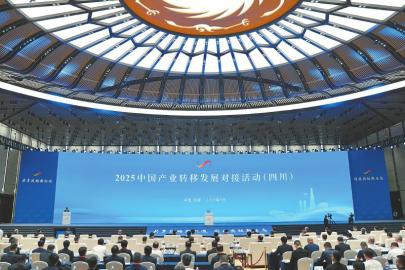
2025中国产业转移发展对接活动(四川)在成都举行
news flash· 2025-05-09 05:22
5月8日—9日,2025中国产业转移发展对接活动(四川)在成都举行。四川省委书记、省人大常委会主任 王晓晖出席开幕式,省委副书记、省长施小琳,工业和信息化部党组成员、副部长单忠德出席开幕式并 致辞。四川省副省长左永祥主持开幕式,副省长李文清作产业推介。单忠德表示,在"精准"和"有序"上 下功夫,发挥市场机制作用,持续完善政策举措,为建设以先进制造业为骨干的现代化产业体系提供坚 实支撑。着力加强政策引导,落实好制造业有序转移指导意见,支持引导中西部和东北地区承接发展特 色优势产业,促进产业有序发展和良性竞争。着力推进深化改革,纵深推进全国统一大市场建设,完善 产业在国内梯度有序转移的协作机制,推动转出地和承接地利益共享。扎实开展规范涉企执法专项行 动,优化营商环境。着力完善生态建设,研究完善促进产业转移政策,建立健全部门密切配合、政企协 同联动、各方广泛参与的工作机制,形成强大合力。着力扩大开放合作,落实全面取消制造业领域外资 准入限制措施,扩大电信等领域开放试点,充分发挥西部陆海新通道等作用,更大力度吸引和利用外 资,支持外资企业参与产业链上下游配套协作。(工信微报) ...
紧抓产业转移机遇的四川路径
Si Chuan Ri Bao· 2025-05-09 00:15
Core Insights - The rapid establishment of the sodium-ion battery production project by Sichuan Xingkong Sodium Battery Co., Ltd. in Dazhou highlights the effectiveness of industrial transfer initiatives in China [1] - The 2024 China Industrial Transfer Development Matching Event in Sichuan aims to attract high-quality industrial projects and core enterprises in strategic emerging industries [5][10] Group 1: Industrial Transfer Initiatives - The 2024 event is part of a series of national industrial transfer activities aimed at optimizing production capacity and facilitating orderly industrial transfer across regions [3][4] - Sichuan's unique advantages, including a complete industrial chain and strong manufacturing capabilities, position it as a key player in attracting industrial transfers [3][4] Group 2: Project Developments - The sodium-ion battery project is expected to begin production by the end of May 2024, following a successful trial run [1] - Sany Silicon Energy has invested in a 2GW high-efficiency crystalline silicon photovoltaic component production base in Sichuan, leveraging the region's comprehensive industrial chain [4][12] Group 3: Government Support and Ecosystem - The local government provides comprehensive support to projects, including free office space, environmental assessments, and connections with leading enterprises [13] - Sichuan's approach emphasizes a collaborative ecosystem between government and enterprises to enhance industrial development [8][10] Group 4: Future Prospects - Companies like Xingkong Sodium Battery plan to expand their application scenarios and increase production capacity to 50GW [14] - The event has attracted over 1,000 participating companies, indicating strong interest in Sichuan as a destination for industrial transfer [15]