
宽基指数

Search documents
国内股市:沪指破3700,期权IV上升策略调整
Sou Hu Cai Jing· 2025-08-18 14:11
Core Insights - The domestic stock market is experiencing a rapid increase, with the Shanghai Composite Index surpassing 3700 points [1] - Growth stocks and mid-cap indices have shown significant gains, particularly the ChiNext Index, which rose by 8.5% during the week [1] - Market trading activity is robust, with transaction volumes nearing 2.8 trillion yuan on Monday [1] Market Environment - External factors include positive developments in US-Russia negotiations and rising US PPI data, which introduces uncertainty regarding the Federal Reserve's interest rate cuts in July [1] - Overall risk appetite is high, but attention is needed on future policy directions [1] Valuation and Policy Impact - Some broad market indices still exhibit low valuations, and stimulus policies are showing effectiveness [1] - The approaching Federal Reserve interest rate cuts and a strong RMB exchange rate contribute to an improved internal and external environment [1] Market Sentiment and Volatility - The market is currently driven by sentiment, and after a rapid increase, volatility may be amplified [1] - In the options market, implied volatility (IV) has risen significantly due to the stock market's acceleration, particularly for the ChiNext Index [1] Strategy Outlook - With the index rising quickly, options IV has notably increased; strategies include selling shallow out-of-the-money call options to reduce risk while holding ETFs [1] - For low-volatility assets, buying near-term shallow out-of-the-money put options for hedging is recommended if there are substantial long positions or existing call options [1] - The long-term outlook remains optimistic, suggesting holding long-dated call options on the CSI 300 or ChiNext Index, or selling near-term put options on the SSE 50 ETF to lower costs [1] - The narrowing of the discount on the CSI 1000 long-dated index futures still leaves room for strategies involving selling at-the-money or out-of-the-money call options [1]
上证重回3700点,现在和2021年有何不一样?
雪球· 2025-08-18 08:04
Core Viewpoint - The article discusses the fluctuations of the Shanghai Composite Index around the 3700-point mark, highlighting its psychological significance and the differences in market conditions compared to previous years. It emphasizes that despite the index's stagnation, the total return index has shown significant growth, indicating underlying investment opportunities [3][4][5]. Group 1: Index Performance - The Shanghai Composite Index briefly surpassed 3700 points but closed at 3666.44 points, indicating a struggle to maintain this level [3][4]. - The index has shown a slight increase of 0.31% from 3655.09 points to 3666.44 points, but the total return index has increased by 13.73% from 3666.87 points to 4170.49 points, reflecting better investment performance [7][8]. - The largest ETFs tracking the Shanghai Composite Index have surpassed their values from February 2021, indicating strong performance despite the index's struggles [10]. Group 2: Changes in Index Composition - The composition of the Shanghai Composite Index has changed significantly over the past four and a half years, with 72 stocks exiting and 763 new stocks entering, resulting in a total of 2232 constituent stocks [12][15]. - The weight of the electronics sector has increased from 4.45% to 9.47%, while the food and beverage sector has seen a significant decrease from 12.41% to 5.49% [18][19]. Group 3: Sector Contributions - The banking sector has contributed significantly to the index's performance, with a weight increase from 16.04% to 18.52%, while the food and beverage sector has been a major drag on performance [18][19][31]. - The top-performing sectors include coal (178% increase), oil and petrochemicals (116% increase), and banking (78% increase), while the worst-performing sectors include social services (-73%), beauty and personal care (-50%), and food and beverage (-42%) [30][31]. Group 4: Key Stocks Impacting the Index - Key stocks such as Agricultural Bank, Industrial and Commercial Bank, and China Petroleum have significantly influenced the index's performance, contributing to a rise of 14.64% if excluded from the analysis [32][33]. - Conversely, stocks like Kweichow Moutai and China Duty Free have negatively impacted the index, suggesting a substantial influence of individual stocks on overall performance [32][33].








ETF观察日志
Mai Gao Zheng Quan· 2025-08-18 05:06
- The report tracks various types of ETFs on a daily basis, categorizing them into "broad-based" and "thematic" ETFs based on the indices they track, such as CSI 300, CSI 500, and industry/style indices like non-bank financials and dividends[2] - The RSI (Relative Strength Index) is calculated using the formula: $ RSI = 100 - 100 / (1 + RS) $, where RS is the average gain divided by the average loss over a 12-day period. RSI values above 70 indicate an overbought market, while values below 30 indicate an oversold market[2] - The net subscription amount is calculated using the formula: $ NETBUY(T) = NAV(T) - NAV(T-1) * (1 + R(T)) $, where NETBUY(T) is the net subscription amount, NAV(T-1) is the ETF's net asset value from the previous trading day, and R(T) is the return on the current day[2] Quantitative Models and Construction Methods 1. **Model Name: RSI (Relative Strength Index)** - **Construction Idea**: Measures the speed and change of price movements to identify overbought or oversold conditions - **Construction Process**: - Calculate the average gain and average loss over a 12-day period - Compute the RS (Relative Strength) as the ratio of average gain to average loss - Apply the formula: $ RSI = 100 - 100 / (1 + RS) $ - **Evaluation**: Useful for identifying potential reversal points in the market[2] 2. **Model Name: Net Subscription Amount** - **Construction Idea**: Measures the net inflow or outflow of funds into an ETF - **Construction Process**: - Calculate the net asset value (NAV) of the ETF for the current and previous trading days - Compute the return (R) for the current day - Apply the formula: $ NETBUY(T) = NAV(T) - NAV(T-1) * (1 + R(T)) $ - **Evaluation**: Indicates investor sentiment and fund flow dynamics[2] Model Backtesting Results 1. **RSI Model** - **Indicator Values**: - CSI 300 ETFs: RSI values range from 69.68 to 75.23 - CSI 500 ETFs: RSI values range from 74.47 to 75.37 - CSI 800 ETFs: RSI values range from 73.39 to 77.74 - CSI 1000 ETFs: RSI values range from 77.70 to 78.26 - CSI A50 ETFs: RSI values range from 65.77 to 67.30 - CSI A500 ETFs: RSI values range from 74.12 to 75.83 - STAR 50 ETFs: RSI values range from 75.53 to 77.78 - GEM ETFs: RSI values range from 76.39 to 77.42 - Hang Seng ETFs: RSI values range from 56.98 to 61.45 - Nikkei 225 ETFs: RSI values range from 72.84 to 72.88 - Nasdaq 100 ETFs: RSI values range from 65.70 to 68.11 - Other overseas broad-based indices: RSI values range from 33.64 to 60.46[4][6] 2. **Net Subscription Amount Model** - **Indicator Values**: - CSI 300 ETFs: Net subscription amounts range from -3.97 billion to 7.87 billion - CSI 500 ETFs: Net subscription amounts range from -0.08 billion to 4.57 billion - CSI 800 ETFs: Net subscription amounts range from -0.06 billion to 5.86 billion - CSI 1000 ETFs: Net subscription amounts range from 0.44 billion to 2.21 billion - CSI A50 ETFs: Net subscription amounts range from -0.89 billion to -0.08 billion - CSI A500 ETFs: Net subscription amounts range from -0.13 billion to 0.38 billion - STAR 50 ETFs: Net subscription amounts range from -5.00 billion to 0.02 billion - GEM ETFs: Net subscription amounts range from -0.86 billion to 5.64 billion - Hang Seng ETFs: Net subscription amounts range from -0.82 billion to 0.02 billion - Nikkei 225 ETFs: Net subscription amounts range from -0.21 billion to -0.06 billion - Nasdaq 100 ETFs: Net subscription amounts range from -1.34 billion to -0.47 billion - Other overseas broad-based indices: Net subscription amounts range from -0.28 billion to 0.89 billion[4][6]
300增强ETF(561300)涨超1.3%,多重因素支撑宽基指数配置价值
Mei Ri Jing Ji Xin Wen· 2025-08-18 04:44
Group 1 - The core viewpoint is that the CSI 300 index, as a broad-based index, demonstrates stable performance in dividend strategies, with a high weight in the banking sector and significant representation from coal and transportation industries [1] - High dividend-paying companies exhibit a return on equity (ROE) significantly above the industry average, showcasing strong cash flow protection and creating a positive cycle of stable earnings, continuous dividends, and improved ROE [1] - The CSI 300 Enhanced ETF (561300) tracks the CSI 300 index (000300), which consists of 300 large-cap, liquid securities from the Shanghai and Shenzhen markets, covering approximately 48% of the total market capitalization of A-shares [1] Group 2 - The industry distribution of the CSI 300 index is broad, encompassing cyclical sectors such as finance, materials, and industrials, while also increasing the weight of emerging sectors like information technology and healthcare as the economic structure transforms [1] - Investors without stock accounts can consider the Guotai CSI 300 Enhanced Strategy ETF Initiated Link A (021847) and Guotai CSI 300 Enhanced Strategy ETF Initiated Link C (021848) [1]
又见抄底,241亿!
Xin Hua Wang· 2025-08-12 05:48
Group 1 - The recent popularity of index funds, particularly the launch of the second batch of Sci-Tech 100 ETFs by four major fund companies, highlights the growing interest in ETF products [1][2] - The Sci-Tech 100 ETF tracks the Sci-Tech 100 Index, which selects 100 medium-sized and liquid securities from the Sci-Tech board, complementing the existing Sci-Tech 50 Index and enriching the index system [2] - The first batch of Sci-Tech 100 ETFs launched on September 15 showed active trading and high investor interest [2] Group 2 - A total of 241.13 billion yuan net inflow was recorded in A-share ETFs last week, with significant investments in major broad-based index ETFs such as CSI 500, Sci-Tech 50, and CSI 300 [4] - Notable net inflows included 51.15 billion yuan into the Southern CSI 500 ETF and 30.49 billion yuan into the Huaxia Sci-Tech 50 ETF [4] - The market experienced a rebound on the basis of recovering investor sentiment, despite external economic pressures [5] Group 3 - Several fund companies have reported plans for CSI 2000 index-enhanced funds, indicating a growing trend in the market for enhanced index products [3] - The CSI 2000 ETF fundraising results revealed significant amounts raised by various fund companies, with the highest being 12.13 billion yuan by Huatai-PB [2][3]

沪指创年内新高,A500ETF易方达(159361)、沪深300ETF易方达(510310)等产品助力布局核心资产
Sou Hu Cai Jing· 2025-08-12 05:07
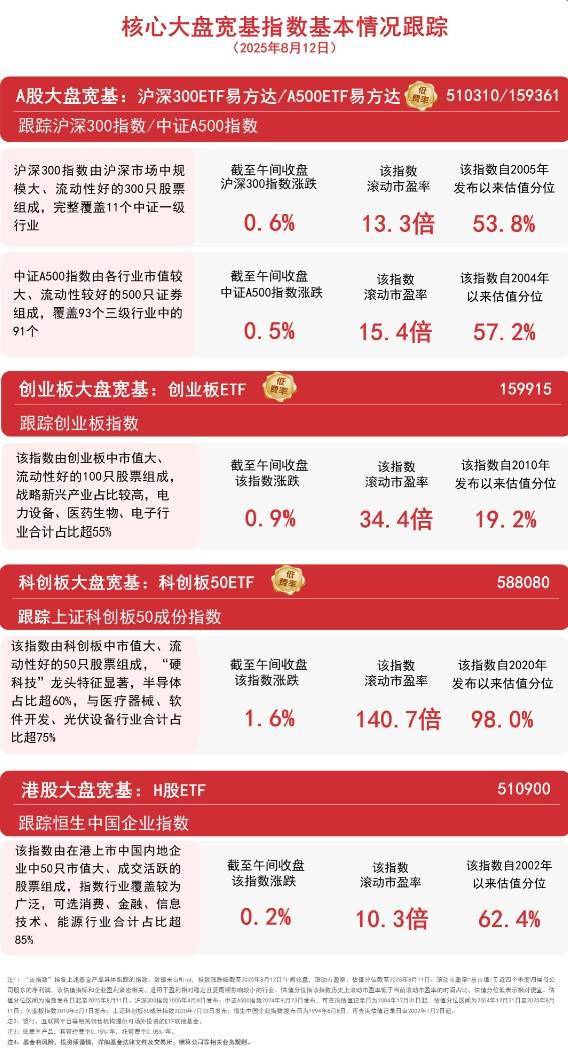
走3. 保费平产品、其前空景节0.169年,非管理中0.06%年。 在4. 基金利同阶,投资深蛋情,对加基金达体交件及文易乐、他综合同等相关业务规则. 每日经济新闻 | A股大盘宽基:沪深300ETF易方达/A500ETF易方达 (8) | | | 510310/159361 | | --- | --- | --- | --- | | 跟踪沪深300指数/中证A500指数 | | | | | 沪深300指数由沪深市场中规 | 截至午间收盘 | 该指数 | 该指数自2005年 | | 模大、流动性好的300只股票 | 沪深300指数涨跌 | 演动市留学 | 发布以来估值分位 | | 组成,完整覆盖11个中证一级 | | | | | 行业 | 0. 6% | 13.3倍 | 53. 8% | | 中证A500指数由各行业市值较 | 截至午间收盘 | 该指数 | 该指数自2004年 | | 大、流动性较好的500只证券 | 中证A500指数涨跌 | 滚动市盘率 | 以来估值分位 | | 组成,覆盖93个三级行业中的 | | | | | 91个 | 0. 5% | 15.4倍 | 57. 2% | | 创业板大盘宽基 ...
螺丝钉指数地图来啦:指数到底如何分类|2025年8月
银行螺丝钉· 2025-08-12 04:01
Core Viewpoint - The article introduces a comprehensive index map that includes various commonly used stock indices, their codes, selection rules, industry distribution, average and median market capitalization of constituent stocks, and the number of constituent stocks, which will be regularly updated for easy reference [1][2]. Group 1: Types of Indices - The index map includes several categories of stock indices: broad-based indices, strategy indices, industry indices, thematic indices, and overseas indices [4][2]. Group 2: Broad-based Indices - Examples of broad-based indices include: - CSI 300 (000300.SH): Comprises 300 large-cap stocks with an average market cap of 1,929.37 billion and a median of 955.29 billion [5]. - CSI 500 (000905.SH): Comprises 500 mid-cap stocks with an average market cap of 295.98 billion and a median of 271.81 billion [5]. - CSI 800 (000906.SH): Comprises 800 stocks with an average market cap of 908.50 billion and a median of 358.74 billion [5]. Group 3: Strategy Indices - Strategy indices focus on specific investment strategies, such as: - CSI Dividend (000922.CSI): Selects 100 stocks with high dividend yields and stable dividends, with an average market cap of 1,963.17 billion [6]. - Shanghai Stock Exchange Dividend (000015.SH): Comprises 50 stocks with high dividend yields from the Shanghai Stock Exchange, with an average market cap of 2,809.85 billion [6]. Group 4: Industry Indices - Industry indices reflect the performance of specific sectors, such as: - Financial Sector Index: Represents the performance of up to 50 banking stocks with an average market cap of 3,507.12 billion [7]. - Real Estate Sector Index: Comprises 50 stocks from the real estate industry with an average market cap of 195.47 billion [7]. Group 5: Thematic Indices - Thematic indices focus on specific investment themes or trends, providing insights into particular market segments [8].

基差方向周度预测-20250808
Guo Tai Jun An Qi Huo· 2025-08-08 12:11
Group 1: Core Views - Recent leveraged funds continue to flow in, with the total margin trading balance exceeding 2 trillion this week. The market sentiment remains optimistic, but the increase in the ratio of margin trading to market capitalization is limited. The 2 trillion mark has stronger signaling meaning than practical meaning and may trigger reverse trading, weakening risk appetite [2]. - Seven departments including the central bank jointly issued the "Guiding Opinions on Financial Support for New - type Industrialization", creating credit demand for banks through monetary structured tools, supporting the manufacturing industry, and stimulating a rapid rebound in the banking sector [2]. - US employment data released last week plunged, increasing market bets on interest rate cuts. The US dollar index has continued to decline to around 98, and foreign capital has replenished A - share positions, supporting the sentiment in the mainland market after the A - share index correction [2]. - This week's total A - share trading volume slightly decreased compared to last week, with daily trading around 1.6 trillion. Most broad - based indices recovered last week's losses, with small - and medium - cap stocks remaining strong. The CSI 1000 rose more than 2%, and together with the CSI 2000 and micro - cap stock indices, reached new highs for the year. Large - cap broad - based indices rose slightly more than 1% this week [2]. - The downward support for basis has weakened, and the intraday structured divergence in trends among varieties has increased. The risk appetite shown in the futures market has declined, and there is a need to guard against the risk of a slowdown in the index's upward rate or even a continuous adjustment [2]. - As of Friday, the annualized basis of each variety was basically the same as last week, with the annualized discounts of IC and IM still around 10% and 11% respectively [2]. Group 2: Weekly Forecast - The model's judgment on the movement direction of the basis of IH, IF, IC, and IM next week is: strengthening, weakening, strengthening, and weakening respectively [4].
每日钉一下(中证A500所属的A系列指数,是啥意思呢?)
银行螺丝钉· 2025-08-03 13:44
Group 1 - The article discusses the importance of diversifying investments across different asset classes, including both RMB and foreign currency assets, as well as stocks and bonds [2] - It highlights the significance of USD bond funds as a crucial component of investment diversification [2] - A free course is offered to provide systematic knowledge on investing in USD bond funds, along with supplementary materials like course notes and mind maps for efficient learning [2] Group 2 - The article explains the concept of the CSI A500 index, which belongs to the A series of indices, and its classification into several major types [5] - It points out the drawbacks of market capitalization-weighted indices, such as increased index risk due to short-term speculative companies and high concentration in certain industries [5] - The A series indices incorporate two strategies: broad-based indices and strategy indices, along with industry and thematic indices to enhance long-term returns [6]

一周市场数据复盘20250801
HUAXI Securities· 2025-08-02 11:21
- The report does not contain any quantitative models or factors for analysis[1][2][3]