
投资于人

Search documents
我国教育经费总投入逼近7万亿元
21世纪经济报道· 2026-01-09 13:59
Group 1 - The core viewpoint of the article emphasizes the continuous growth of national education funding, highlighting that investment in education is crucial for human development and national competitiveness [1][3][6] - In 2024, the total national education funding reached 68,899.24 billion yuan, a 6.66% increase from the previous year, with government funding accounting for 54,161.05 billion yuan, up 7.38% [1][3] - The proportion of national fiscal education funding to GDP in 2024 is 4.02%, maintaining above 4% for 13 consecutive years, which is significant given the low overall fiscal revenue to GDP ratio in China [1][8][9] Group 2 - The article notes that 78.61% of the total education funding comes from government sources, indicating a strong reliance on public investment for education [6] - The general public budget for education accounted for 14.58% of the total public budget, with its growth rate exceeding that of overall public budget revenue by 0.31 percentage points [6] - The government has implemented free preschool education, benefiting over 12 million children and reducing family expenses by approximately 20 billion yuan for a single semester [6] Group 3 - The article discusses the adjustment in reporting education funding, stating that average per-student spending will no longer be reported by educational stage to better align with changes in school-age populations [12][13] - It highlights the need for resource integration across educational stages due to the declining school-age population, particularly in primary and preschool education [12][13] - The report emphasizes the importance of adapting fiscal education funding mechanisms to support higher education in response to demographic changes, particularly in populous provinces and central-western regions [13][17]


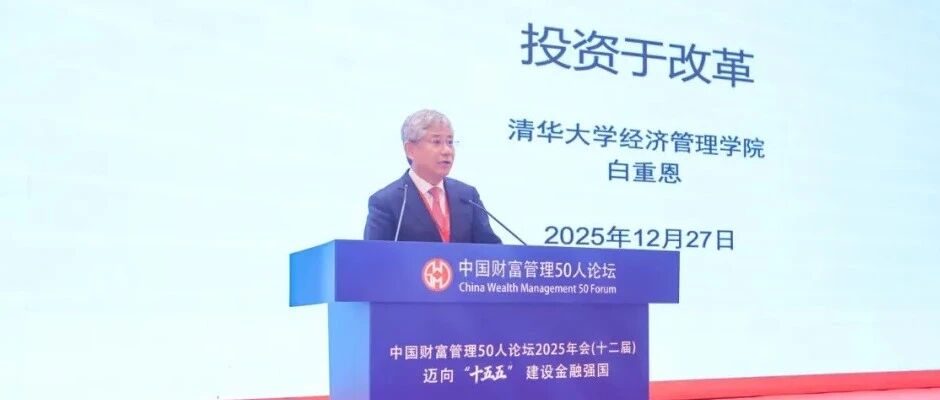
白重恩:为什么要“投资于改革”?
和讯· 2026-01-08 09:36
Core Viewpoint - The article emphasizes the need to shift focus from traditional investments in physical assets and human capital to "investment in reform" to address current economic challenges and achieve long-term sustainable growth [4][5]. Group 1: Limitations of Traditional Investment Directions - Current investment strategies primarily focus on "investment in physical assets" and "investment in human capital," both of which face constraints in the current environment [6]. - "Investment in physical assets" is limited due to high inventory in real estate, diminishing returns in traditional infrastructure, and potential overcapacity in certain manufacturing sectors [6]. - "Investment in human capital" is crucial for sectors like healthcare and education, but it must consider fiscal sustainability, as such expenditures are rigid and difficult to reverse [6]. Group 2: Establishing a Strategic Direction for "Investment in Reform" - The article suggests establishing a policy direction focused on "investment in reform" to address issues of insufficient demand and weak prices [7]. - Utilizing the current low-cost environment for fiscal deficits and monetary expansion can help cover the transitional costs of reforms, thereby optimizing the fiscal structure and institutional arrangements [7]. Group 3: Historical Experience - Reform of State-Owned Commercial Banks - The reform of state-owned commercial banks in the late 1990s serves as a successful example of "investment in reform," where approximately 1.4 trillion yuan of non-performing assets were removed, accounting for about 17% of GDP at that time [9]. - This reform not only mitigated financial risks but also laid the groundwork for the modernization of the banking system and the establishment of a vertical management system to shield banks from local government interference [9]. Group 4: Pathway Suggestions for Local Fiscal and Financing Platform Reform - The article recommends applying the lessons from bank reforms to local fiscal reforms and financing platform transformations, addressing the structural issues underlying local debt [10]. - Suggestions include central government issuance of bonds to replace local debt, comprehensive reform of fiscal systems, and ensuring that financing platforms operate as true market entities [10]. - Coordination between fiscal and monetary policies is essential, with recommendations for increased bond issuance and liquidity support to stimulate demand and stabilize prices [10]. Conclusion - The article concludes that leveraging the current macroeconomic policy window to enhance fiscal and monetary policies and focus funding on transitional reform costs is an effective strategy for addressing short-term demand issues and achieving long-term goals of financial strength and high-quality development during the "14th Five-Year Plan" period [11].
涨薪潮席卷大厂!专家:战略重心向人才资本倾斜
Ge Long Hui A P P· 2026-01-08 09:05
Group 1 - Major companies are increasing salaries, with JD.com reporting that 92% of its employees received full or exceeded year-end bonuses, with total year-end bonus investment increasing over 70% year-on-year [1] - ByteDance announced a 35% increase in bonus investment for 2025 and a 1.5 times increase in salary adjustment investment [1] - Other industry giants like BYD and CATL are also raising employee salaries, indicating a trend of companies shifting focus towards talent capital amid intense technological competition [1] Group 2 - The macroeconomic context includes the 2025 State Council government work report promoting more funding for human investment and the recent Central Economic Work Conference emphasizing the implementation of urban and rural resident income increase plans [2] - Strong financial performance provides confidence for these companies, with JD.com reporting Q3 2025 revenue of 299.1 billion yuan, a year-on-year increase of 14.9% [2] - BYD's revenue for the first three quarters of 2025 reached 566.27 billion yuan, up 12.75% year-on-year, while CATL achieved total revenue of 104.2 billion yuan in Q3 2025, a 12.9% increase, and a net profit of 18.55 billion yuan, up 41.2% year-on-year [2]



将老年人转化为“城市财富” 专家学者建议构建分层开发人力资源机制和各年龄友好的劳动力市场架构
Jie Fang Ri Bao· 2026-01-08 01:45
Group 1 - The elderly population in Shanghai is projected to reach 5.7762 million by the end of 2024, accounting for 37.6% of the total registered population, highlighting the urgency of addressing aging issues [1] - Experts from various fields gathered to discuss strategies for transforming the challenges of an aging society into opportunities, focusing on activating elderly human resources and improving guardianship systems [1] Group 2 - There is a need to address legal and regulatory gaps in elderly care, with suggestions to expedite legislation on guardianship, social benefits for the elderly, and standards for age-friendly urban development [2] - The recent case of an elderly woman passing away without close relatives has raised awareness about the importance of guardianship systems among the elderly [2] Group 3 - The increasing number of elderly individuals with functional disabilities poses a burden on social and family care, emphasizing the role of exercise medicine in promoting health and extending self-care capabilities among the elderly [3] - Recommendations include promoting exercise as a means to enhance health and create a healthier aging population [3] Group 4 - The concept of "investing in people" should be adopted in elderly services, with policies aimed at guiding the development of a comprehensive elderly service industry [4] - The integration of scattered medical and care resources into a cohesive elderly service network is essential for innovation in service models and product development [4] Group 5 - Developing elderly human resources is crucial for addressing aging challenges and transforming them into opportunities, with a focus on creating a "non-aging city" model in Shanghai [5] - Barriers to elderly employment include a lack of legal protections, skill mismatches, and societal perceptions, necessitating a layered approach to human resource development [5][6] Group 6 - A governance system that balances social value and individual needs is necessary to facilitate the integration of elderly and youth labor resources, aiming to turn the elderly from a "burden" into "wealth" for the city [6]
把惠民利民的好事办实(今日谈)
Xin Lang Cai Jing· 2026-01-08 00:25
Core Viewpoint - The implementation of the childcare subsidy policy starting January 5, 2026, aims to alleviate the financial burden on families and promote a birth-friendly society, benefiting millions of households [1]. Group 1: Policy Implementation - The childcare subsidy policy provides families with a monthly allowance of 300 yuan per child, directly reducing the costs associated with raising children [1]. - This initiative is part of a broader strategy to enhance population quality development and improve the quality of life for citizens, reflecting the importance of "investing in people" [1]. Group 2: Broader Implications - The policy aligns with the "14th Five-Year Plan," which emphasizes the need to improve and guarantee people's livelihoods through various significant measures [1]. - The government aims to ensure that the benefits of modernization reach all citizens by effectively implementing policies in education, healthcare, and elderly care [1]. Group 3: Economic Impact - The initiative is expected to stimulate consumption and investment, contributing to a more vibrant economy and enhancing overall societal well-being [1]. - The connection between improving people's livelihoods and promoting consumption is highlighted as a key strategy for sustainable development [1].
设备投资,能否“持续高增”?
Sou Hu Cai Jing· 2026-01-07 00:16
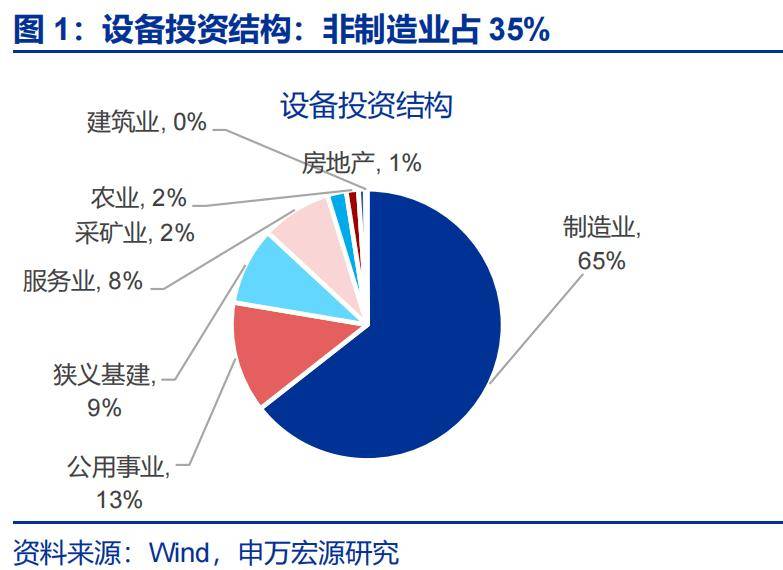
Group 1 - The core argument is that the high growth in equipment investment is not driven by the "Two New" policies or the Juglar cycle, but rather by strong investment in broad infrastructure and the service sector [1][8][70] - Equipment investment growth is significantly higher in sectors such as construction (65.5%), narrow infrastructure (46.1%), public utilities (16.5%), and services (13.9%) compared to manufacturing (6.5%), contributing an additional 8.1 percentage points to overall equipment investment [1][8][70] - In 2025, manufacturing investment growth is expected to decline to 1.9%, while equipment investment will maintain high growth at 12.2%, driven by digital and energy infrastructure [1][8][70] Group 2 - The strong growth in equipment investment is fueled by the establishment of a modern industrial system, which enhances digital infrastructure, alongside natural renewal cycles and recovering travel demand [3][25][70] - Key sectors such as software and computer services are experiencing growth rates of 53%, while aviation and road transport equipment investments are also high due to recovering travel demand [3][25][70] - Public utility equipment investment has been boosted by accelerated energy transition and infrastructure investment in the central and western regions since the implementation of the "dual carbon" policy [4][32][70] Group 3 - The sustainability of high equipment investment growth is anticipated to continue into 2026, supported by both domestic and external demand [5][60][70] - Narrow infrastructure investment is expected to rebound significantly, particularly in digital infrastructure and hub-related investments, with policies promoting new infrastructure and major engineering projects [5][60][70] - The "dual carbon" policy will further enhance investment in equipment for carbon reduction, including modifications in high-energy-consuming industries and investments in renewable energy [5][52][70]
热点思考 | 设备投资,能否“持续高增”?(申万宏观·赵伟团队)
Xin Lang Cai Jing· 2026-01-06 16:25
Group 1 - The core argument is that the high growth in equipment investment is not primarily driven by the "Two New" policies or the manufacturing Juglar cycle, but rather by strong investment in broad infrastructure and the service sector [1][8][69] - Equipment investment growth is significantly higher in sectors such as construction (65.5%), narrow infrastructure (46.1%), public utilities (16.5%), and services (13.9%) compared to manufacturing (6.5%), contributing an additional 8.1 percentage points to overall equipment investment [1][8][69] - In 2025, manufacturing investment growth is expected to decline to 1.9%, while equipment investment is projected to maintain high growth at 12.2%, driven by digital infrastructure and energy infrastructure [1][8][69] Group 2 - The strong growth in equipment investment is fueled by the establishment of a modern industrial system, which enhances digital infrastructure, alongside natural renewal cycles and recovering travel demand, thus boosting narrow infrastructure and construction equipment investment [3][24][69] - Key sectors such as software and computer services are experiencing growth rates of 53%, while aviation and road transport equipment investments are also high, correlating with a 17.9% year-on-year increase in civil aviation passenger transport [3][24][69] - The acceleration of energy transition and infrastructure investment in central and western regions, particularly since the intensification of the "dual carbon" policy in 2021, has led to a significant increase in public utility equipment investment [3][31][69] Group 3 - Fiscal policies have increased research spending and improved travel chain demand, leading to a notable rise in service sector equipment investment, which has outpaced construction investment since 2023 [4][40][69] - The growth rate for service sector equipment investment reached 13.9% in 2024, while construction investment only grew by 2.8% [4][40][69] - The recovery gap in service sector investment is estimated to be around 2-3 trillion yuan, indicating a strong potential for future growth in this area [4][56][69] Group 4 - Equipment investment is expected to continue its high growth into 2026, supported by both domestic and external demand chains [5][69] - Narrow infrastructure investment is anticipated to rebound significantly, particularly in digital infrastructure and hub-related investments [5][46][69] - The "dual carbon" policy is expected to further drive investment in equipment for carbon reduction, including modifications in high-energy-consuming industries and investments in renewable energy [5][51][69]
热点思考 | 设备投资,能否“持续高增”?(申万宏观·赵伟团队)
赵伟宏观探索· 2026-01-06 16:03
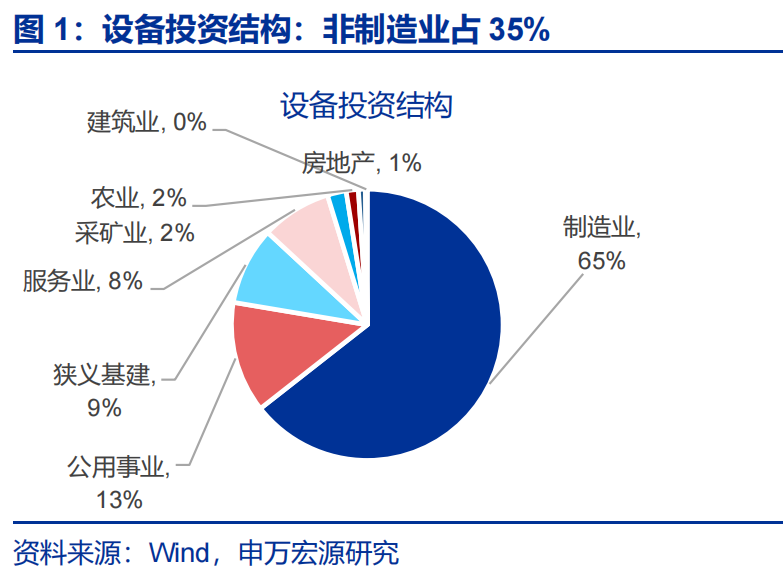
Core Viewpoint - The article argues that the high growth in equipment investment is not primarily driven by the "Two New" policies or the manufacturing Juglar cycle, but rather by strong investment in broad infrastructure and the service sector [2][9][71]. Group 1: Misconceptions about Equipment Investment Growth - Misconception 1: The strong equipment investment is attributed to the "Juglar cycle"; however, it is actually driven by robust growth in broad infrastructure and service sector investments. In 2024, the growth rates for equipment purchases in construction (65.5%), narrow infrastructure (46.1%), public utilities (16.5%), and services (13.9%) significantly outpaced manufacturing (6.5%), contributing an additional 8.1 percentage points to overall equipment investment [2][9][71]. - Misconception 2: The strong equipment investment is influenced by the "Two New" policies; however, the investment rhythm and structure contradict this view. Special government bonds supporting the "Two New" policies will intensify in the second half of 2024, but by February 2024, manufacturing investment and equipment purchase investment had already surged significantly [2][9][71]. - Misconception 3: The strong manufacturing investment is a result of strong equipment investment; in reality, it stems from construction and installation investments (expansion investments). Since 2024, while manufacturing and equipment purchase investments have grown simultaneously, the growth in equipment investment is not solely derived from manufacturing [3][21][71]. Group 2: Drivers of High Equipment Investment Growth - Reason 1: The establishment of a modern industrial system has driven strong digital infrastructure growth, combined with natural renewal cycles and recovery in travel demand, boosting narrow infrastructure and construction equipment investments. In 2024, narrow infrastructure equipment purchases contributed 4.3 percentage points to total equipment investment, exceeding manufacturing's contribution [4][25][77]. - Reason 2: The acceleration of energy transition and thermal power renovation investments in the central and western regions has strengthened public utility equipment investments, particularly since the intensification of the "dual carbon" policy in 2021. Public utility equipment investment has consistently outpaced construction investment by nearly 10 percentage points since 2021 [4][32][77]. - Reason 3: Increased fiscal spending on research and improvement in travel chain demand have boosted service sector equipment investments. Since 2023, service sector equipment investments have shown a trend of being stronger than construction investments, with significant growth in sectors like leasing and scientific research [5][42][77]. Group 3: Sustainability of High Equipment Investment Growth - Main Line 1: Narrow infrastructure is expected to rebound significantly, especially in digital infrastructure and hub-type investment construction. Recent policy measures, including the issuance of special bonds and financial tools, are set to support new infrastructure investments [6][48][79]. - Main Line 2: The "dual carbon" policy is expected to enhance investments in equipment for carbon reduction, including renovations in high-energy-consuming industries and investments in renewable energy [6][53][79]. - Main Line 3: Policies related to "investment in people" are likely to be significantly intensified, with service sector equipment investments related to consumer infrastructure expected to recover actively [6][58][79]. - Main Line 4: Equipment investments related to external demand are expected to remain resilient, particularly in sectors supporting the industrialization of emerging economies [6][63][79].

热点思考 | 设备投资,能否“持续高增”?(申万宏观·赵伟团队)
申万宏源宏观· 2026-01-06 11:19
Core Viewpoint - The article argues that the high growth in equipment investment is not primarily driven by the "Two New" policies or the manufacturing Juglar cycle, but rather by strong investment in broad infrastructure and the service sector [2][9][71]. Group 1: Misconceptions about Equipment Investment Growth - Misconception 1: The strong equipment investment is attributed to the Juglar cycle; however, it is actually driven by robust growth in broad infrastructure and service sector investments. In 2024, the growth rates for equipment purchases in construction (65.5%), narrow infrastructure (46.1%), public utilities (16.5%), and services (13.9%) significantly outpaced manufacturing (6.5%), contributing an additional 8.1 percentage points to overall equipment investment [2][9][71]. - Misconception 2: The strong equipment investment is influenced by the "Two New" policies; however, the investment rhythm and structure contradict this view. The special government bonds supporting "Two New" policies will only ramp up in the second half of 2024, while manufacturing and equipment purchase investments had already surged in February 2024 [2][9][71]. - Misconception 3: The strong manufacturing investment is a result of strong equipment investment; in reality, it stems from construction and installation investments (expansion investments). Since 2024, while manufacturing and equipment purchase investments have grown simultaneously, the growth in equipment investment is not solely derived from manufacturing [3][21][71]. Group 2: Drivers of High Equipment Investment Growth - Reason 1: The establishment of a modern industrial system has boosted digital infrastructure, combined with natural renewal cycles and recovering travel demand, driving equipment investment in narrow infrastructure and construction. In 2024, narrow infrastructure equipment purchases contributed 4.3 percentage points to total equipment investment, exceeding manufacturing's contribution [4][25][77]. - Reason 2: The acceleration of energy transition and thermal power renovation investments in central and western regions has strengthened public utility equipment investments, particularly since the intensification of the "dual carbon" policy in 2021 [4][32][77]. - Reason 3: Increased fiscal spending on research and improvements in travel chain demand have driven strong service sector equipment investments. Since 2023, service sector equipment investments have shown a trend of outpacing construction investments [5][42][77]. Group 3: Sustainability of High Equipment Investment Growth - Main Line 1: Narrow infrastructure is expected to rebound significantly, especially in digital infrastructure and hub-related investments. Recent policy measures, including a reduction in the proportion of special refinancing bonds, are anticipated to support a rebound in infrastructure investment in 2026 [6][48][79]. - Main Line 2: The "dual carbon" policy is expected to enhance investments in equipment for carbon reduction, including renovations in high-energy-consuming industries and investments in renewable energy [6][53][79]. - Main Line 3: Policies related to "investment in people" are likely to be significantly strengthened, with service sector equipment investments related to consumer infrastructure expected to recover actively [6][58][79]. - Main Line 4: Equipment investments related to external demand are expected to remain resilient, particularly in sectors supporting the industrialization of emerging economies [6][63][79].

——宏观专题报告:设备投资,能否持续高增?
Shenwan Hongyuan Securities· 2026-01-06 06:42
Group 1: Misconceptions about Equipment Investment Growth - Equipment investment growth is not primarily driven by the "Juga Cycle" but rather by strong infrastructure and service sector investments, with construction industry growth at 65.5% and narrow infrastructure at 46.1% in 2024, contributing an additional 8.2 percentage points to overall equipment investment[2] - The perception that equipment investment is strongly influenced by the "Two New" policies is misleading, as significant increases in manufacturing investment and equipment purchases occurred as early as February 2024, before the policies were intensified[2] - Manufacturing equipment investment growth was only 6.5% in 2024, significantly lower than the overall equipment investment growth of 15.7%[3] Group 2: Drivers of Equipment Investment Growth - The establishment of a modern industrial system has strengthened digital infrastructure, with software industry growth at 53% and computer services at 35%, contributing to overall equipment investment[4] - Public utility equipment investment has surged since the "dual carbon" policy was intensified in 2021, with electricity and heat equipment investment growing at 17.6%[4] - Service sector equipment investment has outpaced construction investment since 2023, with growth rates of 13.9% compared to 2.8% for construction investment[5] Group 3: Sustainability of Equipment Investment Growth - Equipment investment is expected to continue high growth in 2026, supported by a rebound in narrow infrastructure, particularly in digital infrastructure and hub-related investments[6] - The "dual carbon" policy is expected to further drive investment in equipment for carbon reduction, including high-energy-consuming industries and renewable energy investments[7] - Policies focused on "investing in people" are anticipated to boost service sector equipment investment, with a recovery gap of 2-3 trillion yuan in consumer-related service investments[7] Group 4: External Demand and Investment Resilience - Equipment investment related to external demand is expected to remain resilient, particularly in sectors supporting industrialization in emerging economies, with strong export growth to ASEAN countries driven by improved internal demand[8] - The inflow of foreign direct investment (FDI) into emerging economies is likely to accelerate, supporting industrialization and urbanization, which will further bolster equipment investment[8]