
碳排放双控

Search documents
韩文科:“能源安全新战略”叠加“双碳”目标下的能源政策有三大着力点
Zhong Guo Xin Wen Wang· 2025-08-29 03:55
Core Viewpoint - The main focus of China's energy policy under the new "Energy Security Strategy" and "Dual Carbon" goals includes actively developing non-fossil energy, strictly controlling fossil energy consumption, and deepening energy system reforms [1][3]. Group 1: Non-Fossil Energy Development - The active development of non-fossil energy involves implementing renewable energy substitution actions and continuously increasing the proportion of non-fossil energy consumption [3]. - Key initiatives include constructing a new power system dominated by renewable energy and enhancing the grid's capacity to absorb and regulate high proportions of renewable energy [3]. Group 2: Fossil Energy Consumption Control - Strict control of fossil energy consumption includes accelerating the reduction of coal use, strictly controlling the scale of coal-fired power generation, and reaching a peak in oil consumption during the 14th Five-Year Plan period [3][4]. Group 3: Energy System Reform - Deepening energy system reforms encompasses promoting electricity marketization, advancing grid system reforms, and improving the unified energy market [3]. - The focus during the 14th Five-Year Plan will shift from energy consumption intensity control to carbon emission intensity control as a binding indicator for national economic and social development [4]. Group 4: Carbon Emission Control - After reaching carbon peak, the focus will shift to total carbon emission control, with a system for evaluating carbon neutrality goals and strengthening carbon emission management across regions and industries [4]. - The establishment of a product carbon footprint management system and the promotion of product carbon labeling certification are also key components [4]. Group 5: Industrial Low-Carbon Transition - The industrial sector's low-carbon transition will follow four main pathways: adjusting industrial structure, promoting energy-saving low-carbon technologies, developing a circular economy, and large-scale application of clean energy such as hydrogen [4].

郑州市印发落实碳排放双控制度体系工作方案
Zhong Guo Chan Ye Jing Ji Xin Xi Wang· 2025-08-28 00:26
Core Viewpoint - Zhengzhou Municipal Government has issued a work plan to implement a dual control system for carbon emissions, aiming to achieve carbon peak and carbon neutrality goals while promoting green transformation of development methods [1] Group 1: Overall Requirements and Key Tasks - The plan outlines differentiated control measures during different phases, focusing on intensity control during the "14th Five-Year Plan" period and total control post-carbon peak [1] - The "14th Five-Year Plan" period will emphasize establishing a comprehensive carbon emission statistical accounting system and enhancing management levels in key energy-consuming and carbon-emitting sectors [1][2] - Post-carbon peak, the focus will shift to total control, reinforcing management measures towards carbon neutrality and implementing product carbon footprint management systems [1] Group 2: Institutional Planning - The plan includes ten key tasks, such as improving carbon emission planning systems, establishing carbon emission target decomposition and budget management systems, and developing a digital intelligent carbon control system [2] - Carbon emission indicators will be integrated into the city's economic and social development plans, with intensity reduction targets replacing energy consumption intensity constraints during the "14th Five-Year Plan" period [2] Group 3: Statistical Accounting and Target Management - The plan aims to enhance the timeliness and quality of carbon emission data through annual and quick reporting systems, and by compiling energy balance sheets [3] - It will focus on key industries such as electricity, steel, and construction, establishing monitoring and early warning mechanisms for carbon emissions [3] Group 4: Digital Carbon Management - Zhengzhou will develop a digital carbon management platform, creating a dynamic accounting model library and promoting various carbon management scenarios [4] - The initiative encourages enterprises and parks to establish digital carbon management centers, aiming for a comprehensive digital governance system for carbon emissions [4]
免费有偿结合 全国碳市场建设提速
Bei Jing Shang Bao· 2025-08-25 16:06
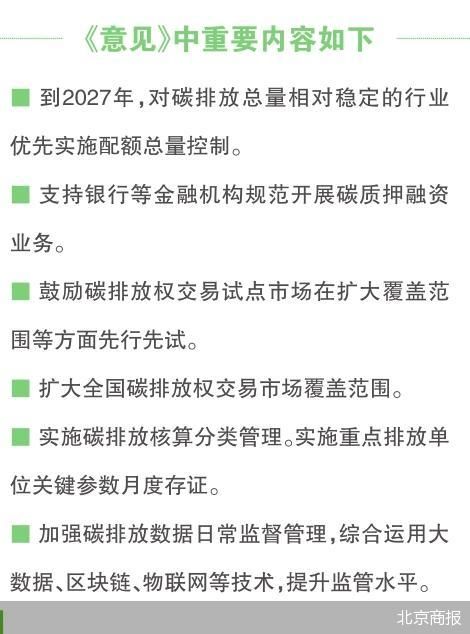
全国碳市场建设正在进一步加快。8月25日,中共中央办公厅、国务院办公厅《关于推进绿色低碳转型 加强全国碳市场建设的意见》(以下简称《意见》)对外公布。《意见》提出,到2027年,全国碳排放 权交易市场基本覆盖工业领域主要排放行业,全国温室气体自愿减排交易市场实现重点领域全覆盖。到 2030年,基本建成以配额总量控制为基础、免费和有偿分配相结合的全国碳排放权交易市场,建成诚信 透明、方法统一、参与广泛、与国际接轨的全国温室气体自愿减排交易市场,形成减排效果明显、规则 体系健全、价格水平合理的碳定价机制。其中,《意见》明确,稳妥推行免费和有偿相结合的碳排放配 额分配方式,有序提高有偿分配比例。 《意见》明确,碳市场是利用市场机制积极应对气候变化、加快经济社会发展全面绿色转型的重要政策 工具。目前,我国已建立重点排放单位履行强制减排责任的全国碳排放权交易市场和激励社会自主减排 的全国温室气体自愿减排交易市场。 《意见》针对碳市场多方面提出具体举措。《意见》包括总体要求、加快建设全国碳排放权交易市场、 积极发展全国温室气体自愿减排交易市场、着力提升碳市场活力、全面加强碳市场能力建设、加强组织 实施保障等六个方面17条 ...
规模最大的化工ETF(159870)开盘涨超1.2%,机构称行业景气度有望回升
Xin Lang Cai Jing· 2025-08-21 01:54
Group 1 - The chemical sector is experiencing a rise in opening prices, with institutions indicating that the "anti-involution" trend may lead to a recovery in chemical industry prosperity, benefiting leading companies [1] - Key factors for potential investment opportunities in the chemical industry include stricter new project approvals, the positive impact of old facility renovations, attempts at industry self-discipline, and rising energy consumption standards [1] - As of August 21, 2025, the CSI Sub-Industry Chemical Theme Index (000813) increased by 1.25%, with notable stock performances including: Nucor Titanium (002145) up 8.76%, Rongsheng Petrochemical (002493) up 5.24%, and Dongfang Shenghong (000301) up 3.24% [1] Group 2 - The Chemical ETF (159870) closely tracks the CSI Sub-Industry Chemical Theme Index, which consists of seven sub-indices reflecting the overall performance of listed companies in related sub-industries [2] - As of July 31, 2025, the top ten weighted stocks in the CSI Sub-Industry Chemical Theme Index (000813) accounted for 43.54% of the index, including companies like Wanhua Chemical (600309) and Yilong Co. (000792) [2]
从源头把好固定资产投资项目节能低碳“准入关”
Zhong Guo Huan Jing Bao· 2025-08-19 23:14
Core Viewpoint - The National Development and Reform Commission has revised the "Energy Conservation Review and Carbon Emission Evaluation Method for Fixed Asset Investment Projects," which will take effect on September 1, 2025, aiming to enhance energy conservation and carbon emission management in investment projects [1] Group 1: Key Changes in the Review Process - The revision incorporates carbon emission evaluation and coal consumption management requirements into the energy conservation review process [1] - A dynamic adjustment mechanism for energy conservation review authority has been established to improve management requirements during and after the review process [1][2] Group 2: Importance of Energy Structure - China's energy resource endowment is characterized by "rich coal, poor oil, and scarce gas," leading to a coal-dominated energy consumption structure [1] - Controlling total energy consumption, optimizing energy consumption structure, and improving energy efficiency are crucial for achieving carbon neutrality goals [1] Group 3: Implementation of Carbon Emission Evaluation - The new requirements for carbon emission evaluation during project reviews will help identify high carbon emission projects and prevent the blind approval of "high energy consumption, high pollution, and low efficiency" projects [2] - The evaluation of coal consumption will be strictly controlled, using coal consumption volume as a key basis for review authority classification [2] Group 4: Historical Impact of Energy Conservation Review - Since its implementation, the energy conservation review system has significantly improved energy efficiency and reduced unreasonable energy consumption, saving approximately 14 million tons of standard coal annually since the 14th Five-Year Plan [3] - However, issues such as weak regulatory enforcement and the delegation of review authority have led to the over-concentration of high energy consumption projects in certain areas [3] Group 5: Future Directions for Green Development - Ensuring strict energy conservation and low-carbon entry standards for fixed asset investment projects is a critical step towards promoting green and high-quality development [4] - Future efforts should integrate various policy tools to support comprehensive green transformation in economic and social development [4]
国家发展改革委修订印发《固定资产投资项目节能审查和碳排放评价办法》
Xin Hua Wang· 2025-08-12 06:21
据悉,办法自2025年9月1日起施行,原《固定资产投资项目节能审查办法》同时废止。下一步,国家发 展改革委将持续加强工作指导和监督管理,推动各有关方面落实好办法要求,更好发挥节能审查和碳排 放评价源头把关作用,坚决遏制高耗能高排放项目盲目无序上马,扎实推动产业结构和能源结构调整优 化,加快经济社会发展全面绿色转型。 新华社北京7月25日电(记者魏玉坤)记者25日从国家发展改革委获悉,为贯彻落实党中央、国务院决 策部署,建立能耗双控向碳排放双控全面转型新机制,更好适应新形势下的节能降碳工作需要,强化固 定资产投资项目能源消费和碳排放管理,近日,国家发展改革委修订印发《固定资产投资项目节能审查 和碳排放评价办法》。 【纠错】 【责任编辑:王頔】 办法将碳排放评价和煤炭消费管理有关要求纳入节能审查,对项目用能和碳排放情况进行综合审查评 价;建立节能审查权限动态调整机制,由国家发展改革委对重点领域重大项目实施节能审查和碳排放评 价;强化节能审查事中事后监管,压实地方管理节能工作部门的监督管理职责,完善项目节能报告和情 况说明编制、项目重大变动情形、节能审查验收等方面的具体规定,明确相关违法违规行为的法律责 任。 ...
划重点!下半年经济工作,这些经济主管部门打算这么做→
Jin Rong Shi Bao· 2025-08-06 05:39
Group 1 - The central government emphasizes the importance of stabilizing employment, enterprises, markets, and expectations to achieve economic goals for the year and ensure a successful conclusion to the 14th Five-Year Plan [1][2] - The State Council highlights the need to enhance macro policy effectiveness and address challenges to meet the annual development targets [1][2] - Various departments have outlined key work areas to support economic stability and growth, focusing on domestic and international dual circulation [1][2] Group 2 - The National Development and Reform Commission aims to strengthen internal circulation, optimize external circulation, and complete annual targets and tasks of the 14th Five-Year Plan [1][2] - Emphasis on stabilizing employment and promoting consumption through investment and policy measures [2][8] - The Ministry of Industry and Information Technology focuses on enhancing the quality of key industrial chains and promoting technological innovation [5][7] Group 3 - The Ministry of Finance plans to implement more proactive fiscal policies to support consumption and expand domestic demand [8][10] - The People's Bank of China is committed to maintaining a moderately loose monetary policy to support innovation, consumption, and small enterprises [16][17] - The China Securities Regulatory Commission aims to consolidate market stability and enhance regulatory effectiveness [31][35] Group 4 - The National Administration of Foreign Exchange is working on reforms to facilitate foreign trade and investment, enhancing the management of cross-border capital flows [37][38] - The focus is on improving the regulatory framework for foreign exchange management to ensure safety and efficiency [42][43]
风电周报(2025.7.28-2025.8.3):25H1海风新增并网同比+200%,破内卷推进招投标制度改革-20250806
Great Wall Securities· 2025-08-06 03:04
Investment Rating - The report maintains a "Buy" rating for several companies including Jin Feng Technology, Daikin Heavy Industries, and Yun Da Co., while recommending "Hold" for others like Tai Sheng Wind Energy and Jin Lei Co. [1][4] Core Insights - The report highlights a significant increase in offshore wind power grid connections, with a year-on-year growth of 200% in the first half of 2025, indicating a positive trend in the industry [2][3][4] - The National Development and Reform Commission emphasizes the need to eliminate "involution" competition and promote reforms in the bidding system, which is expected to stabilize and potentially increase wind turbine prices [2][4] - The report notes that the wind power sector is experiencing accelerated construction and a strong demand for large-scale products, which is expected to enhance profitability for key players [4][7] Industry Dynamics - The report outlines that in the first half of 2025, the total installed capacity of wind power reached 572.60 million kW, with a year-on-year increase of 22.70% [25][30] - The total new installed capacity for wind power in the first half of 2025 was 51.39 GW, representing a 98.88% increase compared to the same period in 2024 [25][28] - The average bidding price for offshore wind turbines has shown a downward trend, currently averaging 3266.17 yuan/kW [3][53] Market Performance - The wind power equipment index reported a TTM price-to-earnings ratio of 33.17 and a market-to-book ratio of 1.69 [14][21] - The wind power equipment sector outperformed the broader market, with a weekly increase of 1.86%, ranking 12th among 124 sub-sectors [14][17] Company Performance - Key companies such as Jin Feng Technology and Yun Da Co. are highlighted for their strong market positions and expected benefits from the ongoing industry trends [4][7] - The report identifies specific companies for investment based on their market advantages and growth potential, including Daikin Heavy Industries and Tai Sheng Wind Energy [7]





国家发改委:将碳排放评价纳入节能审查制度
Zhong Guo Hua Gong Bao· 2025-08-06 02:17
Core Viewpoint - The National Development and Reform Commission (NDRC) has revised and issued the "Measures for Energy Conservation Review and Carbon Emission Evaluation of Fixed Asset Investment Projects," which will take effect on September 1, 2025, replacing the previous energy conservation review measures [1] Group 1 - The revised measures incorporate carbon emission evaluation and coal consumption management requirements into the energy conservation review system, allowing for a comprehensive assessment of project energy use and carbon emissions [2] - A dynamic adjustment mechanism for energy conservation review authority has been established, with the NDRC responsible for reviewing major projects in key areas and detailing specific review processes [2] - The measures enhance the management of energy conservation reviews during and after project implementation, requiring oversight of review implementation and clarifying circumstances for significant project changes and non-compliance with review opinions [2]
建信期货焦炭焦煤日评-20250805
Jian Xin Qi Huo· 2025-08-05 02:17
Report Summary 1. Report Industry Investment Rating No relevant information provided. 2. Core Viewpoints - On August 4, the main contracts of coke and coking coal futures rebounded significantly after hitting lows, with coking coal showing a larger increase. The spot market of double - coking is lagging behind the futures market, resulting in a significant difference in the trend between the two. Considering the tight supply in the double - coking spot market driven by supply - demand relationship, there is still room for price increase. It is possible that the phased decline of double - coking futures has ended, and then it may turn into a volatile trend, waiting for further development of the supply - demand relationship after the spot market price increase to determine the direction [5][11]. 3. Summary by Related Catalogs 3.1 Market Review - **Futures Market**: On August 4, the main contract J2509 of coke futures had a previous closing price of 1585 yuan/ton, an opening price of 1585.5 yuan/ton, a highest price of 1626 yuan/ton, a lowest price of 1551.5 yuan/ton, and a closing price of 1615 yuan/ton, with a decline of 0.15%. The trading volume was 30,451 lots, the open interest was 25,782 lots, a decrease of 2,331 lots, and the capital outflow was 0.58 billion yuan. The main contract JM2601 of coking coal futures had a previous closing price of 1092.5 yuan/ton, an opening price of 1099.5 yuan/ton, a highest price of 1143 yuan/ton, a lowest price of 1066.5 yuan/ton, and a closing price of 1141 yuan/ton, with an increase of 2.33%. The trading volume was 1,908,758 lots, the open interest was 487,977 lots, an increase of 59,997 lots, and the capital inflow was 10.71 billion yuan [5]. - **Spot Market**: On August 4, the flat - price index of quasi - first - grade metallurgical coke at Rizhao Port, Qingdao Port, and Tianjin Port was 1420 yuan/ton, with no change. In Tangshan, it was 1350 yuan/ton, also with no change. For low - sulfur main coking coal, the price in Tangshan increased by 180 yuan/ton to 1485 yuan/ton, in Linfen it remained unchanged at 1500 yuan/ton, etc. [8]. - **Technical Indicators**: On August 4, the daily KDJ indicator of the coke 2509 contract showed a divergent trend, with the J - value turning up slightly, while the K - value and D - value continued to decline. The daily KDJ indicator of the coking coal 2601 contract continued to decline. The daily MACD indicator of the coke 2509 contract had a dead - cross the previous day and the green bar enlarged; the daily MACD indicator of the coking coal 2601 contract had a dead - cross [8]. 3.2 Future Outlook - **Policy**: The National Energy Administration will guide coal - producing provinces and enterprises to ensure coal production and supply, and conduct production inspections to prevent over - capacity production [10]. - **Fundamentals**: For coke, the output of independent coking plants decreased slightly after two consecutive weeks of increase, and the output of steel mills reached a new low since late February. The port coke inventory reached a new high since early June, while the inventories of steel mills and coking plants reached new lows since late December last year. The profit per ton of coke has been in the red for 11 consecutive weeks, and the fifth round of spot price increase for coke was proposed on August 3. For coking coal, from January to June, the import volume of coking coal in China still showed a large year - on - year decline of 7.4%. The inventories of raw coal and clean coal in coal washing plants have dropped significantly in the past 7 weeks, with declines of 17.6% and 33.8% respectively. The inventory of independent coking plants has increased for 6 consecutive weeks and reached a new high since early February, the port inventory reached a new low since early August last year, and the steel mill inventory has increased for 3 consecutive weeks. With the continuous increase of steel mill inventory, the replenishment of coking plants has significantly cooled down [10]. 3.3 Industry News - The National Development and Reform Commission has completed the allocation of the third batch of 69 billion yuan of ultra - long - term special treasury bond funds for consumer goods trade - in this year, and will allocate the fourth batch of 69 billion yuan in October to complete the annual allocation plan of 300 billion yuan. The 800 billion yuan list of "two major" construction projects and 735 billion yuan of central budgetary investment have been basically allocated. The NDRC will promote project construction and strengthen supervision [12]. - From July 19 - 25, the average coal price in Inner Mongolia was 730.96 yuan/ton, a week - on - week decrease of 0.7% and a year - on - year decrease of 9.8%. Domestic coal production capacity is continuously released, and overseas coal imports have increased significantly year - on - year [14]. - In the first half of 2025, Shaanxi Coal Industry Group achieved an operating income of 227.5 billion yuan and a profit of 18.04 billion yuan, with coal production reaching 129 million tons, a year - on - year increase of 1.5%, and power generation reaching 27.27 billion kWh, a year - on - year increase of 3.4% [14]. - Henan Dayou Energy Co., Ltd. has transferred its coal production capacity replacement indicators to Shenmu Shengfu Mining Co., Ltd. for a total transaction price of 1.01132 billion yuan [14]. - The "Xinjiang Coal to Jiangsu" railway direct - access channel of Xinjiang Energy Group has been successfully connected. The comprehensive shipping cost has decreased by 20% compared with the beginning of the year, and it aims to achieve an annual sales volume of 3 million tons in the East China region this year [14]. - In July, the single - month power sales of State Grid Shandong Electric Power exceeded 62.12 billion kWh for the first time, a year - on - year increase of 20.19% [15]. - As of July 30, Gansu has signed new inter - provincial power transmission agreements with 9 provinces and cities this year, and the cross - provincial and cross - regional power transmission transaction volume has reached 61.742 billion kWh, of which new energy accounts for 57.57%, a year - on - year increase of 27.18% [15]. - In July, the coal production of Coal India Limited was 46.4 million tons, a year - on - year decrease of 15.7% and a month - on - month decrease of 19.72%, and the sales volume was 53.7 million tons, a year - on - year decrease of 9.9% and a month - on - month decrease of 11.09% [16].