
税收收入

Search documents
8月全国一般公共预算收入12043亿元
Xin Hua Cai Jing· 2025-08-08 06:59
前8个月累计,全国一般公共预算支出149925亿元,同比下降2.1%。其中,中央一般公共预算本级支出 21276亿元,同比下降4.1%;地方一般公共预算支出128649亿元,同比下降1.7%。 政府性基金预算收支方面,前8个月累计,全国政府性基金预算收入47030亿元,同比增长2.3%;全国政 府性基金预算支出63889亿元,同比增长21.1%。 从主要税收收入项目来看,前8个月累计,国内增值税38086亿元,同比下降15.2%;国内消费税9822亿 元,同比下降5.7%;企业所得税29382亿元,同比下降5.3%;个人所得税7640亿元,同比增长5.9%;进口货 物增值税、消费税9552亿元,同比下降11.5%;关税1653亿元,同比下降12.8%。 财政支出方面,8月份,全国一般公共预算支出16426亿元,同比增长8.7%,主要是各地抓紧推进重大 项目实施,直达资金支出进度进一步加快。 财政部18日发布数据显示,8月份,全国一般公共预算收入达12043亿元,同比增长5.3%,增幅较7月份 提高1个百分点,连续3个月实现正增长。 前8个月累计,全国一般公共预算收入126768亿元,同比下降7.5%。其中,中 ...
上半年广义财政收支差5.3万亿,中央定调下半年财政政策|财税益侃
Di Yi Cai Jing· 2025-07-31 12:27
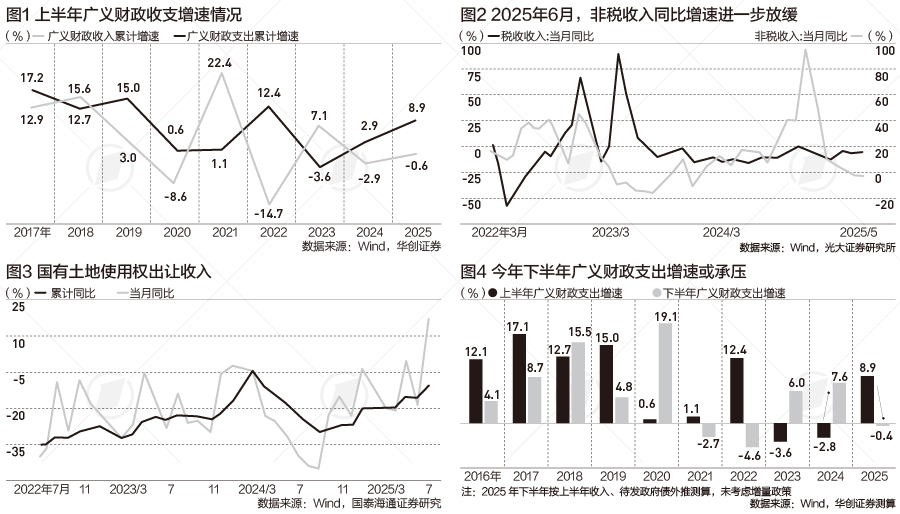
Core Viewpoint - Despite a slight decline in general fiscal revenue in the first half of the year, general fiscal expenditure reached a historical high, indicating a proactive fiscal policy aimed at stabilizing economic growth [1][3][4]. Fiscal Revenue and Expenditure - In the first half of the year, general fiscal revenue was approximately 135,008 billion yuan, showing a year-on-year decrease of about 0.6% [3]. - General fiscal expenditure amounted to nearly 188,800 billion yuan, with a year-on-year growth of approximately 8.9%, significantly higher than the economic growth rate of 5.3% [2][3]. - The fiscal expenditure exceeded revenue by 52,536 billion yuan, reflecting a year-on-year increase of about 45% [3]. Policy Measures and Economic Impact - The central government has emphasized the need for sustained and timely fiscal policy adjustments to support economic stability, particularly in the second half of the year [2][4]. - The Ministry of Finance reported that the fiscal policy has been more aggressive, contributing to a stable economic environment despite pressures [2][4]. - The government plans to accelerate the issuance of bonds and enhance the efficiency of fund utilization to address the fiscal gap [7][11]. Tax Revenue Trends - Tax revenue in the first half of the year was 92,915 billion yuan, down 1.2% year-on-year, indicating a mismatch with nominal GDP growth [4][6]. - Non-tax revenue grew by 3.7% to 22,700 billion yuan, but the growth rate has slowed compared to previous quarters [7]. - The decline in tax revenue is attributed to factors such as tax cuts and changes in the tax base, particularly in traditional industries [6]. Future Outlook - The fiscal space for the second half of the year is estimated to be 60,700 billion yuan, with significant remaining quotas for deficits and special bonds [9]. - The issuance of special bonds has accelerated, with a record monthly issuance of approximately 6,169 billion yuan in July [10]. - The government aims to enhance the management and efficiency of special bonds to ensure effective fund allocation for key projects [11].

7月30日电,截至当前,泰国财政年度的税收收入同比增长1.8%,预算赤字融资同比增长88.3%。
news flash· 2025-07-30 09:51
智通财经7月30日电,截至当前,泰国财政年度的税收收入同比增长1.8%,预算赤字融资同比增长 88.3%。 ...
“十四五”中国税务部门累计征收税费料逾155万亿元
Zhong Guo Xin Wen Wang· 2025-07-29 09:48
Group 1 - The core viewpoint is that during the "14th Five-Year Plan" period, China's tax revenue is expected to exceed 155 trillion yuan, accounting for about 80% of total fiscal revenue [1] - Tax revenue (excluding export tax rebates) is projected to surpass 85 trillion yuan, an increase of 13 trillion yuan compared to the total tax revenue during the "13th Five-Year Plan" [1] - The tax authority's collection of social insurance fees and land transfer fees is expected to exceed 70 trillion yuan, strengthening the financial foundation for economic and social development [1] Group 2 - The structure of tax revenue is improving, with manufacturing tax revenue maintaining a steady share of around 30%, indicating the sector's crucial role in the economy [1] - The fastest growth in tax revenue is seen in modern service industries such as information software and technology services [1] - The number of tax-related business entities has surpassed 100 million, reflecting strong market vitality and resilience [2] Group 3 - Tax policies aimed at improving people's livelihoods in areas such as elderly care, childcare, healthcare, and education are expected to reduce tax burdens by an average of 11.7% annually from 2021 to 2024 [2] - Economic factors such as tax cuts, price changes, and tax source structures influence tax revenue, leading to discrepancies between economic growth and tax revenue [2] - The decline in growth rates of traditional industries like real estate has resulted in slower tax revenue growth, while emerging industries, despite their positive momentum, currently contribute less to overall tax revenue [2]
2025年6月财政数据点评:如何看待上半年财政形势?
EBSCN· 2025-07-27 12:36
Revenue Analysis - The cumulative year-on-year growth rate of national general public budget revenue from January to June 2025 is -0.3%, unchanged from the previous value[1] - The cumulative year-on-year growth rate of general public budget expenditure is +3.4%, down from +4.2%[1] - Government fund budget revenue shows a cumulative year-on-year growth rate of -2.4%, improving from -6.9% previously[1] Tax Revenue Insights - In June, tax revenue shows a year-on-year growth of +1.04%, an improvement compared to May[3] - The domestic consumption tax in June increased by +1.96%, while the vehicle purchase tax rose by +5.99%, indicating a positive contribution from automotive consumption[4] - The corporate income tax grew by +2.73%, reflecting a low base effect, but remains lower than the growth rate of value-added tax[4] Government Fund Performance - Government fund budget revenue in June increased significantly by +20.8%, recovering from -8.1% the previous month, driven by land sales[25] - The expenditure of government funds in June surged by +79.2%, compared to +8.8% in the previous month, with land-related expenditures showing a year-on-year growth of +5.9%[25] Expenditure Trends - General public budget expenditure growth in June is +0.38%, a decrease of 2.25 percentage points from the previous month[15] - Infrastructure-related expenditure in June fell by -8.80%, while social security and health expenditures also saw declines[15] - The completion rate for general public budget revenue from January to June is 48.8%, lower than the average of the past five years[15]
【广发宏观吴棋滢】6月财政数据简评
郭磊宏观茶座· 2025-07-26 11:34
Core Viewpoint - The overall performance of public finance in the first half of 2025 is stable, with a slight decline in revenue growth, indicating the need for continued improvement in tax and government fund income through PPI and land market enhancements [5][23]. Group 1: Public Finance Revenue - In the first half of 2025, public finance revenue showed a cumulative year-on-year decline of 0.3%, slightly lower than the previous year's growth of 1.3% [1][6]. - Tax revenue decreased by 1.2% year-on-year, an improvement compared to last year's decline of 3.4%, while non-tax revenue growth significantly slowed from 25.4% last year to 3.7% this year [1][8]. - The decline in non-tax revenue is attributed to a high base last year and a reduced reliance on non-tax income by the government [1][6]. Group 2: Monthly Performance - In June, tax revenue increased by 1.0% year-on-year, slightly higher than the previous value, while non-tax revenue fell by 3.7%, indicating an expanded decline [2][9]. - Domestic value-added tax and corporate income tax recorded year-on-year increases of 5.0% and 2.7%, respectively, contributing positively to June's fiscal revenue growth [2][11]. - The equipment manufacturing industry, modern services, and cultural sports entertainment sectors showed strong tax performance, reflecting the economic recovery in these areas [2][11]. Group 3: Fiscal Expenditure - Narrow fiscal expenditure in June saw a year-on-year decline of 0.4%, down from 2.6% previously, influenced by a decrease in non-tax revenue and a lull in infrastructure funding [3][12]. - Technology spending led the expenditure categories with an 18.1% year-on-year increase, while infrastructure-related expenditures showed weak performance, particularly in transportation and agriculture [3][14]. - The overall expenditure progress for the first half of the year was at 47.6%, indicating a slower pace compared to previous years, with expectations for acceleration in the second half [3][13]. Group 4: Government Fund Income - Government fund income in the first half of 2025 decreased by 2.4% year-on-year, primarily due to continued weakness in the land market, with land transfer income down 6.5% [4][19]. - In June, government fund budget revenue surged by 20.8%, marking a significant increase, although July data showed a notable decline, raising questions about the sustainability of this recovery [4][19]. - Government fund budget expenditure rose sharply by 79.2% year-on-year, largely driven by the issuance of special bonds, indicating a significant increase in overall fiscal spending [4][20].

宏观经济点评:广义财政支出强度大幅提升
KAIYUAN SECURITIES· 2025-07-26 07:18
Revenue Performance - In June, the national general public budget revenue was CNY 18,943 billion, a year-on-year decline of 0.3%[2] - Tax revenue showed marginal improvement, growing by 1% year-on-year, while non-tax revenue decreased by 3.7%[2] - Corporate income tax and consumption tax saw marginal increases, with corporate income tax benefiting from a low base effect[2] Expenditure Trends - Public fiscal expenditure in June was CNY 28,318 billion, growing by only 0.4% year-on-year, down from 2.6% in the previous month[3] - Cumulative expenditure growth for the first half of the year was 3.4%, below the annual target of 4%[3] - Expenditure on science and technology increased by 18%, while infrastructure spending continued to decline, with transportation spending down by 13%[3] Government Fund Dynamics - Government fund revenue in June was CNY 3,959 billion, a year-on-year increase of 20.8%, marking a significant recovery[4] - Land sales revenue rose by 22% year-on-year, contributing to the improved government fund revenue[4] - Government fund expenditure surged by 79% year-on-year in June, driven by accelerated issuance of special bonds[5] Fiscal Deficit Insights - The broad fiscal deficit has widened, but the gap between actual revenue and budgeted revenue has narrowed effectively[6] - The potential fiscal gap for the year is estimated to be no more than CNY 3,000 billion if current revenue growth is maintained[6] - There is a risk of further widening fiscal gaps if revenue growth does not sustain the levels seen in the first half of the year[7]
【新华解读】上半年财政运行总体平稳,下半年有何看点?
Xin Hua Cai Jing· 2025-07-25 15:11
Core Insights - The overall fiscal performance in China for the first half of 2025 shows a slight decline in public budget revenue and an increase in expenditure, indicating a stable fiscal environment despite economic pressures [1][2]. Revenue Summary - Total public budget revenue reached 115,566 billion yuan, a year-on-year decrease of 0.3% [2]. - Tax revenue amounted to 92,915 billion yuan, down 1.2% year-on-year, while non-tax revenue increased by 3.7% to 22,651 billion yuan [2]. - Central government revenue was 48,589 billion yuan, a decline of 2.8%, while local government revenue rose by 1.6% to 66,977 billion yuan [2]. - Monthly tax revenue has shown a recovery since April, with growth rates of 1.9% in April, 0.6% in May, and 1% in June [2]. Expenditure Summary - Total public budget expenditure was 141,271 billion yuan, reflecting a year-on-year increase of 3.4% [4]. - Central government expenditure grew by 9% to 19,914 billion yuan, while local government expenditure increased by 2.6% to 121,357 billion yuan [4]. - Key areas of expenditure included social security and employment (up 9.2%), education (up 5.9%), and science and technology (up 9.1%), while spending on urban and rural communities, agriculture, and transportation saw declines [4]. Future Outlook - Analysts expect favorable conditions for fiscal revenue in the second half of the year, driven by policies aimed at economic recovery and infrastructure investment [3]. - The introduction of new policy financial tools is anticipated to accelerate infrastructure recovery, benefiting sectors with significant accounts receivable [3]. - The government has substantial room for borrowing, with manageable debt levels and a large deficit space compared to international standards [3]. Key Areas of Focus - The government issued 26,000 billion yuan in new local government bonds to support major projects in the first half of the year [4]. - The upcoming "15th Five-Year Plan" will focus on tax system reforms, which may include adjustments to consumption tax collection and local government incentives to improve the consumption environment [5].
上半年中国财政收入近11.56万亿元
Zhong Guo Xin Wen Wang· 2025-07-25 13:30
Summary of Key Points Core Viewpoint - The overall fiscal performance in China for the first half of the year shows a slight decline in general public budget revenue, but with signs of recovery in tax revenue and continued growth in non-tax revenue, indicating a stable fiscal environment despite challenges [1][2]. Revenue and Expenditure - National general public budget revenue reached 115,566 billion RMB, a year-on-year decrease of 0.3% [1]. - Tax revenue amounted to 92,915 billion RMB, reflecting a year-on-year decline of 1.2%, while non-tax revenue increased to 22,651 billion RMB, showing a growth of 3.7% [1]. - General public budget expenditure was 141,271 billion RMB, representing a year-on-year increase of 3.4% [1]. Tax Revenue Trends - Monthly tax revenue has shown growth for three consecutive months starting from April, with increases of 1.9% in April, 0.6% in May, and 1% in June [2]. - Key tax categories such as domestic value-added tax, domestic consumption tax, and personal income tax grew by 2.8%, 1.7%, and 8% respectively [2]. - Export tax rebates totaled 12,700 billion RMB, an increase of 1,322 billion RMB compared to the same period last year, supporting foreign trade exports [2]. Sector Performance - The equipment manufacturing and modern service industries exhibited strong tax revenue performance, with specific sectors like railway, shipping, aerospace equipment, and computer communication equipment seeing tax revenue growth of 32.2%, 9.2%, and 6.3% respectively [2]. - The scientific research and technical service industry experienced a tax revenue increase of 13.8%, while the cultural, sports, and entertainment sectors saw an 8.6% rise [2]. Non-Tax Revenue Insights - Non-tax revenue growth slowed down, with a decrease of 5.1 percentage points compared to the first quarter [2]. - Revenue from the paid use of state-owned resources increased by 4.8%, driven by local governments optimizing asset utilization [2]. - Administrative and institutional fee income grew by 1%, but the growth rate fell by 4.5 percentage points compared to the first quarter, while confiscated income declined by 4.3% [2]. Local Budget Performance - Local general public budget revenue increased by 1.6%, with 27 out of 31 provinces reporting growth [2]. - Fiscal departments at all levels are focusing on optimizing expenditure structures and ensuring funding for key areas [2].
财政部详解上半年财政数据:税收收入逐步回升,支出加力
Di Yi Cai Jing· 2025-07-25 12:00
Group 1: Fiscal Performance Overview - The overall fiscal performance in the first half of 2025 is stable, with increased fiscal spending supporting economic stability [1] - National general public budget revenue reached 11.5566 trillion yuan, a year-on-year decrease of 0.3%, while general public budget expenditure was 14.1271 trillion yuan, an increase of 3.4% [1] - The broad fiscal expenditure (including general public budget and government fund budget) grew by 8.9%, significantly higher than the broad fiscal revenue growth of -0.6% [1] Group 2: Tax Revenue Trends - National tax revenue for the first half of 2025 was approximately 9.29 trillion yuan, down 1.2% year-on-year, which is lower than the economic growth rate of 5.3% [2] - The decline in tax revenue is attributed to multiple factors, including falling industrial product prices, economic downturn, and tax reduction policies [2] - Tax revenue decline has been narrowing since April, with major tax categories showing stable growth, including domestic value-added tax and personal income tax [3] Group 3: Government Fund Revenue - Local government land transfer revenue was 1.4271 trillion yuan, down 6.5%, but this decline is less severe compared to earlier months [4] - The narrowing decline in land sales revenue reflects improvements in the real estate market due to various supportive policies [5] Group 4: Debt Issuance and Financing - The issuance of government bonds reached a record high of 7.88 trillion yuan in the first half of 2025, an increase of 35.28% year-on-year [5] - Net financing from government bonds was 7.66 trillion yuan, up 4.32 trillion yuan year-on-year [6] Group 5: Social Spending and Policy Focus - Social security and employment spending reached 2.4504 trillion yuan, growing by 9.2%, indicating a strong focus on social welfare [7] - The government is committed to increasing the "people's livelihood" content in fiscal spending and improving the efficiency of fund usage [8] Group 6: Debt Management and Risk Mitigation - The implementation of debt replacement policies has alleviated liquidity pressure on local governments and promoted economic development [9] - The fiscal department is focused on ensuring the effective implementation of various debt support policies to sustain economic stability [9]