能源转型

Search documents
澳大利亚部长称应尽一切努力维持力拓铝冶炼厂运营
Wen Hua Cai Jing· 2025-10-30 01:48
Bowen于10月29日表示,Tomago Aluminium宣布将就其员工未来进行磋商"深表关切"。 Bowen还表示,该公司称尚未做出最终决定让他看到了希望。 Bowen说:"这意味着我们不应有任何保留,必须尽最大努力去争取一个可行的方案。" 澳大利亚气候变化与能源部长Chris Bowen表示,为找到解决方案维持力拓集团Tomago铝冶炼厂在2028 年后继续运营,"不应有任何保留"。 力拓子公司Tomago Aluminium于10月28日宣布,已"就业务潜在未来开始与员工进行磋商程序"。 Tomago Aluminium自2022年以来已"进行了全面的市场征询过程",以"在当前电力供应合同到期时找到 经济可行的能源解决方案"。 该公司表示,从2029年1月开始,燃煤和可再生能源方案的成本都将显著上升,"根本性地改变运营经济 性,使该冶炼厂无法持续运营"。 此外,Tomago Aluminium"尚未找到支持2028年后商业可持续运营的路径"。 Tomago Aluminium首席执行官Jérome Dozol在10月28日的声明中表示,"可再生能源项目何时能够以我 们所需的规模投入使用存在重大不确定 ...
非洲关键矿产战略地位凸显
中国能源报· 2025-10-30 00:45
Core Viewpoint - The report highlights Africa's strategic role in the global energy transition, emphasizing the importance of key minerals such as copper, lithium, cobalt, nickel, rare earths, and platinum group metals in the clean energy supply chain, with Africa being a crucial player due to its rich resources and high grades [3][5]. Group 1: Mineral Resource Development - Zimbabwe, historically known for chrome and coal, is now gaining attention for its lithium resources, with local government pushing for the upgrade of the industry chain from raw mineral exports to mandatory processing into lithium sulfate and lithium carbonate [3]. - Africa holds a central position in global energy transition mineral supply, with the Democratic Republic of Congo possessing 54.55% of global cobalt reserves, and South Africa and Zimbabwe accounting for 79.26% of platinum group metal reserves [5]. - The report indicates that despite Africa's rich resource endowment, mineral development faces challenges such as inadequate infrastructure, weak processing capabilities, and policy uncertainties [4][5]. Group 2: Sino-African Cooperation - There is significant complementarity between Africa's resources and China's manufacturing and green technology capabilities, which can enhance mineral cooperation and support sustainable development in Africa [5][6]. - Chinese enterprises are increasingly involved in infrastructure projects in Africa, improving mineral logistics efficiency, and a collaborative model of "resource development + infrastructure + livelihood projects" is suggested for mutual economic and social benefits [6][7]. - The shift from "resource for capital" to "industry co-construction" is noted, with examples of green practices in mining projects, such as solar-powered operations and electric mining vehicles [7][10]. Group 3: Challenges and Solutions - The need for policy continuity and a dynamic balance between resource sovereignty and investor rights is emphasized as crucial for cooperation [8]. - The concept of "zero-carbon mining" aligns with international trends, and Chinese companies are encouraged to adopt green technologies to enhance competitiveness [8][10]. - The establishment of microgrids in mining areas is proposed as a viable solution to address energy challenges, with a focus on solar, storage, and diesel solutions being more commercially feasible than large-scale power sources [9][10].


多因素共振 铜价上方空间有多大?
Qi Huo Ri Bao· 2025-10-29 23:33
Group 1: Core Insights - Domestic and international copper prices have been rising significantly since late September, driven by supply shortages, global monetary easing, and increased demand from AI-related infrastructure [1][8] - Supply concerns are primarily stemming from the copper mining sector, where declining ore grades and geopolitical instability have hindered expected production increases [2][3] - The copper market is expected to face a tight supply situation in the next 1-2 years, with significant production disruptions anticipated in major copper-producing countries [3][4] Group 2: Supply Dynamics - The average grade of copper ore has decreased by 30% since 1991, contributing to supply challenges [2] - The processing fees for copper concentrate have drastically changed, with current fees indicating that smelters are incurring losses due to extreme shortages of copper concentrate [4] - Chinese copper smelters have been forced to reduce production due to a depletion of cold material inventory and high prices for raw materials [4][5] Group 3: Demand Factors - Despite high copper prices, demand remains robust, particularly in sectors like electric power, automotive, and household appliances, with a projected growth rate of 6%-7% for refined copper consumption in China by 2025 [6][7] - The rapid development of AI is expected to drive a new wave of copper demand, particularly for chip production and power infrastructure [7][8] - Global monetary easing policies are likely to stimulate investment demand for copper, especially in the context of low interest rates [6] Group 4: Inventory and Market Conditions - Current copper inventories are low, particularly in China, where social inventory can only meet about a week’s consumption [7] - The market is experiencing a strong buying sentiment due to low inventory levels, which supports the potential for copper prices to reach new highs [8] - The premium for copper sold from Chile to Europe has surged, indicating strong demand and further supporting price increases [5][6]
氢能、核能、新型储能写入规划,“十五五”能源产业要怎么干?
2 1 Shi Ji Jing Ji Bao Dao· 2025-10-29 12:30
Core Insights - The "15th Five-Year Plan" aims to enhance China's energy sector, focusing on achieving carbon peak targets and establishing a clean, low-carbon, safe, and efficient energy system [1][7] Group 1: Energy Sector Development Goals - The overall goal for the energy sector during the "15th Five-Year Plan" is to achieve carbon peak targets and establish a new energy system [1] - The plan emphasizes the importance of energy transition, with a focus on enhancing energy supply capacity and accelerating green transformation [1][7] Group 2: Emerging Industries and Future Technologies - The plan highlights the need to cultivate emerging industries, particularly in new energy, new materials, aerospace, and low-altitude economy [2] - Hydrogen energy and nuclear fusion are specifically mentioned as future industries to explore diverse technological routes and business models [2][3] Group 3: Infrastructure Development - The plan calls for the construction of modern infrastructure to support energy transition, including optimizing energy transmission channels and building new energy facilities [3][4] - The development of charging stations and energy storage systems is deemed essential for the new energy infrastructure [5] Group 4: Market Regulation and Competition - The plan aims to eliminate barriers to building a unified national market and address "involution" in competition within the energy sector [5][6] - Establishing a unified electricity market is crucial for optimizing resource allocation and supporting energy transition [5] Group 5: Achievements and Future Directions - As of mid-2025, China's renewable energy installed capacity reached 2.159 billion kilowatts, accounting for 59.2% of total installed capacity [7] - The plan emphasizes the need for further acceleration of low-carbon and clean transformation in the energy sector to support economic development [7]
永泰能源三季报:电力业务强劲增长,彰显保供“压舱石”实力
Xin Jing Bao· 2025-10-29 11:41
Core Insights - Yongtai Energy reported strong financial performance for the first three quarters of 2025, with total revenue of 17.728 billion yuan and net profit of 198 million yuan, supported by robust cash flow from operating activities of 4.450 billion yuan [1] Financial Performance - The company achieved a revenue of 13.052 billion yuan from its electricity segment, with a gross profit of 2.656 billion yuan, reflecting a year-on-year increase of 26.48% and a gross margin improvement of 5.24 percentage points [2] - Total power generation reached 31.429 billion kWh, with sales of 29.812 billion kWh, marking a significant operational achievement [2] Coal and Power Synergy - Yongtai Energy's coal business generated revenue of 4.213 billion yuan, with raw coal production of 11.331 million tons and sales of 11.390 million tons [3] - The company is advancing the construction of the Haizetang coal mine, expected to start trial production in July 2026, which will enhance its coal supply for power generation [3] Regional Energy Supply - Yongtai Energy plays a crucial role in regional energy supply, with a total installed capacity of 9.18 million kW, primarily serving the economically developed Yangtze River Delta and densely populated Central Plains regions [4] - The company has been recognized for its contributions to energy supply stability during peak demand periods, particularly in Jiangsu and Henan provinces [6] Operational Achievements - Several subsidiaries of Yongtai Energy set new records for power generation in Q3, with Zhangjiagang Shazhou Power Company achieving a monthly generation of over 20 billion kWh [5] - The company has implemented technical upgrades to enhance operational efficiency, resulting in significant reductions in equipment defects and improved performance metrics [5]

铜价创新高,供应紧张升级:嘉能可铜产量或连降四年
智通财经网· 2025-10-29 11:33
Group 1 - Glencore (GLNCY.US) announced it is likely to meet its annual production targets, alleviating investor concerns about operational deterioration [1] - The company's copper production for the first nine months of the year was 583,500 tons, a 17% decrease year-on-year, primarily due to lower ore grades [2] - Glencore's copper production guidance for 2025 has been narrowed from 850,000-890,000 tons to 850,000-875,000 tons, representing a 40% decrease from 2018 levels [2] Group 2 - The company expects its marketing profit for the year to be near the midpoint of its long-term guidance range of $2.3 billion to $3.5 billion [3] - Glencore's coal production for the year is projected to be between 92 million and 97 million tons, with coking coal production between 30 million and 35 million tons [3] - The company restructured its coal business after abandoning plans to spin off the entire coal division, integrating recently acquired Canadian mines into a unified management unit in Australia [3] Group 3 - The copper market is experiencing supply tightness, with prices reaching historical highs, driven by various operational issues at major mines [2] - Factors contributing to the copper supply crunch include a deadly landslide at Freeport-McMoRan's Grasberg mine, flooding at Ivanhoe Mines' Kamoa-Kakula complex, and rockfall incidents at Codelco's main copper mines [2]

媒体报道︱能源政策机制创新分论坛 进一步推动新型能源体系和新型电力系统建设
国家能源局· 2025-10-29 09:24
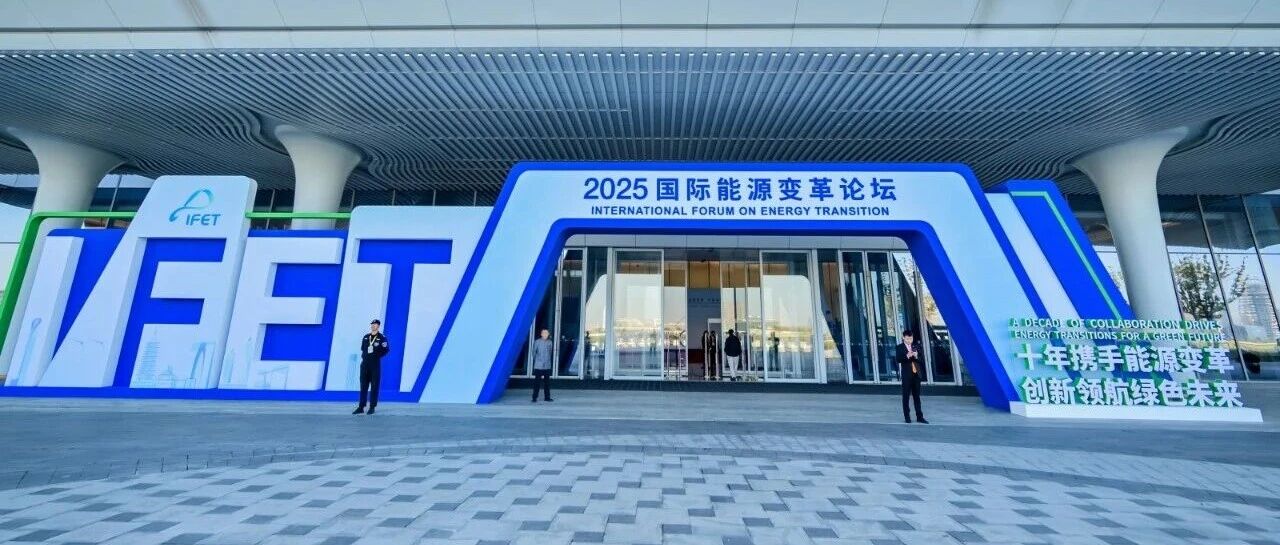
Core Viewpoint - The forum aimed to analyze energy reform innovations and explore key directions for future energy policy mechanisms, promoting the construction of a new energy system and power system [2][4]. Group 1: Forum Overview - The "2025 International Energy Transformation Forum" was held in Suzhou, Jiangsu, with participation from over 70 organizations and nearly 160 experts from various sectors [2]. - Discussions focused on policy mechanism innovations in the context of global energy transition, emphasizing the need for collaboration and international exchange [4]. Group 2: Key Discussions and Insights - Experts shared insights on energy transition topics, including the design and operational effectiveness of the Southern regional electricity market, experiences from European countries in marketization and system flexibility, and technological innovations in zero-carbon park construction [4]. - A roundtable discussion addressed the empowerment of new business models in the energy sector, with experts presenting typical cases and policy innovation suggestions [4]. Group 3: Collaborations and Agreements - The State Grid General Institute signed a memorandum with the Climate Group to focus on technical standards and certification for decarbonization in industrial parks, aiming to replicate successful experiences globally [5]. - Additionally, a memorandum was signed with the German International Cooperation Agency (GIZ) to enhance cooperation on green transformation of power systems, leveraging complementary advantages between China and Germany [5].
【今晚播出】人类能源的未来,一位跨界大师的远见与忧思 | 两说
第一财经· 2025-10-29 09:22
Core Viewpoint - The dialogue features Zhu Diwen, the 12th U.S. Secretary of Energy and 1997 Nobel Prize winner in Physics, discussing his unexpected journey to winning the Nobel Prize, his decision to join the Obama administration, and his perspectives on energy transition and U.S.-China relations regarding climate change challenges [1]. Group 1 - Zhu Diwen's unexpected discovery that led to his Nobel Prize is highlighted, showcasing the importance of serendipity in scientific achievements [1]. - The conversation touches on Zhu's motivations for joining the Obama administration, marking a significant milestone as the first Chinese-American cabinet member [1]. - The dialogue emphasizes the shared global challenge of climate change and the need for collaboration between the U.S. and China in addressing energy transition [1].
中美贸易曙光与供应中断共推涨势 铜价“狂飙”创历史新高
Zhi Tong Cai Jing· 2025-10-29 08:13
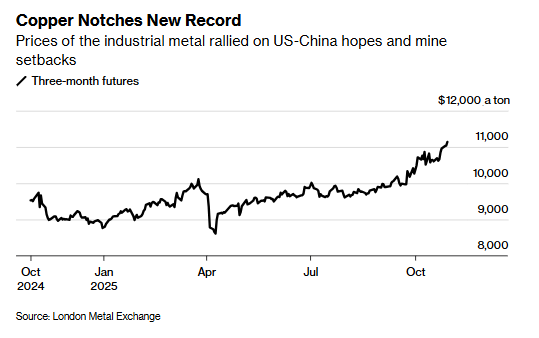
Group 1 - Copper prices have surged to a historical high due to an impending comprehensive agreement between the US and China to ease trade tensions, alongside supply disruptions from global mining operations [1][4] - The three-month copper futures price on the London Metal Exchange reached $11,146 per ton, marking a year-to-date increase of over 25% [1][4] - The upcoming bilateral talks between US President Trump and Chinese leaders at the APEC meeting are viewed positively, with expectations for an agreement that could impact copper prices [4] Group 2 - The copper market has experienced volatility this year, with historical price highs adding new uncertainties, influenced by Trump's trade war and industry sanctions that have disrupted pricing [4] - Major mining accidents, such as the landslide at Freeport-McMoRan's Grasberg mine in Indonesia, have contributed to supply constraints [4] - There is a strong market outlook for copper demand growth, driven by energy transition processes and the construction of AI data centers, with China committing to significantly increase consumption's share in its economy [4]
活动预告 | 2025进博会:全球新型储能生态圈共话能源转型新阶段
中关村储能产业技术联盟· 2025-10-29 08:05
Core Viewpoint - The forum titled "High-Quality Development of New Types of Energy Storage Accelerates Global Energy Transition" aims to discuss the critical role of new energy storage technologies in facilitating the global energy transition and addressing climate change [3][4]. Group 1: Forum Overview - The forum will be held on November 5, 2025, at the National Exhibition and Convention Center in Shanghai, co-hosted by the National Energy Administration and the Ministry of Commerce [3][9]. - It will gather over 300 participants, including representatives from energy regulatory bodies, power grid companies, renewable energy enterprises, and leading research institutions from both domestic and international markets [5][10]. Group 2: Industry Significance - As of June 2025, China's new energy storage installed capacity reached 94.91 million kilowatts (22.2 billion kilowatt-hours), accounting for over 40% of the global total, marking a 30-fold increase since the end of the 13th Five-Year Plan [4][5]. - China is recognized as a global leader in new energy storage, possessing the most complete and advanced energy storage industry chain, and is actively promoting its "China solution" worldwide [4][5]. Group 3: Key Topics of Discussion - The forum will cover various topics, including technological breakthroughs in energy storage, exploration of business models, policy incentives, and international cooperation in the industry [4][5]. - Notable speakers include leaders from the National Energy Administration, international guests, and representatives from major energy companies and research institutions [10][12]. Group 4: Future Directions - The forum aims to foster global cooperation and integration within the energy storage industry, contributing to sustainable energy development and the green low-carbon transition [5][16]. - It emphasizes the importance of building a global energy storage ecosystem that encompasses technology research, equipment manufacturing, project application, and capital connection [5][10].