
分散投资

Search documents
荐股骗局的“幸存者偏差”游戏:为什么你总被“小涨股票”迷惑?
Sou Hu Cai Jing· 2025-06-03 08:09
Group 1 - The allure of stock recommendation scams often involves enticing slogans such as "expert recommendations," "insider information," and "guaranteed profits," which attract investors through social media, telemarketing, and investment seminars [2] - Survivor bias is a significant factor in stock recommendation scams, where investors focus on successful cases while ignoring failures, leading to a misleading perception of potential returns [4] - Small gain stocks can mislead investors due to short-term profit temptations, psychological suggestions from so-called "experts," and herd mentality, which often results in buying at high points and incurring losses [5] Group 2 - To avoid becoming a victim of survivor bias, investors should maintain rational thinking, conduct thorough research before making investment decisions, and remain cautious of claims of guaranteed profits [5][6] - Independent thinking is crucial; investors should not blindly follow others and must take responsibility for their investment choices [6] - Diversification is an effective method to reduce risk, advising against putting all funds into a single stock [7]

买股票,哪些习惯帮我避了坑?| 猫猫看市
Zheng Quan Shi Bao Wang· 2025-06-01 05:51
Group 1 - The company emphasizes the importance of avoiding high-priced stocks and those with poor financial fundamentals, as these often do not present suitable investment opportunities [4][12] - The company maintains a cautious approach towards popular stocks and sectors, recognizing that high demand often leads to inflated prices and increased competition [5][6][7] - The company shows interest in under-the-radar stocks that are undervalued and overlooked by the market, as these can potentially yield significant returns if identified correctly [8][12] Group 2 - The company advocates for diversification in investment portfolios, which helps in risk reduction and achieving a more optimized investment strategy [9][11] - The company acknowledges that while these investment habits may lead to missed opportunities for high returns, they contribute to a more secure and stable growth of the investment portfolio [12][13]
瑞银吕子杰,最新发声!
Zhong Guo Ji Jin Bao· 2025-05-31 10:32
Core Viewpoint - UBS emphasizes the importance of the Chinese market as a critical area for investment and business development, highlighting its significant economic growth and potential opportunities [4]. Group 1: Investment Trends - Diversification in investment has become a mainstream trend, with some family offices considering reducing their exposure to USD assets and shifting towards non-USD assets [3]. - Gold is identified as a favorable diversification asset, with UBS recommending clients to invest in gold when prices were at $1,700 per ounce [3]. - European stocks are gaining attention from family offices, particularly in the food and healthcare sectors, despite UBS maintaining a neutral rating on the overall European stock market [3]. Group 2: UBS's Operations in China - UBS has been operating in Hong Kong for over 60 years, establishing a mature business platform that provides a range of services including investment banking, asset management, and wealth management [4]. - The firm has over 35 years of experience in mainland China, with more than 20 years in wealth management, and has set up global investment banking and wealth management teams in key cities like Shenzhen and Guangzhou [4]. - UBS has increased its stake in UBS Securities to 100%, reflecting its long-term commitment to the Chinese market [4]. Group 3: Integrated Banking Services - UBS is increasingly focusing on "integrated banking services" and global connectivity to meet diverse client needs across different life stages and financial goals [5]. - The wealth management business is considered the core of UBS, with close collaboration between investment banking and asset management departments to enhance client service [6]. - A new department, "Strategic Clients and Global Connectivity," has been established to better coordinate global resources and leverage the advantages of integrated banking services [6].

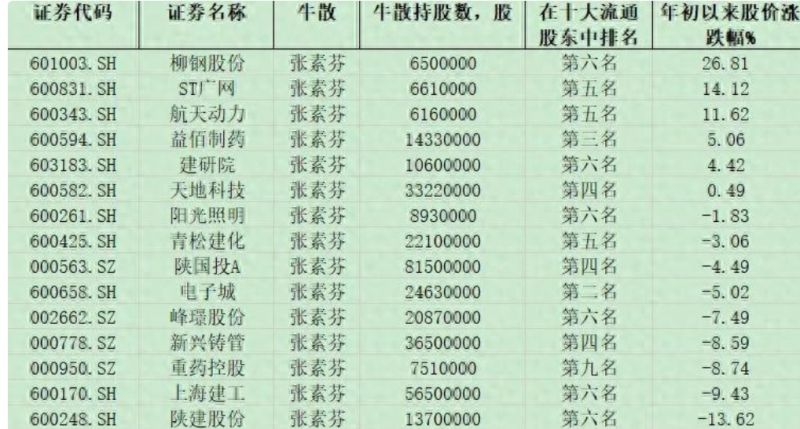
低价股抄底王!揭秘A股牛散“张素芬”:耗资逾13亿元买成15家上市公司前十大股东
Hua Xia Shi Bao· 2025-05-27 06:46
Core Viewpoint - The article highlights the emergence of a notable individual investor, Zhang Sufen, in the A-share market, who has made significant investments in multiple listed companies, positioning herself among the top shareholders of 15 companies as of the first quarter of 2025 [1][2][3]. Group 1: Investment Profile - Zhang Sufen holds substantial shares in various companies, with a total holding of 349.66 million shares across 15 listed companies, making her the second-largest shareholder in Electronic City and the fourth-largest in Shaanxi Guotou A [3][4]. - Her investment strategy appears to focus on low-priced stocks, with most of her holdings priced below 10 yuan, indicating a preference for undervalued assets [7][8]. - The total market value of her holdings exceeds 1.38 billion yuan, with five stocks valued over 100 million yuan each [8]. Group 2: Performance and Strategy - Zhang's investments have shown mixed results, with the highest floating profit being 26.81% from Liugang Co., while the largest loss is 13.62% from Shaanxi Construction [3][4]. - She has demonstrated a long-term investment approach, often increasing her holdings over several quarters, as seen in her continuous accumulation of shares in low-performing stocks like New Star Foundry [6][7]. - Despite her success, she has also faced significant losses, such as a 30% loss in Yibai Pharmaceutical, highlighting the risks associated with her investment choices [8][9]. Group 3: Market Impact and Perception - Zhang Sufen's investment activities have drawn attention in the market, with speculation about her potential connections to larger investment networks, suggesting that her strategies may not be typical of individual investors [7][8]. - Her approach to investing, characterized by a focus on low-priced stocks and a willingness to endure volatility, positions her as a unique figure in the A-share market, comparable to institutional investors [6][7].



新加坡银行:关税让优质股更具性价比 客户配置中国香港及内地资产比例逐渐增加
Zhi Tong Cai Jing· 2025-05-26 07:58
Group 1 - The current market is filled with uncertainty due to U.S. tariff policies, leading clients to adopt a cautious investment attitude and hold significant cash reserves [1] - Despite the cautious approach, clients are increasingly allocating funds to Hong Kong and mainland China assets, viewing tariffs as an opportunity to buy quality stocks [1][2] - There has been a notable increase in trading activities, with a 36% rise in trading income for Singapore Bank's Hong Kong branch in the first quarter, contributing to a 25% overall revenue growth [2] Group 2 - Following signals of economic reform from China in September and October last year, client interest in Chinese assets has risen, although large-scale buying has not yet occurred [2] - The bank has observed a 21% growth in assets under management (AUM) for fund subscriptions and a 47% increase in discretionary portfolio management (DPM) AUM in the first quarter [2] - The bank maintains a long-term positive outlook on gold prices, having advised clients to invest in gold early on, reflecting a shift in client investment strategies towards a more diversified portfolio [2]
富达国际:政策能见度相对较高 亚洲本币债市前景具吸引力
Zhi Tong Cai Jing· 2025-05-26 02:45
Group 1 - The core viewpoint emphasizes the attractiveness of Asian local currency bond markets due to expected interest rate cuts by central banks and decreasing inflation, which provides a conducive environment for capital gains and diversification amidst global trade uncertainties [1][2] - The size of the emerging East Asia local currency bond market has significantly increased from $866 billion in 2000 to $23.2 trillion by the end of 2022, enhancing its appeal to investors [1] - The correlation between Asian local currency government bonds and major global government bonds is relatively low, with coefficients of 0.4% and 0.3% with U.S. and German government bonds respectively, making them an attractive diversification tool [1] Group 2 - Long-term investment in Asian investment-grade local currency government bonds has shown a risk-adjusted return of 28.2% over the past decade, outperforming the 14.5% return from U.S. Treasury bonds [2] - The Sharpe Ratio for the Asian local currency sovereign bond portfolio is 0.6, indicating a higher return per unit of risk compared to the 0.4 ratio for U.S. Treasury bonds, suggesting better compensation for risk [2] - Despite potential pressures from global trade order changes, Asian economies are expected to remain resilient, supported by domestic fiscal and monetary policies [3] Group 3 - The need for Asian countries to rely on domestic demand as a new engine for economic growth is highlighted, with a large and young population supporting this structural shift [3] - Investors are advised to closely monitor the evolving trade situation and its impacts on Asia, while improvements in market infrastructure, liquidity, and transparency in the local currency government bond market are necessary [3] - Asian local currency government bonds are becoming increasingly attractive as a diversification option for investors concerned about rising U.S. debt and trade policy uncertainties [3]
瀚亚投资:中国H股及A股的估值仍然有吸引力 为自下而上的投资者带来机会
Zhi Tong Cai Jing· 2025-05-26 02:27
Group 1 - The core viewpoint is that significant uncertainties from tariffs and U.S. policies will suppress global economic growth in 2025, with U.S. growth expected to slow to 1.2-1.5% and a downward risk bias [1] - The implementation of a 30% tariff on certain Chinese goods and a 10% tariff on all goods from other countries represents a tax increase equivalent to approximately 1.5% of U.S. GDP, marking one of the largest single-year tax hikes in decades [1] - The anticipated slowdown in U.S. economic growth and ongoing geopolitical pressures are expected to lead to further capital outflows from the dollar over the next year [1] Group 2 - Most Asian currencies are expected to strengthen to some extent due to the depreciation of the dollar, with controlled inflation in Asia and emerging markets providing central banks the space to cut interest rates to support economic growth [1] - The dual effect of currency appreciation and interest rate cuts is expected to enhance the attractiveness of Asian asset markets to international capital flows [1] - The uncertainty surrounding the long-term direction of tariff negotiations may continue to trigger intermittent market volatility, prompting investors to seek further diversification in their portfolios [1] Group 3 - Japan remains one of the lowest-valued markets globally based on price-to-book (P/B) ratios, while Chinese H-shares and A-shares still present attractive valuations for bottom-up investors [2] - Despite being perceived as overvalued at the beginning of 2025, the Indian stock market continues to show resilience due to supportive measures from the Reserve Bank of India, low oil prices, and stable domestic capital flows [2] - The bond market offers multiple opportunities to acquire quality assets at ideal valuations, with local currency bonds in Asia showing attractive investment prospects due to appealing real yields and strong economic fundamentals [2] Group 4 - Investors are advised to adopt a defensive strategy to cope with future market pressures, with low volatility strategies recommended to minimize downside risks while allowing participation in market uptrends [2]
降息破1%!储蓄搬家潮要来了?帮主解读居民投资新选择
Sou Hu Cai Jing· 2025-05-25 03:10
Group 1 - The recent interest rate cuts by banks have significantly reduced the appeal of traditional savings, with one-year deposit rates dropping below 1% from around 2% previously, leading to a shift in investment behavior [1][3] - Investors are exploring alternatives to savings accounts, such as money market funds with annualized returns of 1%-2%, bond funds yielding 4%-6%, and high-dividend stocks like Industrial and Commercial Bank of China, which has maintained a dividend rate above 5% [3][4] - The stock market is experiencing increased activity, with some viewing it as a signal of "savings migration," particularly towards stable, high-dividend stocks that have shown annualized returns exceeding 10% over the past decade [4] Group 2 - The interest rate cuts are part of a broader economic strategy aimed at reducing financing costs for businesses and stimulating consumer spending and investment, thereby revitalizing dormant capital [5] - The government is implementing policies to support the capital market, including promoting registration system reforms and attracting long-term funds from sources like insurance and pension funds, which could create structural opportunities in sectors such as technology and consumer goods [5] - Individuals are encouraged to adapt their investment strategies in response to the low-interest environment, diversifying their portfolios with money market funds, bond funds, and high-dividend stocks while enhancing their financial literacy [6][8] Group 3 - The trend of declining interest rates is expected to continue, with predictions of further reductions in the Loan Prime Rate (LPR) by 20-30 basis points, indicating that reliance on interest income from savings will diminish [7] - The current economic climate necessitates a shift in mindset regarding savings, urging individuals to seek diverse investment avenues to grow their wealth in a low-rate environment [8]

存款利率全面下跌,年轻人开始流行攒“新三金”
盐财经· 2025-05-22 10:49
Core Viewpoint - The article discusses the significant decline in deposit interest rates in China, leading to a shift in investment strategies among young people who are moving away from traditional bank savings to alternative investment options like money market funds, bond funds, and gold funds [2][3][4]. Group 1: Decline in Deposit Rates - As of May 20, 2023, the one-year fixed deposit rate has fallen below 1%, and the interest rate for demand deposits has dropped to 0.05% [2]. - The trend of decreasing deposit rates is not limited to large banks; even small and medium-sized banks that previously attracted deposits with high rates are now lowering their rates [2]. - The decline in deposit rates has sparked discussions on social media about the ineffectiveness of traditional savings, with many realizing that the interest earned may not even cover travel expenses [2][3]. Group 2: Shift to Alternative Investments - Young individuals are increasingly abandoning the idea of earning interest from bank deposits, opting instead to diversify their savings into what is referred to as the "new three golds"—money market funds, bond funds, and gold funds [3][4]. - The "new three golds" have gained popularity as they are perceived to offer lower risk, better returns than bank deposits, and the potential to outpace inflation [11][12]. - Data from Ant Financial indicates that as of the end of April, 9.37 million individuals born in the 1990s and 2000s have simultaneously invested in money market funds, bond funds, and gold funds, indicating a growing trend [12]. Group 3: Individual Experiences and Strategies - A case study of an individual named Li Jing illustrates the frustration of watching savings diminish due to low interest rates, prompting her to explore alternative investment options [5]. - Another individual, Zhao Qi, has adopted a strategy of investing heavily in bond funds, which he refers to as "collecting eggs," highlighting the stability and long-term benefits of such investments compared to traditional savings [18][21]. - Zhao Qi's experience reflects a broader trend where individuals are forming communities to share investment strategies and support each other in navigating the changing financial landscape [26]. Group 4: Changing Financial Mindset - The article notes a generational shift in financial attitudes, where younger individuals prioritize risk management and diversified investments over traditional savings methods [28][30]. - The concept of "new three golds" symbolizes a proactive approach to personal finance, contrasting with the previous reliance on bank deposits and real estate for wealth accumulation [29]. - This evolving mindset emphasizes the importance of having a financial safety net and the ability to withstand economic uncertainties, leading to a more cautious yet strategic approach to investing [30].

摩根资管:亚洲各国货币政策转向宽松 可考虑通过投资亚洲股票来分散投资
Zhi Tong Cai Jing· 2025-05-21 03:04
摩根资产管理环球市场策略师 Raisah Rasid 表示,近期亚洲各国纷纷转向更为宽松的货币政策,加上财 政措施,为国内经济增长创造了有利环境。亚洲股市在财政刺激时期的历史弹性为多元化提供了令人信 服的理由。虽然美国股票仍然是投资组合的重要组成部分,但投资者不妨考虑通过投资亚洲股票来分散 投资,特别是那些有望受益于国内消费和财政支持的行业,以增强投资组合抵御全球不确定性的能力。 摩根资管表示,亚洲各国转向宽松的货币政策加上财政措施,这可能会提振消费者和企业情绪,为抵御 关税引发的经济放缓等外部冲击提供缓冲。由于美国与亚洲经济体之间的谈判仍在继续,因此预计贸易 政策的最终结果仍将在较长一段时间内保持不确定性。因此,这标志着亚洲市场的关键点,国内需求可 以在推动增长方面发挥更大的作用。 Raisah Rasid 称,在中国,包括降息、降低存款准备金率和其他流动性注入在内的全面货币刺激计划突 显了其对刺激国内增长和应对外部下行风险的关注。同样,印度、菲律宾和泰国也已恢复宽松周期,并 提供了明确的前瞻性指引,表示未来几个月将进一步降息以支持经济活动。新加坡也调整了货币政策, 有效放松了货币政策。 Raisah Ra ...