多资产配置

Search documents
新发规模创2022年以来新高,部分长盈产品仍呈现高申购
Shenwan Hongyuan Securities· 2025-07-22 12:44
Report Title - "New Issuance Scale Reaches a New High Since 2022, with High Subscriptions for Some Long - Term Products - Analysis of 25Q2 FOF Quarterly Reports" [1] 1. Investment Rating - No investment rating information is provided in the report. 2. Core Viewpoints - The new issuance scale of FOF in 25Q2 reached a new high since 2022, with the number of FOF funds increasing. Bond - type FOF remained popular, and some products under the long - term plan had net subscriptions exceeding 7 billion yuan.绩优FOF generally showed multi - asset allocation characteristics, and FOF managers preferred Hong Kong stocks and overseas funds, with a consensus on increasing holdings of pharmaceutical and technology stocks at the stock - holding end. The scale of personal pension funds continued to grow [3]. 3. Summary by Directory 3.1 Scale Dimension: New Issuance Scale Reaches a New High Since 2022 - **FOF Classification Method**: FOF funds are classified into four types: "bond - type FOF", "fixed - income + FOF", "balanced FOF", and "equity - type FOF" based on the post - penetration equity position or the equity index proportion in the performance benchmark. For pension target funds, classification is based on the holding period [8][9]. - **Scale Review**: The new issuance scale of FOF has been rising steadily. In 2025, the issuance enthusiasm was strong, with the number of FOF funds reaching 517, 6 more than in 25Q1. The new issuance scale in 25Q2 was 19.071 billion yuan, a new high since 2022. The second - highest was in 22Q1, with a cumulative new issuance scale of 15.948 billion yuan. The holding - operation scale declined slightly, but the cumulative scale still increased by 14.626 billion yuan [10]. - **New Issuance Representatives**: Dongfanghong Asset Management and China Merchants Bank had prominent new issuance scales. Dongfanghong's new product, Dongfanghong Yinfeng Steady Allocation 6 - month Holding, had a new issuance scale of over 6 billion yuan, and China Merchants Bank's new custody scale exceeded 10 billion yuan [13]. - **Product New Issuance and Holding - Operation**: Bond - type FOF remained popular, and some products under the long - term plan had net subscriptions exceeding 7 billion yuan. Investors still preferred low - risk bond - type FOF and fixed - income + FOF. The product with the largest increase in holding - operation scale in 25Q2 was Boshi Zhenxuan Chuhui Three - month Holding [15][16]. - **Fund Company Dimension**: Except for the top 3 fund companies in terms of scale, other leading fund managers had significant changes. Among the top 15 managers in terms of total FOF scale, 5 had an increase in scale, and 10 had a decline. There were two institutional replacements in the top 15 management list [19]. 3.2 Performance Dimension: High - Performing FOF Still Shows Multi - Asset Allocation Characteristics - **Market Environment**: In the second quarter, both the bond and equity markets fluctuated greatly. The ChinaBond Composite Wealth Total Index rose 1.67%, and the Wind All - A Index rose 3.86%, with equities being relatively dominant [21]. - **Overall Performance**: As the position increased, the performance of FOF gradually improved. The median return of equity - type FOF reached 2.43%, similar to that in 25Q1. Over 20% of equity - type FOF and fixed - income + FOF outperformed the corresponding market indices. The probability of positive returns for all types of FOF exceeded 90% [23]. - **High - Performing FOF Characteristics**: High - performing fixed - income + FOF showed characteristics of extending duration or increasing convertible bond holdings; high - performing balanced FOF generally showed multi - asset allocation characteristics, with QDII funds and commodity ETFs being the top - holding funds; high - performing equity - type FOF had differences [29]. 3.3 Investment Characteristics: Preference for Hong Kong Stocks and Overseas Funds, and a Consensus on Increasing Holdings of Pharmaceutical and Technology Stocks at the Stock - Holding End - **Manager Allocation Characteristics**: Leading managers generally emphasized multi - asset allocation, with different investment directions. Some focused on QDII stock - type assets, some on mutual - recognition funds, some on commodity investments, and some products under certain managers would choose to overweight REITs, but the overweight proportion was generally low [37]. - **Overall Market Characteristics**: In the second quarter, FOF generally increased holdings of pure - bond funds, and there was a preference for passive investment. The proportion of holdings in Shanghai and Shenzhen funds and passive stock indices decreased, while the proportion of pure - bond funds, QDII stock funds, and REITs funds increased [39]. - **Asset Preference**: The allocation of top - holding funds in the second quarter showed a preference for US and Hong Kong stock assets. There was a differentiation in the increase of equity assets. The increase in active equity products was diverse [40][42]. - **Stock - Holding End Allocation**: Three types of FOF with equity exposure generally reduced holdings in cyclical sectors and increased allocations to pharmaceutical and technology sectors. The consensus on increasing holdings of pharmaceutical and technology stocks was reached [49]. 3.4 Personal Pension Fund: The Total Y - Share Amounts to 1.0834 Billion Yuan - **Scale Growth**: In the second quarter, the scale of personal pension funds was 1.0834 billion yuan, an increase of 630 million yuan compared to 25Q1, maintaining a high growth rate. Pension target date funds were more popular, with a current scale of 649.4 million yuan [3]. - **Popular Products**: The scale of fixed - income + FOF increased significantly, and products in the 2040, 2045, and 2050 series were also favored. Y - share products with a large increase in scale were generally target - date FOF [3].

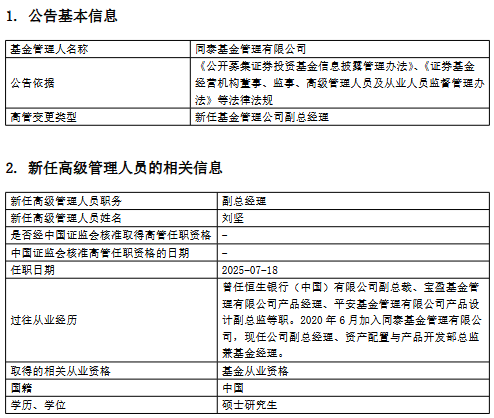
绩优则仕!同泰基金再次擢升刘坚:“产品专家”如何凭2.7亿FOF撬动副总席位?
Xin Lang Ji Jin· 2025-07-21 03:57
Core Viewpoint - Liu Jian has been promoted to Vice General Manager of Tongtai Fund, reflecting the trend of talent incentives in the public fund industry, particularly the "performance-based promotion" approach [1][15]. Group 1: Promotion Details - Liu Jian officially assumed the role of Vice General Manager on July 18, 2025, after being appointed as Assistant General Manager at the end of 2024 [1][4]. - His career path includes significant roles at Hang Seng Bank (China) and various fund management companies, showcasing a strong background in product development and asset allocation [3][4]. Group 2: Performance Overview - As of July 18, 2025, Liu Jian manages two funds with a total scale of 273 million yuan, both of which have underperformed compared to the CSI 300 index [5][11]. - The "Tongtai Preferred Allocation" fund has a total return of -11.14% since its inception in October 2021, ranking 11th out of 47 in its category, while the "Tongtai Active Allocation" fund has a total return of -2.31% since its inception in November 2022, ranking 3rd out of 12 [5][11]. Group 3: Investment Strategy - Liu Jian's investment strategy combines ETFs and active management, focusing on a diversified asset allocation approach [11][12]. - The top holdings in the "Tongtai Preferred Allocation" fund include various ETFs covering high-dividend Hong Kong stocks, gold, and long-term government bonds, while the "Tongtai Active Allocation" fund emphasizes equity funds in healthcare and consumer sectors [11][12]. Group 4: Future Outlook - Liu Jian anticipates a complex macroeconomic environment with potential structural investment opportunities, particularly in dividends and gold, amidst ongoing geopolitical tensions and economic recovery [16]. - As of June 2025, Tongtai Fund achieved a 20.64% return, placing it among the top five in the industry, indicating a strong focus on research performance and talent development [16].

面对市场不确定性,投资何去何从
天天基金网· 2025-07-07 12:26
Core Viewpoint - The article emphasizes the increasing uncertainty in the global economic environment, particularly due to fluctuating U.S. trade policies, which negatively impact GDP growth forecasts for major economies in 2025 [1][3]. Group 1: Current Market Environment - Uncertainty is a critical factor in global economic development and outlook, largely stemming from unpredictable economic policies of major countries [3]. - The International Monetary Fund (IMF) has revised down GDP growth forecasts for the U.S., Europe, and emerging markets for 2025 following trade tensions [1]. Group 2: Investment Strategy in Uncertain Times - Investors should focus on high-quality companies that can thrive in a high-interest-rate environment, as not all companies will flourish under increased financing costs [5]. - High-quality companies typically exhibit characteristics such as long-term management vision, strong adaptability, and valuations based on free cash flow [6]. - Active fund managers may have a greater willingness and ability to analyze these companies compared to passive managers, who often rely on market indices for portfolio construction [6]. Group 3: Importance of Long-Term Investment - Investment should be viewed as sharing in the growth of the economy and companies, rather than merely reacting to market fluctuations [6][7]. - The article stresses that market prices will eventually reflect the intrinsic value of companies over time, reinforcing the idea that short-term market movements should not dictate investment decisions [7]. Group 4: Multi-Asset Allocation - Diversification is essential for risk management, as it helps mitigate the impact of market uncertainties [8][9]. - The concept of correlation is crucial in constructing a diversified portfolio, as combining assets with low correlation can reduce overall investment risk [9][10]. - Regular rebalancing and careful consideration of asset correlations are necessary to maintain an effective multi-asset allocation strategy [10]. Group 5: Maintaining Confidence Amid Uncertainty - Investors should acknowledge and confront their fears regarding uncertainty, as this is a normal psychological response [11]. - Long-term commitment to investment, rather than attempting to time the market, is more likely to yield success [11][13]. - Historical data shows that markets tend to recover from uncertainties, reinforcing the importance of maintaining investment discipline and a diversified portfolio [13][14].

FOF“中考”成绩亮眼 多资产配置升温
Zheng Quan Shi Bao· 2025-07-06 18:10
Core Insights - FOF products have demonstrated strong performance in the first half of the year, achieving an average return of 3.11% as of June 30, indicating a positive trend in multi-asset strategies [1][2][4] - The popularity of newly launched FOF products continues to rise, with a diverse range of product types and refined strategy designs, reflecting a growing acceptance of multi-asset strategies in the asset management industry [1][4][7] Performance Highlights - Top-performing FOFs in the first half of the year include Bohai Huijin Preferred Progress 6-Month Holding A, ICBC Smart Progress 1-Year A, and ICBC Pension 2050Y, with returns of 15.19%, 14.88%, and 14.59% respectively [2][3] - These successful FOFs predominantly utilize high elasticity and theme-driven asset allocation strategies, focusing on passive index funds while incorporating QDII and commodity assets [3][7] New Product Launches - A total of 31 new FOF products were launched in the first half of the year, with significant initial scales, indicating sustained market interest in multi-asset allocation tools [4][5] - Notable new products include Dongfanghong Yingfeng Stable Allocation 6-Month Holding with an initial scale of 6.573 billion, and other products like Fuguo Yinghe Zhenxuan 3-Month Holding and Nanfang Stable View 3-Month Holding, which also attracted considerable investment [4] Market Trends - The rapid expansion of FOFs in the domestic market reflects investor recognition of professional asset allocation and signifies the accelerated adoption of multi-asset strategies in China [7] - The current market environment, characterized by macroeconomic uncertainty and frequent rotations between equity and fixed income markets, has made the cross-asset, cross-cycle, and cross-style allocation philosophy advocated by FOFs increasingly relevant [7]
首批科创债ETF获批 深市指数化投资多点开花显活力
Zheng Quan Shi Bao Wang· 2025-07-02 10:47
Group 1 - The approval of four innovative bond ETFs by Southern, Fortune, Jiashi, and Invesco marks a significant development in the technology innovation bond market, providing efficient investment channels for investors [1] - The total scale of domestic ETFs surpassed 4.3 trillion yuan as of June 25, setting a historical record, indicating a rapid growth in index-based investment [1] - The Shenzhen series indices have shown strong performance, with the number of products reaching 159 and a total scale of 283.8 billion yuan by the end of June, reflecting a 15% and 12% increase respectively since the beginning of the year [1] Group 2 - The scale of bond ETFs has been continuously increasing, with the Shenzhen benchmark market credit bond ETF providing a convenient and transparent trading channel for mid-to-high-grade bonds, achieving explosive growth in scale [2] - As of the end of June, the Shenzhen benchmark market credit bond index has issued four ETFs with a scale exceeding 47 billion yuan, with over 20 billion yuan growth in June alone, showcasing its strong capital attraction [2] - The demand for multi-asset allocation is rising, with the launch of the first batch of four multi-asset indices and the deep AAA technology innovation bond index, providing diverse performance benchmarks and investment targets [2] Group 3 - The ChiNext Index, as a core index of the Shenzhen market, has become a popular benchmark with a strategic emerging industry weight of 92%, highlighting strengths in new-generation information technology, new energy vehicles, and biotechnology [3] - The average R&D investment growth for sample companies in the ChiNext Index is projected to be 10% in 2024, indicating strong innovation vitality [3] - By the end of June, there were 49 index products established under the ChiNext Index system, with a total scale exceeding 150 billion yuan, effectively guiding funds towards high-growth and innovative sectors [3] Group 4 - The recent revisions to the ChiNext Index are expected to attract more ESG-preference funds, enhancing its appeal and investment potential [4] - The deep Shenzhen 100 index, which aggregates new quality blue-chip companies, has seen a rise in interest and demand for allocation, with seven new index products established this year [4] - The ChiNext 50 index, known for its role as a market leader during bullish phases, has also seen 13 new index products established this year, reflecting its growth resilience [4] Group 5 - The Shenzhen Stock Exchange has been actively promoting the development of key industry chain indices and related products, directing funds towards high-quality technology enterprises [5] - The "Chuang Series" indices cover various types, including broad-based, thematic, strategy, and ESG, with a total tracking product scale exceeding 200 billion yuan, providing rich vehicles for investors to capture industry transformation dividends [5] - There has been a significant increase in thematic index product layouts in artificial intelligence, new energy, and biomedicine sectors, with the ChiNext AI index seeing a more than twofold growth in tracking product scale since the beginning of the year [5]
【银行理财】低利率运行周期加速深化下的银行理财变局
华宝财富魔方· 2025-05-29 09:40
Core Viewpoint - The low interest rate environment in China is deepening, leading to a structural asset shortage and forcing banks to adjust their liability rate mechanisms, impacting the wealth management market significantly [1]. Group 1: Deposit Migration Effect - The continuous decline in deposit rates has strengthened the "deposit migration" effect, with the scale of wealth management products returning to 30 trillion yuan [2][3]. Group 2: Performance Pressure and Asset Allocation Transformation - Wealth management companies are continuously lowering the performance benchmarks of newly issued products, reflecting increased pressure on investment returns across the industry [5][6]. - Companies are accelerating the transition to multi-asset and multi-strategy allocations, introducing strategies like dividend+, gold+, and quantitative+ to address the "yield drought" [8][9]. - Investors are shifting preferences towards daily opening and minimum holding period fixed-income products, balancing liquidity and yield amid narrowing advantages of cash management products [11]. Group 3: Regulatory Framework Upgrade - Strict implementation of net value management and control over net value smoothing techniques is being enforced, with regulatory bodies addressing practices that deviate from the original intent of net value transformation [13][14]. - The information disclosure framework is being improved to enhance product transparency, addressing the complexities of multi-asset allocations and increasing volatility [13][14]. - The pace of license approvals for wealth management companies is slowing, leading to a differentiated competitive landscape where established firms focus on specialized product systems based on customer profiles [15].

ETF-FOF市场迎“第二春”!产品焕新与配置热度上升
券商中国· 2025-05-23 08:12
Core Viewpoint - The ETF-FOF market is experiencing a resurgence since 2025, becoming an important tool in multi-asset allocation for institutions, driven by increased product launches and a shift in asset allocation strategies [1][2]. Group 1: Market Dynamics - The ETF-FOF market is entering a "second spring" with renewed interest from fund companies and investors, following a period of stagnation from 2023 to 2024 [2]. - Several new ETF-FOF products are being launched, including those from Zhongou Fund and other companies, indicating a growing trend in this investment category [2]. - The performance of existing ETF-FOF products has shown strong competitiveness, with notable returns such as 19.80% for FuGuo ZhiXin Industry Select A and 17.67% for ICBC RuiZhi JinQu A over the past year [3]. Group 2: Institutional Adoption - There is a significant increase in institutional interest in ETFs, with many funds, including public FOFs, bank wealth management subsidiaries, and insurance funds, raising their ETF allocation [4]. - The rise in ETF popularity among institutions is attributed to market conditions that favor high liquidity, low transaction costs, and the ability to trade intraday, making ETFs efficient tools for portfolio adjustments [4]. - The evolution of ETF products, which now cover a wider range of themes and strategies, has allowed them to compete effectively with active funds, particularly in niche areas [4]. Group 3: Strategic Importance of ETFs - The transparency and stable style of ETFs make them attractive for FOFs, as they clearly express the investment strategies of FOF managers [5]. - ETFs are increasingly viewed as essential components of long-term FOF allocation strategies, moving beyond mere trading tools to become key drivers of diversification and precision in asset management [5].
跟踪基准下,哪些行业配置价值更高?
2025-05-21 15:14
Summary of Conference Call Records Industry or Company Involved - Public Fund Industry Core Points and Arguments - The expansion of public fund scale is significantly correlated with excess returns, especially in favorable market years. However, current challenges in share and scale growth are evident, with a redemption rate of approximately 10% in Q4 and 2-3% in Q1 of the current year [1][2][3] - Adjusting to narrow-based indices (such as consumption, manufacturing, TMT) can improve the probability of outperforming benchmarks, but the win rate remains below 50%. Over the past three years, more than half of narrow-based index products failed to outperform benchmarks, indicating limited effectiveness of this strategy for excess returns [1][3] - In bond funds, a lower bond content and higher stock content correlate with increased difficulty in outperforming benchmarks. The significantly lower allocation to financial and cyclical sectors compared to index weights is a key factor, with potential for future weight increases in these sectors [1][3] - Achieving relative returns under new regulations requires attention to the stability of style and industry exposure, enhancing style and industry allocations to improve portfolio performance while controlling volatility. Industry-led investments have high potential for excess returns, but the risk-reward ratio is declining, making it a suboptimal strategy [1][3][4] - For absolute returns, multi-asset allocation can simplify investment processes. Relative returns require clarity on the stability of various benchmarks' style and industry exposures, along with methods to enhance these while controlling volatility [4] Other Important but Possibly Overlooked Content - Public funds should allocate at least half of their positions to benchmark indices and use the other half to seek excess returns, regardless of whether through style or industry allocation. Financial sectors, particularly non-bank and bank stocks, are notably underweighted in public funds compared to their index allocations [10][14] - The risk control benchmark can be compared to index-enhanced products, with the median risk of these products showing a relative drawdown of about 10%. If actively managed equity products can achieve a 10% relative drawdown with higher annualized excess returns, they will outperform traditional ETFs and broad index products [5][6] - The probability of selecting industries that yield over 1% excess returns annually is low, typically around 10%, with a special case in 2021 where 30% of industries met this standard. Achieving 10% excess returns is considered a high target for public funds [9][14] - The distinction between using style versus industry for excess returns is significant; style offers stability but lower ceilings, while industry can achieve higher ceilings but with less stability in win rates [11][14]
【私募调研记录】敦和资管调研新余国科、天元宠物等3只个股(附名单)
Zheng Quan Zhi Xing· 2025-05-21 00:06
Group 1: Xinyu Guoke - Xinyu Guoke is rapidly developing in the field of explosive devices, which has become a major economic growth point for the company [1] - The company has won bids for four to five product models, and if these models can be finalized for mass production, it will bring considerable sales revenue [1] - The company has expansion plans, with a new special equipment production line project having obtained land use rights and undergoing internal technological upgrades [1] Group 2: Tianyuan Pet - The domestic pet market in China has seen rapid growth since 2010, with the urban pet (dog and cat) consumption market expected to reach 300.2 billion yuan in 2024, a 7.5% increase from 2023 [2] - The company has established an efficient multi-category product supply chain management system and is expanding production capacity in Vietnam and Cambodia [2] - The company plans to focus on its own brand, develop traditional e-commerce, and explore content e-commerce, with a projected domestic revenue of 1.431 billion yuan and a gross margin of 11.65% in 2024 [2] Group 3: Lianchuang Optoelectronics - Lianchuang Optoelectronics has introduced the progress and future plans of the "Spark One" project, which has entered the operational phase and is expected to complete key construction by 2028-2029 [3] - The company anticipates business development in 2023, focusing on upgrading laser products, expanding overseas, and ensuring delivery [3] - The company detailed the composition and R&D progress of superconducting coils in controlled nuclear fusion, highlighting the technical barriers and innovations in high-temperature superconducting technology [3] Group 4: Company Overview - Dunhe Asset Management Co., Ltd. was established on March 2, 2011, and is a domestic macro private equity fund company focused on investment in domestic and international capital markets [4] - The company has developed a multi-asset allocation strategy, utilizing various tools such as spot, futures, options, and OTC derivatives [4] - Dunhe Asset Management has an asset management scale exceeding 40 billion yuan, ranking among the top in the private equity securities investment fund industry [4]


[5月16日]指数估值数据(多资产配置如何指数化:固收+指数来了;港股专题估值表更新;抽奖福利)
银行螺丝钉· 2025-05-16 13:26
Market Overview - The market experienced a slight decline, with overall volatility remaining low, closing at a five-star rating [1] - The recent trend showed a reversal, with strong performance in small-cap stocks while larger financial stocks like banks and securities saw declines [2][4] - The CSI 300 index also showed a minor drop, while small-cap stocks increased [3] Hong Kong Stock Market - Recent earnings reports from Hong Kong stocks indicate continued growth for major companies like JD.com, Tencent, and Alibaba [6] - The first quarter reports for Hong Kong technology companies showed significant revenue and profit growth [7] - Following the earnings updates, the valuation of the Hong Kong technology index is expected to decrease [8] Index Valuation - The valuation metrics for various indices, including the Hang Seng Index and H-share Index, are provided, showing price-to-earnings (P/E) ratios and other financial indicators [11][12][13][14] - The Hang Seng Index has a P/E ratio of 12.97, while the H-share Index has a P/E ratio of 13.37, indicating a relatively stable valuation environment [11][12] Investment Strategies - The introduction of new indices by the China Securities Index Company focuses on constant proportion strategies for asset allocation, including stock and bond combinations [15][16] - Common asset allocation strategies include target risk (constant stock-bond ratios), target life cycle, target cash flow yield, and target valuation [18][25][31] - The constant proportion strategy allows for automatic rebalancing, which can help mitigate risks and enhance returns [20][22] Conclusion - The article highlights the current market dynamics, particularly in the Hong Kong stock market, and discusses various investment strategies that can be employed to optimize asset allocation and manage risk effectively [5][15][20]