
消费者信心

Search documents
一年中最动荡月份来了!美股今年能否打破魔咒
Di Yi Cai Jing· 2025-09-01 23:49
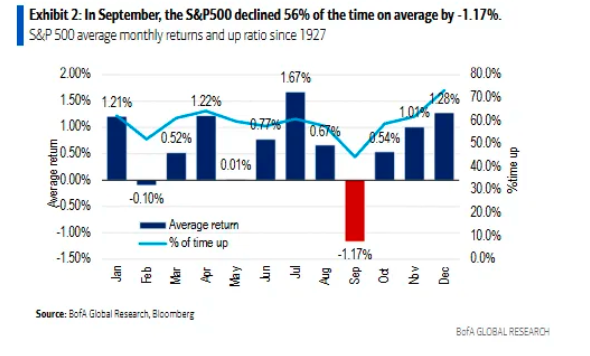
Core Viewpoint - September historically shows a decline in the S&P 500 index, averaging nearly 2% over the past decade, with current uncertainties such as potential Fed rate cuts and political pressures adding to market volatility [1][3]. Market Performance - September is noted as the most volatile month for U.S. markets, with a 56% probability of decline in the S&P 500 index since 1927, averaging a drop of 1.17%. In the last decade, the average decline has worsened to 1.93% [3]. - In the first year of a presidential term, the S&P 500 index has a 58% chance of declining in September, with an average drop of 1.62% [3]. Valuation and Investment Trends - The forward P/E ratio of the S&P 500 index has reached 22 times, nearing levels seen at the end of the internet bubble, raising concerns about potential sell-off pressures during portfolio rebalancing at the end of September [4]. - Recent market shifts show cyclical sectors and small-cap stocks leading gains, while large tech stocks lagged behind. Non-essential consumer goods ETFs rose by 4.3%, financial sector ETFs by 2.6%, and the Russell 2000 small-cap index increased by 7.3% [4]. Economic Indicators - Recent U.S. economic data presents a mixed picture, with significant drops in non-farm payrolls from May to July, while retail sales and major retailers' earnings indicate strong consumer spending [4]. - The upcoming non-farm payroll report is expected to show an increase of 75,000 jobs, with the unemployment rate potentially rising to 4.3% [7]. Federal Reserve Outlook - The Fed is anticipated to consider rate cuts due to recent employment data, with Chairman Powell indicating a shift in stance towards a more accommodative policy [7][9]. - Market expectations for rate cuts have fluctuated, with the probability of more than two cuts this year dropping from over 50% to below 30% [9]. Political Pressures - Concerns arise regarding the Fed's independence amid political pressures from the Trump administration, particularly regarding the potential influence over the Fed's board composition [9].

美国中产阶层经济信心下滑,消费趋势现两极分化
Sou Hu Cai Jing· 2025-09-01 20:57
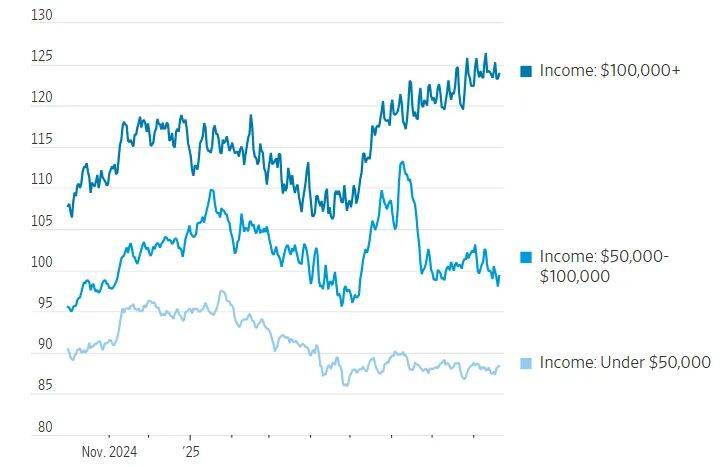
Group 1: Consumer Confidence and Spending Behavior - The consumer confidence index reported by the University of Michigan dropped nearly 6% in August compared to the previous month, reversing the slight recovery seen in June and July, indicating increasing concerns about the economic outlook [1] - Over 70% of respondents in a survey indicated plans to reduce purchases of items with significant price increases over the next year, particularly in retail and dining sectors [3] - Households with annual incomes between $50,000 and $100,000, which had shown optimism earlier, quickly shifted to a more pessimistic outlook, aligning with lower-income groups [1][3] Group 2: Retail and Dining Sector Trends - Walmart observed a decrease in the proportion of non-essential items in the shopping baskets of middle and low-income customers [3] - Kohl's reported that customers are increasingly opting for more affordable clothing and home goods, with the CEO noting that middle and low-income customers face the greatest challenges [3] - Dining establishments like IHOP and Denny's are seeing customers reduce beverage consumption and choose promotional items, reflecting a shift towards budget-friendly options [3] Group 3: High-Income Consumer Resilience - High-income consumers continue to engage in luxury spending, such as purchasing first-class airline tickets and high-end sneakers, showing resilience in their consumption patterns [3] - Swiss sneaker brand On reported a 32% revenue growth in the second quarter and raised its annual sales forecast, indicating strong demand in the high-end market [4] - United Airlines reported a 5.6% revenue increase in premium cabin sales, while economy class revenues experienced a decline, highlighting a clear divide in consumer spending behavior [4] Group 4: Impact on Other Industries - The medical aesthetics industry is witnessing a trend where consumers earning $150,000 or less are extending treatment intervals or reducing dosage, indicating significant impact from economic pressures [4] - Discount brands like Crocs are experiencing a slowdown in sales, contrasting with the performance of premium brands [4]
隔夜美股 | 三大指数下跌 英伟达(NVDA.US)跌超3.3% 黄金逼近历史高位
智通财经网· 2025-08-29 23:45
Market Overview - Major indices closed lower on Friday, but all recorded gains for the month, with the Dow Jones up 3.21%, Nasdaq up 1.58%, and S&P 500 up 1.91% for August [1] - The U.S. Court of Appeals ruled that most of the global tariff policies implemented by former President Trump were illegal, stating that he exceeded his authority [1] Economic Indicators - The core Personal Consumption Expenditures (PCE) price index, excluding food and energy, rose to 2.9% year-over-year, an increase of 0.1 percentage points from June [1] - The overall PCE index showed a year-over-year rate of 2.6% with a monthly increase of 0.2%, both meeting consensus expectations [1] - The University of Michigan's consumer confidence index fell to 58.2 in August, down from 61.7 in July, indicating growing pessimism about the economy [5] Stock Market Performance - On Friday, the Dow Jones fell by 92.02 points (0.20%) to 45,544.88, the Nasdaq dropped by 249.61 points (1.15%) to 21,455.55, and the S&P 500 decreased by 41.60 points (0.64%) to 6,460.26 [2] - Nvidia (NVDA) fell over 3.3%, while Apple (AAPL) and Amazon (AMZN) also experienced declines [2] Commodity and Currency Markets - Crude oil prices fell, with light crude oil futures down $0.59 to $64.01 per barrel (0.91% drop) and Brent crude down $0.50 to $68.12 per barrel (0.73% drop) [3] - The U.S. dollar index decreased by 0.04% to 97.771, with mixed performance against major currencies [3] Cryptocurrency and Precious Metals - Bitcoin dropped by 3.75% to $108,347.3, while Ethereum fell over 3.3% to $4,359.47 [4] - COMEX gold futures rose by 1.19% to $3,515.50 per ounce, approaching historical highs [4] Corporate News - Citadel Securities reported a 8.4% decline in net trading revenue for Q2, totaling $2.39 billion, but achieved a record total revenue of $5.77 billion for the first half of the year [6] - Morgan Stanley is seeking a review of new capital requirements set by the Federal Reserve, which will take effect on October 1 [7] Regulatory Developments - The European Union is expected to impose a moderate antitrust fine on Google for alleged anti-competitive practices in its advertising technology business [8]

关税与通胀忧虑挥之不去 美国消费者信心降至三个月低点
Zhi Tong Cai Jing· 2025-08-29 15:59
Group 1 - Consumer confidence in the U.S. significantly declined in August, reaching a three-month low, indicating ongoing concerns related to tariffs and inflation [1] - The final consumer confidence index for August dropped to 58.2, down from 61.7 in July and below the preliminary value of 58.6 [1] - Consumers expect prices to rise at an annual rate of 4.8% over the next year, an increase from the previous month's expectation of 4.5% [1] Group 2 - Approximately 63% of respondents anticipate an increase in the unemployment rate over the next year, a figure that is higher than both the previous month and the same period last year [1] - The willingness to purchase big-ticket items and automobiles has significantly worsened, with consumers citing high prices and tax/tariff factors as major concerns [1] - The U.S. government reported that consumer spending in July saw the largest month-over-month increase in four months, supported by income growth [2] Group 3 - The core PCE price index, excluding food and energy, rose to 2.9% year-over-year in July, marking the highest level since February [2] - The Michigan University index reflecting future expectations fell to 55.9, a three-month low, and the current conditions index also decreased to 61.7 [2]
爱尔兰8月份消费者信心略有改善
Shang Wu Bu Wang Zhan· 2025-08-28 15:33
Group 1 - The core viewpoint of the article indicates a slight improvement in consumer confidence in Ireland, attributed to a recent agreement between the EU and the US regarding tariffs on EU products exported to the US [1] - The consumer confidence index from the Irish Credit Union rose from 59.1 in July to 61.1 in August, marking a recovery from a two-year low [1]
每日机构分析:8月27日
Xin Hua Cai Jing· 2025-08-27 14:57
Group 1: European Economic Outlook - Pantheon Macroeconomics suggests that September may be the last opportunity for the European Central Bank to lower interest rates in the Eurozone, with current expectations that rates will remain at 2.00% unless August's consumer price inflation falls below expectations [1] - Concerns over Eurozone debt may weaken the Euro, as highlighted by Deutsche Bank, especially with the potential for a government trust vote in France regarding budget deficit cuts [2] Group 2: Consumer Confidence in Germany - The GfK consumer confidence index in Germany fell from -21.7 to -23.6, marking a third consecutive decline due to rising fears of unemployment and inflation uncertainty [2] - Analysts indicate that income expectations have dropped significantly, reaching the lowest level since March, contributing to the overall decline in consumer sentiment [2] Group 3: Market Impact of Political Uncertainty - Swiss bank analysts note that while political uncertainty in France has increased, its impact on the market remains limited, with a widening spread between French and German government bonds [3] - Barclays highlights that India faces heightened economic risks due to high tariffs, with a total trade-weighted tax rate of 35.7%, particularly affecting its electrical machinery and jewelry sectors [3] Group 4: Manufacturing Sector Concerns - CGS International economists warn that Singapore's manufacturing outlook may be negatively impacted by U.S. tariffs, with the manufacturing PMI falling into contraction territory in July [3] - Ongoing uncertainties regarding trade policies and tariffs are expected to sustain downward risks for Singapore's manufacturing sector [3]
失业担忧与通胀持续施压 德国消费者信心连降三月
智通财经网· 2025-08-27 09:15
Group 1 - The consumer confidence index in Germany is expected to decline for the third consecutive month in September, dropping from a revised -21.7 to -23.6 points, indicating increasing concerns over potential unemployment and inflation uncertainty [1][2] - The significant drop in income expectations to the lowest level since March is a key factor contributing to the overall decline in the consumer confidence index [1] - The uncertainty regarding inflation, influenced by geopolitical tensions and U.S. tariff policies, is further dampening consumer confidence and hopes for a significant recovery this year [1] Group 2 - The German economy contracted by 0.3% in the second quarter, leading to bleak recovery expectations for the year [2] - Household economic expectations and purchasing intentions have fallen to their lowest levels since February, indicating a cautious approach among consumers [2] - The HDE retail association has called for targeted relief for low- and middle-income families to stimulate the economy, emphasizing that domestic government actions are more effective than complex international issues [2] Group 3 - The GfK consumer confidence index indicates that a reading below zero signifies a year-on-year decline in private consumption, with each point change corresponding to a 0.1% change in private consumption [3] - The "purchase intention" indicator reflects the difference between positive and negative responses to whether now is a good time to buy large items [3] - The income expectations sub-index measures households' expectations regarding their financial situation over the next 12 months, while the additional business cycle expectations index assesses respondents' evaluations of the overall economic situation for the next year [3]

德国9月消费者信心因担心失业而下滑
Xin Hua Cai Jing· 2025-08-27 06:26
Core Insights - The Gfk consumer confidence index in Germany for September has decreased from -21.7 to -23.6, marking a third consecutive decline in consumer confidence [1] - Concerns over potential unemployment and inflation uncertainties are increasingly impacting consumer sentiment, leading to a cautious approach, especially in purchasing big-ticket items [1] - The uncertainty regarding inflation and geopolitical situations, along with U.S. tariff policies, is causing worries about rising energy prices among consumers [1] Consumer Sentiment Analysis - The significant drop in income expectations has reached its lowest level since March, playing a crucial role in the overall decline of consumer confidence [1] - The growing anxiety about unemployment is prompting many consumers to adopt a more cautious spending behavior [1] - The survey indicates that consumers are particularly concerned about how inflation will develop, which is further exacerbated by external factors such as geopolitical tensions [1]
加拿大零售销售全面走强 加元获强劲数据支撑
Jin Tou Wang· 2025-08-27 04:43
Core Viewpoint - The strong retail sales data from Canada in July indicates robust domestic consumption and consumer confidence, providing solid fundamental support for the Canadian dollar against the US dollar [1]. Group 1: Retail Sales Performance - Canada's retail sales in July increased by 1.5% month-on-month, aligning with market expectations [1]. - Core retail sales, excluding automobile sales, surged by 1.9%, significantly surpassing the market forecast of 1.1% [1]. - The strong performance in retail sales reflects a broad and significant enhancement in domestic consumption power [1]. Group 2: Economic Implications - The unexpected retail performance reinforces market perceptions of the resilience of the Canadian economy [1]. - This economic strength contributes to the relative strength of the Canadian dollar among major currencies [1]. Group 3: Currency Market Dynamics - The USD/CAD exchange rate is currently supported around 1.3820, with short-term resistance between 1.3900 and 1.3920 [1]. - A breakout above the resistance could lead to further gains towards 1.3980, while a drop below 1.3820 may open up a retracement towards 1.3750 [1]. - The overall trend indicates a range-bound movement in the exchange rate, awaiting new policy and data guidance [1].
隔夜美股 | 三大指数收高 英伟达(NVDA.US)涨1.09% 蔚来飙涨10%引领中概股反弹
智通财经网· 2025-08-26 22:55
Market Performance - The three major U.S. indices closed higher, with the Dow Jones up 135.60 points (0.30%) at 45418.07, the Nasdaq up 94.98 points (0.44%) at 21544.27, and the S&P 500 up 26.62 points (0.41%) at 6465.94. Nvidia (NVDA.US) rose by 1.09% ahead of its earnings report [1] - The Nasdaq Golden Dragon China Index increased by 0.72%, with NIO (NIO.US) rising by 10% and Xpeng (XPEV.US) up over 5% [1] European Market - European indices experienced declines, with Germany's DAX30 down 103.02 points (0.42%) at 24158.57, the UK's FTSE 100 down 57.25 points (0.61%) at 9264.15, and France's CAC40 down 133.23 points (1.70%) at 7709.81 [1] Asian Market - The Nikkei 225 index fell by 0.97%, the KOSPI index dropped by 0.95%, and the Indonesian Composite Index decreased by 0.27% [2] Commodity Prices - Crude oil prices declined, with light crude futures for October down $1.55 to $63.25 per barrel (2.39% drop) and Brent crude down $1.58 to $67.22 per barrel (2.30% drop) [2] - Gold prices rose, with spot gold up 0.83% to $3393.49 per ounce, and COMEX gold futures up 0.65% to $3439.60 per ounce [3] Consumer Confidence - The U.S. consumer confidence index for August decreased to 97.4, reflecting growing concerns about employment and income, with the current conditions index hitting its lowest level since April [4] Federal Reserve Developments - Federal Reserve Governor Cook remains in her position pending a court ruling, allowing her to participate in upcoming meetings [5] - Analysts from Evercore predict a significant "Trumpification" of the Federal Reserve by 2026, potentially impacting its independence and policy responses [6] Real Estate Market - U.S. home prices saw a year-over-year increase of 1.9% in June, marking the lowest growth rate of 2023, as the market experiences a slowdown due to high prices and mortgage rates [7] Corporate News - ExxonMobil is in discussions to potentially return to Russia's Sakhalin project, contingent on government approvals [8] - Meta Platforms announced the establishment of a political action committee in California to support candidates advocating for relaxed AI regulations [9] - Morgan Stanley upgraded NIO (NIO.US) from "neutral" to "overweight," raising the target price from $4.8 to $8 [10]

