硬科技

Search documents
港股三大指数集体高开,南向资金年内累计净买入近7000亿港元
Mei Ri Jing Ji Xin Wen· 2025-06-20 02:09
Group 1 - The Hong Kong stock market opened higher on June 20, with the Hang Seng Index rising by 0.23% to 23,291.40 points, the Hang Seng Tech Index up by 0.3%, and the National Enterprises Index increasing by 0.22% [1] - Southbound capital has accumulated a net purchase of Hong Kong stocks amounting to HKD 696.04 billion this year, which is 86% of the projected net purchase of HKD 807.87 billion for the entire year of 2024 [1] - CICC estimates that the relatively certain incremental southbound capital for the year is between HKD 200-300 billion, with total inflows potentially exceeding HKD 1 trillion for the year [1] Group 2 - The Hong Kong Consumption ETF (513230) combines e-commerce and new consumption, covering relatively scarce new consumption sectors compared to A-shares [2] - The Hang Seng Technology Index ETF (513180) includes core AI assets in China, encompassing technology leaders that are relatively scarce compared to A-shares [2]

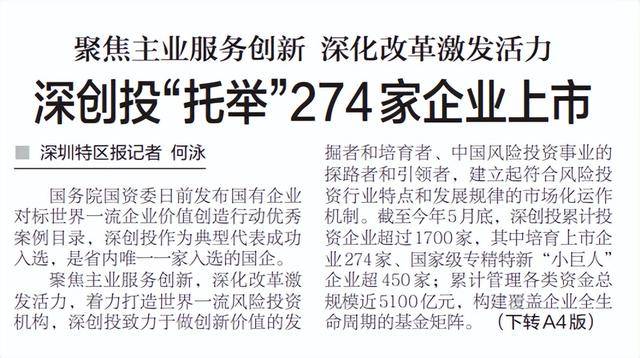
【深圳特区报】聚焦主业服务创新 深化改革激发活力 深创投“托举”274家企业上市
Sou Hu Cai Jing· 2025-06-20 00:13
Core Viewpoint - The State-owned Assets Supervision and Administration Commission (SASAC) has recognized Shenzhen Capital Group (深创投) as a leading example in the value creation action plan for state-owned enterprises, marking it as the only representative from the province [2][6]. Group 1: Investment Strategy and Achievements - Shenzhen Capital Group focuses on its core business and innovation services, aiming to become a world-class venture capital institution, having invested in over 1,700 companies and nurtured 274 listed companies as of May this year [2][6]. - The total scale of funds managed by Shenzhen Capital Group is nearly 510 billion yuan, establishing a comprehensive fund matrix covering the entire lifecycle of enterprises [6][7]. - The company emphasizes the importance of early-stage investments, with over 85% of its projects being in the early or growth stages, effectively meeting the funding needs of high-tech and innovative enterprises [11]. Group 2: Sector-Specific Investments - Shenzhen Capital Group has made significant investments in the semiconductor and new materials sectors, supporting innovation and growth in these industries [3][7]. - In the semiconductor design field, investments include companies involved in various chip applications, while in semiconductor materials, investments cover advanced materials such as special gases and silicon carbide [3][7]. - The company has directly invested over 30 billion yuan in the new materials sector, focusing on strategic and foundational areas, successfully aiding in the domestic production of critical materials [8]. Group 3: Long-term Investment Philosophy - Shenzhen Capital Group adheres to a long-term investment philosophy, providing continuous support to companies, with over 20% of its investments being in companies for more than ten years [11]. - The firm actively engages in nurturing companies through multiple rounds of investment, ensuring they can focus on core technological breakthroughs and accelerate their listing processes [10][11]. - The company’s strategy includes a proactive approach to identifying and investing in high-potential technology enterprises, with over 90% of its funds allocated to hard technology sectors [4][10].
前沿科技企业心思“活”了 券商投行“动”起来了
证券时报· 2025-06-19 23:23
Core Viewpoint - The recent policy changes by the China Securities Regulatory Commission (CSRC) to support unprofitable companies in the Sci-Tech Innovation Board (STAR Market) are expected to significantly enhance the IPO opportunities for companies in emerging sectors such as artificial intelligence, commercial aerospace, and low-altitude economy [2][9]. Group 1: Policy Impact - The CSRC's new guidelines aim to create a more inclusive and adaptable environment for technology-driven companies, allowing them to list on the STAR Market even if they are not yet profitable [2][13]. - The reintroduction of the fifth listing standard is seen as a shift from focusing solely on profitability to considering innovation and potential, which is crucial for companies in high-tech sectors [5][10]. Group 2: Industry Response - Companies in the artificial intelligence, commercial aerospace, and low-altitude economy sectors are actively preparing for IPOs, recognizing the favorable conditions created by the new policies [3][6]. - Firms like Volant Aerospace and Yufeng Future are exploring listing options, indicating a strong interest in leveraging the new capital market opportunities to support their growth and technological advancements [6][10]. Group 3: Investment Community Reaction - Investment banks and venture capital firms are also responding positively, with plans to increase project reserves and encourage portfolio companies to evaluate STAR Market opportunities [7][9]. - The emphasis is on the importance of demonstrating technological uniqueness and industrial value, rather than relying solely on concepts, to attract market interest [7][11]. Group 4: Future Outlook - The reforms are expected to alleviate the financing difficulties faced by tech companies, particularly those with significant R&D investments and long development cycles [8][10]. - The commercial aerospace sector, despite previous funding challenges, is anticipated to benefit from clearer IPO expectations, which could enhance investor confidence and funding availability [10][11].

苏创投管理基金三年增加1000亿
Su Zhou Ri Bao· 2025-06-19 21:51
Core Insights - Suzhou Innovation Investment Group has significantly increased its fund management scale from 160 billion to over 260 billion, with new cooperative fund scale reaching 151.9 billion [1][2] - The company has established a comprehensive investment ecosystem focusing on hard technology, with 70% of its new funds dedicated to specialized industry sectors [3][4] - The firm has directly invested in over 200 projects, facilitating the listing of 13 companies on capital markets [4][6] Fund Management and Growth - The company has added 1 trillion in management funds since its inception, with 70% of these funds allocated to specialized projects [2][3] - It has launched eight mother funds totaling 38 billion, with over 100 sub-funds amounting to nearly 80 billion [2][3] - The firm has partnered with various well-known investment institutions and established 13 funds across ten key sectors, including biomedicine and new energy [2][3] Investment Strategy and Performance - The investment strategy emphasizes early-stage investments, with over 60% of investments in angel and A-round projects [3][4] - The company has nurtured 33 "little giant" enterprises and 10 unicorns, demonstrating its commitment to fostering innovation [3][6] - Among the 33 funds managed for over three years, 10 have a MOIC greater than 2, indicating strong performance [5][6] Project and Industry Focus - The firm has invested in key sectors such as artificial intelligence, biomedicine, and new energy, targeting industry leaders and promising projects [4][5] - It has directly invested in 232 projects, with a total investment exceeding 4.5 billion, attracting over 20 billion in social capital to Suzhou [5][6] - The company has established a full-cycle empowerment ecosystem for technology innovation and industrial upgrading [7][8] Brand and Recognition - Suzhou Innovation Investment Group has developed seven brands to enhance its service offerings and industry collaboration [8] - The firm ranks highly in national venture capital rankings, reflecting its growing influence in the industry [8] - The company aims to achieve ambitious targets for new direct investment projects and cooperative funds in the coming year [8]
帮主郑重:新兴市场三连跌,全球避险情绪再起背后的门道
Sou Hu Cai Jing· 2025-06-19 12:47
Group 1 - The recent decline in emerging markets is attributed to two main factors: rising U.S. inflation and escalating tensions in the Middle East, particularly between Israel and Iran, which has led to a spike in oil prices to $94 per barrel [3] - Emerging markets are facing capital outflows, with foreign investment in A-shares decreasing, particularly in sectors like electronics and food and beverage [3] - Defensive sectors such as energy and precious metals in the A-share market have shown resilience, indicating a shift in investment strategies towards safer assets [3] Group 2 - Countries like Indonesia and Turkey are experiencing significant economic challenges, with Indonesia's foreign capital outflow reaching $165 billion and Turkey's currency hitting a historic low against the dollar [3] - Despite the current market turmoil, long-term investment opportunities may arise in commodities like palm oil in Indonesia and rubber in Thailand, which have seen price declines [3] - The potential for U.S. interest rate cuts later in the year remains, particularly if the job market weakens, which could further impact market volatility [4]
中科创星李浩:中国硬科技投资远远不够,持续关注底层创新丨最前线
3 6 Ke· 2025-06-19 11:16
Core Viewpoint - China's hard technology investment is not overheated but is significantly insufficient, requiring collective efforts from society to enhance the financial system's confidence and understanding of technology [1] Group 1: Investment Landscape - Zhongke Chuangxing, founded in 2013, is a pioneer in hard technology investment, focusing on the transformation of excellent scientific research achievements from research institutions and universities [1] - As of June this year, the fund's managed scale exceeds 12 billion yuan, having invested in and incubated over 530 hard technology companies [1] - Zhongke Chuangxing maintains a rapid investment pace despite the contraction of dollar funds and difficulties in GP fundraising [1] Group 2: Investment Strategy - Zhongke Chuangxing is one of the fastest institutions in the market, with last year's project count equivalent to the total of 30 GPs [2] - The firm employs a unique risk-hedging logic, emphasizing a large project pool to diversify risks, where 50 out of 100 projects may fail, but top projects can cover losses [2] - The company is particularly focused on the AI sector, which, despite being hot, is still in its early development stage, and values breakthroughs in underlying technologies such as quantum computing and controlled nuclear fusion [2] Group 3: Long-term Vision - Hard technology investments require "patient capital," with many projects co-invested with local future industry funds due to long investment cycles that can last up to 20 years [2] - Zhongke Chuangxing aims to balance long-term value with short-term exits by constructing a "research-incubation-industry" flywheel, binding early with research projects and later introducing industrial capital [2] - The company emphasizes the need for more "last-mile" participants to improve the low conversion rate of China's scientific and technological achievements [3]
汇通能源: 关于与专业投资机构共同投资的公告
Zheng Quan Zhi Xing· 2025-06-19 10:39
Investment Overview - The company Shanghai Huitong Energy Co., Ltd. is investing RMB 30 million through its subsidiary Shanghai Huidexinyuan Enterprise Management Co., Ltd. in the Anhui Gaoxin Yuanhe Puhua Private Equity Investment Fund [1][2] - The investment aims to enhance the company's presence in the semiconductor and intelligent manufacturing sectors, focusing on hard technology [2][9] - The investment does not require approval from the board of directors or shareholders and is not classified as a related party transaction or a major asset restructuring [3][9] Fund and Management Details - The Anhui Gaoxin Yuanhe Puhua Private Equity Investment Fund was established on August 22, 2024, with a target total subscription amount of RMB 2.5 billion [3][6] - The fund's investment strategy focuses on key technologies and projects that support the development of emerging industries in the Yangtze River Delta region, with at least 70% of the investment directed towards semiconductor and intelligent manufacturing sectors [6][9] - The fund management is handled by Yuanhe Puhua Tongxin (Suzhou) Investment Management Co., Ltd., which was established on November 17, 2020 [4][6] Partner Contributions - The fund includes various partners, with notable contributions from entities such as Suzhou Yuanhe Holdings Co., Ltd. (RMB 50 million) and Anhui San Chong Yi Chuang Industry Development Fund (RMB 46.3 million) [5][6] - The total contributions from all partners amount to RMB 155.7 million, with the company contributing RMB 30 million, representing 1.93% of the total [5][6] Fund Management and Distribution - The fund will have an investment decision committee composed of five members, with decisions requiring a two-thirds majority [7][8] - The distribution of profits will follow a specific order, ensuring that all partners receive their initial contributions back before any profit sharing occurs [8][9] Impact on Company Operations - The investment is expected to leverage professional investment resources and management capabilities, enhancing the company's investment layout in hard technology sectors without significantly impacting its daily operations [9]

汇通能源:子公司拟出资3000万元参与投资产业基金 后者重点关注以半导体和智能制造为核心的硬科技领域
news flash· 2025-06-19 09:47
Core Viewpoint - Huitong Energy's subsidiary plans to invest 30 million RMB in a private equity fund focusing on hard technology sectors, particularly semiconductors and intelligent manufacturing [1] Investment Details - The investment amount is set at 30 million RMB, which is approximately 4.5 million USD [1] - The subsidiary involved is Shanghai Huidexinyuan Enterprise Management Co., Ltd., acting as a limited partner [1] - The targeted investment fund is Anhui Gaoxin Yuanhe Puhua Private Equity Investment Fund Partnership (Limited Partnership) [1] Strategic Focus - The fund will concentrate on emerging industries within the Yangtze River Delta region, with a primary focus on hard technology sectors [1] - Key areas of investment include semiconductors and intelligent manufacturing [1] Purpose of Investment - The investment aims to leverage the resources and investment management capabilities of professional investment institutions [1] - The company seeks to enhance its investment footprint in relevant sectors while also aiming for financial returns [1]
电子行业快评报告:增强优质科技型企业的制度包容性适应性,推动高水平科技自立自强
Wanlian Securities· 2025-06-19 09:42
Investment Rating - The industry investment rating is "stronger than the market," indicating an expected increase of over 10% in the industry index relative to the broader market within the next six months [8]. Core Insights - The report emphasizes the importance of enhancing the institutional inclusiveness and adaptability for high-quality technology enterprises through the deepening of the Sci-Tech Innovation Board and the Growth Enterprise Market reforms [2][3]. - The establishment of the "Sci-Tech Growth Layer" aims to support technology companies that have significant breakthroughs, broad commercial prospects, and ongoing R&D investments, even if they are currently unprofitable [2]. - The report highlights the introduction of six reform measures on the Sci-Tech Innovation Board, including the pilot introduction of a professional institutional investor system and a pre-review mechanism for IPOs targeting high-quality technology firms [2][3]. - The report identifies emerging industries and future industries as key drivers for achieving high-level technological self-reliance and strength, with a focus on sectors such as artificial intelligence, commercial aerospace, and low-altitude economy [3][7]. Summary by Sections Industry Overview - The report discusses the recent policy measures aimed at enhancing the inclusiveness and adaptability of the capital market for high-quality technology enterprises, which is expected to facilitate the growth of unprofitable yet innovative companies [2][3]. Policy Measures - The report outlines six specific policy initiatives designed to support the growth of technology firms, including expanding the application of the fifth set of listing standards to more frontier technology sectors [3]. Investment Opportunities - The report suggests that the new policies will create investment opportunities in traditional industry upgrades and the cultivation of emerging and future industries, particularly in sectors like artificial intelligence and commercial aerospace [7].
国资创投下一站的故事这样讲
Jing Ji Guan Cha Wang· 2025-06-19 08:37
Core Viewpoint - The new phase of state-owned enterprise (SOE) reform emphasizes guiding SOE funds to "invest early, invest small, and invest in hard technology" [2][4][30]. Group 1: Policy and Implementation - The State-owned Assets Supervision and Administration Commission (SASAC) held a meeting on June 17, 2023, to outline the reform work, focusing on new industries and technological value [2]. - Various regions, including Zhejiang, Jiangsu, Shanghai, Guangdong, and Hubei, have begun exploring the "invest early, invest small, and invest in hard technology" model since 2025 [3]. - SASAC plans to promote reforms in the mechanisms for technological and industrial innovation, guiding SOE funds to adopt the new investment strategy [4][30]. Group 2: Case Studies and Successes - The Zhejiang Science and Technology Innovation Fund is an early adopter of the "invest early, invest small, and invest in hard technology" model, aiming to support technological innovation in the province [3][7]. - Zhejiang's fund evaluation mechanism has been reformed to extend the investment cycle from 8-10 years to 15 years, encouraging patience in capital investment [8]. - Zhejiang's investment in Huahai Qingshi, a semiconductor equipment company, yielded a financial return of 470 million yuan, with an investment return rate of 15.6 times [19]. Group 3: Challenges and Recommendations - SOE venture capital faces challenges, including insufficient risk tolerance for state capital, which affects investment enthusiasm [4][32]. - The SASAC is working on defining the next steps for state capital investment, focusing on avoiding blind competition and ensuring strategic alignment with national industrial development [31]. - Experts suggest enhancing the investment environment by increasing funding, improving exit mechanisms for early-stage projects, and establishing a comprehensive evaluation and incentive mechanism for early-stage investments [32][33].