
价值投资

Search documents
A股重磅!参与两融交易投资者数量,创年内新高!
天天基金网· 2025-08-15 05:02
Core Viewpoint - The article highlights the significant increase in margin trading activity in the A-share market, with the margin balance surpassing 2 trillion yuan, indicating improved market sentiment and policy expectations [2][3]. Group 1: Margin Trading Statistics - As of August 13, the number of individual investors participating in margin trading reached 7.5568 million, with institutional investors numbering 50,004 [2]. - The margin balance stood at 20,320.45 billion yuan, continuing to exceed 2 trillion yuan, which is a notable increase compared to previous periods [2]. - The current margin requirement is set at a minimum of 80%, with a maximum leverage of 1.25 times, contrasting with the 50% requirement and 2 times leverage seen in 2015 [2]. Group 2: Market Sentiment and Policy Impact - Analysts believe that the resurgence of the margin balance above 2 trillion yuan is driven by improved policy expectations and a rebound in market risk appetite [2][3]. - The flow of financing has primarily targeted sectors such as information technology, industrials, and materials, reflecting confidence in structural economic upgrades [2]. - The current market environment is characterized by a more stable and precise allocation of funds, with a clear inclination towards value investing [3]. Group 3: Historical Context and Future Outlook - Compared to ten years ago, the market ecosystem surrounding margin trading has undergone profound changes, with enhanced policies and a more robust market foundation [3]. - Despite the increase in margin trading, the proportion of margin balance to A-share market capitalization remains at historical midpoints, significantly lower than the peak levels seen in 2015 [3]. - The overall liquidity in the A-share market has been improving since September of the previous year, supporting a sustained upward trend in the market [3].


段永平Q2豪赌AI:谷歌持仓暴增75%,英伟达加仓近50%,同时加仓苹果、拼多多
美股IPO· 2025-08-15 04:03
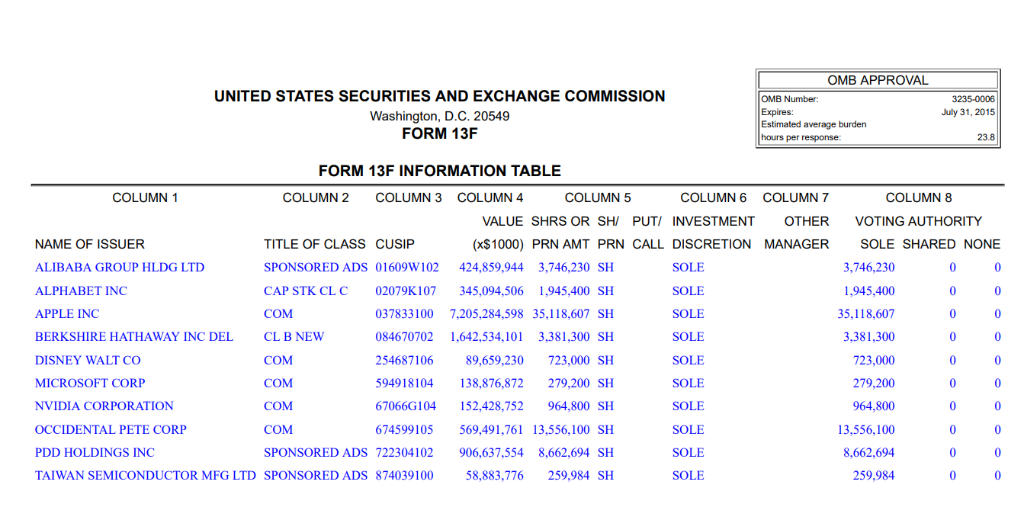
Core Viewpoint - H&H International Investment, managed by Duan Yongping, has made significant adjustments to its portfolio, notably increasing holdings in AI-related stocks like Google and NVIDIA, while also adding to positions in Apple and Pinduoduo, indicating a strong belief in AI's future potential and a focus on high-conviction investments [1][3][8]. Group 1: Portfolio Adjustments - H&H increased its stake in Google by 830,000 shares, a 75.17% increase, and in NVIDIA by 320,000 shares, a 49.56% increase, reflecting a strong commitment to AI investments [1][8]. - The firm also added 894,426 shares of Apple, marking a 2.61% increase, reversing a trend of previous reductions, which underscores a renewed confidence in Apple's long-term value [5][9]. - Pinduoduo saw an increase of 908,794 shares, a rise of 11.72%, solidifying its position as the third-largest holding in the portfolio [9]. Group 2: Sector Focus - The adjustments indicate a concentrated investment strategy in AI, with a clear preference for leading companies in the sector, while showing a selective approach by reducing positions in other tech giants like Microsoft and TSMC [8][9]. - The portfolio's total value reached $11.53 billion, with Apple representing over 62% of the total holdings, followed by Berkshire Hathaway at approximately 14.2% [3][6]. Group 3: Market Sentiment - The moves reflect a broader market sentiment towards AI, with Duan Yongping's actions signaling a strong belief in the growth potential of AI technologies, while also demonstrating a cautious approach by not fully committing to all major tech players [8][10].





证券ETF(512880)涨超2.3%,市场关注两融回暖与政策预期共振
Sou Hu Cai Jing· 2025-08-15 02:13
Group 1 - The core viewpoint is that the A-share market's margin financing balance has returned to a high of 2 trillion yuan, indicating improved policy expectations and a rebound in market risk appetite [1] - Regulatory authorities have released multiple signals to stabilize the capital market, enhancing investor confidence through expectations of incremental reforms and institutional optimizations [1] - Financing funds are primarily flowing into sectors such as information technology, industrials, and materials, reflecting optimism towards industrial structure upgrades [1] Group 2 - Compared to ten years ago, the current market ecosystem is more refined, with more precise capital allocation and a tendency towards value investing [1] - The expansion of insurance capital private equity securities funds, such as the establishment of private equity funds by Taiping Asset Management, aims to increase long-term capital investment in the capital market, supporting national strategies and the real economy [1] - The recent increase in market activity in the securities sector is evidenced by the margin financing balance, which accounts for 2.30% of the A-share circulating market value, indicating a positive impact of leveraged funds on the market [1] Group 3 - The Securities ETF (512880) tracks the Securities Company Index (399975), which selects listed companies involved in securities brokerage, underwriting, and proprietary trading to reflect the overall performance of the securities industry [1] - The constituent stocks of this index have strong market representation, with industry allocation concentrated in the financial services sector [1] - Investors without stock accounts may consider the Guotai CSI All-Share Securities Company ETF Connect C (012363) and Guotai CSI All-Share Securities Company ETF Connect A (012362) [1]
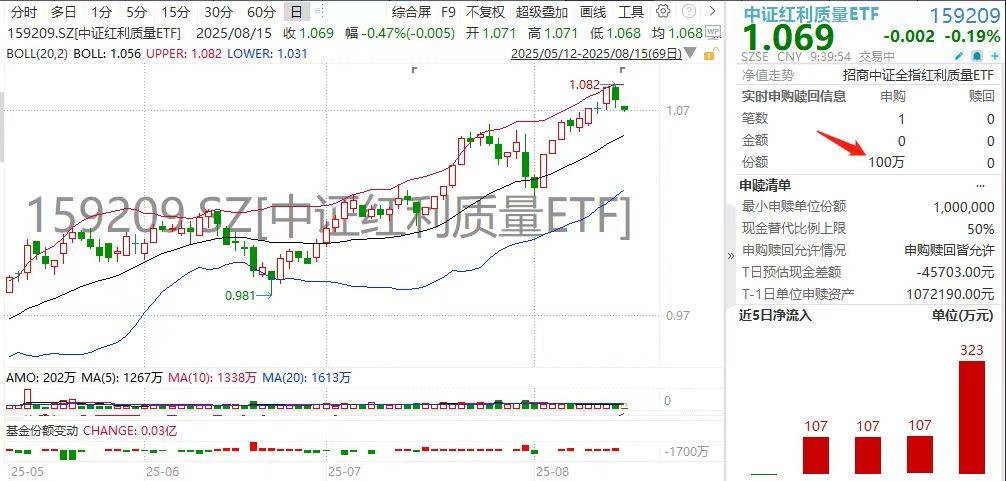
开盘10分钟,聪明资金连续第5日增仓中证红利质量ETF(159209)
Sou Hu Cai Jing· 2025-08-15 01:58
Core Viewpoint - The China Securities Dividend Quality ETF (159209) is experiencing increased trading activity, with a slight decline of 0.09% as of 9:40 AM on August 15, indicating sustained investor interest in the fund's dual focus on dividends and quality metrics like ROE [1] Group 1: Fund Performance - The ETF has seen a continuous increase in positions for five consecutive days, reflecting strong market interest [1] - The fund emphasizes both dividend yield and quality, with top holdings like Fuyao Glass and Kweichow Moutai showcasing high ROE figures of 22% and over 30%, respectively [1] Group 2: Investment Strategy - The fund is positioned as suitable for value investors who prefer acquiring great companies at reasonable prices rather than chasing low stock prices [1] - Investors are encouraged to buy into the fund at appropriate times, with the potential for excess returns when economic conditions improve [1]
帮主郑重:巴菲特突然"抛弃"苹果?这些动作透露股神新策略!
Sou Hu Cai Jing· 2025-08-15 01:56
Core Insights - Berkshire Hathaway's recent quarterly report revealed a significant reduction in its Apple holdings, with a sale of 20 million shares, resulting in a $4.1 billion decrease in market value [3] - The company is shifting its investment strategy from technology stocks to traditional sectors such as healthcare and steel, indicating a potential defensive posture in response to market conditions [5] Group 1: Apple Holdings - Apple remains Berkshire's largest holding, despite the recent reduction, which reflects a strategic decision rather than a complete divestment [3] - The decision to reduce Apple shares may be influenced by its high price-to-earnings ratio exceeding 30, which could be perceived as overvalued by traditional value investors [3] - The potential increase in capital gains tax in the U.S. may have prompted the early reduction in holdings as a tax planning strategy [3] Group 2: Bank of America - Berkshire reduced its stake in Bank of America by 26 million shares, cutting its holdings by half within a year, which raises concerns about the bank's profitability amid changing interest rate policies [4] - The bank is facing $109 billion in unrealized losses, which could pose significant risks to its financial stability [4] Group 3: New Investments - Berkshire has made new investments in three companies: Nucor Steel, Lennar, and D.R. Horton, all of which are considered "hidden champions" in traditional industries [4] - The real estate sector is currently undervalued, with both Lennar and D.R. Horton trading at a price-to-book ratio below 1, presenting potential buying opportunities [4] - Nucor Steel is positioned well as a leading steel producer, which could benefit from future infrastructure spending [4] Group 4: Healthcare Sector - A notable new investment is in UnitedHealth, with Berkshire acquiring 5 million shares for $1.6 billion, reflecting confidence in the healthcare sector's stability and growth potential [5] - The healthcare industry is characterized by strong customer loyalty and stable cash flows, aligning with Berkshire's investment criteria for companies with a "moat" [5] Group 5: Investment Strategy - The overall trend in Berkshire's portfolio indicates a shift towards defensive sectors such as healthcare, steel, and real estate, suggesting preparation for potential economic downturns [5] - Berkshire's cash reserves have exceeded $150 billion, indicating readiness to capitalize on market opportunities during periods of volatility [5] - The investment strategy emphasizes the importance of maintaining a diversified portfolio and being prepared for market fluctuations [6][7]
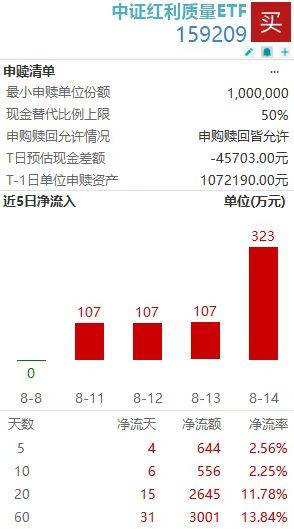
5日4度净流入!“巴菲特钟爱”的中证红利质量ETF(159209)获密集增仓
Sou Hu Cai Jing· 2025-08-15 01:39
Core Insights - The market's upward momentum has temporarily paused, leading to increased risk-averse sentiment among investors [1] - The China Securities Dividend Quality ETF (159209) has seen significant net inflows over the past five days, indicating strong investor interest [1] Summary by Category ETF Performance - The China Securities Dividend Quality ETF (159209) recorded a net inflow of 32.3 million yuan over the last five days, with four days of net inflows [2] - The ETF employs a "dividend + quality" dual-factor screening mechanism, targeting high-quality companies with low valuations [1][2] Investment Strategy - Analysts suggest that combining the China Securities Dividend Quality ETF (159209) with the Hong Kong Dividend Low Volatility ETF (520550) can create a "barbell strategy" that balances offensive and defensive positions [1] - This strategy allows for risk diversification across both markets, enhancing long-term investment returns through low fees and monthly dividends [1] Market Context - The current market environment reflects a cautious approach from investors, as evidenced by the inflows into the dividend-focused ETFs [1]
“股神”巴菲特二季度再抛40亿美元苹果股票!“最新猎物”曝光
Sou Hu Cai Jing· 2025-08-15 01:36
Group 1 - Berkshire Hathaway, led by Warren Buffett, has continued to sell off its shares in Apple, reducing its holdings by over $4 billion, indicating a shift in investment strategy [2] - The company sold 20 million shares of Apple between April and June, bringing its total holdings down to 280 million shares valued at $57.4 billion, marking the first sale since Q3 2024 [2] - The decision to sell was influenced by Apple's high valuation, which has significantly increased since Buffett's initial investment in 2016, leading to concerns about the company's growth not supporting such a valuation [2][3] Group 2 - Following Apple's CEO Tim Cook's commitment to invest in the U.S., Apple’s stock rebounded by 12%, with the sale of Apple shares constituting a major part of Berkshire's total stock sales during the period, which amounted to approximately $6.9 billion [3] - Berkshire also sold shares in Bank of America and completely exited its position in T-Mobile, generating $4.2 billion in investment gains during the second quarter [3] - The company invested $3.9 billion in stocks during the same period, increasing its stakes in Chevron, Domino's Pizza, and Constellation Brands [3] Group 3 - Berkshire disclosed previously undisclosed purchases from Q1, including shares in homebuilders Lennar and DR Horton, as well as steel manufacturer Nucor, and continued to increase its positions in Lennar and Nucor in Q2 [4] - The company also invested in UnitedHealth, with a holding valued at $1.6 billion as of June 30, coinciding with the company facing multiple government investigations and a significant drop in stock price due to the resignation of its former CEO [4] - Following the disclosure of its position in UnitedHealth, the stock price rose by 10% in after-hours trading [4]
段永平Q2豪赌AI:谷歌持仓暴增75%,英伟达加仓近50%,同时加仓苹果、拼多多
Hua Er Jie Jian Wen· 2025-08-15 00:52
Core Insights - Renowned investor Duan Yongping has significantly increased his holdings in AI stocks, specifically Google and NVIDIA, while also adding to positions in Apple and Pinduoduo, and reducing stakes in Alibaba and Microsoft [1][5][6]. Group 1: Portfolio Overview - Duan Yongping's H&H International Investment reported a total portfolio value of $11.53 billion as of June 30, 2025, with Apple being the largest holding at $7.205 billion, accounting for over 62% of the portfolio [1][4]. - The second-largest holding is Berkshire Hathaway, making up approximately 14.2% of the portfolio, followed by Pinduoduo at 7.86%, Occidental Petroleum at 4.94%, and Alibaba at 3.68% [1][4]. Group 2: Key Stock Movements - Duan Yongping reversed his previous trend of reducing Apple shares by purchasing an additional 894,426 shares, increasing his stake by 2.61% during the second quarter [3][4]. - In the AI sector, he aggressively increased his holdings in NVIDIA by nearly 32,000 shares, a 49.56% increase, and bought over 830,000 shares of Google, marking a 75.17% increase [5][6]. - Pinduoduo also saw a significant increase in holdings, with over 900,000 shares added, reflecting an 11.72% rise [7]. Group 3: Adjustments in Other Holdings - Duan Yongping made minor adjustments to his positions in other stocks, maintaining his stake in Berkshire Hathaway while slightly reducing his holdings in Occidental Petroleum by 1.95% and Alibaba [8]. - The approach indicates a selective strategy, as he reduced exposure to Microsoft while focusing on AI leaders [6].
南华基金黄志钢:以量化创新融合价值投资
Zhong Zheng Wang· 2025-08-15 00:18
同时,南华基金团队运用低估值策略(低PE、低PB、高股息),精筛个股构建组合,力求在市场 极端波动中有效缓冲风险,守护投资者体验。团队超越传统估值框架,综合多维因子深度挖掘企业的内 在价值,力争捕捉市场错误定价带来的投资机会。 现如今,南华基金持续深化"深耕浙江"战略,联动区域法人金融机构资源,锻造"小而美、专而 精"的独特竞争优势。这一战略不仅助力区域经济高质量发展,也为南华基金自身在服务实体经济的进 程中开拓了可持续增长的新空间。 凭借"量化+价值"双轮驱动的创新内核,以及对政策与区域经济的深度协同,南华基金在公募赛道 中树立起鲜明的技术派旗帜。展望未来,南华基金将持续迭代模型、拓展能力边界,力求为投资者创造 穿越周期的长期价值,为中国资产管理行业的创新发展贡献"南华智慧"。 中证报中证网讯(王珞)近日,由南华基金总经理助理黄志钢带领打造的数据模型——"南华基金 量化投资时钟"上线。黄志钢表示,这一模型绝非简单的数据堆砌。在公募基金同质化竞争日益激烈的 今天,南华基金开辟出一条量化与价值深度融合的创新路径。凭借对市场规律的深刻洞察与技术的前沿 探索,公司不仅构建了独具特色的量化投资体系,更在波动的市场中为 ...
【私募调研记录】保银投资调研安杰思
Zheng Quan Zhi Xing· 2025-08-15 00:10
Group 1 - The core viewpoint of the news highlights that Anjisi is facing a slight decline in North American sales revenue due to Sino-US trade tariff friction, but the company remains confident in achieving its annual targets [1] - Research and development expenses have increased by 90.73% year-on-year, primarily for the development of Hang'an medical diagnostic equipment, with the reusable soft endoscope entering the product registration phase [1] - Domestic sales gross margin has decreased to 67.58%, mainly due to the impact of centralized procurement on hemostatic clips, although domestic sales revenue has grown by 10.50% [1] Group 2 - The ERCP series products are rapidly gaining market traction, with single-pole ESD products being trialed in over 250 hospitals and an admission rate of 20% [1] - The proportion of self-owned brand sales is increasing, with collaborations with top KOLs in Europe and the Asia-Pacific region to deepen global expansion [1] - The Thai production base project is progressing steadily, with production costs higher than domestic levels, and future mid-to-low-end consumables will be concentrated in Thailand [1] Group 3 - Sales revenue in Europe, Asia, and South America has increased, while North America has seen a decline, with multiple products entering the product registration phase [1]
