
关税

Search documents
Best-Performing ETF Areas of Last Week
ZACKS· 2025-07-15 12:01
Market Overview - U.S. stocks closed lower on July 11, 2025, following President Trump's announcement of a 35% tariff on Canada, raising concerns over trade tensions [1] - The S&P 500 remained flat for the week, while the Dow Jones fell by 1% and the Nasdaq Composite increased by approximately 0.5% [1] Tariff Announcements - President Trump attributed the Canadian tariff increase to fentanyl trafficking concerns and warned of potential retaliation from Canada, which could lead to additional duties [2] - Trump suggested that broader tariffs could be implemented, potentially increasing blanket duties on all countries to 15-20%, up from the current 10% [2] - On July 11, 2025, Trump announced 30% tariffs on the EU and Mexico, effective August 1 [4] Market Sentiment - Despite initial tariff announcements, the S&P 500 rose by 0.3% to a record high on Thursday, indicating some investor optimism [3] - However, sentiment shifted on Friday as traders anticipated updates on potential EU tariffs, leading to a decline in equities [4] - Barclays noted that the recent tariff escalations have caused less disruption to equity markets compared to previous selloffs, but long-term effects on economic growth and inflation remain uncertain [5] Cryptocurrency Market - Bitcoin reached a new all-time high of $118,000, driven by institutional demand and optimism surrounding global crypto adoption [8] - The upcoming "Crypto Week" in Congress, starting July 14, will address key regulations that could impact the cryptocurrency industry, including the GENIUS Act for a federal stablecoin framework [9] ETF Performance - Cannabis ETFs saw significant gains, with Roundhill Cannabis ETF up 25.2% and AdvisorShares Pure US Cannabis ETF up 21.9%, following indications of presidential support for rescheduling [11] - Shipping ETFs also performed well, with Breakwave Dry Bulk Shipping ETF rising by 19.6% due to increased freight rates amid trade route tensions [12] - Ethereum ETFs experienced a surge, with VanEck Ethereum ETF and 21Shares Core Ethereum ETF both up 17% as Ether price gained about 13% [13] - A crypto-based ETF, STKd 100% MSTR & 100% COIN ETF, rose by 16% in line with Bitcoin's rally [14] - The VanEck Rare Earth and Strategic Metals ETF increased by 10.7% following a price hike announcement from two major Chinese rare earth producers, reflecting rising U.S.-China tensions [15]


美股交易员无视通胀风险敞口 今夜CPI或引爆预期差交易
智通财经网· 2025-07-15 11:14
市场对潜在过热通胀的反应,将检验当前这轮反弹的韧性。自4月8日低点以来,标普500指数已上涨约25%,即便特朗普祭出新关税威胁,股市仍屹立不 倒。 智通财经APP注意到,股市交易员似乎对周二可能公布超预期的通胀数据不以为意,这种掉以轻心使他们处于危险境地——若特朗普总统的贸易战推高美国 消费者价格,市场恐将遭受冲击。 花旗集团汇编数据显示,期权市场的押注显示交易员预计标普500指数将在今晚公布的6月CPI数据后波动0.6%,这与前两次低于预期的CPI公布日市场波动 幅度基本持平,但远低于过去一年此类数据公布日平均0.9%的实际波动幅度。 近期温和的通胀数据助推标普500指数强势反弹,同时刺激了市场高风险领域的投机热潮。但经济学家警告,关税推高消费者价格只是时间问题——债券投 资者显然已注意到这个风险,而股市却依然无动于衷。 "本月债券收益率持续攀升,说明固收交易员正在警惕这个风险,"Miller Tabak & Co.首席市场策略师马特·马利表示,"但股票交易员完全忽视了新关税可能 引发通胀升温的可能性。若数据高于预期,股市将遭遇意外震荡。" 若通胀再现加速迹象,将削弱美联储未来数月降息的理由,并使财政担忧重 ...


最痛一击来了?特朗普对欧关税或引爆美国滞胀!
Jin Shi Shu Ju· 2025-07-15 11:03
随着通胀温和、失业率稳定以及美股重回历史高点,特朗普似乎毫无理由收敛其全球对等关税野心。但 8月1日即将生效的30%对欧关税,或将首次给美国消费者和企业带来经济学家长期担忧的毁灭性打击。 "关税税率越高,滞胀风险就越大,"联博经济学家埃里克·维诺格拉德(Eric Winograd)指出。作为彼 此最大贸易伙伴,美欧供应链一旦断裂,破坏力将远超此前任何一轮关税。欧盟委员会主席冯德莱恩警 告,新关税将"破坏跨大西洋关键供应链,损害双方企业、消费者和患者的利益"。 尽管企业通过提前囤货暂时缓解了冲击,但库存耗尽后终将面临抉择——是将成本转嫁给愈发谨慎的消 费者,还是通过裁员来维持利润? 白宫经济顾问哈塞特却坚称"数据未见负面影响",并援引内部研究称进口商品价格自2月以来持续下 降。这种"数据爱国主义"论调遭专家质疑——毕竟最具杀伤力的关税尚未落地。 TS Lombard首席经济学家史蒂文·布利茨(Steven Blitz)指出:"这本质是企业利润税,最终总要有人买 单。"在某个时候,企业将耗尽其现有库存,这意味着它们将不得不以更高的价格进口新的供应。 更棘手的是,美联储正陷入通胀与增长的双重困局。尽管市场预期9月可 ...
瑞达期货多晶硅产业日报-20250715
Rui Da Qi Huo· 2025-07-15 09:37
Report Industry Investment Rating - Not provided Core View of the Report - The demand side of polysilicon still faces significant pressure. Although the polysilicon price increased last week, giving most manufacturers a chance to turn losses into profits, this is not the norm. Most manufacturers will start a new round of hedging, and the polysilicon inventory is at a high level. The short - term speculative market is expected to end, and it is advisable to buy put options appropriately [2] Summary by Relevant Catalogs Futures Market - The closing price of the main polysilicon contract is 42,470 yuan/ton, up 705 yuan; the position of the main contract is 69,821 lots, down 8,507 lots; the price difference between August and September polysilicon is 350 yuan, up 20 yuan; the price difference between polysilicon and industrial silicon is 33,685 yuan/ton, up 615 yuan [2] Spot Market - The spot price of polysilicon is 45,500 yuan/ton, unchanged; the basis of polysilicon is 3,030 yuan/ton, down 705 yuan; the weekly average price of photovoltaic - grade polysilicon is 4.94 US dollars/kg, up 0.72 US dollars; the average prices of cauliflower - type, dense - type, and re - feed type polysilicon are 30 yuan/kg, 36 yuan/kg, and 33 yuan/kg respectively, all unchanged [2] Upstream Situation - The closing price of the main industrial silicon contract is 8,785 yuan/ton, up 90 yuan; the spot price of industrial silicon is 9,150 yuan/ton, up 150 yuan; the monthly output of industrial silicon is 305,200 tons, up 5,500 tons; the monthly export volume of industrial silicon is 52,919.65 tons, down 12,197.89 tons; the monthly import volume of industrial silicon is 2,211.36 tons, up 71.51 tons; the total social inventory of industrial silicon is 552,000 tons, up 10,000 tons [2] Industry Situation - The monthly output of polysilicon is 95,000 tons, down 1,000 tons; the monthly import volume of polysilicon is 793 tons, down 161 tons; the weekly spot price of imported polysilicon in China is 5.04 US dollars/kg, up 0.14 US dollars; the monthly average import price of polysilicon in China is 2.19 US dollars/ton, down 0.14 US dollars [2] Downstream Situation - The monthly output of solar cells is 70,569,000 kilowatts, down 1,359,000 kilowatts; the average price of solar cells is 0.82 RMB/W, up 0.01 RMB/W; the monthly export volume of photovoltaic modules is 103,399,980 pieces, up 19,610,660 pieces; the monthly import volume of photovoltaic modules is 12,098,490 pieces, down 8,021,950 pieces; the monthly average import price of photovoltaic modules is 0.33 US dollars/piece, up 0.04 US dollars/piece; the weekly comprehensive price index of the photovoltaic industry (SPI) for polysilicon is 22.29, up 0.62 [2] Industry News - Trump said that if Russia fails to reach an agreement on the Russia - Ukraine conflict within 50 days, the US will impose a 100% secondary tariff on Russia and also impose secondary sanctions on countries that buy Russian oil. The Brazilian vice - president denied the news that Brazil asked the US to reduce tariffs to 30% and postpone the tariff deadline by 90 days, and Brazil will announce a reciprocal counter - measure decree on US tariffs. The EU is preparing to impose counter - tariffs on 72 billion US dollars of US goods. The Thai Ministry of Finance is considering zero - tariff on more US imports. The US Department of Commerce has launched a 232 investigation into the import of drones and polysilicon [2] Macro - aspect - Currently, the CPI has turned positive, and the PPI continues to weaken. The market's expectations for the end - of - month meeting have increased. On the supply side of polysilicon, the overall output of polysilicon enterprises has increased, with some enterprises increasing production while others are under maintenance, and the self - disciplined production reduction measures have not significantly expanded the capacity fluctuation [2]

瑞达期货贵金属产业日报-20250715
Rui Da Qi Huo· 2025-07-15 09:36
Group 1: Report Industry Investment Rating - No information provided Group 2: Core Viewpoints of the Report - Gold maintains a volatile trend under the environment of a strong US dollar and high interest rates, but long - term support is determined by the de - dollarization process, geopolitical uncertainties, and expectations of monetary policy shifts. Trump's plan to impose tariffs on 14 countries from August 1 could disrupt the global supply chain, driving safe - haven funds into gold ETFs. Fed officials Waller and Daly signaled dovishness, mentioning the possibility of rate cuts this year, attracting long - term allocation buying. Downward pressure on gold prices comes from the currency and interest - rate environment, with the rising US dollar index increasing the cost of holding gold and high US government fiscal deficits pushing up long - term US Treasury yields. If the US June CPI data released tonight exceeds 3.0%, it may strengthen the hawkish stance and push up Treasury yields, further suppressing gold prices; data below 2.5% could boost rate - cut expectations. Attention should be paid to the Fed's Beige Book on July 17 and the risk of trade conflict escalation after the August 1 tariff implementation [2] Group 3: Summary by Relevant Catalogs Futures Market - The closing price of the Shanghai gold main contract is 780.4 yuan/gram, down 1 yuan; the closing price of the Shanghai silver main contract is 9225 yuan/kilogram, up 18 yuan. The main contract positions of Shanghai gold are 198,270 lots, up 7,187 lots; those of Shanghai silver are 450,115 lots, up 2,020 lots. The net positions of the top 20 in the Shanghai gold main contract are 139,691 lots, up 5,899 lots; those of Shanghai silver are 146,976 lots, down 567 lots. The warehouse receipt quantity of gold is 28,872 kilograms, up 15 kilograms; that of silver is 1,222,959 kilograms, down 1,023 kilograms [2] Spot Market - The spot price of gold on the Shanghai Non - ferrous Metals Network is 774.8 yuan/gram, up 0.6 yuan; the spot price of silver is 9,146 yuan/kilogram, down 22 yuan. The basis of the Shanghai gold main contract is - 5.6 yuan/gram, up 1.6 yuan; the basis of the Shanghai silver main contract is - 79 yuan/kilogram, down 40 yuan [2] Supply - Demand Situation - Gold ETF holdings are 947.64 tons, unchanged; silver ETF holdings are 14,966.24 tons, up 207.72 tons. The non - commercial net positions of gold in CFTC are 202,968 contracts, up 988 contracts; those of silver are 58,521 contracts, down 4,879 contracts. The total quarterly supply of gold is 1,313.01 tons, up 54.84 tons; the total annual supply of silver is 987.8 million troy ounces, down 21.4 million troy ounces. The total quarterly demand for gold is 1,313.01 tons, up 54.83 tons; the total global annual demand for silver is 1,195 million ounces, down 47.4 million ounces [2] Option Market - The 20 - day historical volatility of gold is 11.19%, down 0.43%; the 40 - day historical volatility is 13.65%, down 0.04%. The implied volatility of at - the - money call options for gold is 21.81%, up 2.28%; the implied volatility of at - the - money put options is 21.8%, up 2.27% [2] Industry News - Trump urged Russia to reach a cease - fire agreement, threatening 100% secondary tariffs and said the US would consult with other countries on tariffs and is open to trade negotiations with Europe. He also called for Fed Chairman Powell to resign, and White House economic advisor Hassett said Trump has the right to fire Powell. Cleveland Fed President Harker hopes to see further inflation decline before supporting rate cuts. The market generally expects the Fed to keep rates unchanged in the July 29 - 30 meeting. The EU's Šefčovič said the EU is ready to impose additional counter - tariffs on US imports worth 72 billion euros (about 84 billion US dollars) if the US - EU trade talks fail. The probability of the Fed keeping rates unchanged in July is 94.8%, and the probability of a 25 - basis - point rate cut is 5.2%. In September, the probability of keeping rates unchanged is 36.9%, the probability of a cumulative 25 - basis - point rate cut is 60.0%, and the probability of a cumulative 50 - basis - point rate cut is 3.2% [2]
特朗普的关税“核弹”!一旦引爆,欧美1.7万亿贸易或将中断
Jin Shi Shu Ju· 2025-07-15 09:21
Group 1 - The European ministers are optimistic about reaching a trade agreement with the Trump administration before the August 1 deadline, aiming to maintain the $1.7 trillion bilateral trade relationship [2] - Trump's fluctuating sentiments towards the EU, sometimes friendly and other times accusatory, contribute to the ongoing threat of a 30% tariff [2] - The EU trade chief indicated that continuing trade in the traditional transatlantic manner would be nearly impossible under such tariffs, effectively prohibiting trade [2] Group 2 - Barclays economists estimate that an average tariff rate of 35% on EU goods, combined with a 10% retaliatory tariff from Brussels, could reduce Eurozone output by 0.7 percentage points [3] - The potential economic loss for Germany due to tariffs ranging from 20% to 50% could exceed €200 billion by 2028, impacting Chancellor Merz's plans for tax cuts and infrastructure spending [3] - The long-term implications of high tariffs raise concerns about how Europe will compensate for lost economic activity to fund essential services and military restructuring [3] Group 3 - The EU has made progress in establishing preliminary agreements with new trade partners, but faces challenges in finalizing these agreements [4] - Analysts suggest that the confrontation with Trump may provide the EU with an opportunity to push through long-delayed single market reforms and rebalance its economy away from heavy reliance on exports [4] Group 4 - The IMF estimates that internal barriers to the free movement of goods within the EU equate to tariffs of 44% on goods and 110% on services [5] - Proposed reforms to create a more open cross-border capital market have seen little progress over the past decade [5] - The EU remains open to negotiations while preparing retaliatory measures in case talks break down, with uncertainty potentially influencing Trump's decision-making [5]
美股Q2财报季拉开帷幕:市场预期盈利骤降、关税成为关键摇摆因素、四大主题值得关注
Hua Er Jie Jian Wen· 2025-07-15 09:17
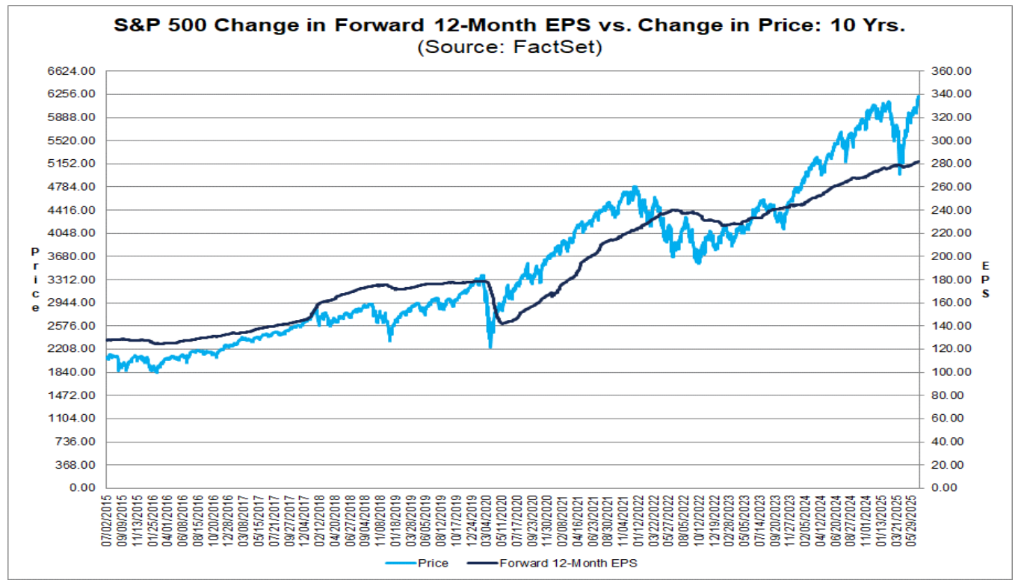
Core Viewpoint - The earnings growth for S&P 500 companies in Q2 is expected to slow significantly, with a projected increase of only 5%, marking the slowest growth since Q4 2023, down from 13% in Q1 [1][2][4]. Earnings Expectations - Analysts have downgraded earnings expectations due to tariff policies and weaker economic data, with a 4% reduction in Q2 forecasts, exceeding the historical average of 3% [4]. - Among the 11 sectors, 6 are expected to see year-over-year growth, led by communication services and information technology, while 5 sectors, including energy, are projected to decline [2][6]. Early Reporting Performance - Early reporting companies have shown strong performance, with 71% exceeding EPS expectations and 81% surpassing sales expectations among the 21 S&P 500 companies that have reported [4][5]. - The current forecast suggests a slight EPS beat of 2%, reaching $64, which represents a 6% year-over-year increase [4]. Sector Analysis - Technology and communication services are expected to drive earnings growth, with a combined growth rate of 20%. Excluding these sectors, S&P 500 earnings growth is projected to be negative 3% [6]. - The growth range for the overall market is expected to be narrow, with negative growth anticipated when excluding technology and communication services [5]. Guidance Trends - Recent trends indicate an improvement in earnings guidance, with the three-month guidance ratio returning to the average level of 0.8 [9]. - Approximately 30% of S&P 500 companies provided annual EPS guidance, a significant increase from 10% during the pandemic [11]. Tariff Impact - Tariff uncertainties remain a key volatility factor, with estimates suggesting a potential 5% direct impact on S&P 500 revenues if no mitigation measures are taken [11]. - Analysts are divided on the ability of companies to pass on tariff costs, with 25% expecting price increases to cover most tariff hikes, while 21% believe companies will struggle to raise prices [11]. Key Themes for Investors - Investors are advised to focus on four key themes: capital expenditure guidance, layoffs, foreign exchange impacts, and the influence of the "Big Beautiful Bill" [12][22]. - The proportion of CEOs planning to increase capital expenditures has dropped to 28%, the lowest level since the pandemic began [12]. Foreign Exchange and Economic Indicators - A 10% depreciation of the dollar is estimated to boost S&P 500 EPS by 3%, with foreign exchange providing a 60-70 basis point benefit in Q2 [18]. - The performance of large tech companies remains strong, with significant capital expenditure growth expected to continue [15][17].
小摩预警:下半年美国通胀或飙升至5%,成本转嫁与行业配置成焦点
智通财经网· 2025-07-15 08:24
Group 1: Inflation Dynamics - The report highlights a critical turning point in U.S. inflation dynamics, with actual tariffs rising from 2.3% at the beginning of the year to approximately 13%, potentially approaching 20% for the year if industry-specific tariffs are implemented [1] - Despite the overall CPI remaining low at 2.4% in May, economists warn that the annualized inflation rate could surge to 5% in the second half of the year, closely linked to the delayed market response to tariff policies and oil prices [1] Group 2: Oil Prices and Corporate Strategies - The current inflation is being dulled by the suppression of oil prices, with Brent crude prices declining year-on-year, but this favorable impact is diminishing as oil prices have been rising since April [1] - Companies initially chose to internalize tariff costs due to concerns over consumer acceptance of price increases and the need to maintain market share, but some have begun to pass on costs, particularly in the automotive and luxury goods sectors [1] Group 3: Economic Impact and Currency Trends - The report predicts a short-term rebound in the dollar, but a continued weak trend in the medium term, which historically correlates with rising import inflation [1] - A sustained depreciation of the dollar could lead to increased prices for imported goods, further elevating the CPI and creating a "tariff-exchange rate-inflation" transmission loop [1] Group 4: Industry Strategies - Morgan Stanley holds a cautious view on the energy sector while expressing optimism for mining companies, reiterating a "double upgrade" rating for the mining sector due to weak dollar conditions and low global metal inventories benefiting mining profitability [2] - The industrial sector shows differentiation, with most companies managing to offset tariff costs through price increases, but some may face profit pressure due to limitations on price adjustments [2] Group 5: Corporate Responses - Corporate strategies are characterized by three phases: initially focusing on internal cost absorption, then attempting price adjustments, and finally shifting towards supply chain optimization [3] - Examples include H&M adjusting pricing strategies, Inditex leveraging global procurement to mitigate risks, and ArcelorMittal quantifying tariff costs (approximately $800 million/year, accounting for 10% of EBITDA) while benefiting from rising U.S. steel prices [3] Group 6: Conclusion on Market Dynamics - The core strategy emphasizes that inflation rebound is driven by a combination of factors including oil prices, corporate behavior, and currency fluctuations [4] - The industry allocation recommendations reflect a preference for resource assets while cautioning about short-term pain in the industrial sector, highlighting the need for investors to monitor corporate cost transfer capabilities and supply chain resilience to seize structural opportunities amid rising inflation [4]