股息率

Search documents
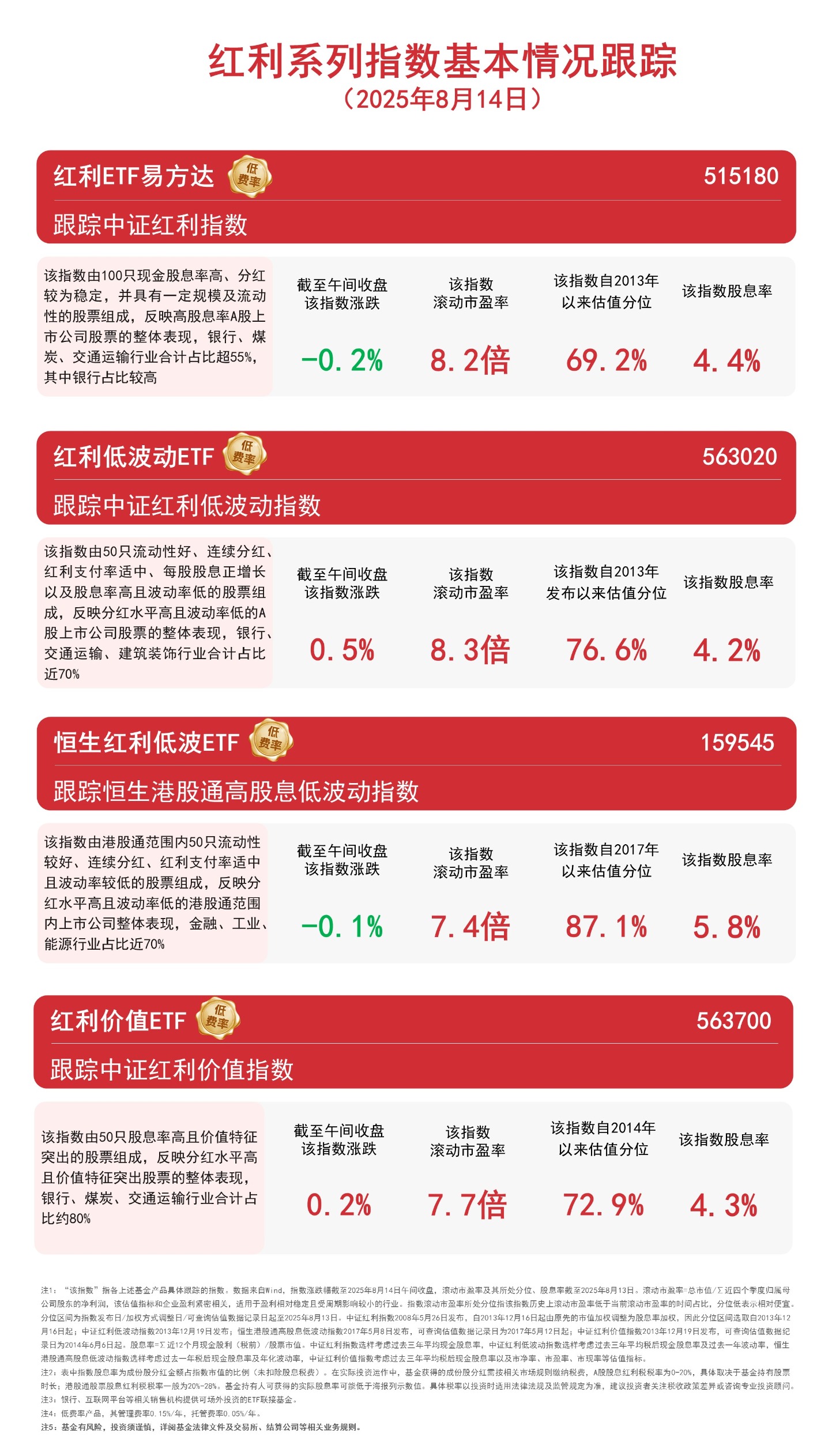
恒生红利低波ETF(159545)半日获净申购660万份,此前连续7个交易日“吸金”
Mei Ri Jing Ji Xin Wen· 2025-08-14 05:43
Group 1 - The Hong Kong Stock Connect companies with high dividend levels and low volatility have shown overall strong performance, with the financial, industrial, and energy sectors accounting for nearly 70% of the index [4] - The dividend value ETF tracks the CSI Dividend Value Index, which consists of 50 stocks with high dividend yields and value characteristics, reflecting the overall performance of such stocks, with banking, coal, and transportation sectors making up about 80% [5] - As of the midday close, the CSI Dividend Value Index has a rolling P/E ratio of 7.7 times, indicating a stable valuation for companies within this index [5] Group 2 - The CSI Dividend Index was launched on May 26, 2008, and was adjusted from a market capitalization-weighted index to a more refined methodology on December 16, 2013 [5] - The index's dividend yield is calculated as the sum of the last 12 months' cash dividends (pre-tax) divided by the market value of the stocks, providing a clear measure of income generation [5] - The fund management fee is set at 0.15% per year, with a custody fee of 0.05% per year, indicating a low-cost investment option for investors [6]

3.9%!茅台股息率史上首次超过农行
Hua Er Jie Jian Wen· 2025-08-13 03:24
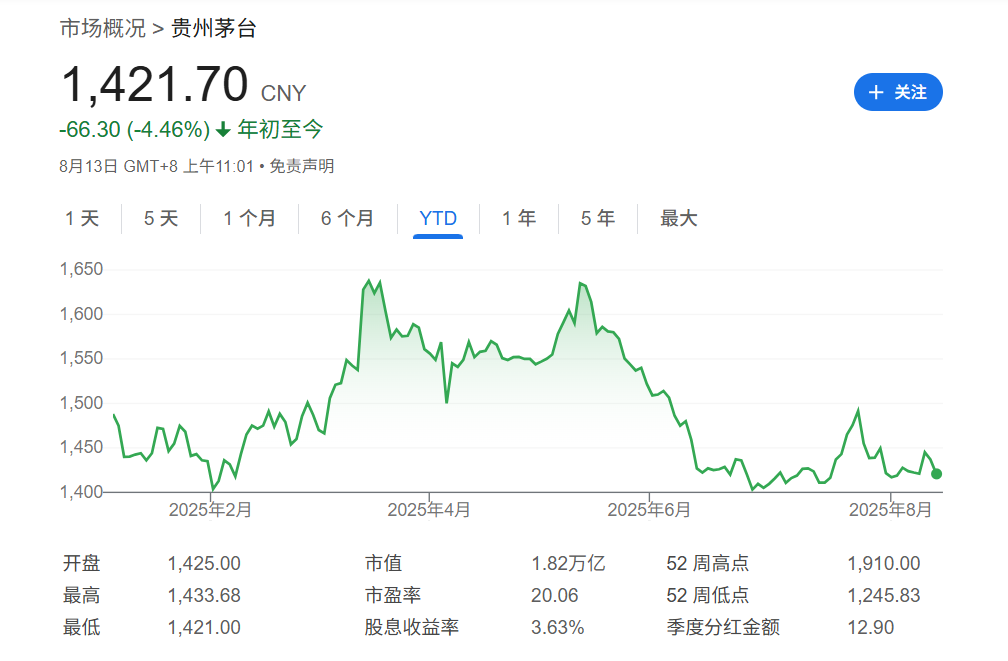
Group 1 - The core viewpoint is that Kweichow Moutai is transitioning from a growth stock to a high-yield value investment, with its dividend yield historically surpassing that of Agricultural Bank of China, indicating a shift in market focus towards high-yield assets beyond traditional bank stocks [1][5] - Kweichow Moutai's expected net dividend yield has reached 3.9%, while Agricultural Bank's yield is at 3.7%, marking the first time Moutai's yield has exceeded that of the bank [1] - Moutai's stock price has declined approximately 5% this year due to weak demand for high-end liquor, contrasting with Agricultural Bank's stock price, which has surged over 30% in the same period, leading to a dilution of its dividend yield [1][5] Group 2 - The increase in Moutai's dividend yield is primarily due to its declining stock price and stable dividend policy, enhancing its appeal to income-focused investors [5] - Moutai's revenue for the first half of the year was 89.39 billion yuan, a year-on-year increase of 9.1%, while net profit attributable to shareholders was 45.4 billion yuan, up 8.89% [5] - The decline in Agricultural Bank's dividend yield may prompt dividend-focused traders to consider Kweichow Moutai and other overlooked consumer staple companies, such as Luzhou Laojiao [5]


真金白银陆续进账 上市银行“分红大戏”正酣
Xin Hua Wang· 2025-08-12 06:26
Core Viewpoint - The A-share listed banks are significant dividend payers, with a total cash dividend distribution exceeding 540 billion yuan for the year 2021, marking a historical high in the banking sector [1][3]. Dividend Distribution - As of June 9, 2022, nine banks have distributed a total of 15.5 billion yuan in cash dividends, with four more banks set to implement their dividend distributions next week [1][2]. - The highest cash dividend distribution among the nine banks is from Jiangsu Bank at 5.9 billion yuan, while Guiyang Bank has the lowest at 1.1 billion yuan [2]. - Three banks have a cash dividend payout ratio exceeding 30%, with Qingdao Bank leading at 31.86% [2]. Future Dividend Expectations - An additional 27 A-share listed banks are expected to distribute over 503.5 billion yuan in dividends, with the six major banks (ICBC, ABC, BOC, CCB, Bank of Communications, and Postal Savings Bank) accounting for 70% of the total expected dividends [3]. - ICBC is projected to lead with a proposed dividend of over 104.5 billion yuan [3]. Dividend Yield - As of June 9, 2022, 18 listed banks have a dividend yield exceeding 5%, with 26 banks yielding over 4% [5]. - The dividend yield of these banks is significantly higher than the average returns of bank wealth management products, which ranged from 2.29% to 3.97% in 2021 [6]. Strategic Considerations - High dividend payouts are seen as a strategy to attract more investors and enhance the banks' image, contributing to stock price stability and market value management [2].



A股上市银行派发史上“最厚”现金红包 逾5400亿元现金本周将全部到账
Xin Hua Wang· 2025-08-12 06:19
8月1日,长沙银行进行2021年度分红股权登记,并将于8月2日派发现金红利。至此,今年的上市银 行分红季宣告结束,40家A股上市银行2021年度合计送出逾5400亿元(税前,下同)的现金"红包",创 下上市银行年度分红的历史新高。 上市银行分红季将结束 由于2021年度业绩大面积增长,加之一以贯之的稳健分红政策,上市银行的分红金额也水涨船高。 根据上市银行披露的分红数据,在全部42家A股上市银行中,有40家银行实施2021年度分红回馈投 资者,这些银行的分红方案全部采用了现金分红方式。 40家上市银行2021年度合计分红金额达到5452.49亿元,较2020年度的分红金额增长11.62%。其 中,6家国有大行合计现金分红额就高达3821.93亿元,在40家上市银行合计分红额的占比超过七成。 长期以来,国有六大行不但年度现金分红额遥遥领先,现金分红比例也多年维持在30%及以上,利 润分配保持良好的连续性和稳定性。 上市银行2021年度分红历时近三个月之久。5月5日,张家港行率先进行了分红派息,开启了上市银 行2021年度分红的大幕。长沙银行作为40家分红银行中的最后一家,将于8月2日实施分红发放。6月份 和7月 ...
有哪些指标,能帮我们判断一个品种是不是便宜呢?|投资小知识
银行螺丝钉· 2025-08-11 13:46
Core Viewpoint - Investing in indices like the CSI 300 during a bull market may lead to losses, while investing during a bear market increases the probability of future gains [2] Valuation Indicators - The most commonly used valuation indicators include four main types: 1. **Price-to-Earnings Ratio (PE)**: This ratio is defined as market value divided by earnings, indicating how much investors are willing to pay for 1 unit of net profit. A lower PE suggests that the index is "cheaper" [3] 2. **Earnings Yield**: This is the inverse of the PE ratio, calculated as earnings divided by market value. A higher earnings yield indicates that the index is "cheaper" [6] 3. **Price-to-Book Ratio (PB)**: Defined as market value divided by net assets, this ratio reflects how much investors are willing to pay for 1 unit of net assets. A lower PB suggests that the index is "cheaper" [7] 4. **Dividend Yield**: This is calculated by dividing the total cash dividends of all companies behind the index by the market value. A higher dividend yield often indicates that the underlying companies have lower valuations, but it should be assessed alongside the stability of dividends [9] - It is important to note that each of these valuation indicators has its own advantages and limitations, and different types of indices may require a focus on specific indicators [10]

电解铝股息率处于全市场什么水平?
Changjiang Securities· 2025-08-11 01:15
Investment Rating - The report maintains a "Positive" investment rating for the aluminum sector [3]. Core Insights - The aluminum sector is experiencing a transition from high elasticity to resilience, with dividends becoming more stable and significant [10][21]. - The dividend yield for the aluminum sector is notably high, surpassing 5%, making it a standout in the market [25][30]. - The report highlights the convergence of aluminum prices, indicating a stable upward trend amidst fluctuating market conditions [46]. Summary by Sections 1. Dividends and Resilience - The aluminum sector is characterized by improving cash flow and reduced capital expenditures, leading to enhanced dividend payouts [21][22]. - The sector's operating cash flow net to (expenditures + interest-bearing liabilities) has improved significantly, indicating a robust financial position [22]. 2. Dividend Yield - The aluminum sector's dividend yield has consistently outperformed other sectors, with a current yield of 5.85% projected for 2024 [25][30]. - Historical data shows that the aluminum sector has maintained a leading position in dividend yield compared to other sectors over the years [25][27]. 3. Price Stability - The report notes a reduction in aluminum price volatility, attributed to stable supply and demand dynamics [41]. - The aluminum sector is positioned in a "low valuation + high dividend" quadrant, suggesting potential for dividend revaluation [42]. 4. ROE Selection - The report emphasizes the importance of selecting stocks based on high dividend yields and return on equity (ROE), with a focus on companies that demonstrate strong financial performance [75]. - Different company profiles are analyzed, showing variations in asset turnover, debt ratios, and dividend rates, highlighting the financial health of key players in the sector [75].
强化上市公司回报投资者理念 多维度增强A股吸引力
Zheng Quan Ri Bao· 2025-08-10 16:44
Core Viewpoint - The China Listed Companies Association has released the 2025 cash dividend ranking to promote a culture of sustainable dividends among listed companies, enhancing investor returns and shifting market focus from financing to investment returns [1][2]. Summary by Relevant Sections Cash Dividend Ranking - The 2025 cash dividend ranking is based on objective data and considers multiple factors, resulting in three lists: total cash dividends over the past three years, dividend payout ratios over the past five years, and dividend yields over the past three years, each featuring 100 companies [2][3]. - The ranking emphasizes long-term evaluation, helping companies enhance the stability and predictability of their dividends, while also allowing smaller companies that share growth profits with investors to be recognized [2][3]. Trends in Dividend Distribution - There has been an increase in the number of companies consistently paying dividends, with 2,447 out of 4,445 companies listed for over three years having paid dividends in the last three years, a 12% increase from 2023 [3]. - The average dividend yield for companies in the three-year yield list is 6.73%, with some companies exceeding 10% [3]. - The five-year payout ratio list saw significant changes, with 40 new companies added, and the average payout ratio for this list is 49% [3]. Mid-Year Dividend Trends - Mid-year dividends have become more common, with 370 companies disclosing mid-year dividend plans in 2023, totaling 791.93 billion yuan in proposed cash dividends [5][6]. - Major companies like China Mobile plan to distribute 541.99 billion yuan as mid-year dividends, indicating a trend towards more frequent and larger dividend distributions [5][6]. Implications of New Policies - The new "National Nine Articles" policy aims to strengthen dividend stability, leading to an expansion in mid-year dividends, diversification of dividend-paying companies, and an increase in the frequency of distributions [6]. - The trend towards multiple dividend distributions per year reflects stable cash flows and operational conditions, signaling positive investment value to investors [6].
ROE≠投资收益率,为何还要重视ROE?
雪球· 2025-08-10 06:19
Core Viewpoint - The article argues that the relationship between Return on Equity (ROE) and investment returns is not as straightforward as often perceived, emphasizing the importance of understanding the nuances of ROE in evaluating companies [3][10]. Group 1: ROE and Net Profit Growth Rate - ROE is defined as net profit divided by shareholder equity, and if a company does not pay dividends, a long-term ROE of 20% implies a net profit annual growth rate of 20% [5]. - In cases where companies distribute dividends, long-term ROE can exceed net profit growth rate, especially if a company pays out 100% of its profits [5]. Group 2: Understanding ROE and Investment Returns - For a company like Kweichow Moutai with a PE ratio of 20 and a dividend yield of 5%, if net profit growth is 0%, the long-term ROE remains at 36%, but investment returns will not exceed 5% [7]. - If net profit growth is 10%, the investment return can be 15%, indicating that investment returns do not necessarily correlate with ROE [8]. Group 3: Importance of ROE - High historical ROE indicates strong past profitability and potential for future growth, suggesting that companies with a history of high ROE are likely to remain strong performers [10]. - The correct use of ROE is to filter for quality companies and analyze their profitability logic rather than using it solely for valuation and return calculations [11]. Group 4: Insights - Long-term returns are derived from initial dividend yield plus long-term growth rate, emphasizing the importance of company quality for stable dividends and growth [13]. - The focus should be on long-term performance, as short-term factors can significantly impact company performance and valuation [14]. - Emphasizing long-term growth is crucial, as it is the primary source of returns, with low growth leading to low returns [16]. - Safety margins are important, as future growth rates are uncertain, while current dividends are more predictable [16]. - The significance of dividend reinvestment is highlighted, as a high initial yield can still provide meaningful returns even with zero growth [16]. - The article advises against unrealistic expectations of rapid wealth accumulation, noting that consistently high growth companies are rare [16]. - A good investment idea held for a long time can yield substantial returns, and frequent trading may lead to missed opportunities [16].

中远海控股价上涨0.96% 入选上市公司股息率榜首
Jin Rong Jie· 2025-08-08 17:30
Group 1 - The latest stock price of China COSCO Shipping Holdings is 15.79 yuan, an increase of 0.15 yuan from the previous trading day, with a trading volume of 1.174 billion yuan [1] - China COSCO Shipping Holdings operates a leading global container shipping fleet, providing international and domestic maritime container transportation services [1] - The company ranks first in the cash dividend yield among listed companies, with the total cash dividends for A-share listed companies in 2024 expected to reach 2.4 trillion yuan, a 9% increase from 2023 [1] - The average dividend yield of China COSCO Shipping Holdings over the past three years has been outstanding [1]

低利率时代,“收息”生活靠什么?
2 1 Shi Ji Jing Ji Bao Dao· 2025-08-07 10:23
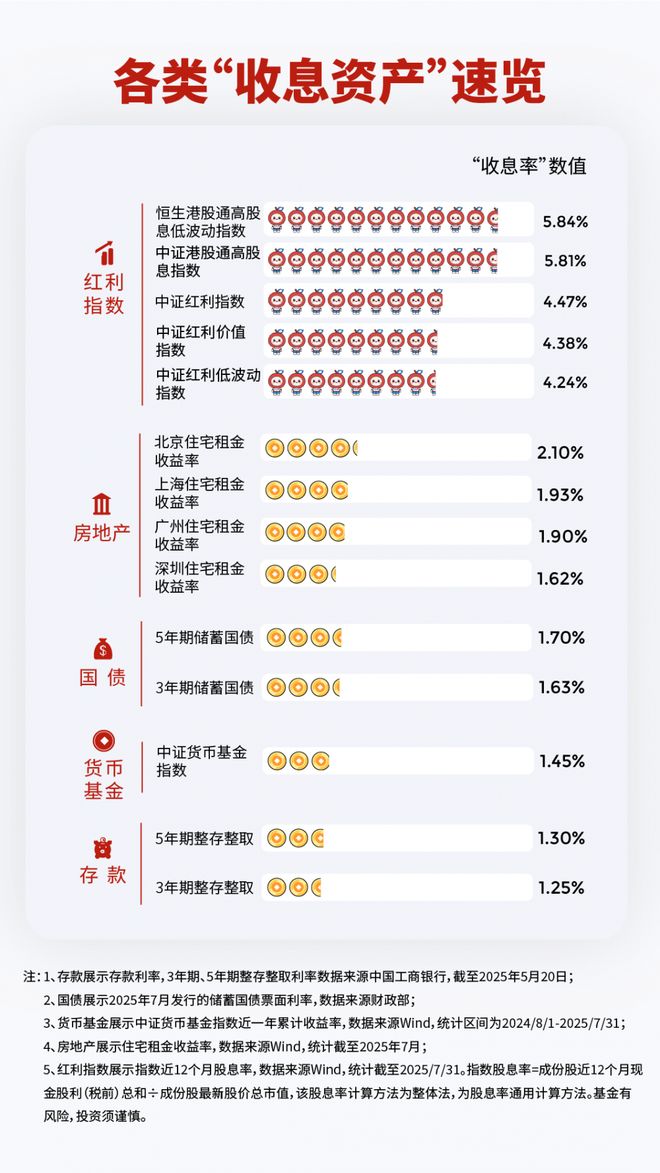
Core Viewpoint - The article discusses the challenges faced by individuals, particularly retirees, in generating income from traditional "income-generating assets" due to declining interest rates and rental yields, leading to a shift towards dividend-paying stocks and dividend index funds as viable investment options [1][6]. Group 1: Current Income-Generating Assets - Bank deposit rates have significantly decreased, with a three-year fixed deposit rate currently at 1.25%, down from 2.6% three years ago, resulting in a drop in interest income from 78,000 to under 38,000 for a 1 million deposit [1][3]. - Money market funds are yielding around 1% annually based on recent calculations, indicating a low return for idle cash [3]. - Government bonds, such as the three-year savings bond issued in July, offer a coupon rate of 1.63%, while five-year bonds yield 1.7% [3]. - Rental yields in major cities like Beijing, Shanghai, Guangzhou, and Shenzhen are relatively low, at 2.10%, 1.93%, 1.90%, and 1.62% respectively, making real estate less attractive for income generation [3]. Group 2: Shift to Dividend Assets - Investors are increasingly turning to high-dividend stocks as a response to low interest rates and unsatisfactory rental returns, as dividends provide tangible returns on investment [3][6]. - Dividend yield is defined as the ratio of a company's dividend payout to its stock price, with higher dividends leading to higher yields [3]. - For instance, a stock with a 5% dividend yield would provide 50,000 in dividends for a 1 million investment, significantly outperforming traditional income sources [3]. Group 3: Dividend Index Funds - Many investors find it challenging to select individual stocks with stable and high dividends, leading to a preference for dividend index funds, which offer a more straightforward investment approach [4][5]. - Dividend index funds, such as the E Fund (515180) tracking the China Securities Dividend Index, select companies with a history of consistent dividends, with the index yielding 4.5% as of July [5]. - Other dividend index funds, like the Hang Seng Dividend Low Volatility ETF (159545) and the Dividend Low Volatility ETF (563020), also report yields in the range of 4% to 6%, significantly higher than traditional deposit rates [5][6]. Group 4: Investor Strategies - Investors like the character Wang Ayi are opting to allocate part of their savings into dividend index funds to achieve stable and higher returns [6]. - Another investor, Zhang, diversifies his investments across multiple dividend funds to ensure monthly cash flow from dividends, reflecting a strategic approach to income generation [6][9].