
货币贬值

Search documents
花旗:担心仓位过高下调黄金评级,黄金价格涨势已经超前于“货币贬值”这一叙事本身!预计未来几周金价将在4000美元/盎司进一步盘整
Ge Long Hui· 2025-10-22 05:55
(责任编辑:宋政 HN002) 格隆汇10月22日|花旗在周二金价暴跌后下调了黄金的评级,理由是担心仓位过高。花旗策略师在报告 中表示,预计未来几周金价将在4000美元/盎司附近进一步盘整。"黄金牛市的旧逻辑(央行持续买入黄 金以实现外储多元化、减少对美元依赖)或许最终会重新发挥作用,但在当前价位下,没有必要急于押 注这一趋势。"黄金价格的涨势"已经超前于'货币贬值'这一叙事本身"。 【免责声明】本文仅代表作者本人观点,与和讯网无关。和讯网站对文中陈述、观点判断保持中立,不对所包含内容 的准确性、可靠性或完整性提供任何明示或暗示的保证。请读者仅作参考,并请自行承担全部责任。邮箱: news_center@staff.hexun.com ...


急跌不改牛市!华尔街:黄金仍是今年“最硬核”资产
Jin Shi Shu Ju· 2025-10-22 02:14
Core Viewpoint - Gold and silver have emerged as the standout performers on Wall Street this year, with gold prices surpassing $4,300 per ounce and a year-to-date increase of over 50%, while silver has surged more than 60% [1][2] Group 1: Market Dynamics - The recent surge in precious metals prices is attributed to easing trade tensions, expectations of Federal Reserve rate cuts, and a weakening dollar, with gold and silver expected to remain strong through 2025 [1][2] - The market perception of gold is shifting, as it is increasingly viewed as a scarce asset rather than just a hedge against currency or portfolio risks [1][2] Group 2: Historical Context - The rise of gold began in earnest in 2022, following the freezing of Russian central bank reserves due to the Ukraine conflict, prompting countries to reassess their dollar reserves [2] - This reassessment has led to a significant increase in central bank gold purchases, continuing into 2023 and 2024, further accelerated by uncertainties from tariff policies introduced by former President Trump [2] Group 3: Investor Behavior - Recent months have seen a return of retail and institutional investors to gold, as evidenced by the growth in gold ETF holdings [3] - Despite the recent price increases, some analysts suggest that gold and silver may need to consolidate in the short term, while maintaining a bullish outlook for the long term [3] Group 4: Future Outlook - Analysts predict that global interest rates will continue to decline, forcing central banks to maintain low rates, which positions gold as a safe haven amid economic uncertainty [4] - There is a divergence in views regarding the future performance of gold compared to AI investments, with some analysts favoring AI for its growth potential while others remain bullish on gold due to a loss of trust in central banks and governments [3][4]
瑞银:黄金交易未算“极端拥挤” 去美元化与货币贬值支撑黄金资产配置需求
智通财经网· 2025-10-18 14:10
Group 1 - UBS reports that gold has become a "market consensus long position" by early 2025, with prices increasing approximately 60% within the year, reaching around 40 new highs [1] - Investor interest in gold is at a very high level, leading to a search for second and third-tier derivatives like silver, platinum, and mining stocks for higher leverage [1] - Despite strong momentum and some signs of crowded positions, UBS does not see conditions for a sustained down cycle in gold prices [1] Group 2 - After years of underperformance, gold stocks (GDX index) have performed well in 2025, rising over 100% and outperforming gold by about 70% [2] - Valuation multiples for gold stocks have recovered compared to the cyclical low from Q4 2024 to Q1 2025, but risk-reward is less attractive than at the beginning of 2025 [2] - If gold miners can continue to rebuild investor confidence, UBS expects earnings forecasts to maintain upward momentum, providing further valuation expansion potential for certain stocks [2]
比索继续遭抛售,“阿根廷人相信,美国来救也没用”
Sou Hu Cai Jing· 2025-10-17 04:08
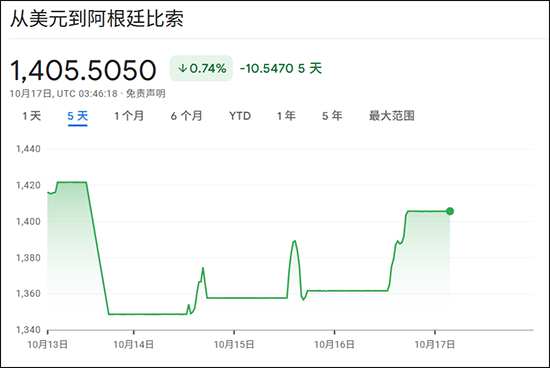
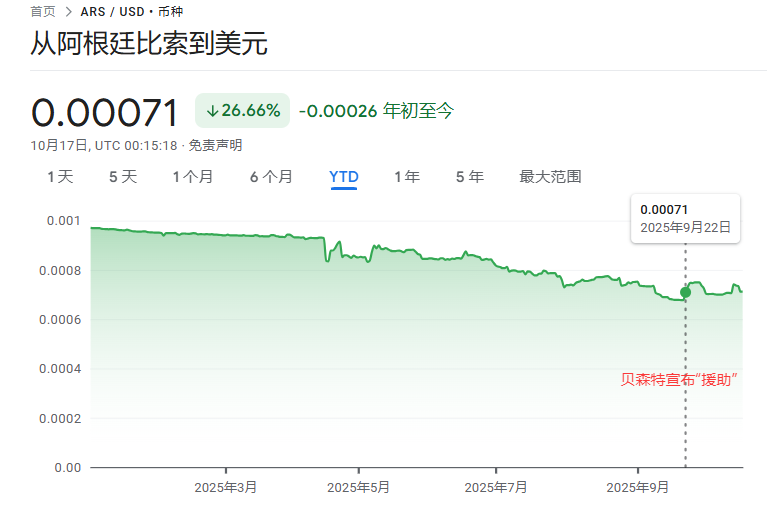
Core Viewpoint - The Argentine peso is expected to face further devaluation despite U.S. financial support, as market confidence in the government's ability to stabilize the currency diminishes [1][3][5] Group 1: U.S. Intervention and Market Reaction - On October 16, U.S. Treasury Secretary Becerra announced intervention in the Argentine foreign exchange market, selling dollars and buying pesos to provide support, with potential aid increasing to $40 billion [1] - The intervention temporarily stabilized the exchange rate, preventing the peso from falling below 1,400 pesos per dollar [1] - However, market sentiment has shifted, with investors increasingly skeptical about the government's ability to maintain the exchange rate, leading to a surge in dollar purchases for hedging [3][5] Group 2: Political Uncertainty and Economic Pressure - Political uncertainty surrounding the upcoming elections on October 26 has heightened concerns about the government's reform agenda and potential policy reversals [5][6] - The Argentine government has raised short-term interest rates to an astonishing 157% in an attempt to absorb peso liquidity, which is putting additional strain on the already fragile economy [3][5] - Since the lifting of currency purchase restrictions in April, unofficial net dollar purchases have reached $18 billion, averaging about $400 per person [5][6] Group 3: Historical Context and Economic Indicators - Analysts draw parallels between the current situation in Argentina and historical events, such as the 1992 British pound crisis, where limited reserves and market speculation led to significant currency devaluation [7][9] - The peso is perceived as overvalued, with inflation rising by 12% since April, further questioning the sustainability of government interventions [9] - The Argentine government's measures to curb capital flight have resulted in tighter credit conditions, with local financing costs significantly increasing and bond yields surpassing 100% [9]
全款和按揭买房差多少?5 年后我那俩朋友,日子过得天差地别
Sou Hu Cai Jing· 2025-10-17 03:04
Core Insights - The article contrasts two individuals' experiences with home buying: one who paid in full and another who took out a mortgage, highlighting the financial implications of each choice [2][3][4] Group 1: Financial Implications of Full Payment vs. Mortgage - Individual A (referred to as "Old Zhang") paid for a home in full, which initially seemed advantageous but later led to financial strain due to lack of liquidity for other expenses [2][3] - Individual B (referred to as "Little Li") opted for a mortgage, which allowed him to retain cash for investments, benefiting from policy changes that reduced monthly payments [2][3] - The article emphasizes that while paying in full may appear secure, it can limit financial flexibility and increase risk exposure [3][4] Group 2: Risk Management and Financial Planning - The narrative suggests that taking a mortgage can serve as a form of forced savings, encouraging better financial planning and investment opportunities [3][4] - The discussion includes the potential risks associated with mortgages, particularly in economic downturns, where income instability can lead to difficulties in meeting payment obligations [3][4] - The article concludes that there is no one-size-fits-all answer to the question of whether to pay in full or take a mortgage, as individual circumstances vary significantly [3][4]

听说美国人要买,阿根廷人“狂卖”比索
Hua Er Jie Jian Wen· 2025-10-17 00:46
Core Viewpoint - The U.S. intervention to stabilize the Argentine peso has failed to restore public confidence, leading to a market battle characterized by a "buy-sell" dynamic among investors [1]. Group 1: U.S. Intervention Efforts - U.S. Treasury Secretary Becerra has taken actions to prevent the depreciation of the peso, including direct market purchases and declaring it "undervalued" [1]. - The U.S. is considering expanding the initial $20 billion swap facility to $40 billion through private arrangements with international banks [1]. Group 2: Market Reactions - Despite initial rebounds in the peso following Becerra's commitment for assistance, the currency has depreciated against the dollar almost every trading day since September 29 [2]. - Market skepticism is reflected in the soaring short-term interest rates, which reached an alarming 157%, further straining the fragile economy [1]. Group 3: Election Impact and Capital Flight - The upcoming legislative elections are a central variable in market pricing, with fears that President Milei's potential defeat could lead to increased capital flight and further depreciation of the peso [6]. - Data from the Argentine Central Bank indicates that citizens have net purchased $18 billion over five months, averaging about $400 per resident, highlighting a trend of capital outflow [4]. Group 4: Economic Fundamentals - The peso's exchange rate does not adequately reflect the country's high inflation, which has risen by 12% since April, suggesting that the currency is overvalued [7]. - Historical parallels are drawn to past currency defense efforts, with analysts recalling the 1992 pound crisis as a cautionary tale for current interventions [6].
黄金狂飙!站上4200美元大关,黄金ETF基金(159937)开盘涨近1%,冲击4连涨
Sou Hu Cai Jing· 2025-10-16 01:56
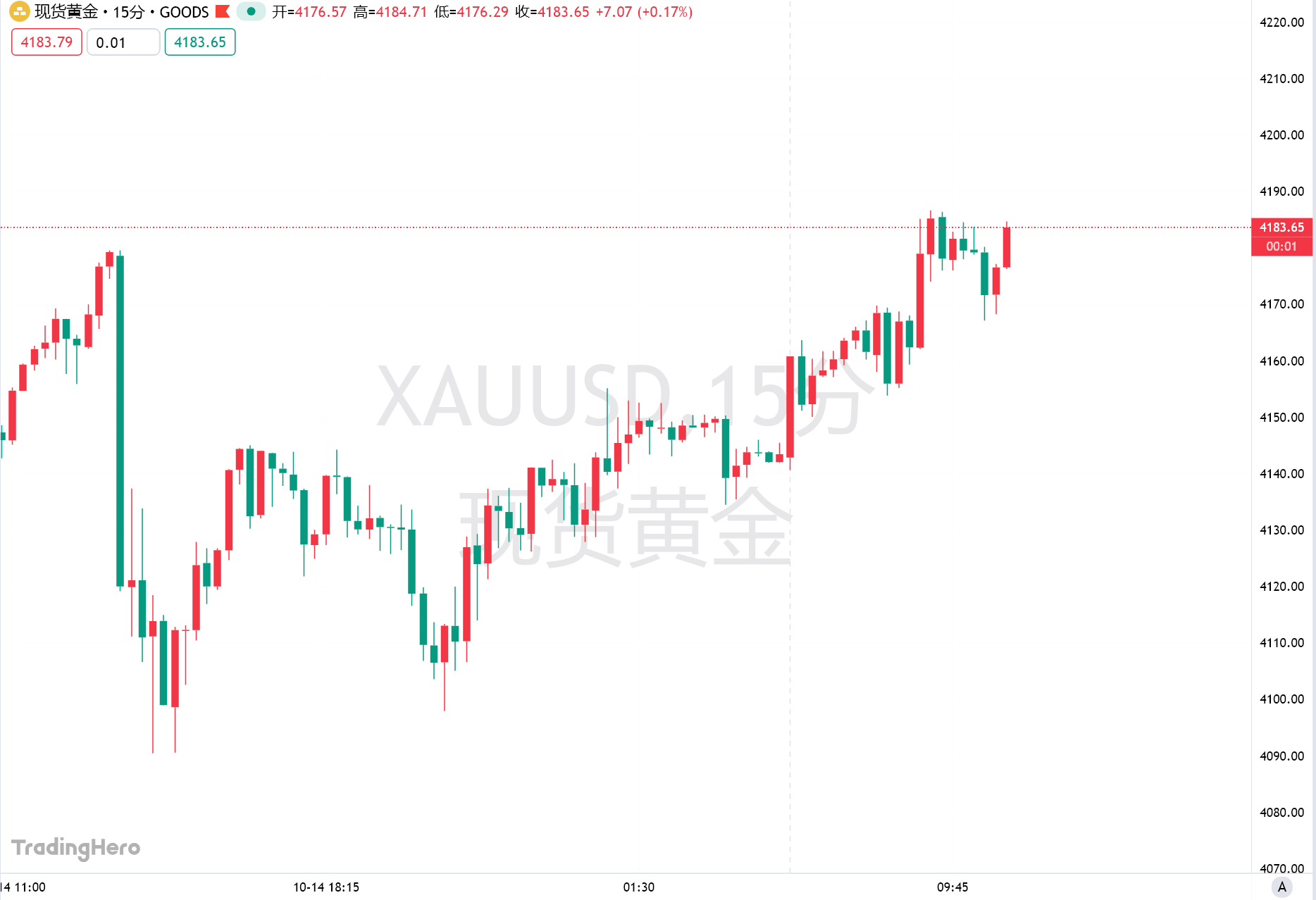
Core Insights - Gold prices have reached a historic high, with COMEX gold futures rising by 1.48% to $4224.90 per ounce, and spot gold surpassing $4200 for the first time [4] - JPMorgan CEO Jamie Dimon has publicly stated that holding gold is "reasonable," predicting prices could easily rise to $5000-$10000, indicating a shift in institutional sentiment towards gold [4][5] - Hedge fund manager Ken Griffin noted that investors are increasingly viewing gold as a safer asset than the dollar, reflecting a growing concern about the stability of the dollar [4][5] Market Dynamics - The ongoing U.S. government shutdown and record-high global public debt are driving strong demand for safe-haven assets like gold [4][5] - There is a sustained optimism in the market regarding potential interest rate cuts by the Federal Reserve, with nearly 100% expectation for a 25 basis point cut in October [4][5] - Political and economic instability, including a prolonged deadlock between U.S. political parties, is further supporting the upward trend in gold prices [4][5] Technical and Fundamental Analysis - The technical breakout above the $4200 psychological level indicates strong upward momentum for gold prices [5] - Dimon's endorsement of gold marks a significant shift in the traditional financial sector's view, suggesting a broader acceptance of gold as a viable investment [5] - The re-evaluation of gold's monetary attributes, as highlighted by Griffin's comments, suggests a potential decline in confidence in the dollar [5] Investment Opportunities - The recent performance of the Gold ETF (159937) shows a 9.81% increase over the past week, with a trading volume of 1.40 billion yuan and a turnover rate of 0.38% [3][8] - The Gold ETF has seen continuous net inflows over the past eight days, totaling 2.773 billion yuan, indicating strong investor interest [8] - The latest share count for the Gold ETF reached 3.924 billion, marking a three-month high, which reflects growing investor confidence in gold as an asset class [7][8]

提振市场情绪!对冲基金巨头Paul Tudor Jones:纳指年底前会上涨 金银是趋势更强的“贬值交易”
美股IPO· 2025-10-15 04:34
Core Viewpoint - Paul Tudor Jones predicts a potential strong rally in the Nasdaq index towards the end of the year, contingent on positive earnings from major tech companies and resolution of trade conflicts by the end of October [3][6]. Group 1: Market Outlook - The period from late October to early November is identified as a critical turning point for the Nasdaq index, with the possibility of a strong year-end rally if the index remains robust [3][4]. - Jones emphasizes that the upcoming market phase could either represent the final "peak phase" of a bull market or a time of accumulating top risks [3][4]. - The expectation of interest rate cuts by the Federal Reserve is a key factor supporting the tech sector, with projections of rates dropping from the current 4%-4.25% range to around 2.5% next year [6][7]. Group 2: Concentration Risk - Jones warns about concentration risk in the market, noting that individual investors' stock allocations are at historical highs, with approximately 35% of the S&P 500's gains driven by just seven stocks [9][10]. - He acknowledges his current lack of long positions in stocks, opting to wait one to two weeks before making any decisions [4][10]. Group 3: Currency Devaluation and Alternative Assets - The trend of currency devaluation has shifted towards investments in gold and Bitcoin, which are expected to demonstrate their value when true debt crises arise [5][12]. - Jones describes the current global economic environment as one of widespread fiat currency devaluation, with central banks being pushed towards accommodative policies [7][12]. - He anticipates a resurgence of inflation within the next 18 months, driven by artificially low funding costs and abundant liquidity, which could lead to significant price increases in gold, silver, and cryptocurrencies [12][14].

黄金不再恐高!散户入场才刚刚开始
Jin Shi Shu Ju· 2025-10-15 04:20
Core Viewpoint - Despite record-high gold prices, Western investors' demand for gold continues to rise, driven by increasing government debt and strong central bank purchases [1][10] Group 1: Market Dynamics - The American Gold Exchange reports that U.S. investors have primarily been net sellers of gold and silver during the ongoing bull market, cashing in profits as prices rise [1] - As of October 9, trading volume for the most active gold futures contracts on the Comex reached 448,407 contracts, the highest since April 12, 2024 [4] - The SPDR Gold Trust ETF saw trading volume rise to nearly 33.7 million shares on October 9, marking the highest level since April 22, 2025 [4] Group 2: Investor Behavior - U.S. retail investors only recently began participating as buyers in the gold and silver markets after the Federal Reserve signaled a dovish shift in late August [3] - The World Gold Council indicates that from June to September, North American gold ETFs experienced higher monthly inflows compared to Asia, despite gold prices reaching historical highs [7] - Tavi Costa from Crescat Capital notes that Western investors have only recently engaged in the current gold rally, influenced by the competitive performance of other asset classes [7] Group 3: Structural Changes - The current ETF infrastructure is more mature than in previous crises, allowing for faster capital inflows into the gold market [6] - The demand for physical gold is being driven by both retail investors and central banks, which are competing for the same physical gold [6] - Will Rhind from GraniteShares highlights that many new investors are more familiar with products like the SPDR Gold Trust ETF, leading to increased purchases [8] Group 4: Economic Context - The rise in gold trading volume reflects the severity of global economic imbalances, with central banks indicating a strong demand for gold to stabilize their currencies [8] - Samuelson from the American Gold Exchange argues that the current gold bull market is driven by unprecedented physical buying, rather than merely being a reaction to currency devaluation [10] - The ongoing inflation is eroding purchasing power, making gold and silver more attractive as stores of value compared to depreciating fiat currencies [10]
提振市场情绪!对冲基金巨头Paul Tudor Jones:纳指年底前会上涨 金银是趋势更强的“贬值交易”
Hua Er Jie Jian Wen· 2025-10-15 01:17
Core Viewpoint - Paul Tudor Jones, a legendary hedge fund manager, expressed optimism about the Nasdaq Composite Index potentially rising by year-end, driven by expectations of lower interest rates and positive earnings from major tech companies [1][3]. Group 1: Market Outlook - Jones predicts that if trade conflicts are resolved by the end of October and large tech companies report strong earnings, the stock market could see a significant rally in the last two months of the year [1]. - He identifies the period from late October to early November as a critical turning point for the Nasdaq, suggesting that a strong performance during this time could lead to a robust year-end rally [1][3]. - The current market sentiment has been bolstered by Jones's comments, contributing to a reversal in the stock index futures that had been declining [1]. Group 2: Economic Conditions - Jones's forecast is based on the expectation that the Federal Reserve will continue its accommodative monetary policy, with interest rates projected to drop from the current range of 4%-4.25% to around 2.5% by next year [3]. - He describes the global economic environment as one of widespread currency devaluation, with central banks being pushed towards easing policies while remaining vigilant in the bond market [3]. Group 3: Concentration Risk - Despite his optimistic outlook, Jones warns that concentration risk poses a significant threat to the current market, noting that individual investors' stock allocations are at historical highs, with approximately 35% of the S&P 500's gains driven by just seven stocks [4][5]. - He acknowledges that he currently holds no long positions in stocks and prefers to wait one to two weeks before making any investment decisions [5]. Group 4: Inflation and Asset Value - Jones emphasizes that the current monetary policies are leading to systemic currency devaluation, with gold and cryptocurrencies becoming the primary assets to hedge against this trend [6][8]. - He anticipates that inflation will reignite within the next 18 months, as the market begins to see through the logic of artificially low funding costs and abundant liquidity [7][8]. - The shift towards gold and cryptocurrencies as a response to currency devaluation is highlighted, with Jones stating that these assets will reveal their true value when the real debt crisis emerges [2][8].