通胀风险

Search documents
鲍威尔杰克逊霍尔释放谨慎降息信号 标普500指数扩大涨幅
智通财经网· 2025-08-22 15:17
Group 1 - Federal Reserve Chairman Powell opened the door for a potential interest rate cut in September, citing rising risks in the labor market despite ongoing inflation concerns [1] - Powell indicated that the employment market is in a "delicate balance," with significant slowdowns in both labor supply and demand, and highlighted that recent job growth has been much weaker than previous estimates [1] - Following Powell's remarks, investors increased bets on a rate cut during the upcoming Federal Open Market Committee (FOMC) meeting on September 16-17 [1] Group 2 - Powell's speech occurred against unprecedented pressure from Trump and allies demanding quick rate cuts, which raises concerns about the Fed's independence [2] - The Fed updated its monetary policy framework, removing the phrase "employment below maximum level shortage" and clarifying that employment levels may sometimes exceed real-time assessments without necessarily posing risks to price stability [2] - There is a notable division among Fed officials regarding the path for rate cuts, with some advocating caution while others suggest support for a September cut following weak employment data [2][3] Group 3 - The Fed has maintained interest rates unchanged this year after three consecutive cuts at the end of last year, with some officials worried that tariffs could lead to sustained inflation [3] - Recent data showed that wholesale prices recorded their fastest increase in three years in July, reinforcing concerns about inflation [3]
暴涨!刚刚,鲍威尔宣布!美联储降息大消息!
Zhong Guo Ji Jin Bao· 2025-08-22 14:52
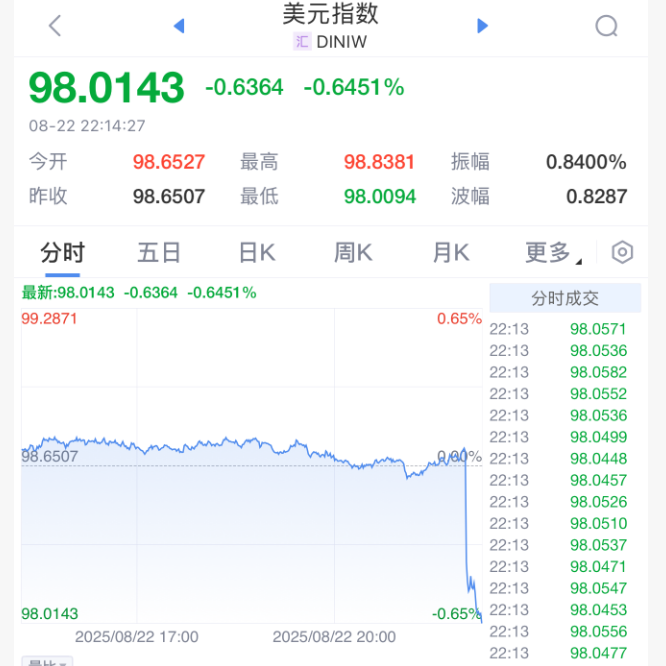
Core Viewpoint - Federal Reserve Chairman Jerome Powell signals potential interest rate cut in September, indicating a shift in monetary policy due to changing economic risks [3][4][8] Group 1: Economic Conditions - Powell highlights that the labor market appears stable but is experiencing a unique balance due to significant slowdowns in both labor supply and demand, leading to rising downside risks for employment [3][12] - The U.S. GDP growth rate has slowed to 1.2% in the first half of the year, significantly lower than the projected 2.5% for 2024, primarily due to reduced consumer spending [13] - Inflation risks are currently tilted upwards, while employment risks are leaning downwards, creating a challenging situation for policymakers [4][14] Group 2: Monetary Policy Outlook - Powell suggests that the baseline outlook and risk balance may necessitate adjustments to the policy stance, with a reasonable scenario indicating a one-time increase in price levels due to tariffs [3][14] - The market now anticipates a 90% probability of a rate cut in September, up from 75% prior to Powell's speech, with traders pricing in two rate cuts by the end of the year [8] - Powell's comments indicate a dovish stance, suggesting he may support a 25 basis point rate cut at the upcoming Federal Open Market Committee meeting [7][8] Group 3: Market Reactions - Following Powell's speech, the dollar index fell approximately 0.5%, and U.S. Treasury yields dropped, with the two-year yield decreasing by 9 basis points to 3.70% [5] - Major U.S. stock indices surged, with the Dow Jones rising over 700 points, the Nasdaq increasing by nearly 2%, and the S&P 500 gaining about 1.5% [8]

杰克逊霍尔会议:给降息预期“踩刹车”?
Minsheng Securities· 2025-08-22 09:14
杰克逊霍尔会议:给降息预期"踩刹车"? 2025 年 08 月 22 日 [Table_Author] 分析师:陶川 分析师:林彦 分析师:邵翔 海外市场点评 执业证号:S0100524060005 执业证号:S0100525030001 执业证号:S0100524080007 邮箱:taochuan@mszq.com 邮箱:linyan@mszq.com 邮箱:shaoxiang@mszq.com 研究助理:武朔 执业证号:S0100125070003 邮箱:wushuo@mszq.com ➢ 当市场几乎一致押注 9 月降息已成定局,杰克逊霍尔会议是否会给降息预期 "泼盆冷水"?7 月以来大幅下修的非农数据和不及预期的 CPI 使得市场降息叙 事进一步强化:在就业随时可能"熄火"的风险下,只要通胀不发生恶性上升, 那么就不足以阻挡 9 月降息的步伐。 ➢ 但这也给鲍威尔带来了两难: ➢ 一方面,潜在的通胀风险仍然存在,尽管 7 月 CPI 同比以及关税影响的部分 核心商品并未出现加速上涨迹象;但 PPI 超预期上行并创下三年多来的最大增 幅,则再次点燃了通胀的隐患,这意味着关税可能已经开始推升企业成本,并将 ...
就市论市|全球央行年会即将召开 如何扰动全球市场?
Sou Hu Cai Jing· 2025-08-22 06:36
Group 1 - The core viewpoint of the article highlights that inflation risks are more concerning than labor market conditions according to the latest Federal Reserve meeting minutes from July [1] - There is an increasing internal division within the Federal Reserve regarding monetary policy, with a focus on reviewing the monetary policy framework [1] - The expectation for interest rate cuts may narrow as inflation risks are perceived to be greater than economic risks, suggesting a continued hawkish stance on interest rates [1] Group 2 - The upcoming global central bank conference in Jackson Hole raises questions about whether Jerome Powell will signal any changes in policy [1] - Risk assets are currently suppressing risk-free assets, indicating potential market volatility in the near term [1]
美联储官员“鹰风阵阵” 削弱9月降息押注
Jin Tou Wang· 2025-08-22 06:34
美国劳工部8月21日周四公布的数据显示,截至8月16日当周,美国首次申请失业救济人数增加1.1万 人,达到23.5万,为今年6月20日以来最高,且高于预期22.5万人和前值22.4万人。四周平均值(用来平 滑波动)也升至22.625万人,为一个月来的最高值。与此同时,美国8月9日当周续请失业救济人数增加 了3万人,达到197.2万人,同样高于预期196万人和前值195.3万人,为自2021年11月以来的最高水平。 美联储官员周四对下月降息的可能性态度冷淡,这为鲍威尔在怀俄明州杰克森霍尔年会上的讲话奠定基 础。 分析称,续请人数上升,说明失业者再就业难度加大。首申人数持续上升,说明裁员可能正在增加。结 合此前7月非农就业数据也显示,招聘放缓、失业率上升,这些都表明劳动力市场较此前走软。目前的 就业市场呈现出一种"没有大量裁员,但招聘也很冷淡"的局面,企业正在应对特朗普总统的贸易保护主 义政策,该政策已将美国的平均进口关税提高到一个世纪以来的最高水平。 7月就业报告意外疲软,加上5月和6月的招聘数据大幅下调,提升借贷成本即将下调的预期,交易员甚 至预估9月的下一次会议将大幅降息。不过此后,其他政策制定者的谨慎言论 ...
美联储公布7月货币政策会议纪要 通胀和就业面临风险
Yang Shi Wang· 2025-08-22 02:09
Core Viewpoint - The Federal Reserve's July meeting minutes indicate a consensus among members that the U.S. economy has experienced a slowdown in growth during the first half of the year, with persistent high inflation levels [1] Economic Activity - Economic activity and consumer spending growth have slowed, leading to significant downside risks in the U.S. labor market, which contributes to uncertainty in economic growth prospects [1] Inflation Concerns - Most Federal Reserve members express greater concern over inflation risks compared to the labor market, resulting in the decision to maintain the federal funds rate target range at 4.25% to 4.5% [1]
美联储的施密德:相对于就业形势,通胀风险更高。
Sou Hu Cai Jing· 2025-08-21 14:55
Core Viewpoint - The Federal Reserve's Schmied emphasizes that inflation risks are currently higher compared to the employment situation [1] Group 1 - The Federal Reserve is prioritizing inflation risks over employment conditions in its economic assessment [1]
美联储施密德:通胀风险高于就业风险,当前政策处于合适位置
Sou Hu Cai Jing· 2025-08-21 13:31
Core Viewpoint - The Kansas City Federal Reserve President, Esther George, believes that inflation risks are slightly higher than employment market risks, indicating that current monetary policy is appropriately positioned [1] Group 1: Monetary Policy - Esther George stated that as the dual mandate goals are approached, it becomes more challenging to determine the direction of policy rates [1] - The ongoing debate about when to lower interest rates hinges on whether individual decision-makers perceive the policy as overly tight [1] - George believes that while the policy is somewhat tight, it is on the right track [1] Group 2: Economic Indicators - Recent consumer and business price data indicate that inflation in the U.S. has accelerated in recent months [1] - There is new evidence that businesses are able to pass some of the rising import costs onto consumers [1] - The employment market has shown signs of slowing down, with an average addition of only 35,000 jobs per month over the past three months [1]
美联储官员施密德:通胀风险高于就业风险 当前政策处于合适位置
Sou Hu Cai Jing· 2025-08-21 13:13
Core Viewpoint - The Kansas City Fed President, Esther George, believes that inflation risks are slightly higher than employment market risks, indicating that current monetary policy is appropriately positioned [1]. Group 1: Monetary Policy - Esther George stated that as the dual mandate goals are approached, it becomes increasingly difficult to determine the direction of policy rates [1]. - The ongoing debate about when to lower interest rates hinges on whether individual policymakers perceive the current policy as overly tight [1]. - George believes that while the policy is slightly tight, the Fed is on the right path [1]. Group 2: Inflation and Employment - Recent data shows that inflation in the U.S. has accelerated in recent months, with evidence that businesses can pass some rising import costs onto consumers [1]. - The employment market has shown signs of slowing down during the summer, with an average addition of only 35,000 jobs per month over the past three months [1].
瑞达期货沪锡产业日报-20250821
Rui Da Qi Huo· 2025-08-21 09:00
Report Summary 1. Report Industry Investment Rating No investment rating is provided in the report. 2. Core View of the Report - The Fed's July meeting minutes signaled a hawkish stance, with most believing inflation risk outweighs employment risk. In the tin market, despite Myanmar's restart of mining permit approvals, actual tin ore output will not occur until the fourth quarter, and the Congo's Bisie mine plans to resume production in phases. Currently, tin ore processing fees remain at historical lows. On the smelting side, production rebounded in July due to multiple factors, but raw material shortages are still severe in Yunnan, and the scrap recycling system in Jiangxi is under pressure with low operating rates. On the demand side, downstream processing enterprises are in the traditional off - season, with most maintaining only essential production and orders being mediocre. Recently, tin prices have fluctuated, with downstream enterprises making essential purchases at low prices. Domestic and LME inventories are on a downward trend. Technically, positions are decreasing, and both bulls and bears are cautious, expecting range - bound oscillations. It is recommended to wait and see, focusing on the 266,000 - 271,000 yuan/ton range [3]. 3. Summary According to the Catalog 3.1 Futures Market - The closing price of the main futures contract of Shanghai Tin was 266,480 yuan/ton, down 1,360 yuan. The closing price of the September - October contract was down 240 yuan. LME 3 - month tin was at 33,770 US dollars/ton, up 68 US dollars. The main contract's open interest of Shanghai Tin was 18,744 lots, down 633 lots. The net position of the top 20 futures was - 1,514 lots, down 642 lots. LME tin total inventory was 1,630 tons, down 25 tons. Shanghai Futures Exchange inventory of tin was 7,792 tons, down 13 tons, and the warehouse receipt was down 25 tons [3]. 3.2现货市场 - The SMM 1 tin spot price was 266,800 yuan/ton, down 184 - 700 yuan. The Yangtze River Non - ferrous Market 1 tin spot price was 268,410 yuan/ton, up 2,300 yuan. The basis of the Shanghai Tin main contract was 320 yuan/ton, up 660 yuan. The LME tin premium (0 - 3) was 81 US dollars/ton, down 8 US dollars [3]. 3.3 Upstream Situation - The import volume of tin ore and concentrates was 1.21 million tons, down 0.29 million tons. The average price of 40% tin concentrate processing fee was 10,500 yuan/ton, unchanged. The average price of 40% tin concentrate was 254,000 yuan/ton, down 2,000 yuan, and the average price of 60% tin concentrate was 258,000 yuan/ton, down 2,000 yuan. The average price of 60% tin concentrate processing fee was 6,500 yuan/ton, unchanged [3]. 3.4 Industry Situation - The monthly output of refined tin was 14,000 tons, down 1,600 tons. The monthly import volume of refined tin was 3,762.32 tons, up 143.24 tons [3]. 3.5 Downstream Situation - The price of 60A solder bars in Gejiu was 173,830 yuan/ton, up 460 yuan. The cumulative output of tin - plated sheets (strips) was 1.6014 million tons, up 0.1445 million tons. The monthly export volume of tin - plated sheets was 140,700 tons, down 33,900 tons [3]. 3.6 Industry News - The Fed's July meeting minutes showed that most thought inflation risk was higher than employment risk, sending a hawkish signal. The National Energy Administration announced that the total electricity consumption in July was 1.02 trillion kWh, a year - on - year increase of 8.6%. The Ministry of Industry and Information Technology and other departments will further standardize the competition order in the photovoltaic industry and curb low - price disorderly competition [3].