价值投资

Search documents
深度绑定投资者利益 公募新品已在路上
Shang Hai Zheng Quan Bao· 2025-08-08 07:19
Core Viewpoint - The "Action Plan for Promoting High-Quality Development of Public Funds" emphasizes a core value of "investor-centric" principles, aiming to enhance long-term returns for investors and bind their interests with fund management [1][2]. Group 1: Key Aspects of the Action Plan - The Action Plan is viewed as one of the most systematic and forward-looking regulatory innovations in China's capital market in recent years [2]. - It focuses on optimizing the evaluation system for fund management, emphasizing investor satisfaction as a key metric [2]. - The plan encourages innovation in equity products and improves mechanisms for aligning interests between fund managers and investors [2]. Group 2: Floating Management Fee Funds - A new batch of floating management fee funds will be launched, which will deeply bind investor interests at the product establishment level [3]. - These funds will adopt a performance-based fee structure, where management fees are determined based on the fund's performance relative to a benchmark during the holding period [3]. - For example, if a fund performs significantly better than the benchmark, it may charge a fee above 1.2%, while underperformance could lead to a reduced fee of 0.6% [3]. Group 3: Market Trends and Historical Context - Since their inception in 1999, floating management fee funds have undergone several market evaluations, with 20 funds set to pilot the new fee structure in 2023 [4]. - By the end of 2024, there will be 75 products using the floating management fee model, with a total management scale of 783.29 billion, of which 63 products are performance-linked [4]. - The differentiation in management fees among floating fee products has been significant, particularly influenced by market performance from 2021 to 2024 [4]. Group 4: Future Investment Strategies - The future of public funds is expected to focus on long-term and value investing, addressing previous misalignments among stakeholders' interests [5]. - The binding of interests between fund companies and investors is seen as beneficial for product management and investor returns [5].
中银基金郑宁: 聚焦创新药投资 优化组合风险收益比
Zhong Guo Zheng Quan Bao· 2025-08-08 07:06
Core Viewpoint - The article emphasizes the unique insights of Zheng Ning, a fund manager at Zhongyin Fund, into value investing in the innovative pharmaceutical sector, highlighting his focus on constructing a high-risk-return investment portfolio based on implied return rates under neutral free cash flow assumptions [1][2]. Investment Philosophy - Zheng Ning's investment logic is influenced by his financial background and experience in the pharmaceutical industry, leading him to establish a comprehensive analysis framework for asset pricing [2]. - The core of his pricing strategy revolves around the implied return rate under neutral free cash flow assumptions, focusing on the probability distribution of cash flows to determine investment opportunities [2][3]. Market Timing and Strategy - Zheng Ning recognized the potential of undervalued innovative pharmaceutical assets as early as July 2022, positioning himself as one of the first fund managers to heavily invest in this sector [3]. - His investment approach involves a systematic process of assessing stock positions based on fundamental, valuation, liquidity, and policy factors, allowing for disciplined portfolio management during market extremes [3][4]. Performance and Adjustments - Since taking over public fund products, Zheng Ning has experienced both successes and setbacks, adjusting his portfolio based on market conditions and sector performance [4][5]. - He has shifted focus towards innovative pharmaceutical companies, particularly as other sectors showed weaker fundamentals, leading to a concentration in this area [4]. Future Outlook - Zheng Ning believes that the current rally in innovative pharmaceutical stocks is fundamentally driven, supported by favorable conditions such as low valuations, policy encouragement, and institutional underweighting [5][6]. - He sees significant growth potential in leading innovative pharmaceutical companies, asserting that the best time to invest in Chinese innovative pharmaceuticals is likely within the next few years [5][6]. Investment Focus - The fund manager is particularly interested in traditional pharmaceutical companies that are successfully transitioning to innovative drug development, viewing them as key players in the future landscape of China's innovative pharmaceutical industry [6]. - As the performance of innovative pharmaceutical companies improves, Zheng Ning aims to balance the exposure of growth and value factors in his portfolio, striving for a "healthy" investment state [6].
做客中信书院播客「知本论」,姜诚这样说价值投资的“断舍离”
中泰证券资管· 2025-08-08 07:03
Core Viewpoint - The discussion emphasizes the importance of value investing and the role of market volatility in identifying undervalued assets, highlighting that a larger market fluctuation can create more opportunities for value investors [5]. Group 1: Investment Philosophy - The company does not experience anxiety about what to buy but rather about the decision-making process when considering an investment [4]. - The investment approach is not focused on popular or obscure stocks but on identifying assets that meet specific aesthetic and value criteria [3][4]. - The company believes that patience and a long-term perspective are crucial for realizing the value of investments, regardless of short-term market fluctuations [3]. Group 2: Market Volatility - Market volatility is viewed as a beneficial factor for value investing, as it can create opportunities to find undervalued stocks [5]. - The company suggests that significant upward or downward market movements can influence investment decisions, allowing for adjustments in portfolio management [5]. Group 3: Relationship with Investors - The importance of maintaining communication and support for investors during periods of market anxiety is highlighted, emphasizing the role of fund managers in addressing investor concerns [6]. - The company acknowledges that conveying investment philosophies accurately to investors is challenging, but it is essential to respond to their anxieties [6]. Group 4: Integrity and Consistency - The concept of aligning actions with words is stressed, indicating that a lack of consistency can lead to self-deception among fund managers [7]. - The company advocates for a disciplined approach to ensure that investment practices reflect stated principles, which is seen as a critical capability for long-term success [7][8].


段永平最新出手了!
Sou Hu Cai Jing· 2025-08-08 05:16
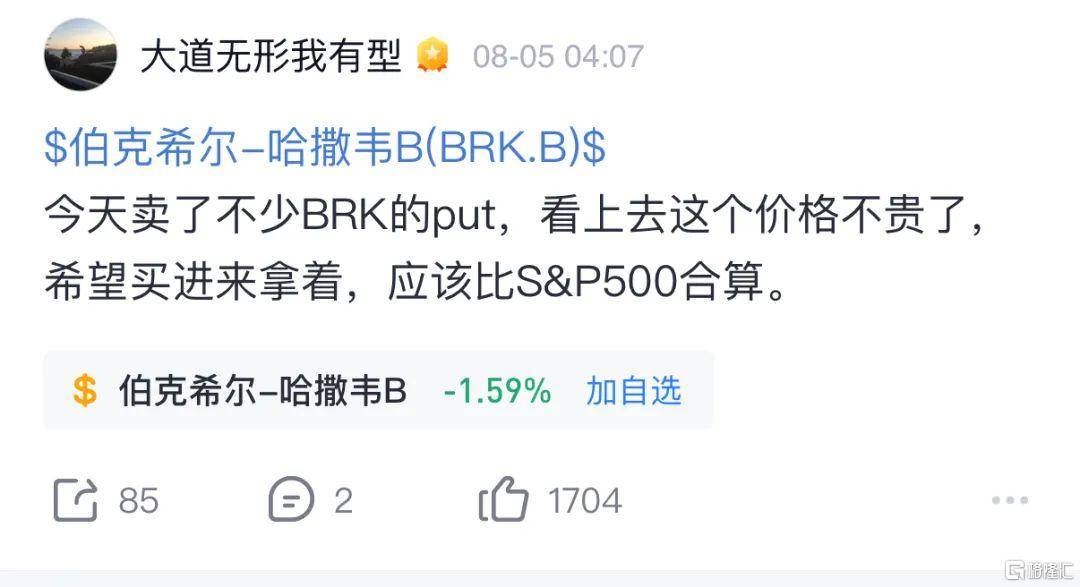
Core Viewpoint - The article discusses the recent investment activities of investor Duan Yongping, particularly his strategy of selling put options on Berkshire Hathaway amid a decline in its stock price following Warren Buffett's announcement to step down as CEO. Group 1: Investment Strategy - Duan Yongping has been actively selling put options, indicating an expectation that the stock price will either rise or not decline further [3][8]. - He sold a significant amount of put options for Berkshire Hathaway, suggesting that he believes the current price is attractive compared to the S&P 500 [1][5]. Group 2: Berkshire Hathaway's Performance - Berkshire Hathaway's stock price fell from a record high of $812,900 per share on May 2 to $685,200 on August 4, marking a 15% decline over three months [4][5]. - The company's Q2 2025 financial results showed total revenue of $92.515 billion, a slight decrease of 1.2% from $93.653 billion in Q2 2024, and a net profit of $12.37 billion, down 59% year-over-year [5][6]. Group 3: Market Context - The decline in Berkshire Hathaway's stock price is attributed to both Buffett's impending retirement and disappointing quarterly earnings, which were impacted by losses in its insurance business and a $3.8 billion impairment on Kraft Heinz [5][7]. - Despite the overall bullish trend in the U.S. stock market, Berkshire has been a net seller of stocks for 11 consecutive quarters and did not repurchase any shares in the first half of the year [5]. Group 4: Duan Yongping's Broader Investment Activities - Duan Yongping has made multiple investments this year, including a $2.9 billion purchase of shares in five companies during a market downturn in early April [10][11]. - Since April 7, notable stock price increases have been observed: Nvidia up 92%, TSMC up 66%, Google up 35%, Apple up 17%, and Tencent up 15% [15][16]. Group 5: Investment Philosophy - Duan Yongping emphasizes a long-term investment philosophy focused on value investing, advocating for investments in companies with strong business models and avoiding leverage and speculation [18][19][20].



历史新高!“巴菲特钟爱的”中证红利质量ETF(159209)年内第21次新高
Sou Hu Cai Jing· 2025-08-08 02:56
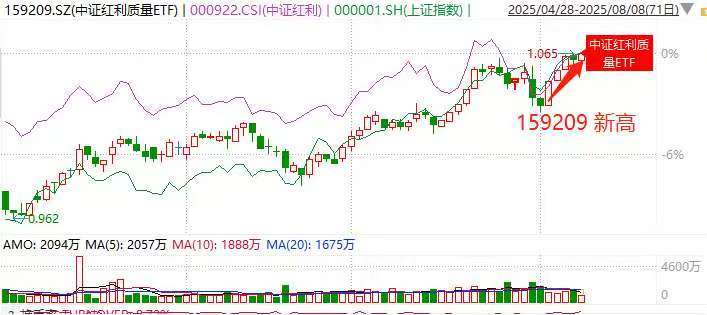
8月8日,红利资产持续走强。截至10时39分,中证红利质量ETF(159209)放量涨0.38%,盘中创年内第 21次新高。截至8月7日,该基金获资金连续2日净流入。 据了解,中证红利质量ETF(159209)跟踪的中证全指红利质量指数选取 50 只分红稳定、股息率较高且盈 利持续性较好的上市公司证券作为指数样本,以反映具有较强分红和盈利能力特征的上市公司证券的整 体表现。以"红利+质量"双因子筛选机制筛选出兼具"低估值"+"高质量"双重护城河的优质企业。其核心 理念与巴菲特"以合理价格投资卓越企业"的价值投资逻辑高度契合。 产品设计层面,中证红利质量ETF(159209)费用模式采用"0.15%+0.05%"的全市场最低档 ,长期持有具 备明显的成本优势;分红模式采用月度评估分红机制,能更好地满足投资者的现金流需求,提升持有体 验。 风险提示:文中提及的指数成份股仅作展示,个股描述不作为任何形式的投资建议。任何在本文出现的 信息(包括但不限于个股、评论、预测、图表、指标、理论、任何形式的表述等)均只作为参考,投资 人须对任何自主决定的投资行为负责。基金投资有风险,基金的过往业绩并不代表其未来表现,基金管 理 ...
段永平的投资哲学:从商业本质到人生智慧的深度解码
Sou Hu Cai Jing· 2025-08-08 02:53
Core Insights - The essence of investing is understanding that buying stocks equates to buying companies and their future cash flows [3][4][17] - Value investing is often misunderstood, with few grasping its true essence [3][17] Group 1: Investment Philosophy - The fundamental value of a company lies in its cash flow rather than profits, as demonstrated by the investment in NetEase, where a low market cap contrasted with high cash reserves [3][4] - Valuation is viewed as an art rather than a precise calculation, with a focus on qualitative assessments rather than strict financial models [4][17] - Market fluctuations are seen as opportunities rather than risks, with a strategy of buying during downturns exemplified by the investment in Tencent [5][17] Group 2: Dynamic Competitive Advantages - The concept of a "moat" is redefined as a dynamic capability to withstand competition, rather than static financial metrics [6][17] - Unique geographical advantages and proprietary formulas create irreplaceable barriers, as seen in the case of Moutai and Yunnan Baiyao [6][17] - Network effects in ecosystems, such as Apple's iOS and Tencent's WeChat, enhance value as user bases grow, leading to increased switching costs [7][17] Group 3: Cultural and Philosophical Insights - Corporate culture is emphasized as a crucial element of competitive advantage, with a focus on values that prioritize customer needs [8][17] - Awareness of one's own limitations is vital, as illustrated by the decision to avoid banking stocks due to a lack of understanding [9][17] - A contrarian approach to investing, such as increasing positions during market declines, is highlighted as a strategy to navigate market volatility [10][17] Group 4: Long-Term Investment Strategies - A long-term perspective is essential, with patience allowing for the benefits of compounding to materialize, as evidenced by the long-term holdings in Apple and Moutai [11][17] - The importance of understanding the fundamental value of companies remains constant, even amidst technological changes like AI [13][17] - Practical application of options strategies, such as selling put options, demonstrates a flexible approach to managing investment costs and risks [14][17] Group 5: Value Creation - The ultimate goal of investing is to create value rather than merely distribute it, with a focus on solving real problems for consumers [15][17] - The insights from the investment philosophy extend beyond finance, offering a broader perspective on life and decision-making [17]

【申·原创】投资者保护日历8月8日长期理念一起学
申万宏源证券上海北京西路营业部· 2025-08-08 02:38
Core Viewpoint - The article emphasizes the importance of value investing and diversification strategies, advising against short-term speculation and highlighting the understanding of compound interest [1]. Group 1 - The article suggests that investors should focus on long-term investment principles rather than short-term market fluctuations [1]. - It advocates for a diversified investment portfolio to mitigate risks associated with market volatility [1]. - The concept of compound interest is presented as a crucial element for achieving significant investment growth over time [1].
两融余额重回2万亿,这次不一样
Bei Jing Shang Bao· 2025-08-07 15:39
两融余额重回2万亿元高位,投资者参与热情高涨,与以往投机力量推高两融余额不同,这次是价值投 资主导的资产配置变化,投资者预期价值投资收益将会超过融资成本,如此的两融余额创新高显得很理 性。 过去股市偏投机市,两融余额从4000亿元飙升至2.27万亿元只用了大约一年时间,市场呈现明显的抱团 炒作特征。当时的两融,投资者融资的主要目的是使用更多的资金进行投机炒作。两融余额的快速增 长,持续性很差,一旦投机行情结束,两融余额将出现快速下降。 而本轮两融扩张呈现出三大变化。第一点是两融标的开始分散。当前参与两融的股票数量超过3000只, 是2015年投机行情高点的数倍,投资者融资买入的股票相对分散,风险性大幅下降。第二点是行业多元 化,电子、生物医药、半导体等新兴产业融资净买入额居前,而非传统金融地产板块。第三点是投资者 结构更加优化。个人投资者账户的增长率远低于机构投资者,专业机构成为杠杆资金的主力。 本轮两融扩张的根本动力在于政策预期改善与制度环境优化。此前,监管层推出降费率、优化规则、强 监管的组合拳,融资利率出现大幅下降,同时融券业务暂停转融通,两融标的扩容至大多数正常交易股 票。这些改革显著降低了杠杆成本, ...
侃股:两融余额重回2万亿 这次不一样
Bei Jing Shang Bao· 2025-08-07 14:48
(文章来源:北京商报) 本轮两融扩张的根本动力在于政策预期改善与制度环境优化。此前,监管层推出降费率、优化规则、强 监管的组合拳,融资利率出现大幅下降,同时融券业务暂停转融通,两融标的扩容至大多数正常交易股 票。这些改革显著降低了杠杆成本,同时优化了风险控制机制,构建起更稳健的杠杆交易体系。 此外,本轮杠杆资金流向具有鲜明的价值投资特征。电子行业、半导体设备、AI算力等细分领域获得 资金重点布局;生物医药行业中的创新药、医疗器械等长周期赛道也受到资金青睐。这种选择背后是投 资者清晰的价值投资逻辑,用较低的融资成本去买入并持有预期收益偏高的投资品种,以达到价值投资 收益完全覆盖融资成本的良性策略。 两融余额的理性扩张正在重塑市场生态。当前市场平均维持担保比例十分健康,这意味着投资者抗风险 能力显著增强。从资金效率看,融资资金换手率也出现快速下降,显示杠杆资金更注重长期持有而非频 繁短线交易。 新的转变带来市场稳定性的大幅提升。在股市出现调整期间,两融余额下降并不明显,而当两融余额开 始回升的时候,对于股市的支撑力度则大幅提升,这表明理性杠杆资金正在发挥稳定器而非加速器的作 用。 事实上,两融余额重返2万亿元具有 ...
Is Kennametal (KMT) Stock Undervalued Right Now?
ZACKS· 2025-08-07 14:41
Core Viewpoint - The article emphasizes the importance of value investing and highlights Kennametal (KMT) as a strong value stock based on various financial metrics [1][7]. Company Overview - Kennametal (KMT) currently holds a Zacks Rank of 2 (Buy) and an A for Value, indicating strong potential for investors [3]. - The stock is trading at a P/E ratio of 17.65, which is lower than the industry average of 18.35 [3]. Valuation Metrics - KMT's P/B ratio is 1.5, significantly lower than the industry average of 2.58, suggesting a solid valuation compared to its book value [4]. - The P/S ratio for KMT is 0.8, compared to the industry's average of 1.48, indicating that the stock is undervalued based on sales [5]. - KMT has a P/CF ratio of 7.96, which is much lower than the industry average of 17.43, further supporting the notion that KMT is undervalued based on cash flow [6]. Investment Outlook - The combination of KMT's strong earnings outlook and favorable valuation metrics positions it as an impressive value stock at the moment [7].