
出口管制

Search documents
中美经贸团队达成3方面共识
Bei Jing Ri Bao Ke Hu Duan· 2025-10-30 07:49
Core Points - The US will cancel the 10% tariff on Chinese goods related to fentanyl, and the 24% reciprocal tariffs will remain suspended for another year [1] - The US will pause the implementation of its 50% export control rule announced on September 29 for one year, while China will also suspend its related measures for the same duration [1] - The US will suspend its 301 investigation into China's maritime, logistics, and shipbuilding industries for one year, with China reciprocating by pausing its countermeasures [1] Summary by Categories Tariff Adjustments - The US will eliminate the 10% tariff on Chinese goods, including those from Hong Kong and Macau, and will continue to suspend the 24% reciprocal tariffs for one year [1] - China will adjust its countermeasures accordingly [1] Export Controls - The US will delay the implementation of its 50% export control rule for one year, while China will also pause its related export control measures for the same period [1] - Both countries will explore detailed plans for these measures [1] Investigations and Cooperation - The US will suspend its 301 investigation into China's maritime, logistics, and shipbuilding sectors for one year, with China also pausing its countermeasures [1] - Both sides reached agreements on fentanyl cooperation, expanding agricultural trade, and handling specific corporate cases [1] - The outcomes of the Madrid economic negotiations were reaffirmed, with the US making positive commitments in investment areas [1]
本田墨西哥工厂因安世半导体争端停产
日经中文网· 2025-10-30 03:19
Core Viewpoint - Honda has halted production at its Mexican plant due to semiconductor shortages caused by geopolitical tensions surrounding Nexperia, a semiconductor manufacturer based in the Netherlands and owned by a Chinese company. This marks the first time a Japanese automaker has explicitly reported being affected by this issue [2][4]. Group 1: Production Impact - Honda stopped production in Mexico on October 28 and began adjusting production in the U.S. and Canada on October 27. The company has not disclosed the scale or duration of the production cuts [4]. - The Mexican plant, located in Celaya, is a crucial facility for Honda, with an annual production capacity of 200,000 vehicles, primarily producing the SUV model HR-V. North America accounts for 40% of Honda's global sales, and prolonged production disruptions in this region could lead to a decline in performance [4][5]. Group 2: Semiconductor Supply Chain Issues - Honda utilizes general semiconductors produced by Nexperia in some of its components. While the motorcycle production facility in Mexico continues to operate normally, the automotive production has been significantly impacted [5]. - The Dutch government has taken control of Nexperia citing national security concerns, while the Chinese government has responded with export controls on products manufactured by Nexperia in China [5].



欧洲人面子论扎心:安世风波,让欧洲终于明白了中国决心
Sou Hu Cai Jing· 2025-10-28 19:13
Core Viewpoint - The semiconductor dispute initiated by the Dutch government has led to a crisis in the European automotive industry, highlighting the severe dependency on Chinese semiconductor supplies and the misjudgment of China's response capabilities [1][3][10]. Group 1: Dutch Government Actions - On September 30, the Dutch government invoked the Cold War-era "Commodity Supply Law" to take control of Nexperia, a semiconductor company, freezing its global assets and transferring 99% of its shares to third-party custody without public hearings [5]. - The Dutch government justified its actions by citing "national security" concerns, leading to the removal of Chinese executives and the appointment of Dutch management [6][8]. - The actions were reportedly influenced by pressure from the United States, which had just imposed new export controls on the parent company, Wingtech Technology [8]. Group 2: Chinese Response - In response to the Dutch government's actions, the Chinese Ministry of Commerce imposed export controls on chips produced at Nexperia's Chinese factory, effectively cutting off supplies to Europe [10][11]. - Nexperia's Chinese operations declared independence, reinstating the ousted Chinese CEO and shifting production to serve the domestic market only [11]. Group 3: Impact on the Automotive Industry - The immediate impact was felt by major automotive manufacturers, with Volkswagen's production lines halted due to a lack of power semiconductors from Nexperia, putting thousands of jobs at risk [13]. - The crisis escalated, with BMW reporting losses of up to €1 billion per month due to chip shortages, and other manufacturers like Volvo and Nissan facing significant production delays [15]. - The European automotive industry faced a broader crisis, with over 5,000 vehicles' production disrupted and losses exceeding €1 billion [15]. Group 4: European Response and Consequences - The Dutch government found itself in a difficult position, having legally taken control of Nexperia but lacking access to its core production capabilities, which remained in China [19]. - The crisis led to significant layoffs in the semiconductor transport sector, with a 40% drop in shipments through Rotterdam and over 3,000 job losses in Dutch companies reliant on Nexperia [19]. - Pressure mounted from German and French automotive companies on the Dutch government to resolve the dispute, indicating internal divisions within the EU [20].

闻泰科技:荷兰想让本国企业接手,但没用,客户不会追随
Guan Cha Zhe Wang· 2025-10-28 15:28
Core Viewpoint - The Dutch government's forced takeover of the Chinese-controlled ASML Semiconductor has raised concerns about its intentions, with allegations of aiming to transfer control to a local Dutch company, which may lead to significant disruptions in the global automotive supply chain [1][3][4]. Group 1: Company Actions and Reactions - The spokesperson for the parent company, Wingtech Technology, criticized the Dutch government's interference, asserting that any Dutch company taking over ASML Semiconductor would fail as customers would not follow [1]. - Wingtech Technology emphasized that if the Chinese operations were severed from European operations, ASML Semiconductor would lose a significant portion of its backend capacity, which cannot be replaced by Europe or other regions in the foreseeable future [1]. - Following the Dutch government's actions, ASML Semiconductor has seen key employees leave, leading to operational pauses in several industrial sectors [5]. Group 2: Impact on the Industry - The takeover has triggered a "major earthquake" in the global automotive supply chain, affecting major automakers in Europe, the US, and Japan, with warnings from Volvo and Volkswagen about potential temporary closures of European factories if the situation remains unresolved [3]. - A report indicated that 86% of 107 leading European companies across various industries source chips from ASML Semiconductor's production base in China, highlighting the potential risk to a significant portion of European industry [3]. - The Dutch government's actions have prompted urgent discussions with China and other EU member states to seek a "quick and pragmatic solution" to the crisis [3][4]. Group 3: Government and Regulatory Context - The Dutch government invoked a rarely used law from 1952, citing national security concerns to impose restrictions on ASML Semiconductor, preventing any adjustments to assets, intellectual property, or personnel for one year [4]. - The US government has also intervened, with discussions about the "penetration rules" that restrict subsidiaries of entities on the entity list, which directly affects ASML Semiconductor as a wholly-owned subsidiary of Wingtech Technology [4]. - Allegations surfaced that the Chinese team planned to cut 40% of ASML Semiconductor's workforce and relocate operations, although no evidence was provided to support these claims [6].


中欧真的存在一场“稀土危机”吗?
Huan Qiu Shi Bao· 2025-10-28 15:26
Core Viewpoint - The upcoming talks between China and Europe in Brussels regarding rare earth issues are framed against a backdrop of exaggerated fears about a "rare earth supply crisis" and geopolitical tensions, questioning whether a real crisis exists between the two parties [1][3]. Group 1: China and Rare Earths - China is the world's largest producer and exporter of rare earths, which reflects the natural outcome of economic globalization and highlights the economic complementarity between China and Europe [1][2]. - China's export control policies are seen as a necessary step for the long-term stability of the rare earth supply chain, aligning with global green development trends [2][3]. - The Chinese government has established a "green channel" for European companies to facilitate the export process, with over 60% of EU companies expected to obtain export licenses through this channel by mid-2025 [2]. Group 2: European Concerns and Misconceptions - The anxiety expressed by some European officials regarding rare earths is fundamentally a cognitive issue, reflecting a misperception of dependency on China [3]. - The real challenge for Europe lies in overcoming geopolitical constraints and returning to a rational and pragmatic policy towards China, rather than succumbing to external pressures [3]. - The notion of using "economic weapons" against China may contradict European interests and raises questions about the true intentions behind such rhetoric [3]. Group 3: Future Cooperation - The focus should be on establishing a legally viable and reciprocal framework for cooperation on rare earths, which could stabilize the supply chain and send positive signals to the international community [3]. - Continuous emphasis on "reducing dependence on China" could overshadow practical cooperation and hinder Europe's ability to address its own competitiveness issues [3].
美国是否应该向中国出售B30A芯片?
傅里叶的猫· 2025-10-28 13:51
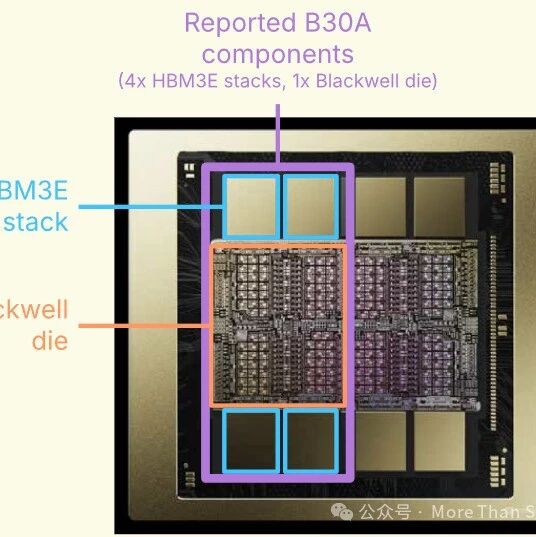
Core Viewpoint - The article discusses the potential implications of the B30A chip, designed by NVIDIA as a downgraded version of its flagship B300 chip, particularly in the context of U.S. export controls to China and the ongoing AI computing race [5][16]. Group 1: AI Computing Race and Export Controls - The U.S. government faces a complex decision regarding the export of the B30A chip to China, which could significantly enhance China's AI computing capabilities despite being a lower-performance version of the B300 [5][6]. - The Trump administration's AI action plan aims to maintain U.S. leadership in AI by restricting access to advanced AI computing resources, with the U.S. currently leading China in AI supercomputing capabilities by approximately five times [7]. Group 2: Hardware Configuration and Performance - The B30A chip has peak performance and memory bandwidth that are 50% lower than the B300, with a single B30A card priced at approximately $22,500 compared to the B300's $45,000 [8][12]. - A server with eight B30A GPUs consumes only 40% of the power of a B300 server, making it more energy-efficient [8]. Group 3: Cluster Cost Analysis - To achieve the same total computing power as a B300 cluster, a B30A cluster requires double the number of chips, leading to a 24% higher initial investment cost, although this is mitigated by Chinese government subsidies [11]. - The overall amortized cost of a B30A cluster, including server, network, and energy costs over five years, is approximately 1.24 times that of a B300 cluster, indicating a 20% higher cost [13]. Group 4: Strategic Implications of B30A Export - If the B30A is allowed for export, it could significantly narrow the AI computing gap between the U.S. and China, potentially reducing the disparity from over 31 times to below 4 times [14]. - The introduction of B30A could pressure domestic Chinese chip manufacturers, as its performance exceeds that of local alternatives while being more cost-effective [14][15]. Group 5: Global Supply Chain Impact - Allowing the export of B30A could disrupt the global chip supply chain, as NVIDIA's production capacity is limited, potentially leading to longer wait times for other markets [15]. - The B30A's established supply chain and controllable procurement costs make it an attractive option for China, representing a "low investment, high return" scenario [15]. Group 6: Technical and Geopolitical Interplay - The decision to allow B30A exports is complicated by geopolitical considerations, as it could undermine U.S. core advantages in AI while providing NVIDIA with significant revenue [16]. - The AI computing race is not solely a technological competition but also a geopolitical struggle, with the potential for U.S. market restrictions to accelerate China's domestic technology development [16].

中美吉隆坡刚谈妥,美国又变脸,美财长通告全球,将继续针对中国
Sou Hu Cai Jing· 2025-10-28 04:53
Core Points - The recent US-China trade negotiations resulted in a preliminary framework agreement, extending certain tariff suspension periods and initiating pilot cooperation on fentanyl enforcement [6][11] - US Treasury Secretary emphasized that the US will not change its export control measures against China, indicating a persistent hardline stance [9][12] - The negotiations highlighted a stark contrast between traditional trade issues and strategic technology competition, with the US aiming to maintain its technological dominance [11][26] Trade Negotiations - The negotiations took place in Kuala Lumpur and were marked by intense discussions on six core issues, including maritime logistics and tariff suspension [3][6] - Despite reaching an agreement, the atmosphere was described as tense, with significant disagreements on agricultural imports and tariffs on China's shipbuilding industry [7][11] Export Controls - The US's firm position on export controls stems from concerns over China's technological advancements, particularly in semiconductors and quantum computing [13][15] - The US plans to tighten export controls further by 2025, affecting companies like TSMC and Samsung in China [15][17] - The US is also implementing restrictions on AI chip exports, which could severely impact Chinese companies and US tech giants alike [17][19] Rare Earths and Supply Chains - China maintains a dominant position in the global rare earth supply chain, controlling 92% of refining capacity [19][21] - The US's attempts to form a "technology alliance" against China have faced internal disagreements among G7 countries, undermining their effectiveness [21][25] - China's strategy includes building processing plants in collaboration with countries like Vietnam and Malaysia, enhancing its resource and technology integration [22][24] Systemic Competition - The negotiations reflect a broader competition between two systemic models: the US's "small yard, high wall" strategy versus China's "new type of state-led system" [26][28] - In the semiconductor sector, the US is providing substantial subsidies to attract foreign investment, while China is heavily investing in its domestic industry [28][30] - The ultimate goal of this competition is to shape global governance rules, with both countries pursuing different paths to influence the global economic landscape [30][32]
小金属资源稀缺叠加供给集中度高,稀有金属ETF基金(561800)半日收涨2.70%冲击3连涨!成分股厦门钨业10cm涨停
Sou Hu Cai Jing· 2025-10-27 04:57
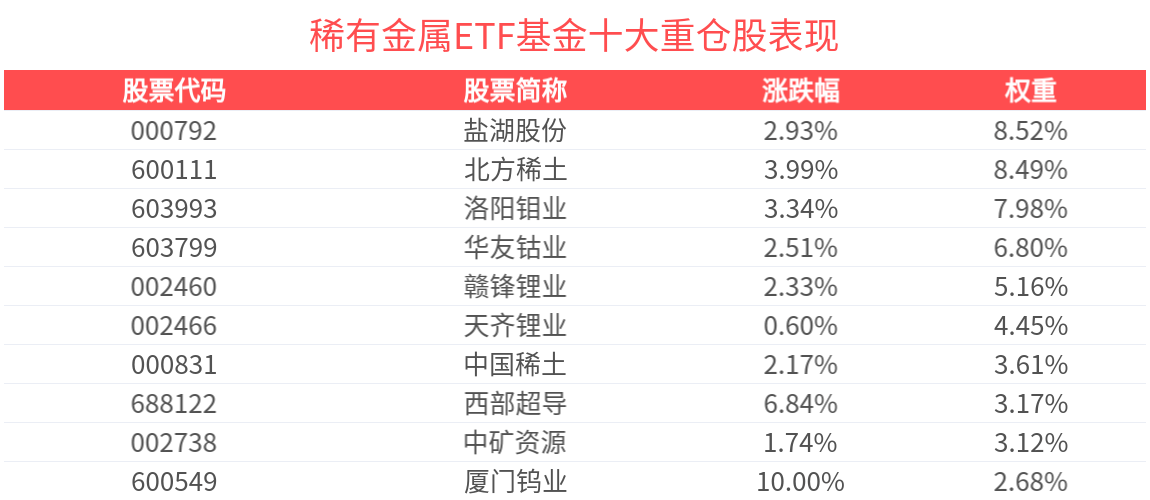
Group 1 - The China Rare Metals Theme Index (930632) rose by 2.83% as of October 27, 2025, with notable gains in component stocks such as Xiamen Tungsten (600549) hitting the daily limit up, and Dongfang Tantalum (000962) increasing by 8.00% [1] - The Rare Metals ETF (561800) also saw a rise of 2.70%, marking its third consecutive increase, with a turnover rate of 10.16% and a half-day trading volume of 25.96 million yuan [1] - Over the past 12 trading days, the Rare Metals ETF has attracted a total of 51.51 million yuan in inflows, indicating active market participation [1] Group 2 - China has imposed restrictions on rare earth exports since April, which has led to a noticeable impact on overseas markets, resulting in rising prices and pressure on manufacturers [1] - The new capacity being built overseas is relatively small compared to China's overall capacity, potentially enhancing China's bargaining power in the international market and increasing sector valuations [1] - Domestic rare earth transactions are active, with prices rising in a tiered manner, reflecting strong market sentiment and tightening supply of low-priced resources [1] Group 3 - CITIC Securities notes that resource-rich countries are likely to continue imposing supply constraints, which may lead to strategic premiums for key minerals [2] - Indonesia's nickel export controls have proven effective in value retention, and the country is expected to further strengthen supply constraints through policy adjustments and illegal mining crackdowns [2] - Guotai Junan Securities indicates that a new cycle has begun in the downstream of the new energy vehicle supply chain, with export controls creating opportunities in the lithium battery sector [2] Group 4 - As of September 30, 2025, the top ten weighted stocks in the China Rare Metals Theme Index (930632) accounted for 59.91% of the index, including Northern Rare Earth (600111), Luoyang Molybdenum (603993), and Ganfeng Lithium (002460) [2]

突发特讯!中美会谈第2天,特朗普专机飞抵现场,美押上全部筹码,准备梭哈,引发国际高度关注
Sou Hu Cai Jing· 2025-10-27 03:26
Group 1 - The core viewpoint of the article emphasizes that both the US and China are keen to avoid escalating trade conflicts, recognizing that a prolonged standoff would be detrimental to both sides [1][10] - The meeting took place in Kuala Lumpur, a relatively neutral location, which contributed to a more relaxed atmosphere for discussions [1] - The delegation from China was led by He Lifeng, while the US team included Bessent and Greer, indicating the importance both sides placed on the talks [3] Group 2 - The agenda for the discussions included several contentious issues such as the US's "301 measures" against China's maritime logistics and shipbuilding industries, the extension of tariff suspension, fentanyl cooperation, agricultural trade, and export controls [3][5] - The atmosphere during the talks was reportedly better than expected, with both sides engaging in "candid, in-depth, and constructive exchanges" without resorting to blame [5][8] - The meeting was seen as a preparatory step for a potential meeting between the two countries' leaders, with the presence of President Trump in Kuala Lumpur adding significance to the discussions [5][7] Group 3 - Both sides are aware that continued confrontation would lead to mutual harm, and thus cooperation is viewed as the way forward, with the preliminary consensus reached during the talks providing reassurance to global markets [8][10] - The complexity of export controls remains a sticking point, with the US citing national security concerns while China perceives it as a form of technological blockade [5] - The outcome of the talks is still uncertain, as the implementation of any agreements will depend on the details and the willingness of both parties to compromise [8][10]
应用材料计划裁员1400人
Zheng Quan Shi Bao Wang· 2025-10-26 06:56
Core Insights - Applied Materials Inc. plans to cut 4% of its global workforce to address sales slowdown and market volatility [1][2] - The company expects to incur costs of approximately $160 million to $180 million related to the layoffs, primarily in severance and other one-time benefits [1] - The layoffs will affect over 1,400 employees based on the current workforce of 36,100 [2] Financial Impact - The new export control rules from the U.S. Department of Commerce are projected to reduce revenue by $110 million in Q4 FY2025 and $600 million in FY2026 [2] - The company’s Q4 revenue guidance is approximately $6.7 billion, below analyst expectations of $7.32 billion [3] - Adjusted earnings per share for Q4 are expected to be around $2.11, also below analyst estimates of $2.38 [3] Market Position and Future Outlook - Despite short-term challenges, the semiconductor industry is expected to see significant growth over the next decade [2] - The company is optimizing its organizational structure to enhance competitiveness and productivity [1][2] - Applied Materials serves major chip manufacturers like TSMC, Samsung, and Intel, making its performance a key indicator of future demand in the semiconductor market [3]
