新能源汽车

Search documents
抓牢“新基建”风口 长盈精密上半年净利同比增长逾九成
Zheng Quan Ri Bao· 2025-12-29 07:10
Core Viewpoint - Changying Precision plans to raise up to 1.9 billion yuan through a private placement to support its strategic transformation and fund new product lines, focusing on the electric vehicle and 5G sectors [1] Group 1: Fundraising and Project Allocation - The company intends to allocate 900 million yuan to the electric vehicle components project and 1 billion yuan to the 5G smart terminal module project [1] - The initial plan for the 5G project was to raise 1.4 billion yuan, which has now been reduced to 1 billion yuan, while a previously planned 600 million yuan for working capital has been canceled [1][2] - The electric vehicle project will focus on the construction of high and low voltage connectors, battery structure components, and hydrogen fuel cell bipolar plates, with an estimated construction period of 18 months [1] Group 2: Market Position and Growth Potential - Changying Precision has become a key supplier of electric vehicle components for Tesla since 2017, with the upcoming Tesla Gigafactory (Phase II) expected to significantly boost market demand for these components [2] - The company aims to enhance its supply chain responsiveness and customer service capabilities through the new projects, which align with its strategic focus on electric vehicles and 5G [2] - The company has seen a 31.42% year-on-year increase in revenue from Tesla during the first half of the year [3] Group 3: Financial Performance - In the first half of the year, Changying Precision reported a revenue of 4.006 billion yuan, a year-on-year increase of 1.20%, and a net profit of 229 million yuan, up 91.10% [3] - The company has successfully adjusted its customer and product structures, leading to significant growth, with non-mobile business revenue exceeding 50% of total revenue during the reporting period [3][4] - The establishment of Shanghai Lingang Changying New Energy Technology Co., Ltd. marks a significant step in the company's industrial layout in the East China region for electric vehicles [3]

供需面格局预期较为宽松 钯期货主力合约触及跌停
Jin Tou Wang· 2025-12-29 07:05
Core Viewpoint - Palladium futures experienced a sharp decline, hitting the limit down at 494.10 yuan, a drop of 10.00% [1] Group 1: Market Analysis - Guosen Futures predicts that platinum and palladium may continue to operate in a volatile but strong manner in the future, supported by ongoing geopolitical tensions and market sentiment [2] - Ruida Futures warns of potential technical pullback pressure on platinum and palladium prices in the short term, noting a divergence in their price movements [2] - The ongoing conflict between Russia and Ukraine, along with other regional risk events, provides a continuous risk premium and uncertainty support for the entire precious metals sector, including platinum group metals [2] Group 2: Price Dynamics - Platinum prices are expected to find short-term support around 650 yuan per gram and resistance near 750 yuan per gram, while palladium support is noted at 500 yuan per gram and resistance at 600 yuan per gram [2] - Recent strong performance in platinum prices is driven by tight physical inventory and cross-regional arbitrage trading, while palladium has shown weakness due to concentrated demand in automotive catalysts and the rise of electric vehicles [2] - The disparity in domestic and international prices has stimulated arbitrage motives, pushing up spot prices and amplifying futures price volatility [2] Group 3: Future Outlook - The long-term outlook for platinum remains positive due to expectations of structural supply-demand deficits and expanding demand in the hydrogen economy, while palladium's market is shifting from a supply shortage to an oversupply situation [2] - Despite the weakening demand expectations for palladium, the prevailing sentiment driven by interest rate cuts may provide some support for its prices, making it a cost-effective choice at current low levels [2] - The recent parabolic rise in platinum and palladium prices may increase the risk of a high-level pullback, necessitating caution against technical correction pressures in the short term [2]
全球1550万个充电桩缺口待补!中国企业双路径“出海”
Mei Ri Jing Ji Xin Wen· 2025-12-29 06:47
Core Insights - The article discusses the growing presence of Chinese electric vehicle (EV) charging stations in international markets, particularly in Europe and Southeast Asia, highlighting the need for flexible strategies based on local conditions [1][4][9] Group 1: Market Demand and Growth - By the end of November this year, China exported 2.315 million electric vehicles, marking a year-on-year increase of approximately 100%, with a projected total exceeding 2.5 million for the year [1] - The International Energy Agency (IEA) estimates that by 2030, there will be a need for 5.5 million public fast charging stations and 10 million public slow charging stations globally, creating a market opportunity of 15.5 million units [3] - The global charging station market is expected to grow from $5.71 billion in 2024 to $14.96 billion by 2032, with a compound annual growth rate of 12.57% [5] Group 2: Regional Market Characteristics - Europe and Southeast Asia are identified as key markets for Chinese charging station companies, with Europe offering strong policy support and high payment capacity, while Southeast Asia shows rapid demand growth and significant potential [4][9] - The European market currently has over 1 million charging guns, while emerging markets like Brazil, Indonesia, Thailand, and Vietnam collectively have over 24,000, indicating a rapid development phase [5] Group 3: Challenges and Strategies - The article notes that the global charging infrastructure landscape is complex, with varying demands for charging types, technical standards, and operational models across different regions [3][11] - Chinese companies are adopting two main strategies for international expansion: following Chinese automakers abroad and leveraging local partnerships or dealer networks [9][10] - The need for local certification and compliance with different standards poses significant challenges for Chinese charging station manufacturers, as they must navigate various international regulations [10][11] Group 4: Competitive Advantages - Chinese charging stations are noted for their high cost-performance ratio, which provides a competitive edge in international markets [10] - The article emphasizes the importance of "localization of certification" to overcome challenges related to compliance and market entry in different countries [11] Group 5: Future Outlook - The charging station industry is expected to continue thriving, with projections indicating that the overseas market for EV charging equipment could reach 75.9 billion yuan by 2027, with the U.S. and European markets expected to account for 28.4 billion yuan and 33.5 billion yuan, respectively [14]


20cm速递|创业板新能源ETF国泰(159387)盘中微跌,锂电下游动储需求两旺
Mei Ri Jing Ji Xin Wen· 2025-12-29 04:24
Group 1 - The core viewpoint of the article highlights the strong demand for lithium battery downstream energy storage since 2025, leading to a mismatch in supply and demand, which is expected to drive price increases in the industry [1] - Lithium battery materials have been at low prices for an extended period, resulting in the clearance of substantial production capacity, and the current industry concentration is high, making effective capacity insufficient to meet explosive demand growth [1] - The price of lithium iron phosphate has increased by over 30% this year, with strong demand for high-end products; negative electrode materials are operating at full capacity, and the diaphragm industry is entering a second round of price increases [1] Group 2 - In terms of energy storage, domestic policy changes (Document 136) and capacity electricity pricing have altered revenue models, increasing project IRR to between 6% and 12%, significantly enhancing installation willingness [1] - In the overseas market, the U.S. is driven by IRA policy incentives and AIDC storage, while Europe is shifting from household storage to large-scale storage dominance, and emerging markets are propelled by energy transition goals [1] - The ChiNext New Energy ETF (159387) tracks the Innovation Energy Index (399266), which has a daily fluctuation of 20%, selecting technology innovation companies in clean energy, new energy vehicles, and energy storage sectors to reflect the overall performance of cutting-edge technology enterprises in the new energy field [1]

刚刚,一汽正式入股零跑汽车,37.4亿拿下5%股份
3 6 Ke· 2025-12-29 04:18
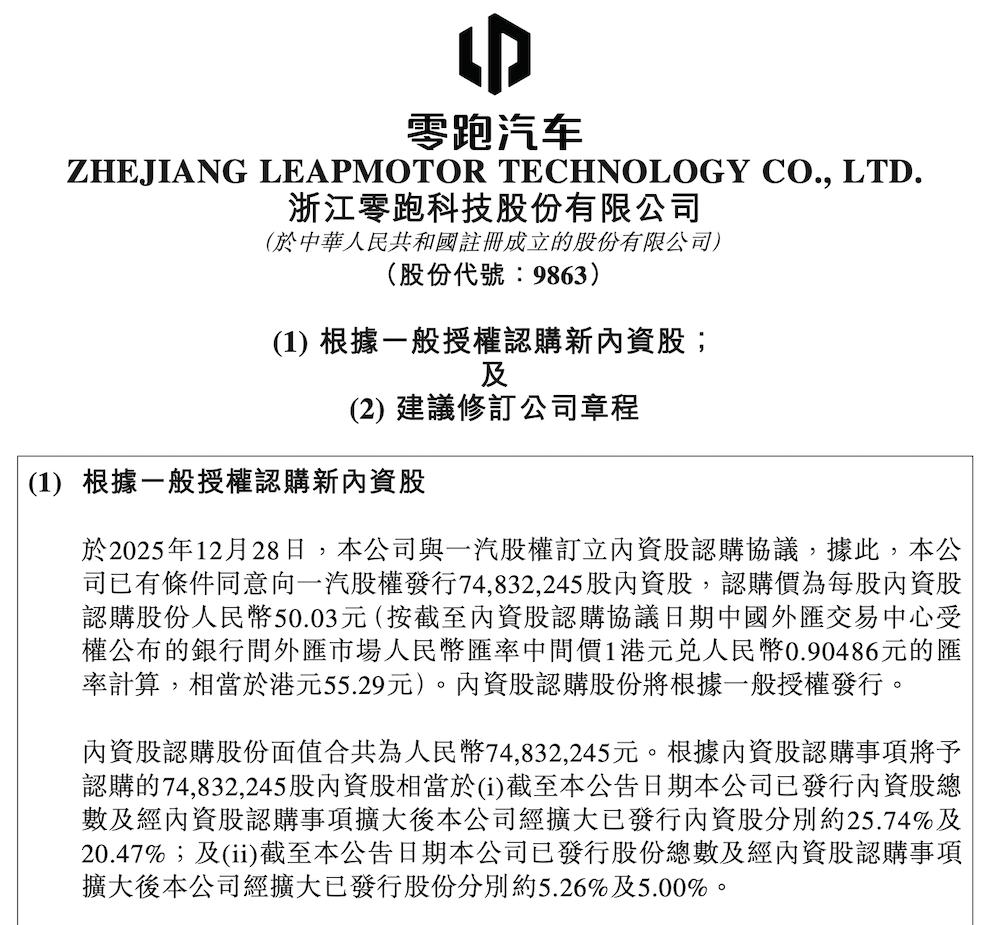
Core Viewpoint - Leap Motor has entered into a share subscription agreement with FAW Group, raising approximately RMB 3.744 billion through the issuance of about 74.83 million shares at a price of RMB 50.03 per share, which will be used for R&D, operational funding, and expanding sales networks [1][5][12]. Group 1: Financial Details - The total amount raised from the share subscription is RMB 37.44 billion [5]. - Approximately 50% (RMB 18.72 billion) of the funds will be allocated for R&D investments [5]. - About 25% (RMB 9.36 billion) will be used to supplement working capital and for general corporate purposes [5]. - The remaining 25% (RMB 9.36 billion) will be directed towards expanding the sales and service network and enhancing brand awareness [5]. Group 2: Strategic Implications - FAW's investment is expected to provide Leap Motor with critical strategic resources and a trust endorsement for its current and future development [12][25]. - The partnership aims to strengthen strategic collaboration and resource sharing between Leap Motor and FAW, enhancing product competitiveness in the electric vehicle market [20][21]. - Leap Motor's founder emphasized the importance of maintaining control by the existing management team despite the new investment [7][9]. Group 3: Future Outlook - Leap Motor aims to transition from a new car manufacturer to a more established electric vehicle company, targeting an annual sales volume of 4 million units in the next decade [11]. - The collaboration with FAW is seen as a strategic empowerment that provides Leap Motor with additional resources to navigate the competitive landscape of the automotive industry [25][27]. - The first overseas model developed through this partnership is expected to enter production in the second half of next year [24].

揭晓!2025中国汽车十大新闻!
Bei Jing Ri Bao Ke Hu Duan· 2025-12-29 04:17
Group 1 - The core theme of 2025 in the automotive industry is "anti-involution and strong regulation," with significant policy support and market response to boost automotive consumption [2][4] - The Ministry of Industry and Information Technology and other departments have intensified enforcement against issues like false evaluations and unfair competition, promoting a shift from price competition to value competition [4] - The "old-for-new" vehicle replacement program has led to over 11.2 million applications, accounting for about one-third of total sales, with new energy vehicles making up approximately 60% of this figure [6] Group 2 - The first batch of L3-level conditional autonomous driving vehicles has received approval for road testing in designated areas, marking a significant step towards commercialization [8] - The establishment of China Changan Automobile Group as the third state-owned automotive enterprise reflects the government's push for electric vehicle development and aims to enhance global competitiveness [10][11] - The "Energy-saving and New Energy Vehicle Technology Roadmap 3.0" outlines a vision for the automotive industry to achieve peak carbon emissions by 2040, with over 80% penetration of new energy vehicles [13] Group 3 - The "Automotive Industry Steady Growth Work Plan (2025-2026)" aims for total vehicle sales of approximately 32.3 million in 2025, with new energy vehicle sales targeted at 15.5 million [14] - China's automotive exports have reached 6.34 million units in the first 11 months of 2025, with a year-on-year growth of 18.7%, and are expected to exceed 7 million units by year-end [16] - Major automotive companies have committed to reducing payment terms to within 60 days, addressing long-standing issues of delayed payments to suppliers [18][19] Group 4 - New national standards for electric vehicle batteries, set to be implemented in July 2026, aim to enhance safety and quality, marking a significant upgrade in regulatory standards [21] - The Ministry of Commerce and other departments have introduced stricter regulations on used car exports to ensure compliance and promote healthy market development [23]


350亿,又一家新势力宣布破产
首席商业评论· 2025-12-29 04:07
Core Viewpoint - The demise of Qoros Auto serves as a warning for the Chinese automotive industry, highlighting the challenges of transitioning from product development to market success in the rapidly evolving new energy vehicle sector [5][7]. Group 1: Qoros Auto's Downfall - Qoros Auto, once seen as a benchmark for high-end domestic brands, has entered bankruptcy proceedings due to long-standing debts and operational failures, marking a significant moment in the transformation of the Chinese automotive landscape [7][9]. - The company faced over 1,000 enforcement actions and a total equity freeze amounting to over 35 billion yuan, reflecting severe financial distress and operational challenges [7][9]. - Despite initial success with its first model, Qoros 3, the brand struggled with high R&D costs and aggressive pricing strategies that alienated potential customers, leading to cumulative losses exceeding 6 billion yuan from 2014 to 2016 [9][11]. Group 2: Lessons for the Industry - Qoros Auto's experience underscores the importance of brand recognition and consumer trust, which are critical for long-term success in the automotive market [13][15]. - The company's failure to adapt to market changes, particularly the shift towards electric vehicles and consumer preferences, highlights the necessity for agility and strategic foresight in a rapidly evolving industry [16][19]. - The case illustrates the need for collaboration within the automotive ecosystem, as independent operations can lead to inefficiencies and increased costs, making it difficult to compete effectively [17][19]. Group 3: Future of the New Energy Vehicle Market - The new energy vehicle sector is entering a critical phase where the focus will shift from mere production capabilities to delivering real value and user satisfaction [21][29]. - Companies must evolve from being "car manufacturers" to "smart mobility technology enterprises," emphasizing the importance of understanding user scenarios and providing tailored solutions [21][23]. - The competitive landscape will increasingly rely on software capabilities and user engagement, necessitating a shift from traditional sales models to a more integrated approach that fosters long-term customer relationships [25][29].
港股异动 赛力斯(09927)盘中涨超4% 旗下海外品牌DFSK进军埃及市场
Jin Rong Jie· 2025-12-29 04:05
智通财经获悉,赛力斯(09927)盘中涨超4%,截至发稿,涨3.34%,报108.2港元,成交额7183.65万港 元。 本文源自:智通财经网 消息面上,近日,赛力斯集团副总裁康波在微博上宣布,集团旗下海外品牌DFSK在埃及开罗胡夫金字 塔旁举行了新品发布会,标志着DFSK正式进入埃及市场。此次发布会展示了战略车型E5 Plus及两款全 新产品,是DFSK在海外深耕20年后,全面开启新能源化、智能化转型的重要里程碑。 公开资料显示,截至目前,DFSK的产品已经覆盖了70多个国家和地区,全球销售服务网点超过1000 个。DFSK此次进入埃及市场,不仅扩大了其全球业务版图,也显示了其在全球新能源汽车领域的影响 力和竞争力。通过在埃及市场的布局,DFSK将进一步推动其新能源和智能化产品在全球的普及和应 用。 ...

320亿,重庆超级IPO来了
投中网· 2025-12-29 03:30
Core Viewpoint - The article discusses the rapid competition in the automotive industry, particularly focusing on the rise of Avita Technology, a high-end electric vehicle manufacturer backed by Changan Automobile, CATL, and Huawei, which is preparing for its IPO in Hong Kong [6][15]. Group 1: Company Overview - Avita Technology, established in 2018 as a joint venture between Changan Automobile and NIO, aims to become a global leader in luxury smart electric vehicles [8]. - The company has launched four main production models, including the Avita 11 and Avita 12, with prices ranging from 200,000 to 700,000 yuan, offering both pure electric and range-extended options [9]. - Avita Technology's revenue has seen significant growth, reaching approximately 56.45 billion yuan in 2023, 151.95 billion yuan in 2024, and 122.08 billion yuan in the first half of 2025 [9]. Group 2: Financial Performance - Despite the revenue growth, Avita Technology has incurred cumulative losses exceeding 11.3 billion yuan over three and a half years due to high sales, marketing, and R&D expenditures [10]. - The company has successfully raised 19 billion yuan in financing over three years, achieving a valuation of approximately 32 billion yuan [11][14]. Group 3: Strategic Partnerships - Avita Technology benefits from strategic partnerships with Changan Automobile, CATL, and Huawei, which provide support in manufacturing, supply chain, and technology development [9][12]. - The company has signed comprehensive strategic cooperation agreements with Huawei, including joint product development and marketing plans, and has acquired a 10% stake in Huawei's subsidiary for 11.5 billion yuan [9][12]. Group 4: Market Expansion Plans - Avita Technology plans to enter over 50 countries by 2025 and over 80 countries by 2030, establishing more than 700 sales channels globally [10]. - The company is also expanding into Southeast Asia, the Middle East, Africa, Eurasia, and Latin America as part of its global strategy [10]. Group 5: Industry Trends - Several automotive companies, including Avita Technology, are pursuing IPOs in Hong Kong as part of their globalization strategies, responding to the competitive pressures in the Chinese automotive market [15][18]. - The trend of automotive companies going public in Hong Kong is seen as a way to enhance their capital base and support international expansion [18].


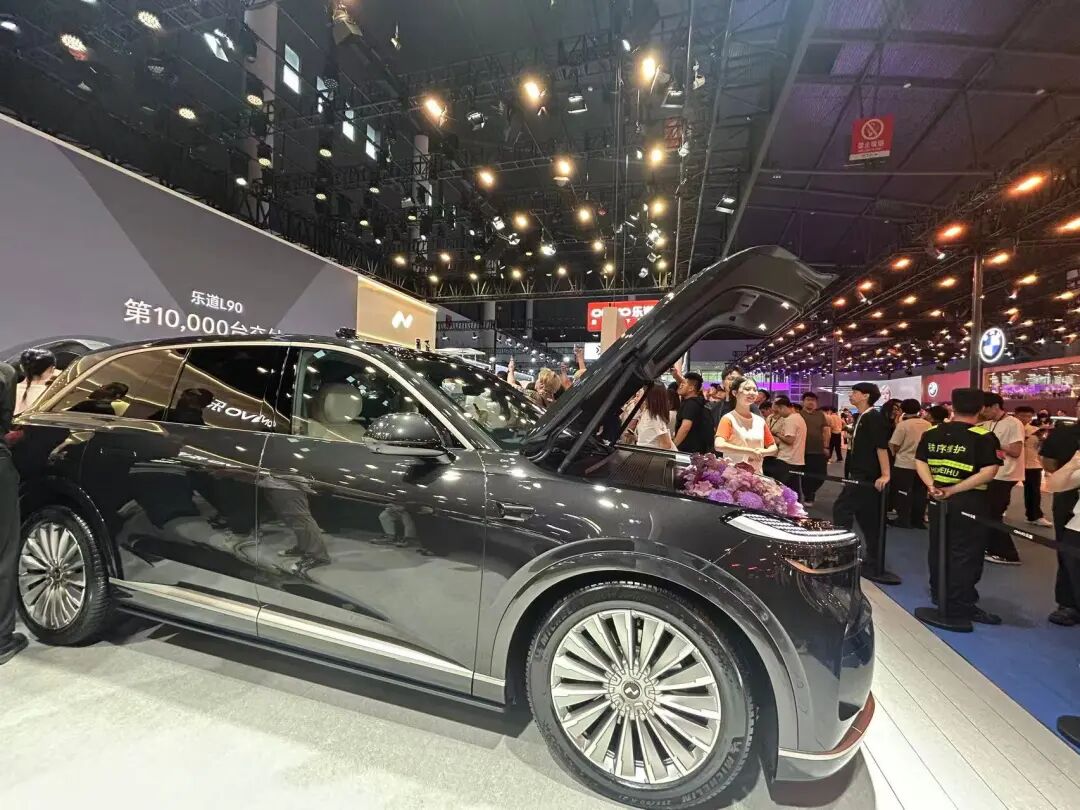
2025车市盘点:蔚来新ES8狂降10万上市,集中爆发的大三排SUV还能火多久?
3 6 Ke· 2025-12-29 03:26
Core Insights - The SUV market is thriving in 2025, with Tesla's Model Y maintaining its position as the top-selling SUV from January to November, while Xiaomi's YU7 set a record by surpassing 200,000 pre-orders within three minutes of its launch [1][2]. SUV Market Performance - From January to November, SUV sales exceeded 10.699 million units, leading among sedans, SUVs, and MPVs, with a year-on-year growth rate of 7.3% [2]. - The market share of six-seat SUVs has increased from 3% in 2021 to 6.5% in the first half of this year, while seven-seat SUVs have maintained a stable share of around 5% [2]. New Model Launches - Numerous new three-row SUV models have been launched this year, including the Aito M8, Lido L90, and NIO ES8, with significant price adjustments and configurations to attract consumers [2][3][7]. - The Aito M8 and M9 have achieved sales of over 100,000 units each from January to November, ranking first and second in large SUV sales [9]. Market Trends and Consumer Demand - The demand for three-row SUVs is driven by the increasing number of multi-child families in China, which is expected to peak by 2035, indicating a long-term growth potential for this segment [4][15]. - The shift in family structure from "one-child" to "multi-child" is pushing consumer preferences from functional vehicles to those offering greater comfort and flexibility [4]. Pricing Strategies - The pricing landscape for three-row SUVs is becoming more competitive, with models like the Lido L90 and Galaxy M9 entering the market at significantly lower price points, making them more accessible [7][9]. - The introduction of aggressive pricing strategies, such as the Lido L90 starting at 26.58 million yuan and the Galaxy M9 at 19.38 million yuan, reflects the intense competition in this segment [8][9]. Future Outlook - Analysts predict that the three-row SUV market will continue to grow, with a focus on electric and hybrid models, as consumer preferences evolve towards more sustainable options [11][12]. - The future of three-row SUVs is expected to be shaped by family demand upgrades, product breakthroughs, and the acceleration of new energy trends, ensuring their position as optimal solutions for family travel [15].