
绿色低碳转型

Search documents
国电南京自动化股份有限公司2025年第一季度报告
Shang Hai Zheng Quan Bao· 2025-04-25 02:32
Core Viewpoint - The company, Guodian Nanjing Automation Co., Ltd., has released its 2024 annual report summary, highlighting its financial performance, business operations, and future development plans, emphasizing its leading position in the power automation industry and the impact of national policies on its growth [1][5]. Company Overview - Guodian Nanjing Automation operates in the power automation sector, which is crucial for national economic stability and is significantly influenced by macroeconomic conditions [5]. - The company is recognized as a pioneer in China's power automation field, maintaining a strong market position amid increasing competition and transformation pressures [5]. Financial Performance - As of December 31, 2024, the company's undistributed profits amounted to RMB 1,245,321,175.51, with a proposed cash dividend of RMB 1.4 per 10 shares, totaling RMB 142,253,098.68, which represents 41.76% of the net profit attributable to shareholders [4][54]. Business Segments - The company’s main business segments include: - **Power Grid Automation**: Achieved cumulative orders of RMB 503,288,000 and revenue of RMB 382,644,000, focusing on innovative solutions for the new power system [21]. - **Power Plant and Industrial Automation**: Cumulative orders reached RMB 183,894,000 with revenue of RMB 151,632,000, emphasizing green and low-carbon technology [23]. - **Rail Transit Automation**: Cumulative orders of RMB 42,182,000 and revenue of RMB 38,840,000, benefiting from national infrastructure development [26]. - **Information and Security Technology**: Cumulative orders of RMB 111,950,000 and revenue of RMB 81,917,000, with a focus on digital energy and security services [29]. - **Power Electronics**: Cumulative orders of RMB 28,156,000 and revenue of RMB 17,364,000, with ongoing projects in energy conversion [31]. Market Position and Competitive Landscape - The company faces intense competition in various segments, particularly in power grid automation and power plant automation, where it holds a strong market share but must navigate challenges from new entrants and evolving market demands [10][12][14]. - The company has established long-term partnerships and maintains a strong brand recognition, which supports its competitive advantage [10]. Future Outlook - The company is positioned to benefit from national policies aimed at promoting green and low-carbon transitions, which are expected to drive demand for its automation solutions [6][7]. - The ongoing development of new technologies and solutions, such as virtual power plants and energy storage systems, is anticipated to enhance the company's growth prospects [21].

可持续社区建设迫在眉睫 万科公益基金会谢晓慧:企业与消费者需要“双向奔赴”
Mei Ri Jing Ji Xin Wen· 2025-04-23 13:01
每经记者 王郁彪 每经编辑 董兴生 "其中,我们以可再生能源利用、黑水虻处理厨余等低碳技术为起点,结合社区花园、社区堆肥、社区 生物多样性保护以及社区环境教育,逐步探索碳中和社区的综合推进模式。"谢晓慧表示。 2023年起,万科公益基金会启动企业"零碳加速度"项目。该项目旨在为中国高碳排企业提供系统性双碳 转型支持,目前正聚焦能源、电力等转型关键行业,计划在西北地区两个重点排放区域开展示范,为从 业人员提供数字化碳中和培训平台,精准解决传统产业人员转型与新兴产业人才升级的双重挑战。 社会绿色低碳转型,企业与消费者需要"双向奔赴" 在去年9月举办的中非合作论坛期间,故宫环保文创成为环保界和文创界的"网红"。 4月18日,国际环保机构野生救援(WildAid)联合可持续发展及ESG咨询机构商道纵横(SynTao)共同 发布《公众气候行动手册3.0版》,旨在建立应对气候变化和减塑行动的关联,推动消费者和企业携手 减少塑料全生命周期产生的碳排放。 据国际环境法中心(CIEL)统计,到2050年,塑料产生的温室气体排放量可能超过560亿吨,占全球剩 余碳预算总量的10%~13%。而经过一系列步骤与工艺重塑,被丢弃的塑料 ...
继特斯拉上海超级工厂后 又一具全球影响力新能源汽车项目 雷克萨斯新能源车项目落沪
Jie Fang Ri Bao· 2025-04-23 01:37
Core Viewpoint - The Shanghai Municipal Government and Toyota Motor Corporation signed a strategic cooperation agreement to enhance collaboration in the field of new energy vehicles, contributing to China's green and low-carbon development [1]. Group 1: Strategic Cooperation - Toyota will establish a comprehensive new energy vehicle company in Shanghai, focusing on research, manufacturing, and sales, including the production capacity for Lexus electric vehicles and advanced power batteries [1]. - This project marks a significant step for Toyota's wholly-owned Lexus new energy vehicle project in Jinshan District, Shanghai, with a total investment of 14.6 billion yuan and an initial land acquisition of 1,692 acres, expected to commence construction in June 2023 and produce its first vehicle by 2027 [1]. Group 2: Industry Impact - The agreement signifies Shanghai's commitment to expanding high-level openness, promoting technological and industrial innovation, and accelerating the development of a global leading new energy vehicle industry cluster [1]. - Jinshan District currently hosts 159 automotive industry chain enterprises, including 96 large-scale enterprises and 64 specialized and innovative enterprises, covering various aspects of the new energy vehicle industry chain [2]. - The Jinshan District government has been actively facilitating the Lexus new energy project since October of the previous year, ensuring efficient land acquisition and project progression through coordinated efforts among relevant departments [2].

投资不低于142亿元,雷克萨斯如何跑出“上海速度”
Di Yi Cai Jing· 2025-04-22 07:39
Group 1 - The signing of the agreement marks a significant advancement for the Lexus electric vehicle project in Shanghai, becoming another globally influential EV project after Tesla's Shanghai Gigafactory [1][4] - Toyota will establish a comprehensive electric vehicle company in Shanghai, focusing on research, manufacturing, and sales, and will produce Lexus brand vehicles locally for the first time [2][4] - The project site covers approximately 1,127,800 square meters (about 1,692 acres) with a transaction price of 1.3534 billion yuan [2][3] Group 2 - The project, named "Lexus Electric Vehicle and Toyota Battery Project," requires a minimum investment intensity of 842,000 yuan per acre and a fixed investment of no less than 14.248 billion yuan, with an expected annual sales revenue of 23.6 billion yuan [3] - Construction is set to begin in June 2023, with the first vehicle expected to roll off the production line in 2027 [3][4] - The rapid progress from the announcement on February 5 to land acquisition on April 1 demonstrates the efficiency of the Shanghai government in facilitating the project [5]
华创策略:DeepSeek读A500年报第三期
Huachuang Securities· 2025-04-21 13:44
Core Insights - The report utilizes AI to analyze the annual reports of the A500 index constituents, focusing on industry trends and structural changes [1][4] - The A500 index reflects the overall performance of 500 representative listed companies across various industries in China [1][4] Industry Summaries - **Media**: The domestic gaming market is expected to grow steadily in 2024, with a focus on high-quality transformation and rapid growth in the mini-game sector. The policy emphasizes a dual drive of culture and technology [6] - **Electronics**: The semiconductor industry is experiencing structural recovery, driven by AI technology breakthroughs and strong demand for high-performance computing and smart terminals. Traditional consumer electronics are recovering at a slower pace [6] - **Computers**: The computer industry is witnessing collaborative development across multiple fields, with a focus on AI integration and data security governance. Companies are increasing R&D investments to enhance domestic alternatives [6] - **Telecommunications**: The telecommunications sector is experiencing growth driven by technology and market demand, with applications in high-precision navigation and green low-carbon transformation [6] - **Real Estate**: The real estate sector continues to face deep adjustments, with a 10.6% year-on-year decline in development investment. However, policy support is expected to stabilize the market gradually [6] - **Banking**: The banking industry is challenged by insufficient macroeconomic recovery and intensified competition, with a focus on digital transformation and structural policy opportunities [6] - **Healthcare**: The healthcare sector is driven by policy support for innovative drug development and an aging population, with significant growth in blood products and vaccines [6] - **Electric Power Equipment**: The electric power equipment industry is experiencing structural growth, with increasing demand for new energy systems and technological innovations [8] - **Environmental Protection**: The environmental protection industry is transitioning to high-quality development, with a focus on technological innovation and resource recycling [9] - **Basic Chemicals**: The basic chemicals sector is facing structural differentiation, with opportunities in high-end products and challenges in traditional segments due to overcapacity [9] - **Transportation**: The transportation industry is navigating complex external challenges while pursuing international expansion and smart logistics solutions [9] - **Petrochemicals**: The petrochemical industry is facing geopolitical challenges and fluctuating demand, with a focus on energy efficiency and green transformation [9] - **Nonferrous Metals**: The nonferrous metals sector is benefiting from strong demand in new energy and consumer electronics, with a focus on green transformation and resource integration [9]
沙钢股份(002075) - 002075沙钢股份投资者关系管理信息20250418
2025-04-18 14:58
Export Business Performance - The company's export revenue reached 556 million CNY in 2024, representing a year-on-year growth of 90.22%, accounting for 3.86% of total revenue [2][3] - The company aims to maintain export growth by optimizing product structure and developing high-value specialty steel, while diversifying market presence beyond Southeast Asia [2][3] Industry Outlook and Demand - The steel industry is currently in a cyclical adjustment phase, with a cautiously optimistic outlook for 2025 demand driven by major projects under the "14th Five-Year Plan" and structural growth in downstream sectors like new energy and automotive [3][4] - The company plans to enhance production capacity through smart upgrades and technical innovations, focusing on high-end products to balance capacity utilization and profitability [3][4] Financial Performance - In 2024, the company reported total revenue of 14.416 billion CNY, a decrease of 7.69% year-on-year, with a net profit of 163 million CNY, down 27.75% [4][5] - The net cash flow from operating activities improved to 412 million CNY, reversing from a negative 139 million CNY in 2023 [4][5] Research and Development - The company invested 582 million CNY in R&D in 2024, which is 4.04% of total revenue, focusing on specialty steel and automotive steel [3][4] - Significant breakthroughs in core processes have led to 18 invention patents, and the company aims to continue investing in high-end steel for new energy vehicles and wind power applications [4][5] Strategic Focus - The company is prioritizing quality improvement and transformation during the steel industry's "stock optimization" phase, emphasizing equipment upgrades, green low-carbon transformation, and high-value product development [4][5] - Future growth drivers include optimizing product structure, enhancing supply chain collaboration, and advancing smart manufacturing to reduce costs and improve efficiency [5][6] Environmental Initiatives - The company has invested 3.08 billion CNY in eliminating outdated equipment and upgrading to efficient electric furnaces, achieving a 100% compliance rate for pollutant emissions [6][7] - The company is actively exploring opportunities in energy-saving technologies and has established a nearly 60MW solar project, generating approximately 52 million kWh of green electricity annually [6][7] Competitive Advantages - The company has established a unique competitive advantage in the specialty steel sector, leveraging its location in the Yangtze River Delta and advanced production capabilities to meet diverse customer needs [8][9] - The company’s export growth rate of 90% significantly outpaces the industry average of 22.7%, indicating strong international market competitiveness [8][9]

我国生物质能发电规模达4599万千瓦
Zhong Guo Dian Li Bao· 2025-04-18 03:11
Core Viewpoint - The development of biomass energy in China is projected to significantly increase by the end of 2024, with installed capacity reaching 45.99 million kilowatts and electricity generation hitting 208.3 billion kilowatt-hours, highlighting its potential as a key renewable energy source for achieving carbon neutrality goals [1][2] Group 1 - Biomass energy is characterized as a zero-carbon renewable energy source with diverse forms (solid, liquid, gas) that can replace fossil fuel consumption, particularly in low-carbon transportation fuels [1] - The global energy landscape is undergoing rapid restructuring, with biomass energy being a crucial element for achieving China's dual carbon goals, emphasizing energy security and resource recycling [1] - The "2025 China Biomass Industry Development Annual Report" indicates that the biomass industry will experience technological breakthroughs, diversified application scenarios, and a dual policy-market approach over the next five years [2] Group 2 - The "2025 Biomass Energy Innovation Development Forum" was supported by various governmental departments and attracted widespread attention from society, focusing on themes of green journeys, innovation-driven development, and future empowerment [2]
研判2025!中国消费品零售行业相关政策、行业现状及重点企业分析:消费升级趋势持续深化,服务性消费与新兴品类成增长新引擎[图]
Chan Ye Xin Xi Wang· 2025-04-16 01:20
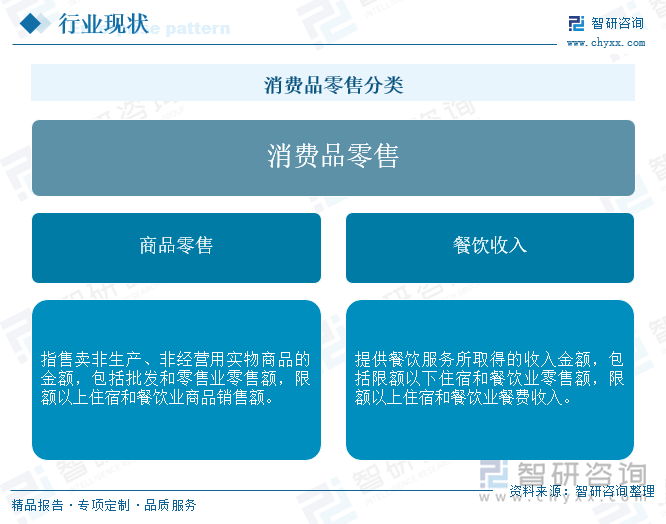
Core Viewpoint - The Chinese consumer goods retail industry is showing signs of gradual recovery, with a total retail sales of 8.37 trillion yuan in January-February 2025, reflecting a year-on-year growth of 2.98% despite external challenges [1][12]. Industry Overview - Consumer goods retail refers to the commercial activity of selling final consumer goods directly to consumers, playing a crucial role in the distribution of goods from producers to consumers [2]. - The industry has evolved through three main stages: the essential goods phase (1978-1995), rapid growth phase (1996-2010), and the personalized consumption phase (2011-present) [4][5][6]. Industry Development - The retail sales of goods increased by 3.9% year-on-year, with significant growth in specific categories such as communication equipment (26.2%) and cultural office supplies (21.8%) [1][12]. - The retail sales of new energy passenger vehicles surged by 35.5%, with a retail penetration rate of approximately 45%, indicating strong growth in the automotive consumption market [1][12]. Industry Chain - The upstream of the consumer goods retail industry includes suppliers from various sectors such as food and beverages, daily necessities, cosmetics, clothing, and electronics, providing resources for the midstream retail sector [8]. Policy Environment - The Chinese government is implementing policies to enhance consumption quality and structure, with the "Three-Year Action Plan for Optimizing the Consumption Environment (2025-2027)" aiming for significant improvements in consumer experience and market order by 2027 [10][11]. Current Industry Status - The service retail sector grew by 4.9% year-on-year, outpacing goods retail growth, with notable increases in dining (4.3%) and travel services [1][12]. - During the Spring Festival, domestic tourist spending increased by 7.0%, and box office revenue reached a record high of 9.51 billion yuan [1][12]. Key Companies - Major players in the industry include JD.com, Suning.com, Yonghui Superstores, and Walmart, with a trend towards digital transformation and online-offline integration [16][18][20]. Future Trends - The industry is expected to witness continuous innovation in consumption models, with trends such as instant retail, membership retail, and community commerce becoming mainstream [22]. - Technological advancements, including AI and big data, will significantly alter operational models and enhance customer experiences [23]. - The shift towards green and sustainable practices is becoming increasingly important, with companies needing to adapt to consumer preferences for environmentally friendly products [24].


华润电力20250320
2025-04-15 14:30
Summary of China Resources Power Holdings Company Limited 2024 Annual Performance Conference Company Overview - **Company**: China Resources Power Holdings Company Limited - **Industry**: Power Generation, focusing on renewable and traditional energy sources Key Points Industry and Market Context - The power industry is experiencing a transition towards a new energy system under the guidance of national energy security strategies, emphasizing green and low-carbon transformation [2][15] - The company is committed to high-quality development and has achieved significant milestones in renewable energy projects [2][4] Financial Performance - **2024 Shareholder Profit**: HKD 14.388 billion, a year-on-year increase of 30.8% [3] - **Dividend Proposal**: HKD 1.19 per share, up from HKD 0.69 per share in the previous year, maintaining a payout ratio of 40% [3] - **Core Profit Contribution**: - Total core profit: HKD 13.87 billion, a 4.0% increase [8] - Renewable energy core profit: HKD 9.23 billion, a decrease of 5.1% [5][8] - **Revenue from Renewable Energy**: - New installed renewable energy capacity: 7,788 MW in 2024, with a cumulative total exceeding 20,000 MW by the end of the 14th Five-Year Plan [4] - Renewable energy accounted for 25.2% of total electricity consumption, with a 19.2% increase in renewable energy consumption [5] Operational Highlights - **Electricity Generation**: - Total electricity generation from coal-fired plants: 1,554 billion kWh, a 4.0% increase [7] - Average utilization hours for coal-fired plants: 4,625 hours, slightly down by 1.2% [7] - **Market Pricing**: - Average on-grid price for wind power: RMB 437.5 per MWh, down 5.3% [6] - Average on-grid price for solar power: RMB 317.9 per MWh, down 10.8% [6] Future Development Strategy - The company plans to focus on clean and efficient power generation, energy technology innovation, and enhancing competitive advantages [10][11] - Emphasis on optimizing investment strategies and project planning to adapt to policy changes and market dynamics [10][12] - Commitment to maintaining a balance between growth and shareholder returns, particularly in the context of the new energy market [15][16] Challenges and Opportunities - The transition to a fully market-oriented renewable energy sector presents both challenges and opportunities for the company [15] - The company aims to enhance its project selection and operational efficiency to navigate the competitive landscape effectively [16] Regulatory and Market Dynamics - Anticipated changes in coal market dynamics due to macroeconomic factors and increased renewable energy supply [18] - The company is preparing for potential fluctuations in coal prices and electricity market conditions in 2025 [18][19] Investor Engagement - The management team encouraged ongoing dialogue with investors and stakeholders, emphasizing transparency and responsiveness to market conditions [12][30] This summary encapsulates the key insights from the conference, highlighting the company's performance, strategic direction, and the broader industry context.

新动能驱动供需结构优化
Sou Hu Cai Jing· 2025-04-14 00:49
Core Viewpoint - China's energy supply and demand structure is undergoing profound changes driven by carbon peak and carbon neutrality goals alongside high-quality economic development. Energy consumption is expected to continue rising, with a significant increase in the share of clean energy consumption by 2025 [1] Energy Consumption Analysis - Total energy consumption is projected to grow steadily, with a forecast of 61 to 62 billion tons of standard coal in 2025, reflecting a year-on-year growth rate of approximately 3% to 4%. Renewable energy consumption is expected to exceed 1.2 billion tons of standard coal, showcasing strong green growth momentum [1][2] - Coal consumption is anticipated to see slight growth, with raw coal consumption estimated at 4.8 to 4.9 billion tons in 2025, a year-on-year increase of 1% to 2%, while its share of total energy consumption will slightly decline [2] - Oil consumption is expected to stabilize, with crude oil consumption projected at 77 to 78 million tons in 2025, reflecting a year-on-year growth of about 1% [2] - Natural gas consumption is forecasted to grow steadily, reaching 450 to 460 billion cubic meters in 2024, with a year-on-year increase of approximately 6% to 7% [3] - Electricity consumption is expected to maintain rapid growth, with total electricity consumption projected to reach 10.4 to 10.5 trillion kilowatt-hours in 2025, reflecting a year-on-year growth of 5% to 7% [3] Energy Production Analysis - Total energy production is expected to reach 505 to 515 million tons of standard coal in 2025, with a slight slowdown in growth due to a high base from previous years. The share of non-fossil energy production is projected to rise to 22.3% to 23.0% [4] - Coal production is expected to remain stable at 4.8 to 4.88 billion tons in 2025, with a year-on-year increase of 1.5% to 2% [6] - Crude oil production is projected to reach 22 million tons in 2025, reflecting a year-on-year growth of about 2% [6] - Natural gas production is anticipated to enter a rapid development phase, with production expected to reach 250 to 260 billion cubic meters by 2025, reflecting a year-on-year growth of approximately 5% [7] Energy Supply and Demand Outlook - Energy consumption growth is expected to outpace production growth by about 0.5 percentage points, with an energy self-sufficiency rate maintained above 80%. Coal supply and demand are projected to remain stable, with coal imports expected to be between 500 to 550 million tons in 2025 [8] - The crude oil supply-demand gap is expected to exceed 50 million tons, with high levels of crude oil imports maintained. Natural gas imports are projected to have a demand gap of approximately 180 to 200 billion cubic meters [8] Recommendations - Strengthening energy security strategies and establishing a more robust energy reserve and emergency mechanism is recommended, along with enhancing collaboration with key energy supplier countries [9] - Continuous improvement of the share of electricity in final energy consumption and optimizing the power system's adjustment capacity to support the rational consumption of new energy is advised [9] - Attention should be paid to new business layouts and energy demands in areas such as artificial intelligence computing power and the new energy industry [9]