
生成式AI

Search documents
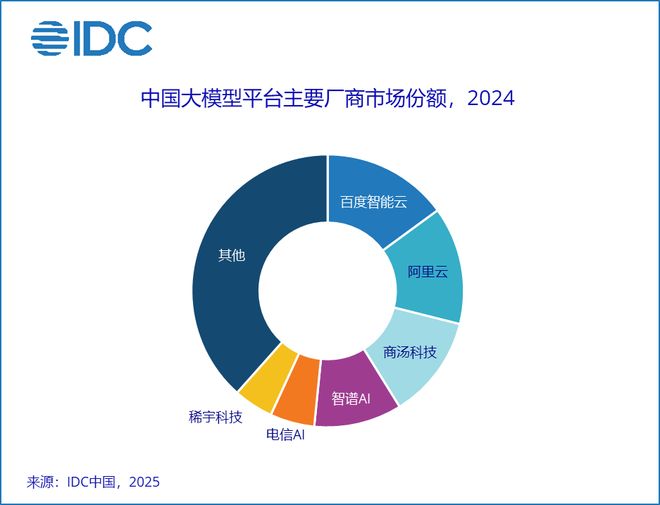
IDC:2024年中国大模型开发平台市场规模达16.9亿元人民币
Zhi Tong Cai Jing· 2025-08-20 05:57
Market Overview - The market size of China's large model development platform is projected to reach 1.69 billion RMB in 2024, driven by various applications aimed at enhancing productivity in both state-owned and private enterprises [1] - The market growth is supported by the development of AI applications, with internet companies favoring public cloud platforms for API integration in entertainment applications [1] Key Players - The top six companies in the market include Baidu Smart Cloud, Alibaba Cloud, SenseTime, Zhipu AI, Telecom AI, and Xiyu Technology [1] - Other notable companies include Zhongshu Ruizhi, which focuses on RAG technology and enterprise-level intelligent self-optimization, as well as Shenzhou Digital and Ruijie Technology, which have launched large model platforms earlier [1] International Expansion - The outbound market for China's large model platforms is expected to reach 860 million RMB in 2024, with applications in generative AI gaining global popularity [3] - Users primarily utilize OpenAI GPT on Azure and Claude on Amazon Web Services, while many Chinese companies also opt for Alibaba Cloud for their large model platform needs [3] Future Development - The construction of large model platforms is currently focused on application development, with a need to lower usage barriers by providing low-code flexible development tools [5] - There is also a demand for high-code development tools aimed at professionals to enhance platform capabilities [5]


重压之下的陈立武:能否复刻格鲁夫式“死亡之谷”的穿越?
首席商业评论· 2025-08-20 04:26
Core Viewpoint - Intel is facing significant challenges under CEO Pat Gelsinger, including a projected net loss of $18.8 billion in 2024 and a nearly 60% drop in stock price, leading to its removal from the Dow Jones index [3] Group 1: Leadership and Management Challenges - Pat Gelsinger's leadership has been marked by a dramatic political episode, where he was publicly called to resign by Trump due to alleged conflicts of interest, but later received praise after a meeting [2] - Gelsinger has initiated a major restructuring effort, including a 50% reduction in management layers and a global workforce reduction of approximately 25,000 employees [6] - The historical context reveals that Intel has repeatedly missed critical opportunities over the past two decades, such as rejecting the acquisition of Nvidia and OpenAI, which has contributed to its current struggles [3][4] Group 2: Organizational and Cultural Reforms - Gelsinger has identified the company's bureaucratic structure and rigid management as key issues, stating that the organization is "too slow, too complex, and stuck in its ways" [6] - The new strategy emphasizes a cultural shift towards "engineering-first" principles, focusing on innovation, speed, and execution [6] - Gelsinger's approach reflects the management philosophy of former CEO Andy Grove, who advocated for a flat organizational structure and the elimination of bureaucracy to enhance agility and decision-making [7][8] Group 3: Strategic Focus and Future Outlook - Gelsinger's reforms include pausing non-core capacity expansion projects and focusing on core chip design capabilities, indicating a strategic pivot [6] - The emphasis on direct reporting from key departments to the CEO aims to streamline communication and decision-making processes [6] - The effectiveness of Gelsinger's strategies remains uncertain, as he faces the daunting task of navigating Intel through its current crisis, reminiscent of Grove's challenges in the past [10]


净利润暴增71.3%!美图靠AI半年狂赚4亿,CFO颜劲良:未来增长战略是AI驱动生产力与全球化【附生成式AI行业发展趋势】
Qian Zhan Wang· 2025-08-20 04:23
Core Insights - Meitu has successfully transformed its business model by leveraging generative AI, leading to significant financial growth and a shift towards subscription-based services [2][3] - The company's total revenue for the first half of 2025 reached 1.8 billion yuan, a year-on-year increase of 12.3%, with adjusted net profit soaring by 71.3% to 467 million yuan [2] - The growth in revenue and profit is primarily attributed to breakthroughs in AI applications and an increase in global paid subscription users, which surpassed 15.4 million, marking a 42% year-on-year growth [2][3] Financial Performance - Meitu's imaging and design business generated 1.35 billion yuan in revenue, accounting for 75% of total revenue, with a growth rate of 45.2% [2] - Advertising revenue reached 430 million yuan, reflecting a 5% year-on-year increase, while revenue from beauty industry solutions was 30.1 million yuan and other business revenue was 6.2 million yuan [2] Industry Trends - The generative AI sector is rapidly evolving, with significant potential across various industries, including customer operations, marketing, and software engineering, contributing to 75% of industry value [4] - The market size for generative AI in China is estimated to be approximately 14.4 trillion yuan in 2023, with projections to exceed 30 trillion yuan by 2035, representing over 35% of the global market [5] Strategic Insights - Meitu's transition from traditional software sales to a smart creation platform exemplifies the value of generative AI in addressing real user pain points and establishing a technology-driven competitive barrier [3] - The shift towards an "AI+" era indicates a significant opportunity for China to excel in the global generative AI competition [7]

AI“烧钱大战”仍然如火如荼! AI初创公司吞下1220亿美元 一己之力带动VC复苏
智通财经网· 2025-08-20 04:13
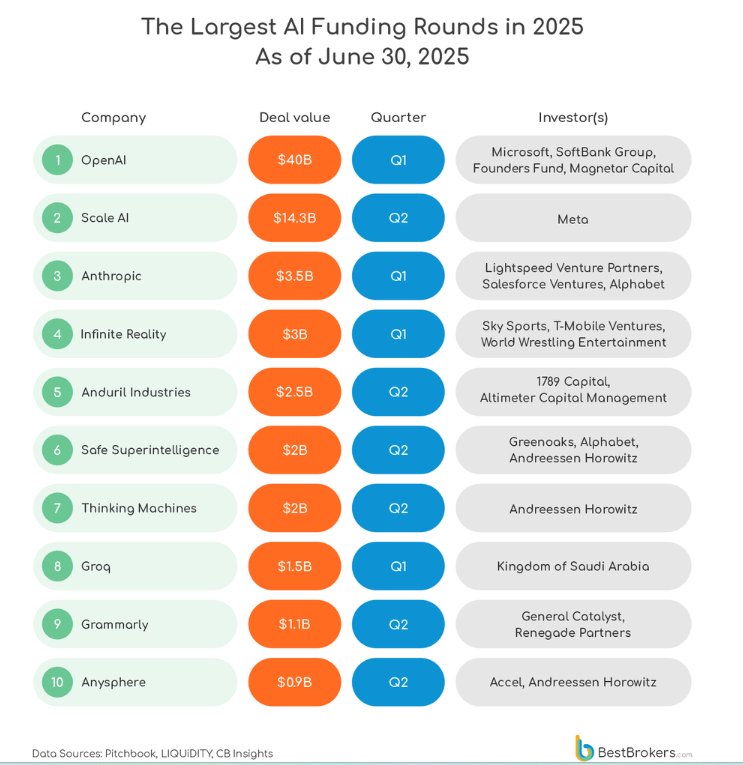
Core Insights - The global AI startup funding has reached an astonishing $122 billion since the beginning of the year, with the US market accounting for $104.3 billion, representing 85.5% of the total raised [1] - The AI funding landscape continues to grow, with a projected $110 billion in 2024 and significant investments from major players like Meta and Anduril [1][5] - Despite a slight decrease in total investment from the previous quarter, AI-related funding remains at historically high levels [4][5] Investment Trends - In Q2, global AI startup funding totaled $50 billion, nearly half of the total VC investment of approximately $101.5 billion during the same period [1][5] - The largest funding round this quarter was Meta's $14.3 billion investment in Scale AI, which resulted in CEO Mark Zuckerberg acquiring a 49% stake [5] - There is a notable shift towards AI projects with "intensive infrastructure," supported by significant public and private sector investments [6] Market Dynamics - The AI-driven venture capital market has shown resilience, with a year-over-year growth of 7.28% from 2023 to 2024 and 9.26% from 2024 to 2025, totaling a 17.22% increase over two years [5] - Major VC firms like SoftBank, Andreessen Horowitz, and Sequoia continue to dominate the AI startup funding landscape [7] - The concentration of capital in leading AI startups has created a challenging environment for smaller companies seeking funding [7] Future Projections - OpenAI plans to invest trillions in core AI infrastructure, including AI chips and advanced power systems, indicating a long-term commitment to AI development [8] - Analysts predict that major tech companies will spend over $350 billion on AI infrastructure in 2023, with expectations of nearly 50% growth in 2024 [8] - Morgan Stanley forecasts that the AI investment boom could add $13 to $16 trillion in value to the S&P 500 index, representing a potential 30% increase [9][10]



同程旅行(00780.HK):利润率优化逐季验证 付费用户与ARPU值良性增长
Ge Long Hui· 2025-08-20 04:02
Core Viewpoint - The company demonstrated robust revenue growth in Q2 2025, with adjusted net profit increasing by over 18% year-on-year, indicating a focus on profitability and operational efficiency [1][2]. Revenue Performance - Q2 revenue reached 4.669 billion yuan, a 10.0% increase year-on-year, while the net profit attributable to shareholders was 642 million yuan, up 48.0% [1]. - The OTA segment saw a revenue increase of 13.7%, with an operating profit margin (OPM) of 24.7%, reflecting a 2.4 percentage point improvement [1]. - The company experienced a strategic contraction in packaged business due to demand pressures in Southeast Asia, resulting in an 8.0% decline in revenue from this segment, but maintaining a positive profit contribution [1][2]. User and ARPU Growth - The company achieved a healthy increase in paid users and Average Revenue Per User (ARPU), with cumulative paid users reaching 250 million, a 10.2% increase, and ARPU at 72.2 yuan, up 13.9% [2]. Profitability and Cost Management - The gross profit margin improved by 0.4 percentage points in Q2, driven by enhanced monetization rates in the OTA business and efficiencies gained through generative AI [2]. - The sales expense ratio decreased by 2.4 percentage points, indicating a focus on balancing marketing investment returns, with expectations of breakeven in international business by 2025 [2][3]. - R&D and management expense ratios also saw a decline, with management projecting an overall increase in core business profit margins for the year [2]. Strategic Focus and Industry Positioning - The management emphasized the importance of the OTA core strategy, aiming to capitalize on domestic consumption trends while enhancing international business monetization and cross-selling opportunities [3]. - The company has positioned itself among the top 10 hotel management companies in China, with over 2,700 hotels operational and a target of 3,000 by year-end [3]. - Recent acquisitions, including a proposed 2.49 billion yuan purchase of Wanda Hotel Management, are expected to strengthen the company's market position and operational synergies [3].
ChatExcel获近千万天使轮融资,全链路AI DataAgent从数据获取到价值交易打造商业闭环平台
3 6 Ke· 2025-08-20 02:49
Group 1 - ChatExcel has completed nearly 10 million angel round financing, led by Shanghai Changlei Capital and Wuhan East Lake Angel Fund, to accelerate product development and global market promotion [1] - The company aims to enhance its leading position in the DataAgent field, having served over 10 million users and won multiple honors, including first place in the CCTV "Win in AI+" entrepreneurship competition [1][2] - ChatExcel is currently initiating a Pre-A round of financing to further support its growth [1] Group 2 - ChatExcel defines AI DataAgent and aims to create a comprehensive commercial closed-loop platform for data, allowing users to process Excel and data analysis through dialogue, thus lowering the usage threshold [2][4] - The company supports various data sources for processing and analysis, including Excel files, databases, and third-party data, and has developed the world's first data vertical model suitable for AIPC-level edge deployment [6] - ChatExcel plans to launch more new features in the coming months to enhance product intelligence and user experience, while also accelerating its expansion into overseas markets [6] Group 3 - ChatExcel's commercial value has been validated through practical applications, having served over 10 million users since its launch and collaborating with major companies like Huawei, Lenovo, HP, and Alibaba Cloud [7] - The company has upgraded its data security strategy through a "cloud-edge-end product matrix," ensuring data compliance and security [7] - The big data analytics market is projected to grow from $348.21 billion in 2024 to over $924 billion by 2032, creating significant market opportunities for AI data analysis [7] Group 4 - The recent angel round financing will inject strong momentum into ChatExcel's development, aiming to reconstruct traditional data links and promote data democratization, enabling everyone to become a data analyst [8]

【点击报名】xMEMS Live - Asia 2025 | 技术研讨会
Cai Fu Zai Xian· 2025-08-20 02:13
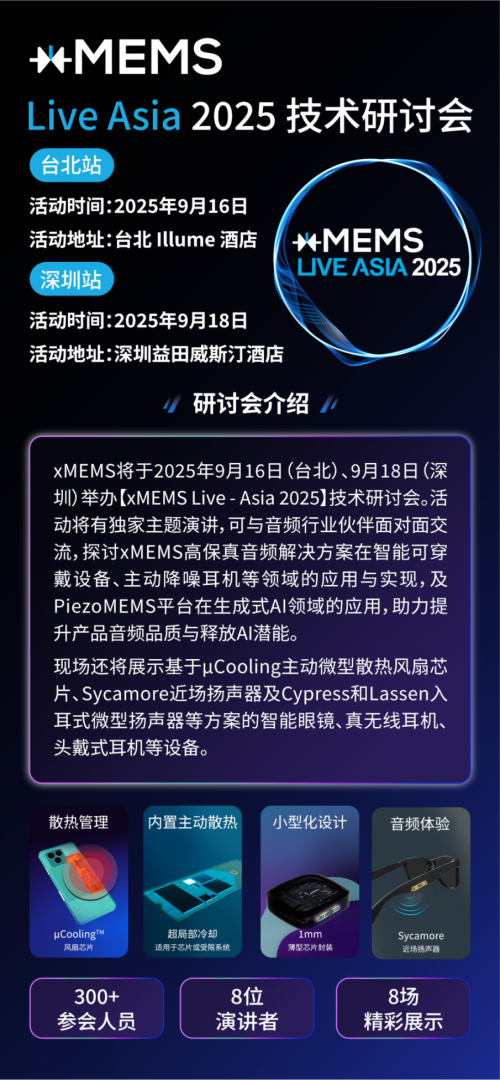
Core Insights - xMEMS will host the "xMEMS Live - Asia 2025" technology seminar on September 16 in Taipei and September 18 in Shenzhen, focusing on high-fidelity audio solutions and the application of PiezoMEMS platforms in generative AI [1][9][20] - The seminar will feature exclusive keynote speeches and opportunities for face-to-face discussions with industry partners, exploring innovations in audio quality and AI potential [1][9] Event Highlights - The launch of the Sycamore near-field micro-speaker, a groundbreaking audio product, will be showcased, which is only 1mm thick and delivers full-frequency sound [4][5] - The seminar will cover the design and application of Sycamore, including distortion measurement and the competitive advantages of using MEMS speakers for spatial audio [4][5] - The new PiezoMEMS platform will be discussed, highlighting three innovative solutions that address hardware limitations for edge AI devices, including the μCooling chip for thermal management [4][6] Product Features - Sycamore near-field micro-speaker: 1mm ultra-thin, full-frequency sound, based on the "ultrasonic sound" platform [5] - Cypress / Alta design solutions: rich, detailed, high-fidelity sound suitable for active noise cancellation, also based on the "ultrasonic sound" platform [5] - μCooling active micro-fan chip: compact design aimed at enhancing performance stability under high loads [5] Generative AI Development - Lassen in-ear micro-speaker: low barrier and cost, rich high-frequency details without the need for a piezoelectric amplifier [6] Invitation to Attend - The seminar invites participants from audio brands, OEMs, and solution providers to experience cutting-edge audio solutions and active cooling solutions for edge AI devices [9] - Attendees can choose to participate in either the morning session focused on thermal management or the afternoon session on audio [9] Event Details - Taipei event: September 16, 2025, at Illume Hotel [16] - Shenzhen event: September 18, 2025, at Westin Hotel, Nanshan [18] Company Background - xMEMS Labs, established in January 2018, is a leader in the MEMS field, known for its innovative piezoelectric MEMS platform and the first solid-state MEMS speaker for TWS and personal audio devices [20] - The company holds over 250 technology patents globally [20]
中国零售消费行业生成式AI及数据应用研究报告
3 6 Ke· 2025-08-20 01:37
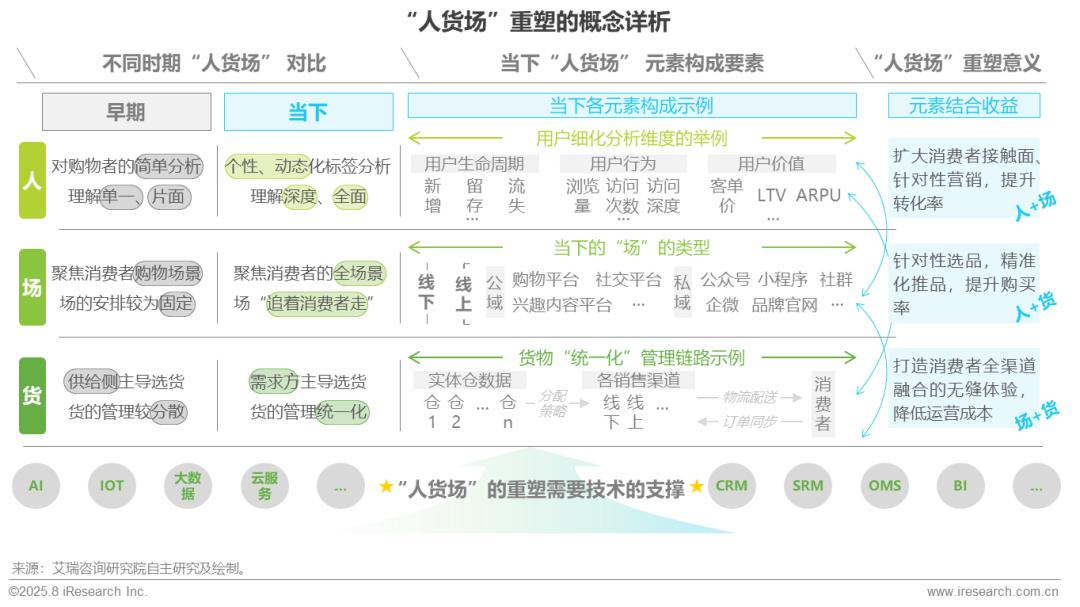
Core Insights - The retail industry is transitioning from rapid growth to stock competition, necessitating a digital transformation of "people, goods, and scenarios" to enhance operational efficiency and consumer engagement [1][2] - The integration of generative AI and data provides a comprehensive solution for retail companies, enabling them to optimize user operations, internal decision-making, and global expansion [1][52] Industry Growth Dynamics and Trends - Retail consumption is shifting from high-speed growth to stock competition, with a focus on digital reconstruction of consumer touchpoints to match supply and demand accurately [2] - Companies must leverage digital technologies to enhance sales conversion rates and inventory turnover while reducing operational costs [2] Demand-Side Transformation - Post-pandemic, consumers are more rational, leading companies to shift focus from traffic-driven strategies to membership economies [4] - Businesses need to create detailed user profiles and utilize digital tools to effectively target high-intent consumers, thereby increasing customer lifetime value [4] Supply-Side Transformation - The retail market is projected to reach approximately 49 trillion yuan in 2024, with online sales channels continuing to grow [7] - Retail companies must establish efficient data processing systems to support digital integration and leverage AI for precise customer acquisition and operational efficiency [7] Sector-Specific Insights: Beauty Industry - Domestic beauty brands have rapidly increased market share from 43.7% in 2022 to 55.7% in 2024, utilizing KOL evaluations and UGC content to establish a marketing loop [10] - Chinese beauty brands are expanding into Southeast Asia, the Middle East, and Europe, enhancing brand presence through local partnerships and offline stores [10] Sector-Specific Insights: Footwear and Apparel Industry - The footwear and apparel market is experiencing intense competition, requiring companies to develop strong product R&D capabilities and brand recognition [13] - Leading firms are focusing on consumer insights to create differentiated products and using content marketing to enhance brand loyalty [13] Sector-Specific Insights: Home Furnishing Industry - The home furnishing market is transitioning to a replacement phase, with companies seeking growth through international expansion [16] - Firms are building omnichannel operations to enhance customer experience and are increasingly focusing on establishing their own brands overseas [16] Generative AI and Data Applications - The synergy between generative AI and data governance is crucial for maximizing AI value, with high-quality data being essential for effective AI implementation [21] - 71% of companies plan to enhance data-driven decision-making, with generative AI primarily applied in marketing and customer service scenarios [25] Cloud Services and AI Integration - Companies are encouraged to choose cloud service providers with comprehensive data and AI capabilities to lower the barriers to generative AI application [28] - Nearly 90% of companies prefer to engage external service providers for AI development, indicating a strong reliance on cloud vendors for diverse model capabilities [30] Marketing and User Journey - Over 90% of retail companies have adopted generative AI in marketing, addressing high costs and fragmented consumer demands [55] - Generative AI significantly reduces content production costs by approximately 30%, enhancing sales conversion rates [58] Internal Decision-Making and Governance - 93% of companies are building knowledge bases across multiple scenarios, with generative AI enhancing data governance and decision-making efficiency [63] - The integration of generative AI allows for real-time data analysis, shifting decision-making from experience-based to data-driven approaches [49] International Market Expansion - 93% of retail companies are pursuing international business, focusing on high-potential markets in Asia-Pacific, Europe, and North America [74] - Generative AI aids in overcoming language and cultural barriers, facilitating localized marketing and efficient customer service [75]
最新综述!扩散语言模型全面盘点~
自动驾驶之心· 2025-08-19 23:32
Core Viewpoint - The article discusses the competition between two major paradigms in generative AI: Diffusion Models and Autoregressive (AR) Models, highlighting the emergence of Diffusion Language Models (DLMs) as a potential breakthrough in the field of large language models [2][3]. Group 1: DLM Advantages Over AR Models - DLMs offer parallel generation capabilities, significantly improving inference speed by achieving a tenfold increase compared to AR models, which are limited by token-level serial processing [11][12]. - DLMs utilize bidirectional context, enhancing language understanding and generation control, allowing for finer adjustments in output characteristics such as sentiment and structure [12][14]. - The iterative denoising mechanism of DLMs allows for corrections during the generation process, reducing the accumulation of early errors, which is a limitation in AR models [13]. - DLMs are naturally suited for multimodal applications, enabling the integration of text and visual data without the need for separate modules, thus enhancing the quality of joint generation tasks [14]. Group 2: Technical Landscape of DLMs - DLMs are categorized into three paradigms: Continuous Space DLMs, Discrete Space DLMs, and Hybrid AR-DLMs, each with distinct advantages and applications [15][20]. - Continuous Space DLMs leverage established diffusion techniques from image models but may suffer from semantic loss during the embedding process [20]. - Discrete Space DLMs operate directly on token levels, maintaining semantic integrity and simplifying the inference process, making them the mainstream approach in large parameter models [21]. - Hybrid AR-DLMs combine the strengths of AR models and DLMs, balancing efficiency and quality for tasks requiring high coherence [22]. Group 3: Training and Inference Optimization - DLMs utilize transfer learning to reduce training costs, with methods such as initializing from AR models or image diffusion models, significantly lowering data requirements [30][31]. - The article outlines three main directions for inference optimization: parallel decoding, masking strategies, and efficiency technologies, all aimed at enhancing speed and quality [35][38]. - Techniques like confidence-aware decoding and dynamic masking are highlighted as key innovations to improve the quality of generated outputs while maintaining high inference speeds [38][39]. Group 4: Multimodal Applications and Industry Impact - DLMs are increasingly applied in multimodal contexts, allowing for unified processing of text and visual data, which enhances capabilities in tasks like visual reasoning and joint content creation [44]. - The article presents various case studies demonstrating DLMs' effectiveness in high-value vertical applications, such as code generation and computational biology, showcasing their potential in real-world scenarios [46]. - DLMs are positioned as a transformative technology in industries, with applications ranging from real-time code generation to complex molecular design, indicating their broad utility [46][47]. Group 5: Challenges and Future Directions - The article identifies key challenges facing DLMs, including the trade-off between parallelism and performance, infrastructure limitations, and scalability issues compared to AR models [49][53]. - Future research directions are proposed, focusing on improving training objectives, building dedicated toolchains, and enhancing long-sequence processing capabilities [54][56].

上海发布实施方案加快推动“AI+制造”发展
Zhong Guo Xin Wen Wang· 2025-08-19 13:09
Group 1 - Shanghai has officially released the "Implementation Plan for Accelerating the Development of 'AI + Manufacturing'" aiming to enhance the level of intelligent development in the manufacturing industry over the next three years [1] - The plan targets the achievement of intelligent applications in 3,000 manufacturing enterprises and the establishment of around 10 "AI + Manufacturing" demonstration factories [1] - The plan emphasizes the application of robotics, particularly humanoid robots, in practical deployment within typical scenarios of "AI + Manufacturing" factories [1] Group 2 - Shanghai will support key industries such as electronics, automotive, and equipment in deploying industrial robots in repetitive, hazardous, and health-risk work scenarios [1] - The initiative aims to promote large-scale applications of intelligent robots in assembly, welding, spraying, and material handling processes [1] - The plan includes the development of safety and reliability testing methods for humanoid robots in industrial scenarios, ensuring that products meet certification requirements [1] Group 3 - The deep integration of "AI + New Industrialization" is viewed as a core force driving industrial transformation [2] - A white paper by KPMG China highlights that generative AI is accelerating its penetration into key areas such as research, production, supply, sales, and services, revitalizing traditional manufacturing processes [2] - Shanghai has previously emphasized the integration of AI technology with manufacturing and service industries in its measures to expand AI applications [2]