人工智能(AI)

Search documents
一线投资人热议AI:三大赛道仍处风口,不完美创业者受青睐
Zheng Quan Shi Bao Wang· 2025-09-14 04:38
Core Insights - The AI industry is at a pivotal moment, transitioning from large models to multimodal systems, agents, and embodied intelligence, indicating a convergence of technological singularity and commercial explosion [1] Investment Trends - Three key investment areas are currently favored: computing power, agents, and "AI + industry" applications [2] - Ant Group has focused on computing power companies, emphasizing the need to address token consumption and energy support for future personalized agents [2] - Ming Shih Venture has invested in several fast-growing agent companies, highlighting that even the best agents currently score only 30-40 out of 100, suggesting a significant market for those achieving 50-60 [2] - Jingwei Venture is particularly interested in the integration of AI with various industries, including consumer electronics and robotics [2] Smart Agent Landscape - The smart agent sector is divided into general and vertical agents, with the former having higher potential but also greater risks [3] - Ant Group primarily invests in vertical agents, focusing on large market space and strong willingness to pay [3] - Investors are advised to avoid competing directly with large model capabilities to mitigate risks from technological upgrades [3] - A "dumbbell strategy" is suggested, investing in both high-risk general directions and stable To B applications [3] Chinese AI Development - China is leading in AI applications, particularly in the deployment of smart agents, due to its extensive experience in internet and mobile internet sectors [4] - The current generation of entrepreneurs is younger and more technically adept, with a higher barrier to entry compared to previous generations [4] Entrepreneurial Characteristics - Investors favor entrepreneurs with unique insights into technology and strong commercial acumen [5] - The ideal entrepreneur is seen as passionate yet imperfect, capable of creating great products despite potential irrationality [5] - Experience in AI should not exceed three years, as the field has evolved significantly [5] Future Outlook - There is a strong belief that the next generation of super intelligent agents will predominantly emerge from Chinese entrepreneurial teams [6]

私募基金涌入全球会计师事务所
日经中文网· 2025-09-14 00:33
Core Viewpoint - Private equity (PE) funds are increasingly investing in accounting firms globally, with half of the top 30 accounting firms in the U.S. accepting such investments to cover high costs associated with AI and other technologies [2][4]. Group 1: Investment Trends - In the U.S., Wipfli accounting firm announced it will accept an investment from New Mountain Capital, with the firm's economic value exceeding $1 billion and the fund's stake being approximately 40% [4]. - A survey by Koltin Consulting Group indicates that by 2025, 15 out of the top 30 accounting firms in the U.S. will have accepted private equity investments [4]. - In the UK, a survey by Kingsley Napley found that 27% of the 22 surveyed major accounting firms have accepted private equity funding [4]. Group 2: Structural Changes - Traditionally, accounting firms relied on personal investments from partners, with few examples of public listings [4]. - Private equity funds aim to recover their investments through options such as resale to other funds or initial public offerings (IPOs) [4]. - Restructuring through AI investments or mergers and acquisitions (M&A) can enhance economic value, allowing for profitable exits [4]. Group 3: Concerns and Regulatory Perspectives - There are concerns that accepting private equity funding may undermine the audit independence of accounting firms, as highlighted by executives from large auditing companies [5]. - In Japan, legal restrictions currently limit investments in audit firms to individual certified public accountants and tax accountants, suggesting that this trend may not extend to Japan [4][5].


日本要借助高质量数据优势推进国产AI研发
日经中文网· 2025-09-14 00:33
Core Viewpoint - Japan aims to leverage its high-quality data resources to advance the development of domestic AI, supported by government strategies and investments [2][4]. Group 1: Government Strategy - The Japanese government will hold its first meeting of the AI Strategy Headquarters, led by Prime Minister Shigeru Ishiba, to discuss the core plan of the AI basic plan, which is based on the "AI Promotion Law" enacted on September 1 [4]. - The strategic plan emphasizes that despite Japan's late start in AI development compared to the US and China, there is still an opportunity for Japan to catch up [4]. - The core components of the plan include: (1) promoting applications, (2) strengthening development, (3) leading governance, and (4) driving sustainable transformation towards an AI society [4]. Group 2: Data Quality and Talent Acquisition - The plan highlights Japan's advantage in high-quality AI data and data reliability, describing it as a "winning path" [6]. - Specific measures include attracting skilled developers from both domestic and international sources and enhancing Japanese language data [6]. - The issue of "data poisoning," which leads to AI malfunctions due to tampered training data, is recognized as a significant problem, making data accuracy and reliability increasingly important [6]. Group 3: Cultural Integration in AI Development - The Japanese government will support the development of high-reliability domestic AI that integrates Japanese culture, customs, and language data [7]. - The National Institute of Information and Communications Technology (NICT) has begun joint research with KDDI on Japanese language-specific generative AI, with a large language model (LLM) featuring 311 billion parameters, the largest among Japanese-specific models [7].

耐心持有!东方红资产管理江琦:创新药是基本面推动的长周期行情
券商中国· 2025-09-13 08:39
Core Viewpoint - The innovative drug sector has shown strong performance this year, bringing the pharmaceutical industry back into the spotlight, with a focus on the potential for significant growth in the coming years [1][4]. Group 1: Fund Management and Strategy - The "Oriental Red Medical Innovation Mixed Fund" is managed by experienced professionals, including Jiang Qi, who has a strong background in both buy-side and sell-side research [1]. - Jiang Qi employs a "combination" strategy in the pharmaceutical sector, focusing on growth stocks, undervalued transformation targets, blue-chip stocks, and companies with stable cash flow, adjusting asset allocation based on market conditions [1][5]. Group 2: Performance and Future Outlook - The "Oriental Red Medical Upgrade Stock Initiation Fund" has demonstrated significant excess returns since its inception, with an A-class share net value growth rate of 71.72% compared to a benchmark decline of 6.17% [2]. - Jiang Qi believes that the innovative drug sector is at the beginning of a rapid growth phase, with many companies expected to transition from losses to profitability in the next five years [2][4]. Group 3: Market Dynamics and Investment Opportunities - The innovative drug industry is anticipated to enter a phase of explosive growth, with 2025 seen as a pivotal year for capital market developments [4]. - Despite the strong performance of innovative drugs, the overall market allocation to this sector remains limited, indicating that excess returns are likely to persist [5][6]. Group 4: Long-term Growth and Challenges - The pharmaceutical industry is characterized by its "long slope, thick snow" nature, where new growth points can be identified at any time, driven by technological advancements [7]. - The development of commercial insurance is expected to positively impact the innovative drug sector by allowing for better pricing and extending product life cycles [7]. Group 5: Technological Impact and Market Trends - AI applications in the pharmaceutical industry are primarily focused on drug discovery and development, with the potential for significant long-term benefits [8]. - The performance of innovative drug stocks in the Hong Kong market has outpaced that in the A-share market, largely due to differences in market liquidity rather than company quality [8][9]. Group 6: Investment Philosophy and Patience - Jiang Qi emphasizes the importance of patience in holding investments in innovative drugs, as the sector is expected to undergo substantial changes driven by fundamental developments [10][12]. - The focus should be on identifying companies with solid fundamentals and the potential for global clinical operations, as these will likely yield significant returns in the long run [10][11].

持续迭代!PCB行业受益AI高速增长
Wind万得· 2025-09-12 23:10
Core Viewpoint - The article discusses the transformative impact of AI on the PCB (Printed Circuit Board) industry, highlighting the expected market growth driven by advanced packaging technologies and increasing demand for high-performance computing [3][5][9]. Group 1: AI-Driven Growth in PCB Industry - The PCB industry is experiencing rapid growth due to the exponential increase in AI computing power, which is reshaping the industry landscape [5][6]. - The global PCB market is projected to exceed $78.6 billion by 2025, with AI servers, smart electric vehicles, and high-speed communication devices as the main growth drivers [5][6]. - The compound annual growth rate (CAGR) for PCBs used in AI servers is expected to reach 32.5%, significantly higher than the industry average [5][6]. Group 2: Technological Advancements and Requirements - The emergence of AI models has led to a surge in computing power demand, necessitating higher technical specifications for PCBs, particularly in terms of layer count and material selection [6][7]. - Advanced packaging technologies like CoWoP (Chip-on-Wafer-on-PCB) are being developed to enhance signal integrity and power efficiency, which will significantly impact the future of the PCB industry [14][15]. - The shift towards high-density interconnect (HDI) PCBs is driven by the need for high-frequency and high-speed data transmission, particularly in AI applications [6][10]. Group 3: Market Dynamics and Competitive Landscape - The AI PCB market is characterized by a concentration of high-end products, while the mid-to-low-end segments face intense competition due to lower entry barriers [16]. - Domestic companies in China are leading the AI PCB sector, benefiting from high demand and limited supply, while Japanese and Korean firms dominate the upstream materials market [16][17]. - The increasing value of AI server PCBs, which can rise from $500 to over $2,500, indicates a significant shift towards high-end PCB products [9][16]. Group 4: Capital Dynamics and Investment Trends - The PCB industry is witnessing a shift from scale expansion to high-end development, driven by innovations in 5G communication, AI computing, and automotive electronics [17]. - Investment activities in the PCB sector are primarily focused on upstream materials and equipment, with significant opportunities for growth [17][18]. - Recent financing events in the PCB sector indicate a growing interest in companies that can meet the rising demand for advanced PCB technologies [18][20].


The market volatility is a chance to re-up positions in high-quality, says Citi's Kate Moore
Youtube· 2025-09-12 15:36
Market Sentiment and Economic Outlook - The market has shown unexpected strength in September, with positive sentiment driven by AI developments and expectations of rate cuts [2][3] - Historical trends indicate that the last two weeks of September are typically the worst of the year, raising concerns about future market performance [3] - Current market pricing reflects expectations of multiple rate cuts by year-end, which may lead to disappointment if inflation data does not align with these expectations [4][5] Growth Projections - The outlook for economic growth is cautious, with expectations of middling growth rather than strong performance, despite some positive policy changes [6][7] - Investments announced by the administration are expected to yield benefits over a multi-year cycle rather than immediate impacts [9][10] - Consensus among economists suggests GDP growth will likely remain below 2%, contradicting more optimistic projections of 3-4% [12] Investment Strategy - A bifurcated investment approach is recommended, focusing on high-quality secular growth companies while being cautious about cyclical sectors that may underperform [12][13] - Current market conditions present opportunities for repositioning in high-quality assets amidst volatility [6]
阿里巴巴引爆港股科技牛!港股互联网ETF(513770)又新高,28亿资金密集进场,掘金港股AI龙头
Xin Lang Ji Jin· 2025-09-12 12:11
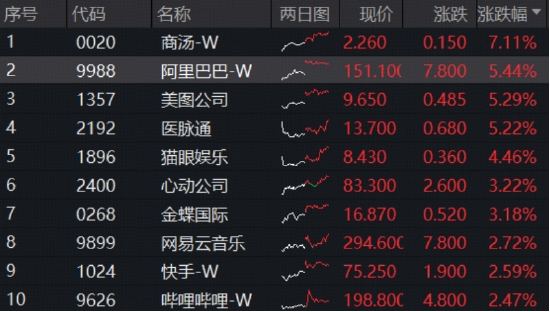
Market Overview - The Hong Kong stock market continues to rebound, with the Hang Seng Index rising over 1% to reach a new high for the current phase, driven by major technology leaders [1] - Alibaba's stock surged over 6% at one point, closing up more than 5%, marking a nearly four-year high [1] - Other tech stocks such as Tencent, Kuaishou, Bilibili, and Xiaomi also saw gains of over 2% [1] Performance of Key Stocks - Alibaba-W (9988) closed at 151.1, up 7.8, a 5.44% increase [2] - Tencent Holdings (0700) and Kuaishou (1024) both saw increases of over 2% [1][2] - The Hong Kong Internet ETF (513770) reached a historical high, with a daily trading volume of 606 million yuan, reflecting increased market activity [2] AI and Technology Developments - Alibaba and Baidu have begun using self-designed chips to train their AI models, partially replacing Nvidia's chips, indicating the rise of China's AI capabilities [3] - Alibaba's Tongyi Qianwen released the next-generation model architecture Qwen3-Next, achieving significant breakthroughs in computational efficiency [4] - The supply of chips and model iterations are seen as core foundations for accelerating cloud computing and are crucial for the valuation reassessment of the internet sector [4] Investment Trends - Southbound funds have returned to aggressively purchase internet leaders, with Alibaba, Tencent, and Meituan being the top three net buyers [5] - As of September 11, Alibaba has seen net purchases from southbound funds for 15 consecutive trading days, totaling over 37.1 billion HKD [5] - Analysts suggest that the internet sector's leading companies are poised to benefit from the AI industry's growth [5] ETF Performance - The Hong Kong Internet ETF (513770) has shown strong performance, with a cumulative net inflow of 2.792 billion yuan over the past 20 days [5] - The ETF's underlying index has outperformed the Hang Seng Tech Index by over 10 percentage points in terms of cumulative returns [8] - The ETF's latest scale has surpassed 10 billion yuan, achieving a historical high, with an average daily trading volume of nearly 600 million yuan [9]

PayPal全球收付平台发布,加码AI赋能跨境支付丨最前线
3 6 Ke· 2025-09-12 10:54
Core Insights - PayPal has launched an upgraded "PayPal Open" global payment platform, enhancing system stability and business scalability [1] - The new platform supports various features including subscription billing, in-app payments, multi-currency display and settlement, and intelligent risk control capabilities [1] - Key checkout experience optimizations include "Fastlane by PayPal" and "New Checkout," aimed at improving cross-border payment efficiency and security [1] Feature Enhancements - "Fastlane by PayPal" allows users to autofill shipping and payment information, increasing merchant checkout sales by an average of 7.5% [1] - "New Checkout" streamlines the payment process from multiple steps to three, reducing payment delays by 35% and improving completion speed by approximately 400 basis points [1] Venmo Expansion - By 2026, Venmo users will be able to use the app for purchases at millions of online and offline merchants globally, expanding its consumer scenarios [2] - This initiative provides new marketing channels for cross-border merchants targeting young, urban, high-spending digital-native consumers [2] AI Integration - PayPal is focusing on integrating AI technology into its services, with a recent developer hackathon aimed at creating smarter, automated cross-border payment solutions [2] - AI is expected to reshape existing search and social customer acquisition models, with 60%-70% of Chinese clients already utilizing AI technologies [2][3] Market Resilience - Despite challenges in the foreign trade environment, Chinese cross-border merchants have shown strong resilience and adaptability [3] - New cross-border business models are emerging, with digital services and content products like games and AI tools becoming new growth points [3] Commitment to China - PayPal plans to increase investment in the Chinese market, particularly in the integration of AI and payment services to help merchants maintain competitiveness in a complex international environment [4]

中密控股(300470) - 中密控股2025年半年度网上业绩说明会投关记录表
2025-09-12 09:43
Financial Performance - In the first half of 2025, the company's revenue increased by 18.45%, while the net profit attributable to shareholders grew by only 8.10%, indicating a significant disparity in growth rates [5] - The gross profit margin decreased by 6.6 percentage points to 44.03%, primarily due to intensified competition in incremental business and changes in project structure [5] Cash Flow and Accounts Receivable - The decline in operating cash flow was mainly due to increased cash payments for operating activities rather than an accumulation of accounts receivable [3] - The increase in accounts receivable is attributed to a sustained rise in order volume and revenue, with the company implementing a management approach to track and recover receivables [3][4] Strategic Direction - The company aims to build a large sealing industry cluster and remains committed to developing its sealing business, despite the uncertain macroeconomic environment [3][4] - The "incremental exchange for stock" business model is designed to secure high-margin service demands in the future, with a focus on expanding incremental business [4][5] Market Expansion and International Business - The company reported international business revenue exceeding 85 million yuan in the first half of 2025, reflecting a growth of over 10% [12] - The international strategy focuses on emerging markets along the "Belt and Road" initiative, with significant efforts in the Middle East, Southeast Asia, Central Asia, and Africa [12] Product Development and Innovation - The company is actively exploring new applications for its mechanical seals in various industries, including pharmaceuticals, papermaking, and wastewater treatment [6] - The integration of artificial intelligence in product development is underway, with initiatives like the SIMS product for monitoring seal health [10] Mergers and Acquisitions - The company has successfully integrated past acquisitions, with a focus on organic growth for future international market expansion, while remaining open to strategic acquisitions [12][13] - The ongoing construction of a new plant is expected to be completed by Q1 2027, enhancing production capacity [14]

他当了一小时世界首富
36氪· 2025-09-12 09:43
Core Viewpoint - Oracle's stock surged dramatically following the release of its earnings report, highlighting the company's strong performance in the AI sector, particularly through a significant partnership with OpenAI, despite some underlying financial concerns [4][7][8]. Financial Performance - Oracle's latest quarterly revenue reached $14.06 billion, a 9% year-over-year increase, although it slightly missed market expectations of $14.1 billion [7]. - The company's adjusted earnings per share were $1.47, below the anticipated $1.48 [7]. - The backlog of unfulfilled orders soared to $455 billion, marking a 359% increase year-over-year, with $317 billion added in the first quarter alone [7][8]. Market Reaction - Following the earnings report, Oracle's stock price increased by 36%, resulting in a market capitalization boost of $244 billion (approximately 1.75 trillion RMB) [4]. - This surge, while impressive, did not set a new record for the largest single-day market cap increase, which remains with Nvidia [4]. AI and Future Projections - Oracle's cloud infrastructure revenue grew by 52% year-over-year to $2.4 billion, with expectations of reaching $18 billion by the end of the fiscal year [7]. - A notable catalyst for Oracle's growth is a $300 billion computing power procurement agreement with OpenAI, set to begin in 2027 [8]. - The market is currently pricing in this long-term contract, which is unusual for the tech sector, as such forecasts typically focus on shorter time frames [8]. Leadership and Controversies - Larry Ellison, Oracle's co-founder, has a history of controversial statements and business practices, which have raised questions about the company's future under his leadership [11][12]. - Despite past financial controversies, including lawsuits and allegations of financial mismanagement, Oracle continues to thrive in the current market environment [13].