
行业轮动

Search documents
A股的牛来了,又走了?
Hu Xiu· 2025-06-26 12:59
Group 1 - The recent surge in A-shares is primarily driven by the approval of a "virtual asset trading license" by Guotai Junan International, allowing direct trading of cryptocurrencies on their platform, which has significantly boosted market confidence [1] - The market experienced a sharp decline after the initial surge, highlighting the challenges of timing short-term market movements despite a generally positive long-term outlook for value investors [1][2] - Economic data has shown resilience despite initial pessimism following the US-China trade conflict, with export figures remaining strong and consumer policies supporting stability [4][5] Group 2 - The current economic environment is characterized by a downward trend in fundamentals, yet there are structural opportunities in certain sectors, particularly in technology, which is seen as a growth driver [6][7] - The concept of technological advancement is emphasized as a key factor in economic growth, with significant breakthroughs in areas like artificial intelligence and nuclear fusion indicating a potential for recovery and prosperity [8] - The market is experiencing a rotation phenomenon, where sector performance varies significantly, reflecting a shift from a bear market to a bull market, with indices showing upward movement amidst this rotation [9][10] Group 3 - Financial stocks have played a crucial role in driving the index above key resistance levels, supported by a macro backdrop of declining interest rates, while technology stocks are also showing signs of recovery [11] - The current market environment is described as both optimistic and challenging for investors, with the need for a disciplined approach to avoid the pitfalls of chasing trends during periods of volatility [11]
中银量化行业轮动系列(十二):传统多因子打分行业轮动策略
Bank of China Securities· 2025-06-26 08:45
Core Insights - The report introduces a quarterly rebalancing industry rotation strategy based on traditional quantitative multi-factor scoring, focusing on "valuation," "quality," "liquidity," and "momentum" [1][11] - The composite strategy achieved an annualized return of 19.64% during the backtesting period (April 1, 2014 - June 6, 2025), significantly outperforming the industry equal-weight benchmark which returned 7.55%, resulting in an annualized excess return of 12.09% [1][68] - The strategy prioritizes low valuation, low crowding, improving economic conditions, upward price momentum over the past year, and industries that have been at low price levels for the past three years [1][11] Industry Factor Backtesting Framework - The backtesting period spans from January 2010 to September 2024, with a quarterly rebalancing approach using data from the last trading day of each quarter [12] - The strategy excludes industries with a weight of less than 2% in the CSI 800 index for risk control, retaining approximately 15-16 major industries for rotation calculations [12][3] Industry Rotation Strategy Overview Valuation Factors - Valuation factors include PE_TTM, PB_LF, PCF_TTM, PEG, and dividend yield, evaluated through various methods such as historical percentiles and marginal changes [15] - Notable factors include: - Dividend yield ranking over three years (4.0% annualized excess for TOP-5) [16] - PE_TTM marginal change over two months (5.8% annualized excess for TOP-5) [16] Quality Factors - Quality factors are based on ROE and ROA, focusing on profitability and financial stability [19] - Key factors include: - ROA_TTM marginal change over one quarter (4.3% annualized excess for TOP-5) [20] - ROE_FY2 (4.7% annualized excess for TOP-5) [20] Liquidity Factors - Liquidity factors are derived from turnover rates of freely circulating shares, assessed through various time frames [21] - Effective factors include: - 21-day average turnover rate (4.3% annualized excess for TOP-5) [22] - Margin of turnover rates over two months (4.6% annualized excess for TOP-5) [22] Momentum Factors - Momentum factors are calculated based on recent returns over different periods, showing varying characteristics [24] - Significant factors include: - One-month momentum (7.7% annualized excess for TOP-5) [26] - Three-month momentum (1.9% annualized excess for TOP-5) [26] Factor Combination - The report explores both z-score and rank equal-weight combinations of selected factors to enhance model performance [27] - The top-performing combinations include: - z-score combination with PE_TTM marginal change, ROE marginal change, and one-year momentum [32] - rank combination with PE_TTM three-year ranking, ROE marginal change, and 21-day momentum [37] Recommended Factors - The report recommends specific factors for the composite strategy: - Momentum: 252_momentum (one-year) and 756_momentum (three-year) [68] - Liquidity: TURNOVER_FREE_m (21-day average) and TURNOVER_FREE_Q_margin (quarterly margin) [68] - Valuation: 股息率_3Y_rank (three-year dividend yield ranking) and PB_LF_d2m (two-month marginal change) [68] - Quality: ROE_TTM_d1q (one-quarter marginal change) and ROE_FY2 (next year's expected ROE) [68]
小盘股又成冲锋旗手!如何用指增ETF“放大”收益?
Sou Hu Cai Jing· 2025-06-26 05:20
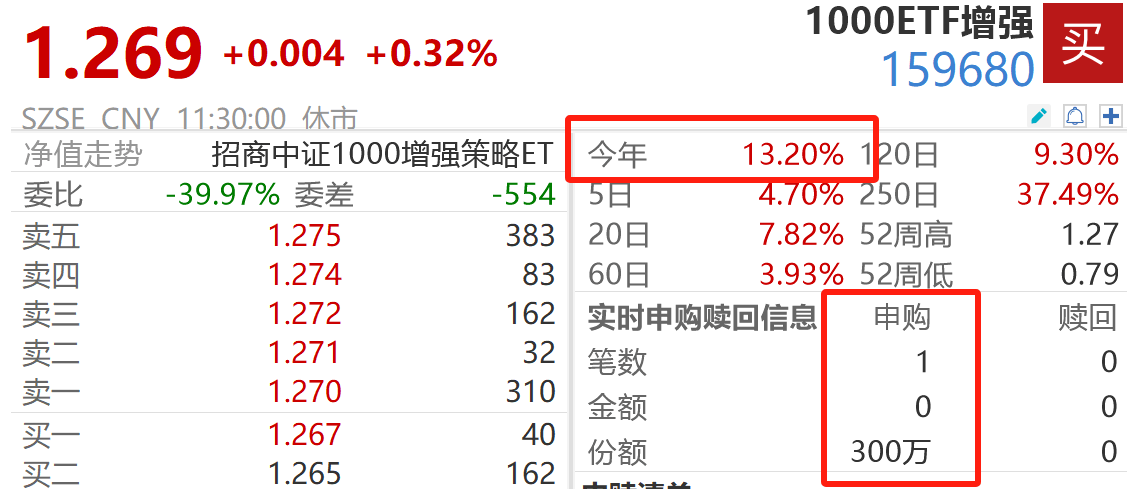
Core Viewpoint - The small-cap indices, represented by the CSI 1000 and CSI 2000, have shown strong performance with significant inflows into related ETF products, indicating a robust market sentiment and potential investment opportunities in these segments [1][2]. Group 1: Market Performance - The CSI 1000 index saw 9 stocks hitting the daily limit up, while the CSI 2000 had 28 stocks, reflecting a strong upward trend with respective gains of 0.47% and 0.72% [1]. - The CSI 1000 Enhanced ETF (159680) received a substantial inflow of 3 million in a single transaction, totaling a net inflow of 22.43 million over the past two trading days [1]. Group 2: ETF Performance - Both the CSI 1000 Enhanced ETF (159680) and the CSI 2000 Enhanced ETF (159552) have outperformed their benchmark indices, achieving excess returns of 7.36% and 13.41% respectively from the beginning of the year to June 25 [3]. Group 3: Driving Forces - The market's performance is driven by three main engines: 1. Liquidity and policy support, with multiple reductions in reserve requirements and interest rates enhancing market liquidity, benefiting small and micro enterprises [3][4]. 2. Enhanced strategies in ETFs that utilize active management to generate excess returns through industry rotation, stock selection, and risk control [6]. 3. A favorable environment for growth sectors, with policies supporting AI, robotics, military, semiconductors, and pharmaceuticals, aligning with the majority of the components in the CSI 1000 and CSI 2000 indices [4]. Group 4: Investment Strategy - The current market conditions resemble the bullish sentiment of September 2022, suggesting that growth stocks within the CSI 1000 and CSI 2000 indices are likely to be key focus areas for investors [7]. - Enhanced ETFs are positioned as offensive allocations in investment portfolios, with recommendations to balance risk by pairing with dividend or bank stocks for a better experience [8].

洗盘!A股年内新高近了!接下来,准备迎接上涨了
Sou Hu Cai Jing· 2025-06-25 06:49
Group 1 - The major indices have been rising for three consecutive days, with the securities sector showing significant gains, although the performance of liquor and banking sectors is holding back the index from reaching new highs this year [1][3]. - The current market trend resembles the rally seen in June 2020, with securities likely to be the main driver of this bull market, especially after strong performance in the first half of the year [1][3]. - The Hong Kong securities market has rebounded significantly, with a nearly 50% increase from 800 points to 1200 points since April [3]. Group 2 - The market is expected to continue its upward trend, with many investors currently pessimistic, which may create opportunities for a rally [5]. - There is a belief that the current market conditions are being manipulated to induce selling, with many investors waiting for a pullback, but this may lead to missed opportunities [5]. - The expectation is for a "short squeeze" rally towards the end of June, with the Shanghai Composite Index still having room to rise [5][7]. Group 3 - The market is close to reaching a new yearly high, with the index currently at 3430 points, and a small upward movement could achieve this milestone [7]. - The prevailing sentiment among pessimistic investors is seen as a positive indicator for future gains, as historically, those who are skeptical often miss out on profitable opportunities [7].

关键一步!科创板ETF纳入基金投顾配置范围,组合策略更丰富、综合费率更低
Sou Hu Cai Jing· 2025-06-24 07:17
Core Insights - The China Securities Regulatory Commission (CSRC) has included Sci-Tech Innovation Board (STAR Market) ETFs in the fund advisory configuration scope, enhancing the flexibility of advisory strategies and reducing investment costs [1][5] - This policy change is seen as a significant breakthrough, allowing advisory institutions to construct more flexible and diverse strategy combinations based on ETFs, leading to improved tracking accuracy and trading efficiency [1][5] Group 1: Policy Impact - The inclusion of STAR Market ETFs is expected to attract more medium to long-term capital towards developing new productive forces [1] - The management fee for STAR Market ETFs is as low as 0.15%, and transactions are exempt from stamp duty and transfer fees, significantly improving cost efficiency [5] - The move is anticipated to enhance the liquidity of the STAR Market, as advisory funds typically have longer investment horizons and rational decision-making characteristics [6] Group 2: Implementation Challenges - Advisory institutions need to address compatibility, trading mechanisms, and risk control issues to effectively implement this policy [5] - There are significant differences between the management of onshore public funds and ETFs, necessitating adaptations in trading systems and account management [5][6] - The introduction of STAR Market ETFs into advisory strategies presents new challenges in cash management and portfolio adjustment due to the real-time price fluctuations of ETFs [5][6] Group 3: Future Opportunities - The inclusion of STAR Market ETFs is expected to enrich the product matrix available for investment and refine investment granularity [6] - If the pilot for STAR Market ETFs is successful, thematic ETFs related to artificial intelligence and biomedicine may also be included in the advisory configuration scope [7] - The anticipated influx of advisory funds could improve the liquidity structure of the STAR Market and reduce market volatility, providing more stable funding support for innovative enterprises [6]

行业轮动周报:ETF资金大幅净流入金融地产,石油油气扩散指数环比提升靠前-20250623
China Post Securities· 2025-06-23 07:25
Quantitative Models and Construction Methods 1. Model Name: Diffusion Index Model - **Model Construction Idea**: The model is based on the principle of price momentum, aiming to capture upward trends in industry performance[27][28] - **Model Construction Process**: The diffusion index is calculated for each industry, ranking them based on their momentum. Industries with higher diffusion index values are considered to have stronger upward trends. The model selects industries with the highest diffusion index values for allocation. - Formula: Not explicitly provided in the report - **Model Evaluation**: The model has shown mixed performance over the years. It performed well in 2021 and 2022 but faced significant drawdowns in 2023 and 2024 due to market reversals and failure to adjust to cyclical changes[27] 2. Model Name: GRU Factor Model - **Model Construction Idea**: This model leverages GRU (Gated Recurrent Unit) deep learning networks to process high-frequency price and volume data, aiming to identify industry trends and generate excess returns[34][39] - **Model Construction Process**: The GRU network is trained on historical minute-level price and volume data to predict industry rankings. The model then allocates to industries with the highest GRU factor scores. - Formula: Not explicitly provided in the report - **Model Evaluation**: The model has shown strong adaptability in short-term cycles but struggles in long-term trends and extreme market conditions. It has faced challenges in capturing excess returns in 2025 due to concentrated market themes[34][39] --- Model Backtesting Results 1. Diffusion Index Model - **2025 YTD Excess Return**: 0.37%[26][31] - **June 2025 Excess Return**: 1.99%[31] - **Weekly Average Return (June 2025)**: -0.65%[31] - **Weekly Excess Return (June 2025)**: 0.79%[31] 2. GRU Factor Model - **2025 YTD Excess Return**: -3.83%[34][37] - **June 2025 Excess Return**: 0.25%[37] - **Weekly Average Return (June 2025)**: -1.18%[37] - **Weekly Excess Return (June 2025)**: 0.25%[37] --- Quantitative Factors and Construction Methods 1. Factor Name: Diffusion Index - **Factor Construction Idea**: Measures the momentum of industries by ranking them based on their upward trends[28] - **Factor Construction Process**: The diffusion index is calculated for each industry weekly. Industries are ranked based on their index values, with higher values indicating stronger momentum. - Example Values (as of June 20, 2025): - Top Industries: Comprehensive Finance (1.0), Non-Bank Finance (0.973), Banking (0.97)[28] - Bottom Industries: Coal (0.174), Food & Beverage (0.313), Oil & Gas (0.387)[28] - **Factor Evaluation**: The factor effectively captures upward trends but may underperform during market reversals[27][28] 2. Factor Name: GRU Factor - **Factor Construction Idea**: Utilizes GRU deep learning to analyze high-frequency trading data and rank industries based on predicted performance[34][39] - **Factor Construction Process**: The GRU network processes minute-level price and volume data to generate factor scores for each industry. Industries are ranked based on these scores. - Example Values (as of June 20, 2025): - Top Industries: Coal (3.48), Non-Bank Finance (3.15), Utilities (2.65)[35] - Bottom Industries: Communication (-17.95), Media (-15.45), Defense (-11.87)[35] - **Factor Evaluation**: The factor is effective in short-term trend identification but struggles with long-term stability and extreme market conditions[34][39] --- Factor Backtesting Results 1. Diffusion Index Factor - **Top Weekly Changes (June 20, 2025)**: - Oil & Gas: +0.09 - Textiles: +0.044 - Metals: +0.036[30] - **Bottom Weekly Changes (June 20, 2025)**: - Agriculture: -0.229 - Defense: -0.086 - Building Materials: -0.078[30] 2. GRU Factor - **Top Weekly Changes (June 20, 2025)**: - Non-Bank Finance: Significant increase - Consumer Services: Significant increase - Comprehensive: Significant increase[35] - **Bottom Weekly Changes (June 20, 2025)**: - Communication: Significant decrease - Electronics: Significant decrease - New Energy Equipment: Significant decrease[35]
【广发金工】龙头扩散效应行业轮动之二:优选行业组合构建
广发金融工程研究· 2025-06-17 06:57
Core Viewpoint - The report discusses the "Leading Stock Diffusion Effect" as a mechanism driving sector trends in the A-share market, emphasizing the importance of constructing optimal investment portfolios based on improved factors like economic conditions and capital flows [1][2][3]. Research Background - The demand for industry-level beta timing has increased due to the development of flexible allocation funds and the growing industry ETF system, making sector rotation a core asset allocation need [6]. - The A-share market has seen accelerated sector rotation, which poses challenges to traditional rotation models, necessitating a reevaluation and improvement of these models [7]. Mechanism of Diffusion Effect - The diffusion effect in the A-share market typically involves capital migrating from core leading stocks to related targets, driven by policy triggers, active capital inflows, cognitive dissemination, and expectation overshoot leading to differentiation [2][16]. - The process includes vertical and horizontal expansions within the industry, market capitalization descent, and valuation arbitrage, ultimately leading to a broader sector rally [17]. Performance of Improved Factors - The report presents improved factors based on the previous discussion, showing significant performance enhancements in the revised SUE and active large order factors, with annualized excess returns of 7.9% and 10.3% respectively [21][22]. - The improved factors demonstrate better stability and lower volatility compared to traditional models, particularly in recent years [64]. Optimal Industry Portfolio - The optimal industry portfolio, constructed using a common condition screening method based on component factors, has shown superior historical performance with an annualized return of 26.0% and an annualized excess return of 19.1% since 2013 [3][64]. - The portfolio has maintained stable excess growth since 2022, with an annualized excess return of 11.7% and a maximum drawdown of 9.2% [74]. Comparison of Multi-Headed Construction Methods - The report compares two multi-headed construction methods: composite factor multi-headed and component factor common condition screening, concluding that the latter offers lower volatility and more stable excess returns [42][64]. - The composite factor multi-headed approach has shown stagnation in excess returns in recent years, while the optimal industry portfolio continues to outperform [53][64].

系好安全带!A股,会复制“924行情”了吗
Sou Hu Cai Jing· 2025-06-17 04:59
Group 1 - The current performance of the liquor market is influenced by external interventions, leading to a halt in the downward trend, but further declines may still occur [1] - The Hong Kong stock market has been stagnant, trading within the range of 3200 to 3400 points for eight months, causing widespread pessimism among investors [1] - The A-share market is expected to experience a rebound, particularly if capital flows from the Hong Kong market into A-shares, potentially leading to a simultaneous surge in both markets [3] Group 2 - The current market conditions may replicate the "924 market" scenario, with expectations of reaching above 3500 points, although the scale of the increase may not be as significant [5] - The concentration of trading chips is high, making a direct downward trend less likely, while a rapid upward movement could occur as chips are redistributed [5] - The complexity of individual stock performances is notable, especially in technology sectors where many investors are trapped, indicating that index growth is necessary for volume expansion [5] Group 3 - The market does not exhibit signs of a significant downturn, with expectations of a quick correction followed by a rebound, suggesting a comfortable state for investors holding positions [7] - The current market dynamics indicate that patience is required, as there has not been a substantial rally this year, and maintaining positions is advised [7]

行业轮动周报:融资资金持续大幅净流入医药,GRU行业轮动调出银行-20250616
China Post Securities· 2025-06-16 09:37
Quantitative Models and Construction Diffusion Index Model - **Model Name**: Diffusion Index Model [6][26] - **Model Construction Idea**: The model is based on the principle of price momentum, aiming to capture upward trends in industry performance. It selects industries with positive momentum for rotation. [26] - **Model Construction Process**: - The model calculates a diffusion index for each industry, which reflects the proportion of stocks within the industry exhibiting upward momentum. - Industries are ranked based on their diffusion index values, and the top industries are selected for portfolio allocation. [6][27] - **Model Evaluation**: The model has shown strong performance in capturing trends during momentum-driven markets but struggles during market reversals or when trends shift to mean-reversion. [26] - **Testing Results**: - 2025 YTD excess return: -0.44% [25][30] - June 2025 excess return: 1.20% [30] - Weekly average return: 0.21%, excess return over equal-weighted industry index: 0.37% [30] GRU Factor Model - **Model Name**: GRU Factor Model [7][32] - **Model Construction Idea**: This model leverages GRU (Gated Recurrent Unit) deep learning networks to process high-frequency price and volume data, aiming to identify industry rotation opportunities. [37] - **Model Construction Process**: - The model uses minute-level price and volume data as input features. - A GRU neural network is trained to predict industry factor scores, which are then used to rank industries for rotation. [37] - **Model Evaluation**: The model performs well in short-term trading environments but faces challenges in long-term trend-following scenarios, especially during extreme market conditions. [37] - **Testing Results**: - 2025 YTD excess return: -4.13% [32][35] - June 2025 excess return: 0.00% [35] - Weekly average return: 0.42%, excess return over equal-weighted industry index: 0.58% [35] --- Backtesting Results of Models Diffusion Index Model - **YTD Excess Return**: -0.44% [25][30] - **June 2025 Excess Return**: 1.20% [30] - **Weekly Average Return**: 0.21% [30] - **Weekly Excess Return**: 0.37% [30] GRU Factor Model - **YTD Excess Return**: -4.13% [32][35] - **June 2025 Excess Return**: 0.00% [35] - **Weekly Average Return**: 0.42% [35] - **Weekly Excess Return**: 0.58% [35] --- Quantitative Factors and Construction GRU Industry Factor - **Factor Name**: GRU Industry Factor [7][33] - **Factor Construction Idea**: The factor is derived from GRU neural network outputs, representing the relative attractiveness of industries based on high-frequency trading data. [37] - **Factor Construction Process**: - The GRU model processes minute-level trading data to generate factor scores for each industry. - Industries are ranked based on their factor scores, and the top industries are selected for portfolio allocation. [37] - **Factor Evaluation**: The factor effectively captures short-term trading signals but may underperform in broader market trends or during periods of concentrated market themes. [37] - **Testing Results**: - Top industries by factor score (as of June 13, 2025): Steel (2.42), Construction (1.47), Transportation (0.85), Real Estate (0.59), Utilities (-0.01), Oil & Gas (-1.52) [7][33] - Bottom industries by factor score: Food & Beverage (-49.88), Comprehensive Finance (-33.65), Consumer Services (-25.42), Media (-21.94), Automotive (-20.34), Non-Banking Finance (-18.36) [33] Diffusion Index Factor - **Factor Name**: Diffusion Index Factor [6][27] - **Factor Construction Idea**: The factor measures the proportion of stocks within an industry showing upward momentum, serving as a proxy for industry strength. [6] - **Factor Construction Process**: - Calculate the diffusion index for each industry based on the percentage of stocks with positive momentum. - Rank industries by their diffusion index values to identify the strongest performers. [6][27] - **Factor Evaluation**: The factor is effective in identifying momentum-driven industries but may lag during market reversals. [26] - **Testing Results**: - Top industries by diffusion index (as of June 13, 2025): Comprehensive Finance (1.0), Non-Banking Finance (0.997), Banking (0.97), Media (0.953), Computing (0.936), Retail (0.93) [6][27] - Bottom industries by diffusion index: Coal (0.166), Oil & Gas (0.297), Food & Beverage (0.323), Utilities (0.604), Real Estate (0.629), Building Materials (0.657) [27] --- Backtesting Results of Factors GRU Industry Factor - **Top Industries by Factor Score**: Steel (2.42), Construction (1.47), Transportation (0.85), Real Estate (0.59), Utilities (-0.01), Oil & Gas (-1.52) [7][33] - **Bottom Industries by Factor Score**: Food & Beverage (-49.88), Comprehensive Finance (-33.65), Consumer Services (-25.42), Media (-21.94), Automotive (-20.34), Non-Banking Finance (-18.36) [33] Diffusion Index Factor - **Top Industries by Diffusion Index**: Comprehensive Finance (1.0), Non-Banking Finance (0.997), Banking (0.97), Media (0.953), Computing (0.936), Retail (0.93) [6][27] - **Bottom Industries by Diffusion Index**: Coal (0.166), Oil & Gas (0.297), Food & Beverage (0.323), Utilities (0.604), Real Estate (0.629), Building Materials (0.657) [27]
投资者微观行为洞察手册:6月第2期:融资资金流入扩大,外资流入中国资产
GUOTAI HAITONG SECURITIES· 2025-06-16 09:06
Market Pricing Status - The overall trading heat in the market has significantly increased, with the average daily trading volume of the entire A-share market rising from 12.2 trillion to 13.8 trillion yuan, and the turnover rate of the Shanghai Composite Index increasing to 82% [1][12][11] - The number of daily limit-up stocks has decreased to 66, with the maximum consecutive limit-up stocks being 7 [1][12] A-Share Liquidity Tracking - Foreign capital has turned to inflow, with a net inflow of 0.3 million USD into the A-share market [4][47] - The net inflow of financing funds reached 125.8 billion yuan, with the total margin balance increasing to 1.8 trillion yuan [4][30] - The issuance scale of new equity funds has decreased to 12.2 billion yuan [4][30] Industry Allocation Tracking - Financing funds have shown divergence in the pharmaceutical sector, with net inflows of 22.5 billion yuan in pharmaceuticals and 17.2 billion yuan in electronics, while there were net outflows of 15.6 billion yuan in agriculture and 2.8 billion yuan in power equipment [4][30] - Foreign capital has primarily flowed into the real estate sector, while food and beverage and power equipment sectors experienced net outflows [4][30] - The top three industries on the trading leaderboard were pharmaceuticals, machinery, and environmental protection [4][30] Global Fund Flow Tracking - Southbound funds have increased, with a net inflow of 154.6 billion yuan, placing it in the 62nd percentile since 2022 [3][4] - Major global markets have shown mixed performance, with the South Korean index leading with a 2.9% increase [3][4]