
价格

Search documents
乙二醇短期弱势难改
Qi Huo Ri Bao· 2025-09-17 23:35
Core Viewpoint - Ethylene glycol futures prices are experiencing a volatile consolidation phase, influenced by increased supply from new projects and declining industry profits [1][2][8] Supply - Ethylene glycol comprehensive capacity utilization rate is at 66.55%, down 0.9 percentage points week-on-week; total production is 404,600 tons, a decrease of 1.33% [2] - The production capacity of coal-based ethylene glycol is at 65.96%, down 2.47% week-on-week, while oil-integrated facilities show a slight increase in utilization [2] - Overall, supply remains relatively ample, with expectations of slight production growth as some coal chemical facilities resume operations [2][8] Inventory - As of September 15, the port inventory of ethylene glycol in East China is 395,600 tons, an increase of 32,400 tons from the previous week [4] Demand - Domestic polyester industry weekly production is 1,546,800 tons, a slight increase of 0.74% week-on-week, with an average capacity utilization rate of 87.9% [5] - Demand in the weaving sector shows a slight recovery, with average order days increasing to 14.55 days, although large orders remain scarce [7] Cost Factors - OPEC+ plans to increase production, but geopolitical risks and seasonal declines in oil consumption are putting pressure on international oil prices [1] - The cost structure for ethylene glycol is expected to continue to decline due to falling prices of crude oil and coal [8] Market Outlook - Short-term expectations indicate a decrease in domestic ethylene glycol production with a potential increase in imports, maintaining stable overall supply [8] - The weak price trend for ethylene glycol is likely to persist, with forecasts suggesting continued downward pressure [8]

中国宏观周报(2025年9月第2周)-20250915
Ping An Securities· 2025-09-15 07:33
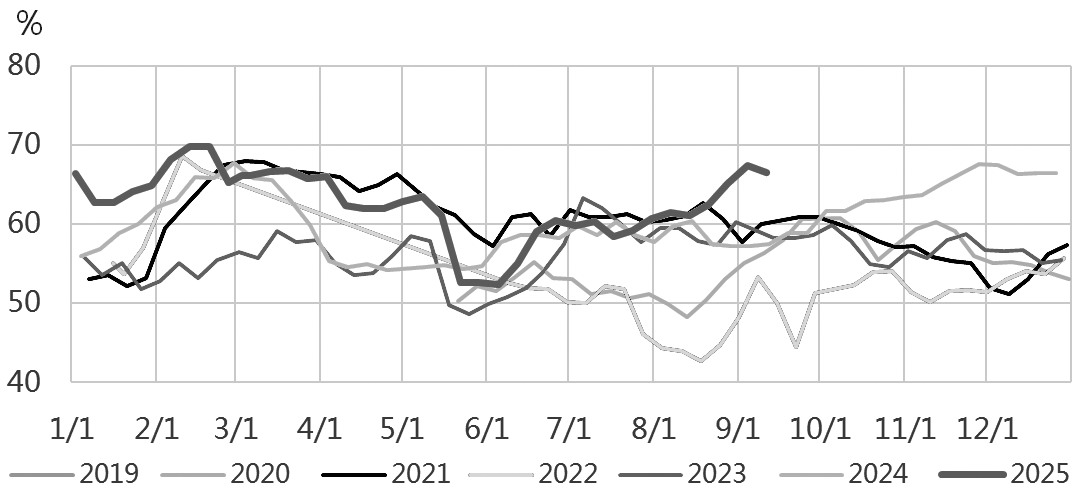
Industrial Production - China's industrial production shows marginal stabilization with daily average pig iron output and cement clinker capacity utilization rates increasing[2] - The operating rates for asphalt and most chemical products have rebounded, while only steel and construction materials show slight adjustments in output and apparent demand[2] - The textile and polyester operating rates have seasonally increased, along with the operating rates for both radial and bias tires[2] Real Estate - New home sales in 30 major cities increased by 7.2% year-on-year as of September 12, with a 5.7 percentage point increase from the previous week[2] - The new home sales area in these cities has shown a 9.8% year-on-year growth since September, reversing from negative growth last month[2] - The listing price index for second-hand homes decreased by 0.59% month-on-month as of September 1[2] Domestic Demand - Movie box office revenue continues to outperform last year's figures, with a 41.0% year-on-year increase in daily average revenue of 51.14 million yuan as of September 12[2] - Domestic flight operations increased by 3.9% year-on-year, with a 4.5 percentage point increase from the previous week[2] - The volume of postal express deliveries grew by 11.0% year-on-year, although this was a slight decline of 1.1 percentage points from the previous week[2] External Demand - Port cargo throughput increased by 5.8% year-on-year, while container throughput rose by 10.5% year-on-year as of September 7[2] - The export container freight rate index decreased by 2.1% week-on-week, with Shanghai and Ningbo's export container rates also declining[2] - South Korea's export value increased by 3.8% year-on-year in the first ten days of September, a 2.5 percentage point increase from August[2] Price Trends - The Nanhua Industrial Index fell by 0.5%, while the Nanhua Black Materials Index and Nanhua Nonferrous Metals Index rose by 0.3% and 0.4%, respectively[2] - Rebar futures closed down by 0.5%, with spot prices also decreasing by 0.4%[2] - Coking coal futures dropped by 1.2%, and Shanxi coking coal spot prices fell by 1.4%[2]
钢材期货行情展望:库存压力不大 钢价维持高位震荡走势
Jin Tou Wang· 2025-08-25 02:08
Price and Basis - Futures prices have declined while the basis has strengthened, with steel billet prices down by 10 to 3080 yuan. The actual transaction price for rebar in East China is 3170 yuan per ton, with the October futures contract at a discount of 51 yuan to the spot price. Hot-rolled coil is priced at 3400 yuan per ton, with the main contract at a discount of 39 yuan to the spot price [1]. Cost and Profit - On the cost side, coking coal production has seen fluctuations, with overall operating rates and output not recovering significantly. After a decline in inventory, there are signs of a potential accumulation again. Iron ore inventories at ports have slightly increased, while steel production remains high, and seasonal demand for steel is declining. Expectations for a contraction in coking coal supply persist, and while iron ore demand remains high, a slight accumulation is expected, leading to a weaker cost support on a month-on-month basis. As prices weaken, steel profits are declining, with profits ranked from high to low as follows: steel billet > hot-rolled coil > rebar > cold-rolled coil [1]. Supply - From January to July, iron element production increased by 18 million tons, a growth rate of 3.1%. Month-on-month, August production rebounded compared to July, mainly due to a significant increase in daily scrap steel consumption. Current molten iron production is stable at 2.41 million tons, with daily scrap steel consumption at 55800 tons, up by 0.6% month-on-month. The total production of the five major materials increased by 64000 tons to 8.78 million tons. By product type, rebar production decreased by 58000 tons to 2.15 million tons, while hot-rolled coil production increased by 96000 tons to 3.25 million tons. Since July, production of the five major materials has exceeded demand, leading to inventory pressure due to last year's low production base in August [1][2]. Demand - From January to July, the apparent demand for the five major materials remained flat year-on-year (-0.2%), while the production decline was greater than the apparent demand (-1.3%). The increase in iron element production (+3%) is primarily directed towards non-five major materials and steel billets. Domestic demand has decreased year-on-year, while external demand has increased significantly, with direct and indirect steel exports rising. Overall steel demand has increased year-on-year, with average daily production rising and apparent demand remaining flat, while inventory has decreased year-on-year. Month-on-month, the seasonal decline was not significant, and the impact of tariffs on demand was offset by the increase in direct exports. Apparent demand for rebar has decreased, dragging down overall apparent demand. The apparent demand for the five major materials decreased by 22000 tons to 8.53 million tons, with rebar demand down by 5000 tons to 1.95 million tons, while hot-rolled coil demand increased by 6500 tons to 3.21 million tons [2]. Inventory - This week saw a significant accumulation of inventory, primarily among traders, with little increase in steel mill inventories. The inventory of the five major materials increased by 25000 tons to 14.41 million tons, with rebar inventory up by 20000 tons to 6.07 million tons and hot-rolled coil inventory up by 4000 tons to 3.6144 million tons. By product type, rebar supply has increased while demand has decreased, leading to significant inventory accumulation; for sheet materials, both supply and demand are weak, resulting in minimal inventory accumulation [2]. Outlook - Molten iron production remains stable, with weekly data indicating a slight increase in the production of the five major materials and a slowdown in inventory accumulation, alongside a rebound in apparent demand. Data shows signs of a bottoming out, but levels remain within the off-peak season. August demand saw a significant month-on-month decline, primarily due to poor rebar demand, affecting the spread between rebar and hot-rolled coil, which has widened to around 290. The market remains weak, with steel prices declining. There is an expectation for a rebound in demand during the peak season from September to October, and considering the situation of steel demand and coking coal supply, steel prices are expected to maintain a high-level oscillation pattern. A long position is suggested for trading, with October hot-rolled coil and rebar prices referenced at 3350 yuan and 3150 yuan, respectively [3][4].
“好收成”如何变为“好收益”(话说新农村)
Ren Min Ri Bao· 2025-08-10 21:57
Core Viewpoint - The article emphasizes the importance of improving the grain supply chain and ensuring farmers can profit from grain production to stabilize food supply and prices [1][2]. Group 1: Grain Production and Sales - The total summer grain production in China reached 299.48 billion jin, with wheat production at 276.32 billion jin, indicating a stable and abundant harvest [1]. - The new online platforms for grain sales, such as "Hui San Nong" and "Zhi Neng Wan Liang," have made the selling process more efficient, allowing farmers to receive payments within 24 hours [1][2]. - The convenience of selling grain has increased farmers' willingness to sell, with an estimated new season summer grain purchase volume of around 100 million tons, including over 85 million tons of wheat [2]. Group 2: Policy Support and Pricing Mechanism - China has established a "three-in-one" policy support system consisting of price, subsidy, and insurance to ensure farmers' income from grain production [2]. - The minimum purchase price mechanism has been activated in provinces like Henan and Anhui, leading to a stable increase in wheat prices and encouraging farmers to grow high-quality wheat varieties [3]. - The pricing mechanism allows for market-driven pricing when market prices exceed the minimum purchase price, while also providing a safety net when prices fall below it [2][3]. Group 3: Future Outlook and Importance of Autumn Grain - Autumn grain is crucial for overall grain production, with significant varieties and regions involved, making its purchase and storage vital for the entire year's grain supply [3]. - The article highlights the need for comprehensive policies to enhance the grain production and sales chain, ensuring farmers experience a sense of gain from their harvests [3].
美联储理事沃勒:关税将对价格产生一次性影响。
news flash· 2025-08-01 12:04
Group 1 - The core viewpoint is that tariffs will have a one-time impact on prices, as stated by Federal Reserve Governor Waller [1] Group 2 - The discussion emphasizes that the effect of tariffs is not expected to lead to ongoing inflationary pressures, but rather a temporary adjustment in pricing [1]
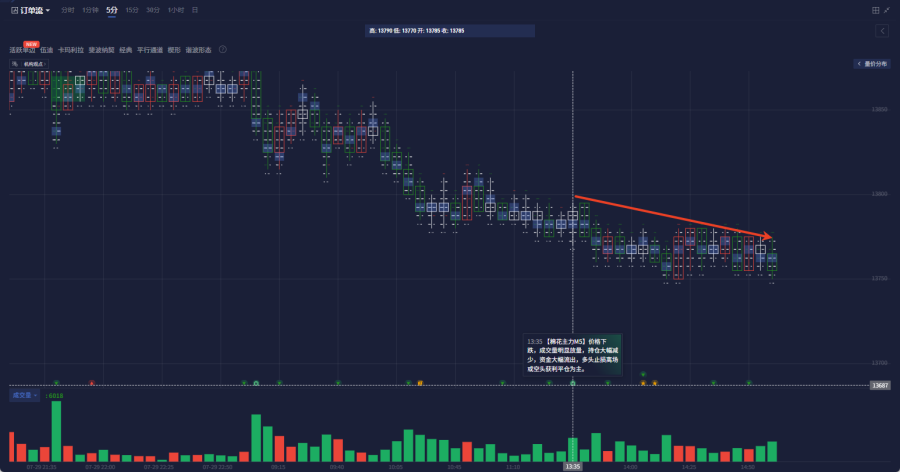
【期货盯盘神器案例分享】今日焦煤涨幅有所收窄,棉花价格跌跌不休,如何从价格、成交量和持仓量的关系洞察主力动向?
news flash· 2025-07-30 12:30
Core Insights - The article discusses the recent trends in coal and cotton prices, highlighting the narrowing increase in coking coal prices and the continuous decline in cotton prices [1] Group 1: Price Trends - Coking coal prices have experienced a reduction in their growth rate, indicating a potential shift in market dynamics [1] - Cotton prices are on a downward trend, suggesting ongoing challenges in the cotton market [1] Group 2: Market Analysis - The relationship between price, trading volume, and open interest is emphasized as a key indicator for understanding the movements of major market players [1]
美联储洛根:经济模型显示关税对价格具有一次性影响,但模型假设的关税规模要小得多。
news flash· 2025-07-16 00:37
Core Insights - The Federal Reserve's Logan indicates that economic models show tariffs have a one-time impact on prices, but the scale of tariffs assumed in the models is significantly smaller [1] Group 1 - The economic models utilized by the Federal Reserve suggest that the effect of tariffs on prices is not ongoing but rather a one-time adjustment [1] - The assumptions made in these models regarding the scale of tariffs are much lower than current levels, indicating a potential underestimation of the impact of larger tariffs [1]
美联储戴利:未看到持续关税对价格的影响证据。
news flash· 2025-07-10 18:56
Core Viewpoint - The Federal Reserve's Daly stated that there is no evidence of sustained impact from tariffs on prices [1] Group 1 - The Federal Reserve is monitoring the effects of tariffs on the economy but has not found lasting evidence of their influence on pricing [1] - Daly emphasized the importance of ongoing analysis to understand the broader economic implications of tariffs [1]
美联储理事沃勒:关税一次性会推高价格,各国央行可忽略其影响。
news flash· 2025-07-10 18:10
Core Viewpoint - Federal Reserve Governor Waller stated that tariffs will lead to a one-time increase in prices, and central banks around the world can disregard their impact [1] Group 1 - Waller emphasized that the effect of tariffs on prices is not ongoing but rather a one-time adjustment [1] - He indicated that central banks should not factor in the influence of tariffs when making monetary policy decisions [1] - The comments suggest a focus on broader economic indicators rather than tariff impacts for central banks [1]
6月高频数据跟踪
LIANCHU SECURITIES· 2025-07-04 11:34
Production Insights - As of the fourth week of June, the national blast furnace operating rate was 83.84%, stable compared to the previous period and above last year's average[11] - The rebar operating rate increased to 43.62%, up by 3.10 percentage points from the previous period, also above last year's average[11] - Cement mill operating rate decreased to 38.14%, down by 4.91 percentage points, slightly below last year's average[11] Inventory Trends - As of the fourth week of June, rebar inventory was 185.65 million tons, up by 1.85 percentage points from the previous period, but below last year's average[28] - Port iron ore inventory decreased to 139.27 million tons, down by 0.05 percentage points, also below last year's average[28] - Cement capacity utilization ratio was 62.76%, down by 0.68 percentage points, remaining stable compared to last year's average[28] Demand Dynamics - In June, the sales area of commercial housing in 30 cities increased by 45.73 percentage points, exceeding last year's average[55] - The average daily sales of passenger cars reached 95,374 units, reflecting an increase of 18.44% month-on-month and 3.00% year-on-year[82] - The total box office revenue for movies was 53.9 million yuan, up by 22.78% month-on-month, but still lower than last year's level[82] Trade and Pricing - The Shanghai Container Freight Index (SCFI) fell to 1861.51, down by 0.43% from the previous period, while the China Container Freight Index (CCFI) rose to 1369.34, up by 2.00%[89] - The average price of cement was 355.26 yuan per ton, down by 2.05% from the previous period, below last year's average[66] - The price of rebar was 3,070.50 yuan per ton, showing a slight increase of 0.10% from the previous period, but still below last year's average[67]