
先进封装技术

Search documents
半导体产业链震荡调整,资金逆势布局,半导体设备ETF易方达(159558)全天净申购达8700万份
Sou Hu Cai Jing· 2026-02-11 10:43
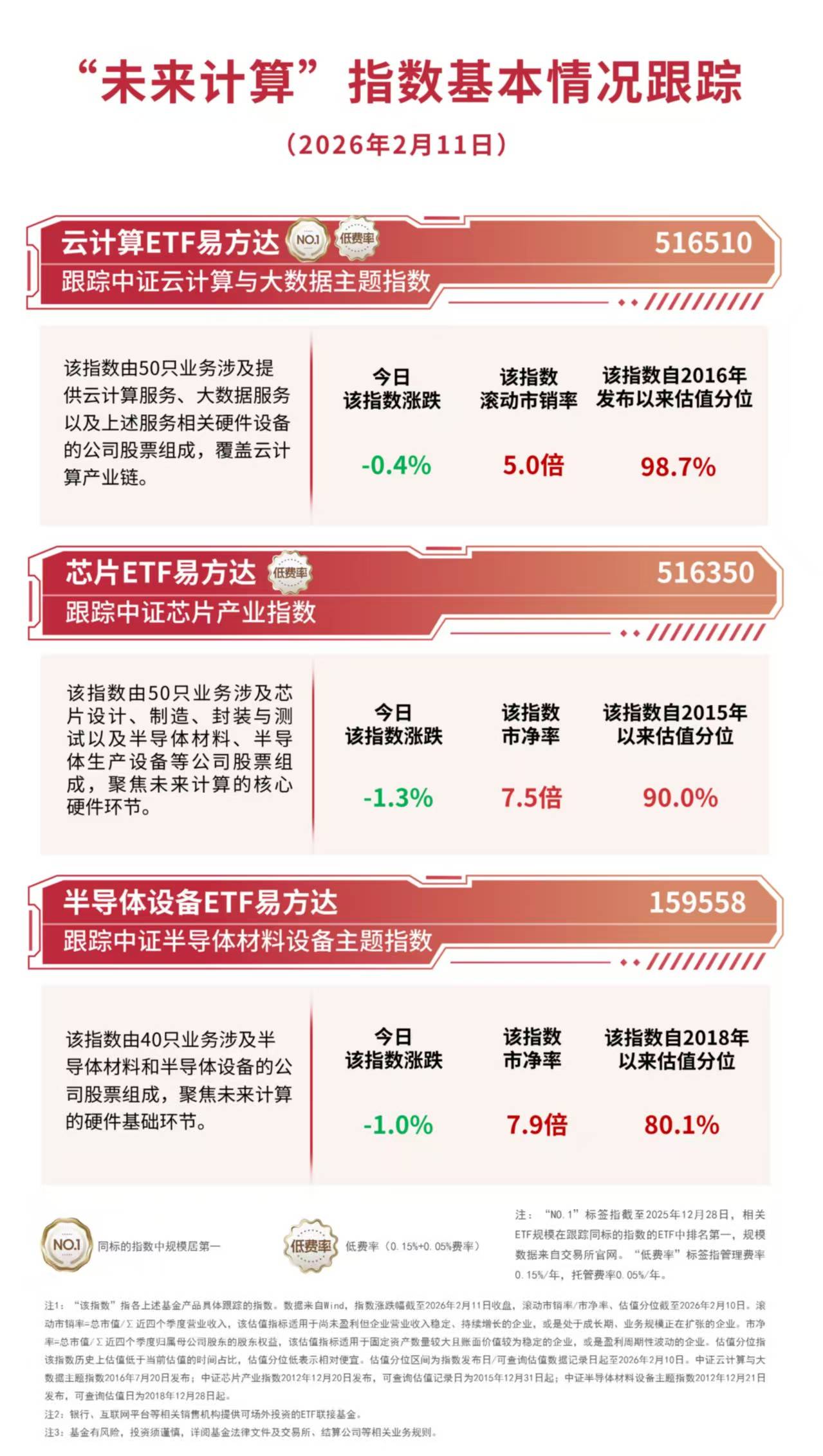
Group 1 - The core viewpoint of the articles indicates a decline in various semiconductor-related indices, with the China Securities Cloud Computing and Big Data Theme Index down by 0.4%, the China Securities Semiconductor Materials and Equipment Theme Index down by 1.0%, and the China Securities Chip Industry Index down by 1.3% [1] - Despite the declines in indices, there is a notable inflow of funds into semiconductor equipment ETFs, with the E Fund (159558) seeing a net subscription of 87 million units throughout the day and approximately 2.4 billion yuan in total inflows over the past month [1] - China Galaxy Securities highlights that the demand for AI computing power, the upward cycle of storage chips, and the penetration of advanced packaging technology are collectively driving the demand for semiconductor equipment, with strong expectations for market growth through 2026 [1] Group 2 - TSMC is projected to have a capital expenditure of between 52 billion to 56 billion USD in 2026, significantly increasing from 40.9 billion USD in 2025, further emphasizing the market opportunities in semiconductor equipment [1] - The semiconductor equipment market is expected to continue its growth trajectory, driven by the aforementioned factors, indicating a robust outlook for the industry [1]

美国正在加速建HBM工厂
半导体芯闻· 2026-02-10 10:29
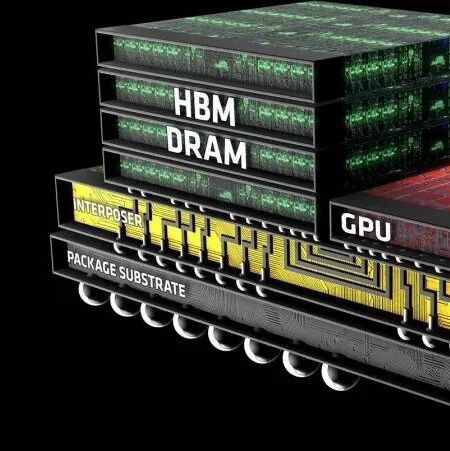
先进封装技术属于HBM生产的后端工艺,是决定HBM良率和性能的核心技术。随着人工智能技术 的飞速发展,封装技术的重要性日益凸显。因此,三星电子和SK海力士等存储半导体公司正致力 于提升自身的封装能力。 SK海力士不仅在美国印第安纳州,也在韩国国内拓展其封装生产基地。该公司计划在韩国忠清北 道 清 州 市 投 资 19 万 亿 韩 元 ( 约 合 131 亿 美 元 ) , 建 设 一 座 新 的 " 先 进 封 装 测 试 专 用 工 厂 (P&T7)"。SK海力士计划于今年4月破土动工,并于明年年底前竣工。 如果您希望可以时常见面,欢迎标星收藏哦~ SK海力士将于本月底开始在美国印第安纳州启动其先进封装工厂的全面基础建设工作。随着人工 智能(AI)芯片领域的竞争转向先进封装领域的竞争,该公司计划加快工厂建设,以满足市场对 高带宽存储器(HBM)的中长期需求。 据业内人士2月9日透露,SK海力士将于2月23日起在位于印第安纳州西拉法叶的先进半导体芯片 制造厂施工现场安装围栏,并开始前期施工工作。该公司计划从3月2日起启动主体施工的准备工 作,包括场地平整和土木工程。 SK海力士正在印第安纳州建设一座先进封装工 ...
环旭电子20260205
2026-02-10 03:24
Summary of Huanxu Electronics Conference Call Company Overview - **Company**: Huanxu Electronics - **Industry**: Semiconductor packaging and testing, AI technology, data center solutions Key Points and Arguments Strategic Partnerships and Collaborations - Huanxu Electronics benefits from strategic adjustments by ASE Group, collaborating with leading packaging manufacturers to advance packaging technology, particularly in AI computing [2][5] - The company has established a close partnership with Meta in the AI glasses sector, securing multiple new project orders, with revenue expected to grow rapidly starting in 2026 [2][9] Business Segments and Growth Opportunities - **Data Center Business**: - Focused on three main areas: computing boards, optical communication, and power supply solutions [5][10] - Successfully entered AWS's AI accelerator card business, with projected orders exceeding $500 million by 2026 [2][5] - Plans to expand into ASIC mainboard PCBA segments, enhancing value per card and cabinet [10][11] - **Optical Communication**: - Huanxu is enhancing its technical capabilities through self-research and acquisitions, notably integrating with Guangchuanglian to strengthen its position in optical modules and components [2][12] - Launched a self-developed 1.6T silicon optical module product, with plans for rapid growth in this sector [12][13] - **Power Supply Solutions**: - Anticipates collaboration with ASE Group to develop next-generation backplane power supply solutions by 2027-2028, which could significantly boost revenue [8][14] Financial Projections - The company has raised its profit forecast, expecting a profit of 2.7 billion yuan in 2026, a 46% increase year-over-year, and 3.71 billion yuan in 2027, a 38% increase [4][15] - Continuous growth is expected through new business layouts, including Plugable optical modules and CPO segments [4][15] Market Position and Competitive Advantages - Huanxu aims to provide longer value chain solutions for top North American clients, leveraging its integration with ASE Group and Guangchuanglian [5][16] - The company is positioned to capitalize on the growing demand for AI technologies and advanced packaging solutions, particularly in the context of new product launches from major clients like Google and Apple [9][16] Challenges and Responses - The company faces challenges in scaling production and process technology, particularly in CPO and NPO products, but is addressing these through strategic acquisitions and partnerships [20][21] - Supply chain pressures exist, but Huanxu is working with North American clients to ensure smooth operations and is developing its own supply chain capabilities [21][22] Future Outlook - Huanxu is actively seeking further acquisitions of small, technically proficient companies to enhance its capabilities and market reach, particularly in optical communication and server power supply sectors [26] - The company is optimistic about the AI data center market and anticipates significant growth in the coming years, driven by its strategic initiatives and partnerships [2][26] Additional Important Information - Huanxu's expansion plans include increasing production capacity in Vietnam and Chengdu, with specific targets set for 2026 [18] - The integration of Guangchuanglian is expected to enhance Huanxu's market position and accelerate growth, with projected revenue growth of at least 100% over the next three years [4][13]

台积电淡出成熟制程
半导体行业观察· 2026-02-10 01:14
Group 1 - The core viewpoint of the article highlights TSMC's strategic shift towards advanced processes and packaging due to strong demand driven by AI, while gradually reducing its focus on mature processes [2][3] - TSMC's 8-inch annual capacity is approximately 5 million wafers, with about 80% expected to be transferred to World Advanced through various means, significantly boosting World Advanced's capacity and market share [3] - TSMC is optimizing its resource allocation by reducing some 6-inch and 8-inch wafer production while still supporting existing customer needs, indicating a strategic shift rather than a complete exit from mature processes [2] Group 2 - TSMC's investment in Arizona is transforming into a significant asset for the U.S. semiconductor industry, with plans to build up to six fabs by 2030, driven by AI demand [5][6] - The first fab in Arizona has begun large-scale production, with the second expected to be operational by 2027/2028, and a total investment exceeding $65 billion [6] - The expansion is expected to create thousands of high-tech jobs and establish Arizona as a central hub for semiconductor manufacturing in the U.S. [6][8]
2纳米被疯抢的原因
半导体行业观察· 2026-02-05 01:08
Core Insights - The introduction of 2nm and more advanced process nodes will require new power consumption and thermal management methods, while also providing greater design flexibility and more options for performance enhancement and cost optimization [2] - The semiconductor market is evolving, with a shift from traditional low-power chips for mobile devices and high-performance chips for servers to more specialized applications driven by artificial intelligence [2][3] - The transition to multi-die components allows for prioritization of different processors and functionalities, simplifying emergency plans during component shortages [2][3] Group 1: Design and Manufacturing Challenges - The complexity of integrating various components in chipsets is significant, as designing and manufacturing chipsets is easier than integrating them [4] - A hybrid design approach allows for the combination of different standard cells, enhancing flexibility and performance while managing power consumption [5] - The interconnect technology between chips has improved, allowing for the mixing of different process nodes, which helps mitigate cost and yield challenges [6] Group 2: Performance and Power Management - The performance and power advantages of new nodes are not absolute; the real value lies in how close the system can approach the physical limits of silicon [7] - The economic benefits of 2nm technology depend on intelligent management of the power band, as excessive power bands can lead to wasted investments [7] - The trend of increasing power density with each new node presents challenges in thermal management, necessitating advanced cooling solutions [11][12] Group 3: Market Dynamics and Future Directions - The reasons for upgrading to higher process nodes are no longer based on a single factor but vary by market segment and workload [15] - The integration of multiple nodes in a single design is becoming more common, with new PPA/C trade-offs to balance priorities in large systems [15] - The semiconductor industry is at a turning point, requiring continuous management of correctness rather than assuming everything is normal at acceptance [10]


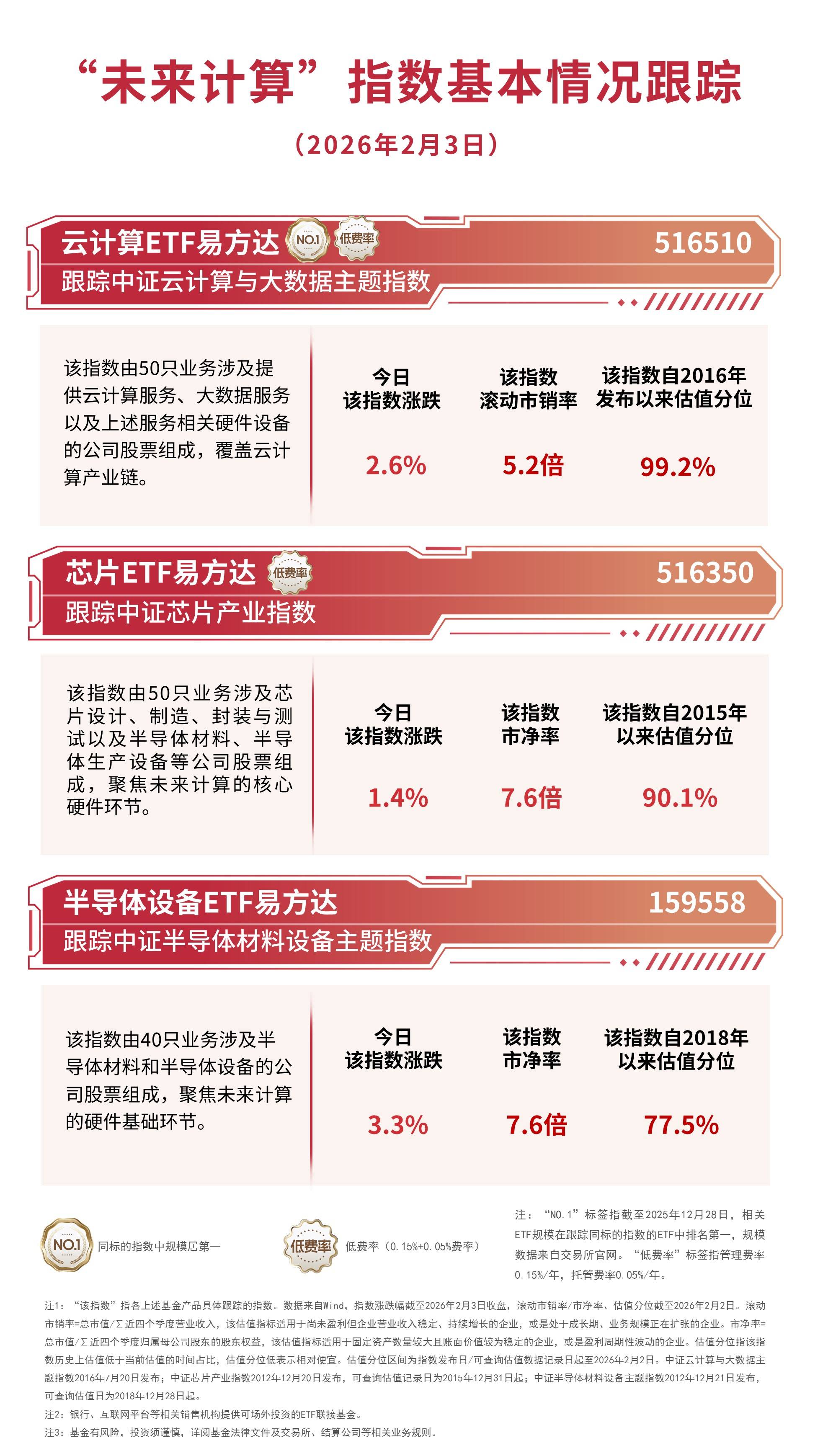
半导体设备板块高开高走,指数涨超3%,关注半导体设备ETF易方达(159558)等产品投资机会
Sou Hu Cai Jing· 2026-02-03 11:22
Group 1 - The core index of semiconductor materials and equipment rose by 3.3%, while the cloud computing and big data index increased by 2.6%, and the chip industry index grew by 1.4% [1] - The semiconductor equipment ETF managed by E Fund attracted approximately 3 billion yuan in the last month, indicating strong investor interest [1] - China Galaxy Securities noted that the semiconductor equipment sector is performing positively this month, driven by sustained AI computing demand, an upward cycle in storage chips, and the penetration of advanced packaging technology [1] Group 2 - The semiconductor equipment market is expected to continue growing, with a strong outlook for 2026 [1] - TSMC anticipates capital expenditures of $52 billion to $56 billion in 2026, a significant increase from $40.9 billion in 2025, highlighting further market opportunities in semiconductor equipment [1]
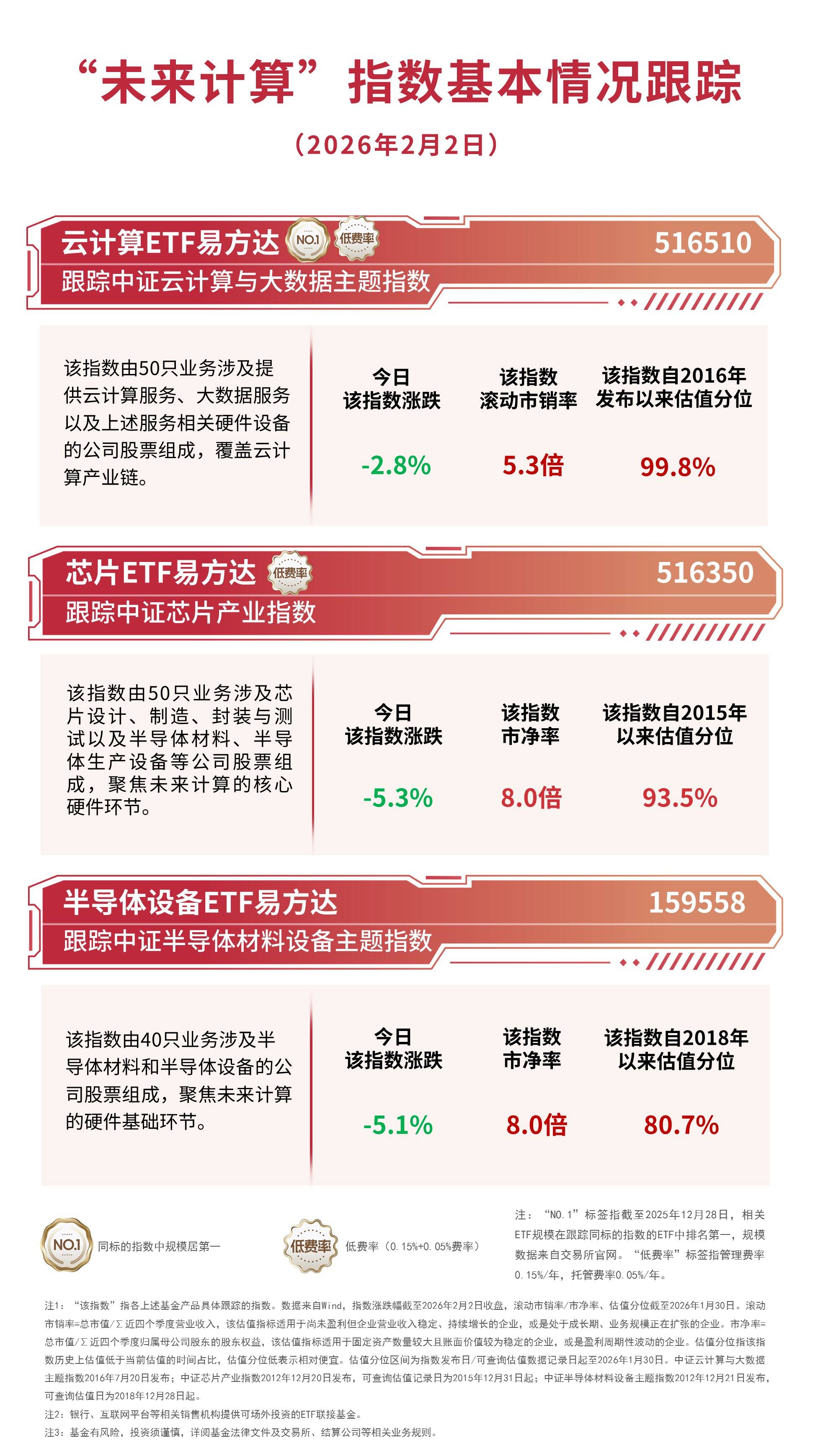
半导体设备板块低开低走,半导体设备ETF易方达(159558)逆势获2000万份净申购
Sou Hu Cai Jing· 2026-02-02 11:32
Group 1 - The core index for cloud computing and big data fell by 2.8%, while the semiconductor industry index dropped by 5.3%, and the semiconductor materials and equipment index decreased by 5.1%. Despite this, there was a significant net subscription of 20 million units for the semiconductor equipment ETF E Fund (159558) throughout the day [1] - In January, the semiconductor equipment ETF E Fund (159558) received nearly 3 billion yuan in net inflows [1] - China Galaxy Securities indicated that the semiconductor equipment sector performed positively this month, driven by sustained AI computing power demand, an upward cycle in storage chips, and the penetration of advanced packaging technology, which collectively boosted semiconductor equipment demand [1] Group 2 - The semiconductor equipment market is expected to continue growing strongly, with a projected market size increase by 2026 [1] - TSMC anticipates capital expenditures of $52 billion to $56 billion in 2026, a significant increase from $40.9 billion in 2025, highlighting further market opportunities in semiconductor equipment [1] - The index tracking semiconductor materials and equipment consists of 40 companies involved in semiconductor materials and equipment, focusing on the hardware foundation for future computing [5]
半导体设备板块本周回调,指数跌逾5%,关注半导体设备ETF易方达(159558)等产品投资机会
Sou Hu Cai Jing· 2026-01-30 10:57
Group 1: Market Performance - The CSI Cloud Computing and Big Data Theme Index decreased by 1.3% this week, the CSI Chip Industry Index fell by 2.1%, and the CSI Semiconductor Materials and Equipment Theme Index dropped by 5.2% [1][3] - The semiconductor equipment ETF managed by E Fund (159558) attracted over 200 million yuan this week [1] Group 2: Industry Insights - China Galaxy Securities reported that the semiconductor equipment sector has shown positive performance this month, driven by sustained AI computing power demand, an upward cycle in storage chips, and the penetration of advanced packaging technologies [1] - The semiconductor equipment market is expected to continue growing, with TSMC projecting capital expenditures of $52 billion to $56 billion in 2026, a significant increase from $40.9 billion in 2025, highlighting further market opportunities in semiconductor equipment [1] Group 3: Index Valuation - The rolling price-to-sales ratio for the CSI Cloud Computing and Big Data Theme Index is 5.3, while the price-to-book ratios for the CSI Chip Industry Index and the CSI Semiconductor Materials and Equipment Theme Index are 7.9 and 8.0, respectively [3] - The valuation percentiles for these indices are 99.6% for the CSI Cloud Computing and Big Data Theme Index, 92.9% for the CSI Chip Industry Index, and 80.7% for the CSI Semiconductor Materials and Equipment Theme Index [3] Group 4: Historical Performance - Over the past month, the CSI Cloud Computing and Big Data Theme Index has increased by 12.4%, the CSI Chip Industry Index by 16.1%, and the CSI Semiconductor Materials and Equipment Theme Index by 19.9% [8] - Year-to-date, the CSI Cloud Computing and Big Data Theme Index has risen by 12.4%, the CSI Chip Industry Index by 16.1%, and the CSI Semiconductor Materials and Equipment Theme Index by 19.9% [8] - The one-year cumulative growth rates are 73.2% for the CSI Cloud Computing and Big Data Theme Index, 70.6% for the CSI Chip Industry Index, and 88.7% for the CSI Semiconductor Materials and Equipment Theme Index [8]

第一创业晨会纪要-20260130
First Capital Securities· 2026-01-30 03:56
Group 1: Company Performance - Shengyi Technology (生益科技) expects a net profit attributable to shareholders of 3.25 to 3.45 billion yuan for 2025, representing a year-on-year increase of 87% to 98%. Shengyi Electronics (生益电子) anticipates a net profit of approximately 1.44 to 1.51 billion yuan, a year-on-year increase of 331.03% to 355.88% [4] - Wei Ce Technology (伟测科技) forecasts a net profit of around 300 million yuan for 2025, reflecting a year-on-year increase of approximately 133.96%. The growth is driven by the penetration of AI and automotive electronics, as well as the recovery in consumer electronics [4] - Jindan Technology (金丹科技) projects a net profit of 96 to 138 million yuan for 2025, indicating a significant year-on-year growth of 156% to 268%. The growth is attributed to the successful launch of a 50,000-ton lactic acid expansion project and a decrease in procurement costs [10] - Hengfeng Paper (恒丰纸业) anticipates a net profit of 178 to 215 million yuan for 2025, a year-on-year increase of 54% to 86%. The growth is primarily due to the successful launch of a new production line and breakthroughs in overseas markets [11] - Jieya Co. (洁雅股份) expects a net profit of 72 to 88 million yuan for 2025, representing a year-on-year increase of 270% to 352%. The growth is driven by increased orders from major international clients and an improved business structure [12] Group 2: Industry Trends - The European Automobile Manufacturers Association reported that pure electric vehicle sales in the EU surged by 51% year-on-year to 217,898 units in December 2025, surpassing gasoline vehicles for the first time. The market share reached 22.6% [7] - In December, China's newly installed photovoltaic capacity was 40 GW, a year-on-year decrease of 43% but an increase of 84% month-on-month. The cumulative installed capacity for the year reached 315 GW, a year-on-year increase of 14% [8] - The snack food sector, represented by Wancheng Group (万辰集团), is expected to see a net profit of 1.23 to 1.4 billion yuan for 2025, driven by the continuous growth of the bulk snack business and an increase in store numbers to approximately 19,000 [14]




伟测科技:预计2025年年度净利润为3亿元左右,同比增加133.96%左右
Mei Ri Jing Ji Xin Wen· 2026-01-29 08:46
每经头条(nbdtoutiao)——水贝黄金平台"杰我睿"兑付危机调查:40倍杠杆对赌,金价越涨平台越 亏!老板自称"还在深圳",投资者:兑付方案本金打两折,无法接受 (记者 王瀚黎) 每经AI快讯,伟测科技1月29日晚间发布业绩预告,预计2025年年度实现归属于母公司所有者的净利润 为3亿元左右,与上年同期相比,将增加约1.72亿元左右,同比增加133.96%左右。业绩变动主要原因 是,基于AI及汽车电子相关产品不断渗透、消费电子回暖、国产替代加速、先进封装技术升级推动半 导体测试需求增加。本期公司持续加码高端产品产能、产品结构优化、加大研发投入、导入新客户、推 进新项目落地、主营业务收入同比增长,归属于母公司所有者的净利润和归属于母公司所有者的扣除非 经常性损益的净利润等财务指标较上年同期增长。 ...