国债利差

Search documents
分析师:2026年10年期国债收益率区间或在1.7%到2.1%之间
Xin Lang Cai Jing· 2026-01-14 00:02
Core Viewpoint - The yield on 10-year government bonds is expected to range between 1.7% and 2.1% by 2026, with the spread between 30-year and 10-year government bonds likely returning to around 50 basis points, reflecting a comprehensive consideration of macroeconomic and policy environments, as well as changes in institutional allocation behavior [1] Group 1 - The market's primary focus since December of last year has been on the supply and demand issues related to ultra-long-term bonds [1] - The capacity of insurance funds and large banks to absorb ultra-long-term bonds has significantly lagged behind the pace of supply expansion, leading to a pronounced steepening of the yield curve during the process of rising yields [1]
美国10月贸易逆差缩窄至2009年中以来最低——海外周报第122期
一瑜中的· 2026-01-11 14:07
Key Points - The article discusses recent economic data from the US, Japan, and the Eurozone, highlighting mixed signals in employment, inflation, and consumer confidence [2][5][15] - It emphasizes the importance of monitoring economic indicators such as the ADP employment numbers, JOLTs job openings, and ISM manufacturing and services PMIs to gauge economic health [5][15] - The article notes that while US consumer confidence has reached a four-month high, employment figures have shown signs of weakness, indicating potential economic challenges ahead [5][15] Group 1: Important Data Review - US December ADP employment numbers were below expectations, with a growth of 41,000 jobs compared to an expected 50,000 [15] - The US trade deficit narrowed to $29.4 billion in October, significantly lower than the expected $58.5 billion [15] - The ISM services PMI rose to 54.4 in December, exceeding expectations, while the manufacturing PMI fell to 47.9, indicating continued contraction [15] Group 2: Economic Activity Index - The US WEI index fell to 2.13% for the week ending January 3, down from 2.49% the previous week, indicating a decline in economic activity [19] - The German WAI index increased to 0.07% for the week ending January 4, up from 0.05% the previous week, suggesting a slight improvement in economic conditions [19] Group 3: Demand - The US Redbook retail sales year-on-year growth rate decreased to 7.1% for the week ending January 3, down from 7.6% the previous week [23] - The US mortgage rates increased slightly to 6.16% for a 30-year fixed mortgage, while mortgage applications rose, with the MBA market composite index reaching 270.8, a 0.3% increase from the previous week [26][27] Group 4: Employment - The ADP weekly employment numbers showed a decline, with a four-week cumulative increase of 46,000 jobs, down from 70,000 the previous week [32] - Initial jobless claims rose to 208,000 for the week ending January 3, up from 200,000 the previous week [33] - The INDEED job vacancy index increased to a weekly average of 104.8, indicating a rise in job openings [36] Group 5: Prices - The RJ/CRB commodity price index rose to 301.47, reflecting a 1.2% increase from the previous week [42] - US gasoline retail prices fell to $2.68 per gallon, a decrease of 0.3% from the previous week [42] Group 6: Financial Conditions - Financial conditions in the US and Eurozone remain loose, with the Bloomberg financial conditions index for the US rising to 0.863 from 0.795 the previous week [47] - Offshore dollar liquidity showed improvement for the yen against the dollar, while the euro against the dollar deteriorated [49] - The 10-year US-EU government bond yield spread widened to 126.8 basis points, up from 121.5 basis points the previous week [52]


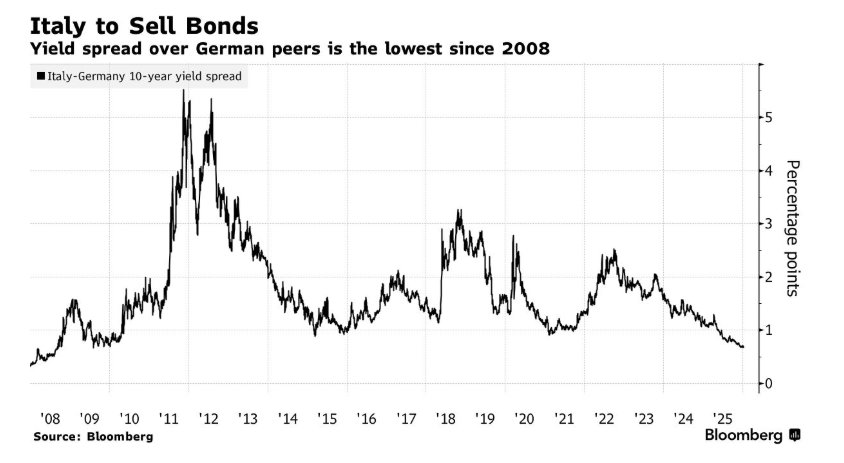
意大利竟成欧债“避震器”! 资金抢购意大利国债 10年期利差创2008年以来最低
Zhi Tong Cai Jing· 2026-01-08 11:37
Core Viewpoint - The Italian government is initiating its 2026 financing plan through a dual-tranche euro bond issuance, capitalizing on strong investor demand for its sovereign debt amid political uncertainties in other major European economies [1][3]. Group 1: Market Dynamics - Italy's political situation and economic growth trends appear more favorable compared to France's "hung parliament" and Germany's fragile coalition, attracting both European and global funds to the Italian bond market [1]. - The Italian government is becoming a preferred borrower in the European sovereign debt market, as political instability and concerns over large fiscal deficits in countries like France put pressure on their bond markets [3][6]. - The demand for the dual-tranche issuance has reportedly exceeded €190 billion, indicating strong market interest [3][6]. Group 2: Financial Metrics - The yield spread between Italian 10-year BTPs and German bonds has narrowed to approximately 66 basis points, the lowest since 2008, reflecting improved investor sentiment towards Italian sovereign risk [5][6]. - Italy's 2026 budget aims to reduce the deficit to 2.8% of GDP, enhancing market confidence in its fiscal consolidation commitments [6]. - The pricing for the new bonds is expected to be 7 to 8 basis points higher than comparable European sovereign bonds, indicating a competitive yet cautious market environment [3][6]. Group 3: Broader Market Context - The start of the year has seen a record issuance scale in the bond market, with various borrowers taking advantage of strong demand for fixed-income assets [4]. - Italy's previous bond issuance attracted a record €142 billion in demand, showcasing its growing appeal among investors [4]. - The competitive landscape includes other European nations like Portugal, France, and Spain, which are also issuing new sovereign bonds, highlighting the ongoing demand for government debt [4].
欧洲债市:欧洲债券上涨 意大利国债领涨
Xin Lang Cai Jing· 2025-12-29 16:58
Core Viewpoint - European bond markets have risen following the public holiday, with Italian bonds leading the gains [1][4]. Market Summary - The yield on German 10-year bonds has fallen by 4 basis points to 2.83%, reaching the lowest level since December 8 [2][5][6]. - German bond futures increased by 38 points to 127.84 [3][6]. - The yield on Italian 10-year bonds decreased by 5 basis points to 3.50% [3][6]. - The spread between Italian and German bonds narrowed by 2 basis points to 67 basis points [3][6]. - The yield on French 10-year bonds dropped by 4 basis points to 3.52% [3][6]. - The yield on 10-year UK bonds fell by 2 basis points to 4.49% [3][6].
固收-年度展望专题汇报
2025-12-29 15:50
Summary of Conference Call Notes Industry Overview - The focus is on the bond market, particularly the 30-year government bonds and their investment value in the current economic climate [1][5][8]. Key Points and Arguments - **Market Adjustment Influences**: Recent adjustments in the bond market are primarily driven by trading sentiment and institutional behaviors rather than fundamental or liquidity pressures. Public funds are prioritizing risk aversion, while banks are focusing on asset allocation [2][8]. - **30-Year Government Bonds**: The current 30-year government bonds are considered to have significant investment value, with both absolute and spread positions being relatively favorable. The after-tax yield of these bonds is comparable to that of mortgage loans, indicating a strong allocation value [1][5]. - **Interest Rate Spread**: The spread between 30-year and 10-year government bonds has risen from historical lows to approximately 40 basis points. However, due to the lack of improvement in household leverage and the real estate cycle, the potential for further steepening of this spread is limited [6]. - **Supply and Demand Dynamics**: The supply of ultra-long-term government bonds is expected to continue increasing, but the growth will not significantly exceed levels from the past two years. Despite uncertainties on the demand side, institutions are still capable of absorbing substantial supply, indicating manageable overall pressure [7]. - **2026 Monetary Policy Outlook**: The fiscal policy is anticipated to remain proactive, with extraordinary increments on the supply side. However, demand-side uncertainties persist, and while total easing may continue, the space for interest rate cuts is expected to be limited to around 20 basis points [3][9][10]. - **Liquidity Operations**: For 2026, the space for reserve requirement ratio cuts is deemed small, as most banks are nearing the invisible lower limit of 5%. The focus will be on managing high levels of medium-term lending facility (MLF) and reverse repos, requiring substantial annual liquidity injections to maintain stability [11][12]. - **First Quarter Liquidity Expectations**: In the first quarter of 2026, banks are expected to rely heavily on the central bank's MLF and reverse repos for liquidity, especially given the low issuance of interbank certificates of deposit in the previous quarter [12]. Additional Important Insights - **Long-Term Investment Sentiment**: The overall sentiment towards the bond market remains optimistic, with expectations of increased participation from banks and insurance companies in 30-year government bonds due to their recognized allocation value [8]. - **Economic Support**: The anticipated continuation of a moderately loose monetary policy is expected to support economic growth and stabilize financial markets, creating a favorable environment for government borrowing and household deleveraging [13].
美国多维度就业高频指标低位趋稳——海外周报第120期
一瑜中的· 2025-12-28 13:45
Core Viewpoint - The article highlights that the U.S. employment indicators are stabilizing at low levels, with various metrics showing signs of steadiness in the labor market [2]. Group 1: Recent Economic Data and Events - Multiple economic data points from the U.S. exceeded expectations, including Q3 GDP growth rate, personal consumption, industrial output growth for November, and the Richmond Fed manufacturing index for December. However, consumer confidence and durable goods orders growth fell short of expectations [4][18]. - In the Eurozone, Spain's November PPI decreased compared to the previous value, while Italy's November PPI increased [5][18]. - Japan's inflation and industrial output were below expectations [5][18]. Group 2: Upcoming Economic Data and Events - Key upcoming economic indicators to watch include the Eurozone manufacturing PMI for December, scheduled for release on January 2, and the S&P Global U.S. manufacturing PMI for December, also set for January 2 [6][20]. Group 3: Weekly Economic Activity Index - The U.S. economic activity index showed a slight rebound, with the WEI index at 2.32% for the week ending December 20, compared to 2.31% the previous week [7][22]. - Germany's economic activity index also trended upward, reaching 0.14% for the week ending December 21 [7][22]. Group 4: Demand - U.S. retail sales growth, as measured by the Redbook index, increased year-on-year to 7.2% for the week ending December 19, up from 6.2% the previous week [8][28]. - Mortgage rates in the U.S. remained stable, with a slight decline in mortgage applications [9][30]. Group 5: Employment - The ADP weekly employment figures showed stabilization at low levels, with approximately 46,000 new jobs added in the four weeks ending December 9, down from 70,000 the previous week [9][35]. - Initial jobless claims fell to 214,000 for the week ending December 20, better than expected, while continuing claims rose to 1.923 million, exceeding expectations [10][38]. - The number of job vacancies remained stable, with the Indeed job vacancy index at 104.66 as of December 12, a slight decrease of 0.2% from the previous week [11][41]. Group 6: Prices - Commodity prices rebounded, with the RJ/CRB commodity price index increasing by 1.8% week-on-week as of December 26, following a decline of 1.1% the previous week [12][46]. - U.S. gasoline prices continued to decline, averaging $2.72 per gallon for the week ending December 22, down 1.9% from the previous week [12][46]. Group 7: Financial Conditions - Financial conditions in the Eurozone improved, while U.S. financial conditions remained stable at high levels [13][49]. - Offshore dollar liquidity showed slight easing, with the three-month swap basis for the yen against the dollar at -24.1 pips, improving from -25.8 pips the previous week [13][51]. - The spread-to-worst for high-yield dollar corporate bonds remained stable at 265.3 basis points as of December 26 [13][54]. - U.S. and Japanese long-term government bond spreads remained stable, with the 10-year U.S.-Japan bond spread at 214.1 basis points [13][57]. Group 8: Fiscal - As of December 24, cumulative federal spending in the U.S. for the year was approximately $7.66 trillion, reflecting a year-on-year growth of 5.9% [15][62].

欧洲债市:PMI数据拖累英国国债走低 市场关注周三的通胀数据
Xin Lang Cai Jing· 2025-12-16 17:01
Group 1 - UK government bonds underperformed compared to US and European counterparts, following a brighter economic outlook indicated by December PMI data [1][4] - UK bond prices narrowed their intraday losses but ultimately closed lower, with the yield curve rising by 1-2 basis points; traders are now focused on the upcoming UK inflation data [1][4] - German government bond yields fell by 1 basis point, following the trend of US bonds, after the US unemployment rate reached its highest level in four years [2][4] Group 2 - Current market data shows German government bond yields stable at 2.85% [3][5] - German government bond futures dropped by 3 points to 127.55% [3][5] - Italian 10-year government bond yields increased by 2 basis points to 3.55%, with the Italy-Germany bond spread widening by 2 basis points to 70 basis points [3][5] - French 10-year government bond yields decreased by 2 basis points to 3.55% [3][5] - The 10-year UK government bond yield rose by 2 basis points to 4.52% [3][5]
意大利与德国10年期国债利差降至70个基点,为2010年以来首次
Mei Ri Jing Ji Xin Wen· 2025-12-03 11:27
Core Viewpoint - The spread between Italian and German 10-year government bonds has decreased to 70 basis points, marking the lowest level since 2010 [1] Group 1 - The decline in the bond spread indicates a potential improvement in investor confidence towards Italian government debt compared to German debt [1] - This development may reflect broader economic trends and market perceptions regarding the stability of Italy's financial situation [1]
美国初请失业金人数好于预期——海外周报第116期
一瑜中的· 2025-12-01 12:04
Group 1: Key Economic Data Review - In the US, September durable goods orders were revised up to 3% from 2.9%, with a preliminary month-on-month value of 0.5% [12] - September retail sales increased by 0.2%, below the expected 0.4%, and the previous value was 0.6% [12] - The Consumer Confidence Index for November was reported at 88.7, significantly lower than the expected 93.3 [12] - The Producer Price Index (PPI) for September showed a month-on-month increase of 0.3%, matching expectations, while the year-on-year figure was revised up to 2.7% [12] Group 2: Upcoming Economic Data - Key upcoming US economic data includes the November ISM Manufacturing PMI on December 1, and the November ISM Services PMI on December 3 [14] - In the Eurozone, the October unemployment rate and November CPI preliminary value are set to be released on December 2 [14] Group 3: Weekly Economic Index - The US Weekly Economic Index (WEI) decreased to 2.1% from 2.33% in the previous week, indicating a slight economic slowdown [17] - Conversely, Germany's Weekly Activity Index (WAI) increased to 0.23%, showing continued economic recovery [17] Group 4: Demand Insights - The US Redbook retail sales year-on-year growth slightly declined to 5.9% from 6.1% in the previous week [20] - Global flight numbers showed a year-on-year growth of 3.3%, down from 8.5% the previous week [22] - The US mortgage rate for a 30-year fixed loan decreased to 6.23% from 6.26% [25] Group 5: Employment Data - Initial jobless claims in the US were reported at 216,000, better than the expected 225,000 [28] - Continuing claims rose to 1.96 million, up from a previous value of 1.953 million [29] Group 6: Price Trends - Global commodity prices increased, with the RJ/CRB commodity price index rising by 1.3% [30] - US gasoline retail prices slightly decreased to $2.94 per gallon, down 0.1% from the previous week [30] Group 7: Financial Conditions - Financial conditions in the US and Eurozone showed marginal easing, with the Bloomberg financial conditions index for the US rising to 0.629 [32] - Offshore dollar liquidity improved slightly, with swap points for USD/JPY and USD/EUR increasing [34] - Long-term bond spreads narrowed, with the 10-year bond spread between Italy and Germany decreasing to 71.4 basis points [36]

欧美金融条件边际趋紧——海外周报112期
一瑜中的· 2025-11-17 15:35
Core Viewpoint - The article discusses the current economic conditions in the US and Europe, highlighting mixed signals in various economic indicators, with a tightening financial environment and stable consumer demand [2][4]. Economic Activity - The US WEI index shows a decrease, with the latest value at 2, down from 2.27 the previous week [5][15]. - The German WAI index has increased to approximately 0.18, up from 0.08 the previous week [5][15]. Consumer Demand - The US Redbook commercial retail sales year-on-year growth has slightly rebounded to 5.9%, with a four-week moving average of 5.45% [19]. - Mortgage rates in the US remain stable, with the 30-year mortgage rate at 6.24% [21]. Prices - The RJ/CRB commodity price index is at 302.35, reflecting a 0.5% increase from the previous week [25]. - US gasoline prices have rebounded slightly to $2.93 per gallon, up 1% from the previous week [25]. Financial Conditions - Financial conditions in the US and Europe are tightening, with the Bloomberg financial conditions index for the US at 0.511, down from 0.514 the previous week [30]. - Offshore dollar liquidity is tightening, with the three-month swap basis for the yen against the dollar at -25.8 basis points [33]. - Credit spreads for US investment-grade and high-yield corporate bonds have widened, with high-yield spreads at 2.91 basis points [36]. Interest Rate Spreads - The 10-year US-Japan and US-Europe bond spreads have narrowed, with the US-Japan spread at 240.5 basis points [38]. - The Italian-German bond spread has also narrowed to 75.5 basis points [38].