
基金费率新规

Search documents
进阶之选,公司债ETF(511030)为您的收益注入新维度
Sou Hu Cai Jing· 2025-11-10 05:42
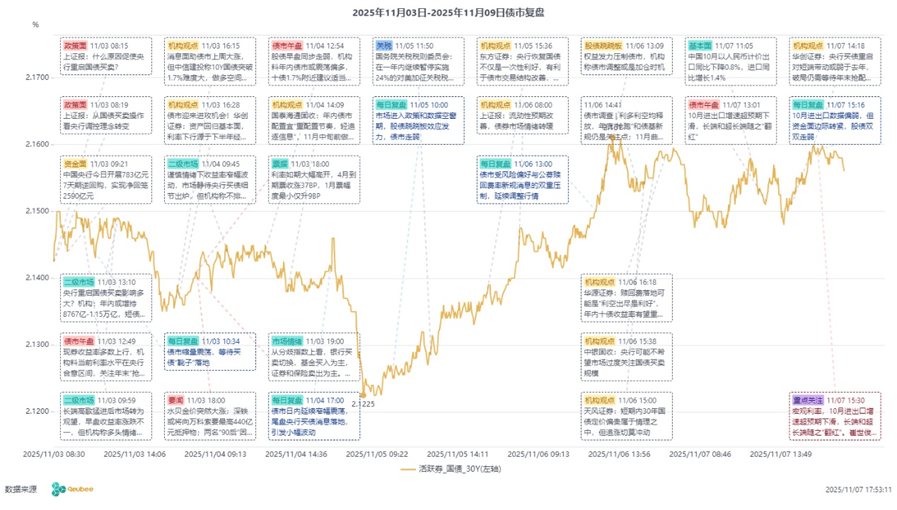
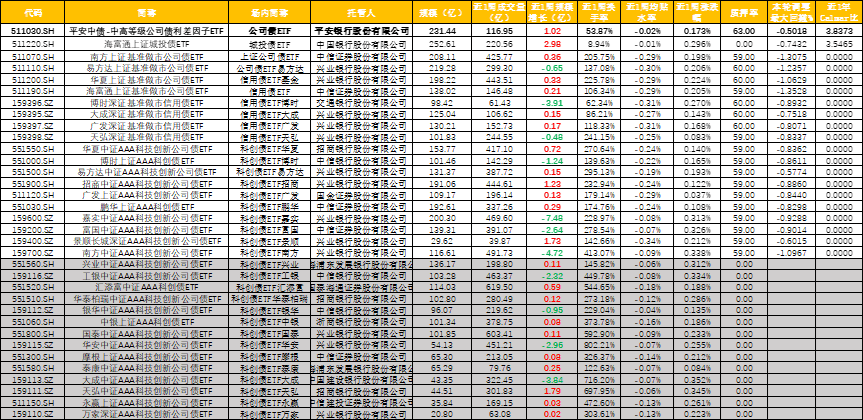
Group 1 - As of November 7, the total scale of credit bond ETFs reached 493.8 billion yuan, with a daily increase of 2.87 billion yuan, while the benchmark market-making ETF decreased by 0.23 billion yuan and the Sci-Tech Innovation Bond ETF increased by 0.63 billion yuan; the weighted average duration median is 3.3 years [1] - The overall trading volume was 169.4 billion yuan, with an average single transaction amount of 5.98 million yuan (benchmark market-making 5.73 million yuan, Sci-Tech Innovation Bond 6.30 million yuan); the median turnover rate was 33.7% [1] - The median yield was 1.84%, and the median discount rate was -19.6 basis points (benchmark market-making -31.3 basis points, Sci-Tech Innovation Bond -16.7 basis points) [1] Group 2 - Last week, the bond market experienced a three-day rally driven by the central bank's bond purchases, but adjustments began due to rumors of redemption new regulations, leading to significant net redemptions in several bond ETFs, although the overall scale still showed slight growth [2] - The top-ranked funds by scale include Hai Fu Tong Short-term Bond ETF (69.073 billion yuan, 1st), Bosera Convertible Bond ETF (57.732 billion yuan, 2nd), and others, with notable inflow into Ping An Corporate Bond ETF (511030) of 470 million yuan, attributed to its short duration (1.95 years) and static high yield (current 1.90%) [2] - The Ping An Corporate Bond ETF (511030) ranked first in drawdown control since the bond market adjustment began this year, with a relatively stable net value and controllable drawdown, averaging a premium of 2 basis points over the past week [3] Group 3 - The bond market's trading last week was primarily influenced by the central bank's treasury transactions, upcoming fund fee regulation rumors, and market risk appetite, with future pricing likely shifting to fundamental changes and the final implementation of bond fund redemption regulations [3] - The market did not continue the bullish trend from the end of last month, maintaining a bearish oscillation, with long-end bonds strengthening towards the end of the week; the overall market showed fluctuations with collective yield increases [3] Group 4 - Institutions believe that domestic demand is weak and supply is excessive, indicating no inflation issues in the coming years; the impact of pandemic-related spending in Europe and the U.S. may have peaked, making sustained export growth challenging [5] - The formal implementation of punitive redemption fees is anticipated to be a negative factor, but the market remains optimistic about the bond market, expecting a second wave of momentum in Q4 [5] - The opening of bond funds under the amortized cost method is expected to lead to a transition from government bonds to credit bonds, benefiting long-duration industrial bonds and urban investment bonds in the next six months [5]

湖北三资三化背景及影响:信用周报20251110-20251110
Huachuang Securities· 2025-11-10 03:44
Group 1: Report Industry Investment Rating - Not provided in the content Group 2: Core Viewpoints of the Report - The "Three Resources and Three Transformations" reform in Hubei has short - term revenue - increasing effects and long - term transformation pressures on local finance, and also poses challenges to local government work and impacts on financial institutions [2][10][12] - In the credit bond market, the yields are differentiated, and different investment strategies are proposed for different maturities and types of bonds [5][13][17] - There are several key policies and hot events in the week, including the cooperation between Vanke and Shenzhen Metro Group, and the establishment of the Debt Management Department by the Ministry of Finance [25][26][29] Group 3: Summary According to the Table of Contents 1. Hubei's "Three Resources and Three Transformations" Background and Impact - **Background**: Since 2021, due to various factors, local governments need to improve the efficiency of state - owned assets. Central documents have been issued to promote asset revitalization, and the "Three Resources and Three Transformations" concept was first proposed in Hunan and then introduced in Hubei [8][9] - **Government Measures**: The scope of asset revitalization includes state - owned resources, assets, and funds. The measures are resource integration, asset revitalization, and capital leveraging [9] - **Market Impact**: For local finance, there are short - term benefits and long - term challenges; local governments face problems in asset confirmation and market - based mechanisms; financial institutions need to support innovation and make prudent investment decisions [2][10][12] 2. Credit Strategy: Allocate Funds to Focus on Long - Term Credit Opportunities, and Trading Funds to Wait for the Opportunity to Play the Secondary Perpetual Bond Market - **Credit Bond Market Review**: This week, credit bond yields were differentiated, with 4 - 5y varieties performing well, and most credit spreads narrowing [13][14][33] - **Outlook**: Credit bonds should focus on the new fund fee regulations and the institutional year - end allocation market in mid - to late November [14][15][17] 3. Key Policies and Hot Events - Vanke signed a borrowing and guarantee framework agreement with Shenzhen Metro Group, with a borrowing limit of up to 22 billion yuan [25][26][31] - The Minister of Finance emphasized fiscal scientific management and local government debt risks [25][27][32] - The "Counter Bond Flagship Store" model was launched, and the Ministry of Finance established a Debt Management Department [25][28][29] - Zhengzhou supported the market - based financing of old community renovation platform companies, and Chongqing adjusted some administrative divisions [25][29][30] 4. Secondary Market - Credit bond yields were differentiated, and most credit spreads narrowed, with 4 - 5y varieties performing relatively better [33][34][35] 5. Primary Market - The net financing of credit bonds and urban investment bonds increased compared to the previous period [not explicitly described in the summary part, but mentioned in the table of contents] 6. Trading Liquidity - The trading activity of credit bonds in the inter - bank market and the exchange market decreased this week [not explicitly described in the summary part, but mentioned in the table of contents] 7. Rating Adjustment - One entity's rating was downgraded this week, and there was no entity with a rating upgrade [not explicitly described in the summary part, but mentioned in the table of contents]

市场多空交织,短期债市震荡
Dong Zheng Qi Huo· 2025-11-09 06:44
1. Report Industry Investment Rating - The investment rating for Treasury bonds is "oscillation" [4] 2. Core View of the Report - The main contradiction in the bond market is between weak fundamentals and strong risk appetite. Fundamentals are favorable for the bond market, but economic data can no longer drive the bond market to strengthen. The stock market has an obvious impact on the bond market, but it is difficult to predict overseas factors and short - term stock market trends. Overall, the bond market is expected to oscillate. The news of the new fund fee regulations may disrupt the market, but it is unlikely to become the main trading theme [2][14][15] 3. Summary by Relevant Catalogs 3.1 One - week Review and Views 3.1.1 This Week's Trend Review - From November 3rd to 9th, Treasury bond futures changed from rising to falling. On Monday, the stock market recovered, and Treasury bond futures were weakly oscillating. On Tuesday, the stock market fell, and the bond market was waiting for the central bank's bond - buying news. On Wednesday, Treasury bond futures opened higher due to the central bank's bond - buying news and lower overseas risk appetite but weakened as the domestic equity market rose. On Thursday, with a calm news background, the stock index was strong, and Treasury bond futures fell. On Friday, the morning session was strong, but the bond market weakened in the afternoon due to concerns about the new fund fee regulations. As of November 7th, the settlement prices of the two - year, five - year, ten - year, and thirty - year Treasury bond futures contracts were 102.472, 105.920, 108.475, and 116.030 yuan respectively, down 0.072, 0.145, 0.190, and 0.610 yuan from the previous weekend [1][11] 3.1.2 Next Week's View - Next week, the bond market will still face the contradiction between weak fundamentals and strong risk appetite. Fundamentals are expected to be weak as the economic indicators in October may be poor due to limited growth - stabilizing policies in September - October and the intensifying Sino - US trade war. The impact of the equity market on the bond market is significant, but it is difficult to predict short - term stock market trends because of the domestic policy window period and the complexity of overseas factors. The news of the new fund fee regulations may disrupt the market, but it is unlikely to be the main trading theme. Overall, the bond market is expected to oscillate [14][15] 3.2 Weekly Observation of Interest - rate Bonds 3.2.1 Primary Market - This week, 57 interest - rate bonds were issued, with a total issuance of 5139.97 billion yuan and a net financing of 2883.44 billion yuan. 32 local government bonds were issued, with a total issuance of 916.07 billion yuan and a net financing of - 359.56 billion yuan. 430 inter - bank certificates of deposit were issued, with a total issuance of 5278.60 billion yuan and a net financing of 1509.90 billion yuan [20] 3.2.2 Secondary Market - Treasury bond yields rose. As of November 7th, the yields of 2 - year, 5 - year, 10 - year, and 30 - year Treasury bonds were 1.43%, 1.59%, 1.81%, and 2.16% respectively, up 3.04, 2.38, 1.91, and 1.35 basis points from the previous weekend. The 10Y - 1Y spread widened by 0.05bp to 41.35bp, while the 10Y - 5Y and 30Y - 10Y spreads narrowed by 0.47bp and 0.56bp respectively [25] 3.3 Treasury Bond Futures 3.3.1 Price, Trading Volume, and Open Interest - Treasury bond futures changed from rising to falling. As of November 7th, the settlement prices of the two - year, five - year, ten - year, and thirty - year Treasury bond futures contracts were 102.472, 105.920, 108.475, and 116.030 yuan respectively, down 0.072, 0.145, 0.190, and 0.610 yuan from the previous weekend. The trading volumes of 2 - year, 5 - year, 10 - year, and 30 - year Treasury bond futures this week were 26156, 53541, 72555, and 114770 lots respectively, down 15303, 18919, 11637, and 20960 lots from last week. The open interests were 83061, 177685, 289869, and 180046 lots respectively, with changes of + 2363, + 7744, + 12390, and - 3495 lots from last week [34][39] 3.3.2 Basis and IRR - In the first half of the week, the market sentiment was strong, and the IRR of Treasury bond futures was relatively high. In the second half, the market adjusted. For stable returns, investors can choose contracts with high IRR for positive arbitrage strategies [42] 3.3.3 Inter - delivery and Inter - variety Spreads - As of November 7th, the inter - delivery spreads of 2 - year, 5 - year, 10 - year, and 30 - year Treasury bond futures contracts (2512 - 2603) were + 0.044, + 0.040, + 0.250, and + 0.240 yuan respectively, down 0.002, 0.035, 0.010, and 0.050 yuan from the previous weekend. Next week, the bond market is expected to oscillate, and the short - sellers' motivation to roll over positions will increase, but it is not enough to significantly widen the inter - delivery spreads [46] 3.4 Weekly Observation of the Funding Situation - The central bank's open - market reverse repurchase operations resulted in a net withdrawal of 15722 billion yuan this week. As of November 7th, R007, DR007, SHIBOR overnight, and SHIBOR 1 - week were 1.47%, 1.41%, 1.33%, and 1.42% respectively, with changes of - 2.46, - 4.21, + 0.60, and - 1.70 basis points from the previous weekend. The average daily trading volume of inter - bank pledged repurchase was 7.97 trillion yuan, 1.27 trillion yuan more than last week, and the overnight proportion was 89.59%, higher than last week [50][53][55] 3.5 Weekly Overseas Observation - The US dollar index weakened slightly, and the 10Y US Treasury yield oscillated narrowly. As of November 7th, the US dollar index fell 0.18% to 99.5477 from the previous weekend, the 10Y US Treasury yield was 4.11%, the same as last week, and the yield spread between Chinese and US 10Y Treasury bonds was inverted by 229.7 basis points. The US government is still shut down, and the Fed officials are cautious about inflation due to low data visibility [59] 3.6 Weekly Observation of High - frequency Inflation Data - Industrial product prices fell across the board, and agricultural product prices generally rose. As of November 7th, the South China Industrial Product Index, Metal Index, and Energy and Chemical Index were 3531.08, 6399.37, and 1584.31 points respectively, down 25.59, 86.53, and 6.51 points from the previous weekend. The prices of pork, 28 key vegetables, and 7 key fruits were 18.23, 5.78, and 7.04 yuan/kg respectively, up 0.43, 0.09, and 0.00 yuan/kg from the previous weekend [62] 3.7 Investment Suggestions - For the short - term oscillating bond market, it is recommended to observe more and trade less. For the cash - and - carry strategy, pay attention to positive arbitrage and widening the basis due to the relatively high IRR of some contracts. For the yield curve strategy, if worried about the stock market's strength, stay on the sidelines. For the inter - delivery strategy, although the short - sellers' motivation to roll over positions will increase, the inter - delivery spreads are unlikely to widen significantly [2][17][18][19]
央行买债,什么速度可参考?:——债券周报20251109-20251109
Huachuang Securities· 2025-11-09 06:12
1. Report Industry Investment Rating No relevant content provided. 2. Core Viewpoints of the Report - The scale of the central bank's bond purchases in October was significantly lower than market expectations. The subsequent bond - buying rhythm should be objectively evaluated, and there is still significant room for the total scale of the central bank's bond purchases compared to overseas countries. The specific scale is difficult to determine, with a monthly purchase of 200 billion yuan being a relatively fast pace [1][2][3]. - The bond market's α - mining strategy has entered the middle stage. The market is currently focused on the implementation of the new fund fee regulations and their subsequent impacts. The new regulations may drive some funds with a strong preference for liquidity to redeem funds, but it is expected that the 10 - year treasury bond is unlikely to reach new highs [4][5]. - In the interest rate bond market, the bond market was in a weak and volatile state due to the central bank's bond purchases being lower than expectations and concerns about the new fund regulations. The central bank's OMO had a large - scale net withdrawal, and the capital market was balanced and loose. The net financing of treasury bonds increased, while that of policy - financial bonds, local bonds, and inter - bank certificates of deposit decreased. The term spreads of treasury bonds and policy - financial bonds both narrowed [10][11][55]. 3. Summary According to the Catalog 3.1 Objective View of the Scale and Rhythm of the Central Bank's Bond Purchases 3.1.1 Overseas Reference - Compared with overseas countries, the proportion of the central bank's treasury bond holdings in its total assets and the overall treasury bond market in China is relatively low. For example, in Japan, the eurozone, Canada, and the United States, the proportion of central bank treasury bond holdings in total assets is over 60%, while in China, it is about 4.7%. The proportion of central bank treasury bond holdings in the total treasury bond market in Japan and the eurozone is 48% and 36% respectively, while in Canada and the United States, it is around 11.9% and 14.1%, and in China, it is about 5.7% [2][15]. - Historically, the proportion of the Federal Reserve's treasury bond holdings in the total US treasury bonds was around 9 - 10% before 2008, and it gradually compressed to around 10% near the end of each round of QT after 2008 [2][16]. 3.1.2 Scale Deduction - If the central bank's annual bond - buying increment is 1 trillion yuan, it will not be until 2030 that the proportion of bond - holding scale to the total treasury bond scale approaches the Federal Reserve's normal - state level of 10%. If the increment is expanded to 2 - 3 trillion yuan, this proportion can be reached by the end of 2026 [22]. - Currently, the central bank has a high degree of flexibility in bond - buying scale. It is difficult to directly compare with last year's level. A monthly net purchase of about 100 billion yuan is a neutral level, while a monthly net purchase of 200 billion yuan may lead to a smoother year - end market trend [25][26]. 3.2 Bond Market Strategy: The α - Mining Strategy Enters the Middle Stage - Since October, the bond market has continued to fluctuate within a narrow range, mainly fluctuating around 1.8%. The market is currently mainly concerned with the implementation of the new fund fee regulations and their subsequent impacts [28]. - The impact of the new fund fee regulations is relatively controllable. It is expected that the 10 - year treasury bond is unlikely to reach new highs, but the regulations may drive some funds to redeem funds, with the estimated redemption scale being around 500 billion yuan. The impact on the bond market can be referenced to the small - scale redemption tides since the second quarter of 2025 [32][33][39]. - The 10 - year treasury bond is still in a volatile market, and the α - mining strategy has entered the middle stage. For perpetual bonds and credit bonds, short - term profit - taking is advisable, and the right - side allocation opportunities should be grasped after the redemption disturbances. For interest rate bonds, different varieties have different investment strategies. For example, local bonds with a maturity of over 6 years have seen a significant decline in their variety spreads, and the medium - term spreads still have some room for compression but are approaching the central level. The purchase of treasury bonds can be carried out in a dumbbell - shaped manner [40][41][44]. 3.3 Interest Rate Bond Market Review: The Bond Market was in a Weak and Volatile State due to the Central Bank's Bond Purchases being Lower than Expectations and Concerns about the New Fund Regulations 3.3.1 Capital Market - The central bank's OMO had a large - scale net withdrawal, and the capital market was balanced and loose. The issuance price of 1 - year national and stock - holding bank certificates of deposit decreased, and the weighted price of DR007 also decreased [11]. 3.3.2 Primary Issuance - The net financing of treasury bonds increased, while that of policy - financial bonds, local bonds, and inter - bank certificates of deposit decreased [61]. 3.3.3 Benchmark Changes - The term spreads of treasury bonds and policy - financial bonds both narrowed. The short - end yields of treasury bonds and policy - financial bonds increased by 2.19BP and 2.51BP respectively, and the long - end yields increased by 1.88BP and 2.35BP respectively. The 10Y - 1Y spread of treasury bonds narrowed by 0.31BP to 40.97BP, and that of policy - financial bonds narrowed by 0.16BP to 33.68BP [55].

公司债ETF:债市稳定之锚
Sou Hu Cai Jing· 2025-11-03 06:00
Group 1 - The macroeconomic expectations are gradually entering a "calm period" after being realized, with a focus on the effectiveness of domestic policy financial tools and export performance during the off-season [1] - The resumption of government bond trading and the replacement of some MLF with outright funds are expected to stabilize bank liability expectations, with the central bank likely to maintain a stable funding environment [1][2] - The bond market's winning rate in November has significantly improved compared to October, necessitating attention to the expectations of loose monetary policy and institutional year-end rush [2] Group 2 - There is a potential year-end rush in the bond market for 2023-2024, with various institutions such as rural commercial banks, funds, and insurance companies expected to enter the market sequentially [3] - The expectation for a decline in yields next year is not high, and the extent of yield decline from the rush may be limited [3] - Recommended strategies include: short-end bonds at a reasonable position around 1.3% for 1-year government bonds, long-end bonds fluctuating between 1.75%-1.83% before new fund rate regulations, and potential yield decline towards 1.7% post-regulation [3] Group 3 - The Ping An Company Bond ETF (511030) has seen a counter-trend growth of 102 million, attributed to its short duration (1.95 years), static high yield (currently 1.92%), and low drawdown (-0.50% year-to-date) [4] - The ETF's performance in controlling drawdown ranks first, with a relatively stable net value and a recent average discount of only 2 basis points [4]
固收观察 跨季前后,债市可能趋于平稳
2025-09-28 14:57
Summary of Key Points from Conference Call Records Industry Overview - The records primarily focus on the bond market, specifically the trends and expectations for the fourth quarter of 2025 and the performance of various financial instruments including government bonds and local government bonds. Core Insights and Arguments 1. **Market Trends**: The bond market is expected to exhibit a "weak before strong" pattern in the fourth quarter, contrasting with historical trends. The market is anticipated to be relatively stable in October, with limited speculative opportunities due to weak positioning [1][2][3]. 2. **October Performance**: October 2025 is projected to show some recovery from previous declines, driven by adjustments in market sentiment and the release of prior pressures. This recovery is not expected to be as weak as in previous years [4][5]. 3. **Policy Changes**: There is a notable shift in policy consistency and proactivity in 2025 compared to previous years. The government is unlikely to announce significant new bond issuance in October, which may lead to lower interest rates in the short term [5][6]. 4. **Central Bank Actions**: The central bank and major banks are actively buying government bonds to stabilize the market. This strategy aims to prevent significant declines in market indices, although it has limited effects on other bond types [6][7]. 5. **Market Reactions**: Recent market declines were attributed to the introduction of new fund fee regulations, which may have been overestimated in their impact. The insurance and wealth management sectors remain stable, mitigating potential risks from credit loans and government bonds [7][8]. 6. **Investment Strategies**: Insurance institutions are increasingly purchasing local government bonds, viewing them as attractive investments due to their yield. This trend indicates a shift towards securing current yield levels rather than capital gains [8][9]. 7. **Long-term Bonds**: There is a divergence in market expectations for local government bonds versus 30-year government bonds. Local bonds are favored for their higher yields, while long-term bonds face skepticism due to their volatility [10][11]. 8. **Credit Bonds Sentiment**: The sentiment towards credit bonds is cautious, influenced by policy uncertainties and new fund redemption fee regulations. The market is expected to stabilize once these uncertainties are resolved [14][15]. Additional Important Content 1. **ETF Market Dynamics**: The second batch of STAR Market ETFs has seen rapid expansion, with significant inflows and a total scale reaching 2,474 billion yuan. However, some products still lack sufficient scale, indicating potential for further growth [12][13]. 2. **Future of Convertible Bonds**: The convertible bond market is showing resilience, with recommendations to focus on high-quality options that exhibit strong anti-drawdown characteristics. The issuance of convertible bonds is expected to normalize, with a focus on technology and undervalued sectors [16][18]. 3. **Investment Opportunities**: There are recommendations for strategic investments in sectors such as AI computing, consumer electronics, and low-valuation sectors like banking and chemicals, which have recently attracted significant capital inflows [18]. This summary encapsulates the key points and insights from the conference call records, providing a comprehensive overview of the current state and future expectations of the bond market and related financial instruments.