小微盘

Search documents
公募收获“盛夏的果实” 基民“信任裂缝”待修复
Zheng Quan Shi Bao· 2025-08-03 19:47
Core Viewpoint - The public fund industry is experiencing a resurgence in 2025 after a prolonged period of stagnation, with over 90% of actively managed equity funds achieving positive returns this year, indicating a potential recovery in investor confidence [1][2]. Group 1: Fund Performance - Active equity funds have seen an average return exceeding 13% year-to-date, with a significant number of products doubling their performance, including 17 funds achieving returns over 140% as of July 29 [2]. - Over 800 active equity funds reached historical net asset value highs in the past month, reflecting a strong recovery in short-term performance [2][3]. - Despite some funds still recovering from previous losses, the overall performance improvement is expected to support long-term growth [2]. Group 2: Fund Manager Sentiment - Fund managers are increasingly optimistic, raising stock positions and focusing on core holdings, with some increasing their stock allocations by 5 to 8 percentage points [5][6]. - A notable shift in investment strategy is observed, with managers concentrating their portfolios, as seen in the increase of top ten holdings' concentration from around 50% to nearly 60% [6][7]. - Fund managers are favoring sectors with clear growth potential, particularly in technology and high-end manufacturing, as they anticipate improving profit growth in the latter half of the year [5][7]. Group 3: Fund Issuance and Market Dynamics - The positive performance of funds has led to a noticeable increase in the pace of new fund issuance, particularly in equity funds, with a significant rise in marketing efforts [8][9]. - In June, 155 new funds were established, marking a near-record high, with July seeing 135 new fund launches, indicating a robust recovery in the fund issuance market [9][10]. - Despite the overall positive trend, not all funds are equally favored, with passive investment products gaining more traction than actively managed equity funds [10].
一天吸金超10亿元!资金涌入这些ETF
Zhong Guo Zheng Quan Bao· 2025-07-30 13:14
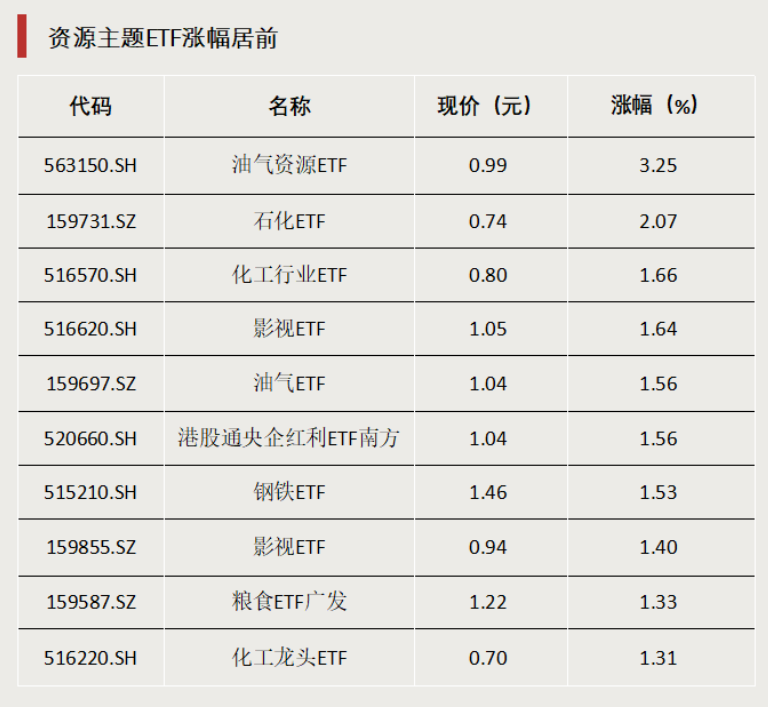
Group 1: Market Performance - On July 30, A-share resource sector strengthened, with oil, gas, and chemical ETFs leading the gains [1][2] - The oil and gas resource ETF (563150) rose over 3%, while other resource ETFs also showed positive performance [2][3] - In the Hong Kong market, the automotive sector experienced significant adjustments, with major stocks like Li Auto and BYD dropping over 5% [5] Group 2: ETF Trading Activity - On July 30, five ETFs exceeded a trading volume of 10 billion yuan, with the Hong Kong Securities ETF and Short-term Bond ETF leading with over 200 billion yuan in trading volume [1][8] - The Short-term Bond ETF (511360) had a trading volume of 203.16 billion yuan, while the 30-year Treasury ETF reached 107.93 billion yuan [9] - On July 29, six ETFs saw net inflows exceeding 5 billion yuan, with the E Fund Hong Kong Securities Investment Theme ETF and the Fuguo Hong Kong Stock Connect Internet ETF attracting over 10 billion yuan [10][11] Group 3: Sector Analysis - Analysts suggest that chemical stocks may enter a new upward cycle as oil prices stabilize and chemical supply growth declines significantly [4] - The automotive sector in Hong Kong is facing downward pressure, with multiple automotive-related ETFs declining over 3% [5][6] - The Hong Kong Innovation Drug ETF experienced volatile trading, initially rising over 8% before closing in the red [6][7]

融资余额史上第二牛,小微盘还能“飞”多久?
Sou Hu Cai Jing· 2025-07-30 02:38
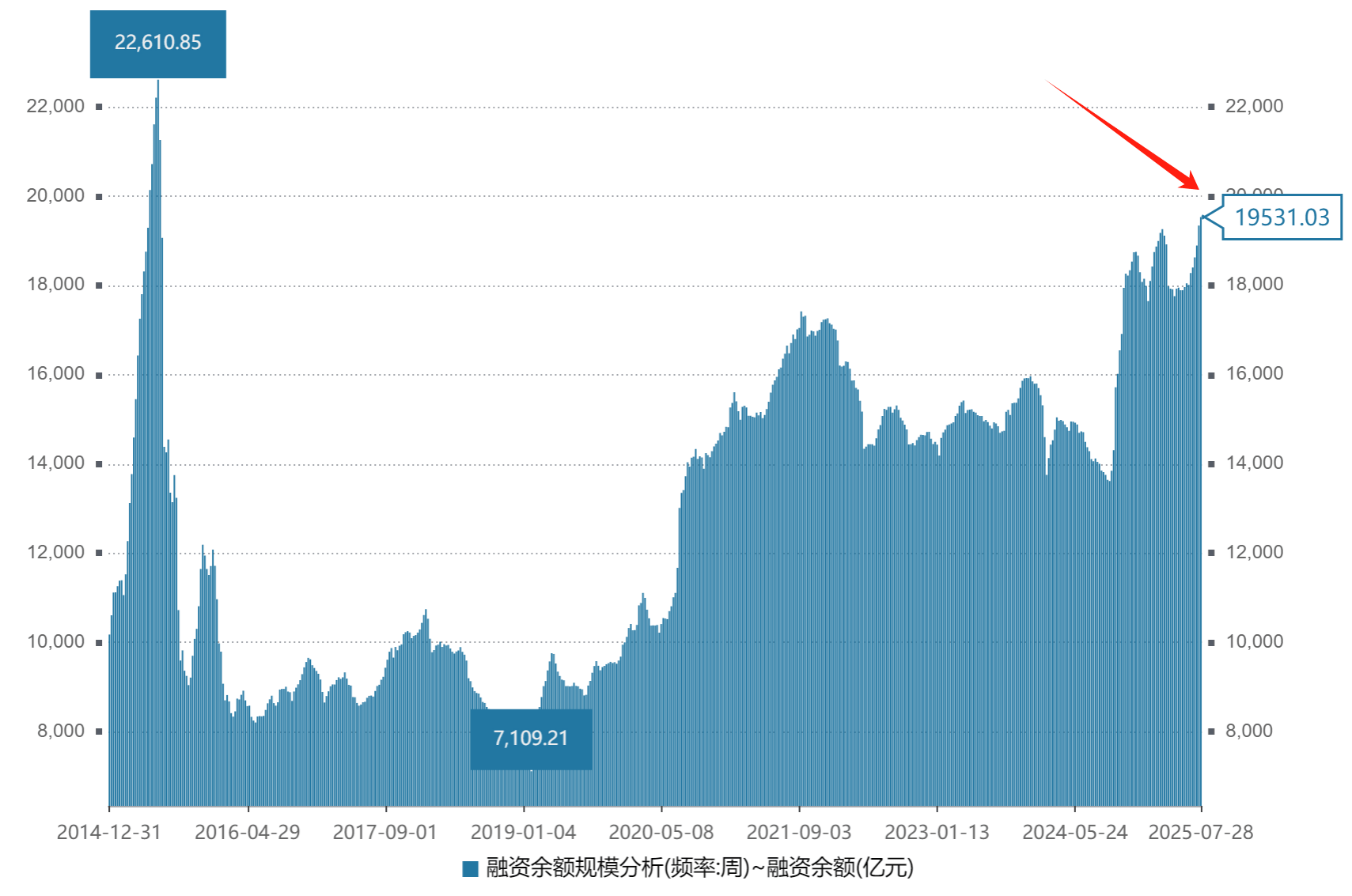
Core Viewpoint - The recent surge in net financing of 19.2 billion indicates a strong return of leveraged funds, reaching a total financing balance of 1.95 trillion, marking the second highest level since the 2015 bull market [1][8] Group 1: Market Dynamics - The influx of leveraged funds is primarily directed towards the small and micro-cap sectors, particularly the CSI 2000 index, which represents small-cap A-share companies [3][5] - The average daily trading volume of the CSI 2000 has been increasing, surpassing that of the CSI 300 and CSI 500, indicating heightened market interest [3] - The CSI 2000 Enhanced ETF (159552) has seen significant net inflows, totaling 330 million over the last 20 trading days, and nearly 400 million year-to-date, making it the top performer among similar ETFs [3][6] Group 2: Investment Rationale - The preference for small and micro-cap stocks is driven by their potential for greater earnings elasticity and recovery prospects, especially following supportive policies for small and specialized enterprises [5][8] - The relatively dispersed ownership structure of small-cap stocks allows for more significant influence from retail and leveraged investors, enhancing short-term trading opportunities [5] - Enhanced ETFs, like the CSI 2000 Enhanced ETF, utilize quantitative models to select small-cap stocks, capturing excess returns and attracting further investment [5][6] Group 3: Performance Metrics - The CSI 2000 Enhanced ETF has achieved a year-to-date return of 40.79%, significantly outperforming other indices and funds [6] - Comparatively, the CSI 300 index has only returned 5.52% year-to-date, highlighting the strong performance of small-cap investments [6] Group 4: Cautionary Notes - The high financing balance of 1.95 trillion serves as a warning signal, as the enthusiasm for leveraged funds often indicates market peaks rather than the beginning of new bull markets [8] - The current market environment, characterized by significant inflows into small-cap stocks, necessitates careful monitoring of volatility and risk management strategies [8]
“成长+”系列领涨,小微盘、高波占优
Changjiang Securities· 2025-07-21 09:12
Group 1: Market Performance - Fund holdings outperformed northbound holdings, with the Fund Heavy 50 index leading at 3.01%[11] - The overall market momentum remains high, with industry and style rotation speeds sustained at elevated levels[4] - The healthcare and telecommunications sectors showed the highest gains, while financial and real estate sectors experienced pullbacks[19] Group 2: Investment Styles and Themes - Small-cap and high-volatility stocks are favored, with the "Growth+" series leading the performance[21] - The Chengdu-Chongqing regional development and the "East Data West Computing" initiatives are the leading themes in the market[25] - The cumulative return for small-cap and growth indices has been the highest since the beginning of 2025[21]
W117市场观察:小微盘、高估值占优,数字货币领涨主题
Changjiang Securities· 2025-07-13 15:14
Group 1: Market Performance - Fund holdings outperformed northbound holdings, with non-fund holdings leading the gains[2] - The real estate sector showed significant growth, with a 6.07% increase, exceeding the overall A-share market by 4.37%[22] - The healthcare sector's leading stocks significantly outperformed the industry benchmark[4] Group 2: Market Trends - Market rotation speed across industries and styles remains high[4] - Small-cap and high-valuation stocks are currently favored, with the reversal index showing strong performance[4] - Digital currency and specialized innovation themes are leading the market[4] Group 3: Investment Insights - Non-fund holdings index gained 2.88%, while fund holdings index only increased by 1.16%[14] - The reversal index has shown a notable increase, indicating a shift in market sentiment towards recovery[26] - The specialized innovation 100 index rose by 3.61%, highlighting strong interest in niche sectors[28]
我错过了什么?做错了什么?
半夏投资· 2025-06-09 04:48
Group 1 - The article discusses the missed investment opportunities in sectors such as small-cap stocks, new consumption, technology, and innovative pharmaceuticals, leading to mediocre returns in equity markets [1][3] - A significant error was made by over-investing in industrial commodities, which have seen substantial declines [1][2] - The analysis emphasizes the importance of a scientific framework and independent research to avoid being swayed by market narratives and to maintain a stable value assessment system [4][5] Group 2 - The article highlights the need for a deeper understanding of foreign capital behavior, which has been a shortcoming in the past [13][15] - It stresses the importance of selecting stocks with alpha rather than merely capturing industry beta, indicating a shift towards more rigorous stock selection criteria [15][16] - The focus on safety and risk-reward ratios in investment decisions is emphasized, with a preference for low PB and high dividend yield stocks [18][20] Group 3 - The article outlines the current investment strategy, which includes maintaining a significant allocation to gold as a strategic hedge against deflation and currency fluctuations [27][28] - It discusses the outlook for government bonds, indicating a preference for short-term holdings due to the negative carry associated with longer-term positions [29] - The article notes that many industrial commodities are trading below marginal costs, leading to a cautious approach in this sector while monitoring for potential opportunities [30][31] Group 4 - The long-term equity holdings are primarily focused on companies with cyclical characteristics, high dividends, and low price-to-book ratios, forming the basis of the investment portfolio [32][33] - Recent adjustments in the portfolio include a complete reduction of bank stocks, reflecting a strategic shift in response to market conditions [34]

W112市场观察:TMT板块涨幅居前,东数西算领涨主题
Changjiang Securities· 2025-06-09 02:13
Market Performance - The TMT sector has shown the highest growth, with the telecommunications sector leading the industry[2] - Non-fund heavy positions have outperformed, indicating a strong institutional profit effect[4] - The market rotation speed remains high across styles and industries, suggesting active trading conditions[4] Investment Themes - The "East Data West Computing" and "Carbon Neutrality" themes are currently leading in market interest[2] - Small-cap and high-valuation stocks are favored, with the ChiNext Growth Index showing significant gains[4] - The ChiNext Growth Index has reported a weekly return of 6.58%, outperforming other indices[22] Sector Analysis - The telecommunications sector achieved a return of 3.82%, exceeding the overall A-share market by 2.21%[17] - The information technology and hardware sector followed closely with a return of 3.45%[17] - The materials sector also performed well, with a return of 2.69%[17] Risk Considerations - The report emphasizes that past performance does not guarantee future results, highlighting the potential for market volatility[26]
中证1000增强ETF(159679)涨超1.8%,资金偏好转向更小市值标的
Mei Ri Jing Ji Xin Wen· 2025-05-29 05:51
Group 1 - The China Securities Regulatory Commission announced on May 21 a decision to modify regulations, establishing a phased payment mechanism for the consideration of restructuring shares, which benefits small and medium-sized companies acquiring large-scale assets, particularly in the new productivity sector [1] - The "2024 China Small and Medium Enterprises Financing Development Report" released on May 26 indicates that the scale of small and medium-sized enterprises in China will continue to expand in 2024, with significant achievements in high-quality development and a steady growth trend in the financing market overall [1] - Huaxi Securities noted that from May 19 to 23, the CSI 1000 index underperformed, while its congestion level did not show significant changes, contrasting with the situation of the CSI 2000 index. This reflects a sustained demand for "potentially small" market capitalization, indicating that the CSI 1000 may no longer meet this standard, as funds increasingly seek "micro-cap" opportunities [1] Group 2 - The current market structure is described as "dumbbell-shaped," with the Shanghai Composite Index 50 representing core large-cap stocks and the CSI 2000 and Wind Micro-Cap Index representing small-cap stocks continuing to strengthen [1] - The CSI 1000 Enhanced ETF (159679) tracks the CSI 1000 index (000852), which is compiled by the China Securities Index Co., Ltd. and covers a wide range of industry sectors, reflecting the overall market performance of small-cap listed companies. This index is characterized by high growth potential and significant volatility [1]
机构研究周报:小微盘或维持强势,短债利率存下行空间
Wind万得· 2025-05-25 22:46
Core Viewpoints - The recent LPR reduction and deposit rate cuts are part of a broader monetary easing policy, with limited impact on bank interest margins expected in the short term [3][21][22] - The small-cap stocks are likely to continue outperforming due to a lack of systemic risk in the capital market and improving risk appetite [6][25] - The aerospace sector is expected to benefit from increased military spending and China's growing share in the global arms trade [13] Interest Rate and Monetary Policy - The LPR was lowered for the first time this year, with the 1-year rate dropping to 3% and the 5-year rate to 3.5%, both down by 10 basis points [3] - Major banks have also reduced deposit rates, with cuts ranging from 5 to 25 basis points, indicating a shift in the monetary policy landscape [3][21] - The impact of these rate cuts on bank net interest margins is expected to be limited, as the trend of deposit rates falling faster than loan rates continues [3][21] Equity Market Insights - Citic Securities highlights that uncertainty surrounding Trump’s policies remains a key factor in asset allocation, with a focus on potential shifts towards domestic policies [5] - The Hong Kong stock market is currently lacking catalysts for upward movement, with external uncertainties and insufficient internal momentum [7] - The small-cap stock trend is expected to persist, supported by a favorable liquidity environment and ongoing economic transformation [6] Industry Research - The aerospace and defense sector is poised for growth due to rising global military expenditures and China's technological advancements in military equipment [13] - The U.S. nuclear energy sector has seen a surge following policy changes, which may influence the domestic nuclear power industry positively [14] - A balanced investment approach is recommended, with optimism for AI and high-end manufacturing sectors amid ongoing uncertainties in U.S.-China trade relations [15] Macro and Fixed Income - The recent deposit rate cuts are not expected to significantly disrupt the funding landscape before 2024, with limited effects on market liquidity anticipated [21] - Short-term interest rate bonds are seen as having strong investment value due to the downward pressure on rates from deposit rate cuts [22] - Gold is viewed as a strategic asset in light of ongoing uncertainties in U.S. policies and potential dollar weakness, suggesting a diversified approach to asset allocation [23]

北证50今天为啥崩了?
表舅是养基大户· 2025-05-22 13:33
Core Viewpoint - The article discusses the recent volatility in the micro-cap market, particularly the significant drop in the North Exchange 50 index, attributing it to various factors including market sentiment, high valuations, and the impact of specific stocks [1][2][4]. Summary by Sections Market Volatility - The North Exchange 50 index experienced a drop of 6.15%, marking it as the 10th largest single-day decline in its three-year history, with six days in 2024 alone seeing declines over 6% [1][2]. Reasons for Market Movement - Increasing warnings about micro-cap risks from fund managers have led to some investors taking profits, especially after the North Exchange 50 reached a historical high [2]. - The current valuations are notably high, with the North Exchange 50 at a rolling P/E ratio of 76, the China 2000 at 136, and the Sci-Tech 50 at 140, all at extreme levels compared to historical data [2]. - The significant drop in the largest component stock, Jinbo Biological, which fell by approximately 15%, has heavily influenced market sentiment, despite its year-to-date increase of 140% [2]. Future Market Pressures - The potential reopening of A-share IPOs is seen as a significant future pressure on the micro-cap market, which has thrived in a favorable speculative environment due to low funding rates and limited IPOs [4][5]. Supportive Market Conditions - The micro-cap market has benefited from low funding rates, restricted IPOs, and a lack of institutional investment, allowing it to flourish despite the absence of significant public fund inflows [5]. - Recent regulatory changes, such as the revised Major Asset Restructuring Management Measures, have positively impacted the shell value of micro-cap stocks [5]. IPO Policy Changes - The article highlights a shift in policy towards supporting high-quality, unprofitable tech companies for IPOs, indicating a trend towards more flexible and inclusive listing regulations [7][8]. - The introduction of a new mechanism for adjusting the pace of new stock issuances suggests that the current high valuations in the micro-cap sector may lead to increased supply in the near future [9][12]. Insurance Sector Investment - The insurance sector has significantly increased its equity investments, with a total of 220 billion yuan allocated, indicating a strong shift towards high-dividend blue-chip stocks [15][16]. Monetary Policy - The central bank's decision to exceed the MLF renewal by 3.75 trillion yuan indicates a net injection of liquidity into the market, which may influence bond market dynamics [17][18].