开源大模型

Search documents
千问系列模型下载量超10亿次
Bei Jing Shang Bao· 2026-01-21 06:21
Core Insights - The AI open-source community Hugging Face reports that Alibaba's Qianwen derivative models have exceeded 200,000, making it the first open-source large model to achieve this milestone globally [1] - The Qianwen series models have surpassed 1 billion downloads, averaging 1.1 million downloads per day, overtaking the U.S. Llama to become the world's leading open-source large model [1]

2025年第53周:数码家电行业周度市场观察
艾瑞咨询· 2026-01-16 00:05
Group 1 - The core viewpoint of the article emphasizes the importance of data quality over algorithms in determining the effectiveness of AI applications in businesses [3][4] - The report "2025 China High-end Home Appliance Market Trends and Innovation Insights" highlights the growth of the high-end market driven by consumer upgrades, with a retail market growth of 10.2% year-on-year [5] - The logistics industry is expected to undergo a transformation by 2025, with a market size projected to reach 965.5 billion yuan, driven by AI and large model technologies [7] Group 2 - The medical AI sector is projected to grow rapidly, with the market size expected to reach 16.4 billion yuan in 2024 and 35.3 billion yuan by 2030, despite facing commercialization challenges [6] - The smartphone market is experiencing a dichotomy, with AI smartphones expected to account for 15% of global shipments in 2024, while the overall market faces extended replacement cycles [11] - The retail industry is undergoing a historic transformation, with AI technology becoming crucial for optimizing supply chain decisions and enhancing marketing precision [12] Group 3 - The humanoid robot industry is anticipated to see significant production increases, with companies planning annual capacities of 100,000 to 1 million units, despite potential mismatches in demand [13] - The L3 autonomous driving era is officially beginning, with regulatory approvals for L3 vehicles, shifting the focus from technology to safety standards and competitive advantages [14] - The AI glasses market is witnessing a surge in interest from major companies, with various product categories emerging, although challenges such as high return rates and technical maturity remain [15][16] Group 4 - The robot industry is experiencing a wave of IPO applications, with over 50 billion yuan in financing in the first three quarters of 2025, despite facing high costs and profitability challenges [19][20] - Xiaomi plans to invest approximately 400 billion yuan in R&D by 2026, focusing on core technologies such as chips and AI [31] - The consumer-grade robotics market is entering a new phase with the launch of autonomous robots, indicating a shift towards integrating intelligent technology into daily life [33]



春节AI王炸突袭!DeepSeekV4硬刚海外巨头,暗藏关键破局点
Sou Hu Cai Jing· 2026-01-15 08:03
Core Viewpoint - DeepSeek, a Chinese startup, is set to launch its new generation model V4 around mid-February 2026, aiming to make a significant impact during the Chinese New Year period [1]. Group 1: Company Development - DeepSeek has shown remarkable growth over the past two years, launching its foundational model V3 on December 26, 2024, and an open-source inference model R1 on January 20, 2025, which gained significant attention for its explicit reasoning capabilities [4]. - The R1+V3 chat product has also received high domestic recognition, establishing DeepSeek as a benchmark enterprise in China's AI engineering capabilities [4]. Group 2: Model V4 Features - The V4 model is designed to significantly enhance programming capabilities, achieving a record score of 92.0 in authoritative programming benchmarks like Design2Code, surpassing products from leading overseas companies such as GPT-4.5 and Claude3.7 [6]. - A key breakthrough of V4 is its ability to handle ultra-long context processing, utilizing an NSA mechanism to achieve a 6-9 times speed increase under a 64K context window, allowing it to process millions of tokens effectively [6]. Group 3: Technical Innovations - V4 was developed under constraints of high-end GPU availability, addressing common issues in large model training such as performance degradation through innovative technical methods rather than relying solely on computational power [7]. - The introduction of the mHC architecture has significantly improved training stability, with a mere 6.7% increase in training time leading to a rise in accuracy for complex reasoning tasks from 43.8% to 51.0% [7]. Group 4: Research Contributions - On January 12, DeepSeek published a new training architecture paper co-authored by its founder and researchers from Peking University, introducing the Engram conditional memory module, which decouples computation from storage [9][10]. - This approach allows for model scaling without relying on an increase in chip quantity, providing a new technical pathway for AI companies constrained by hardware limitations [10]. Group 5: Industry Context - The large model landscape has become increasingly competitive, with open-source becoming a core trend in 2025, as both large enterprises and startups strive for dominance in the global open-source ecosystem [11]. - The launch of V4 transcends mere product iteration, serving as a "technical examination" to validate DeepSeek's technological leadership and the maturity of its architectural innovations [13]. Group 6: Market Implications - The performance of V4 will not only impact DeepSeek's standing in the global open-source ecosystem but also reflect the maturity of China's large model technology route [16]. - The ongoing competition has shifted from a focus on parameter counts to the intricacies of technical methods and operational efficiency, indicating a new phase in the industry [16].


存储大周期的投资机会梳理
2026-01-08 02:07
Summary of Key Points from Conference Call Records Industry Overview - The semiconductor equipment sector in China is currently undervalued, with companies like Changxin Storage showing strong profitability. Capital expenditures in the industry are expected to reach $50-60 billion by 2030, opening up valuation and stock price potential for leading companies [1][3]. - The storage industry is entering a super cycle, with price increases significantly boosting manufacturer profits and accelerating China's market share growth globally [1][8]. Company Insights Changxin Storage - Expected profits for Changxin Storage could reach over 100 billion RMB by 2025, indicating substantial investment in capacity expansion [3][13]. Alibaba Cloud - Alibaba Cloud's Qianwen model is recognized as one of the best open-source models globally, with optimistic revenue projections for 2026. The underlying computing power and supply chain present significant investment opportunities [1][4][5]. Co-Creation Data - Co-Creation Data is the largest third-party computing power leasing platform in China, benefiting from a shorter IDC construction cycle and lower financing costs compared to overseas markets. This positions the company for significant growth [1][7]. - The company has signed wafer supply agreements with major global flash memory manufacturers and has a strong performance in DRAM through strategic inventory management [6]. Koma Technology - Koma Technology has made breakthroughs in its ceramic heater business, with expected revenue growth of 400% from 2025 to 2026, reaching approximately 300 million RMB and a gross margin of 70-80% [1][14][15]. - The company is projected to achieve close to 1 billion RMB in total profit by 2026, with potential to reach 2 billion RMB by 2027 [15][18]. Zhongwei Company - Zhongwei is expected to benefit from increased orders from storage clients, with total revenue projected to reach $9-10 billion during the 14th Five-Year Plan period, targeting a market valuation of 400 billion RMB [1][19]. Changchuan Technology - Changchuan Technology is identified as a leading domestic testing machine manufacturer, with a projected profit of 1.3-1.4 billion RMB in 2025 and significant growth potential thereafter [19]. Market Trends - The storage industry is experiencing a super cycle, leading to substantial growth potential and increased profitability for manufacturers [8][9]. - The financing cost for computing power leasing platforms in China is significantly lower than in the U.S., which positively impacts business models and profitability [10]. Strategic Collaborations - Co-Creation Technology has established a strategic partnership with Alibaba Cloud, enhancing its market position and investment appeal. The company plans to double its investments, potentially leading to significant revenue and profit increases [1][11]. Future Projections - The domestic ceramic heater market is expected to reach 5 billion RMB by 2025, with long-term projections suggesting a market size of 20 billion RMB. Koma Technology aims to capture a significant market share, potentially leading to a valuation of 120-150 billion RMB [16][17]. Conclusion - The semiconductor equipment and storage sectors present compelling investment opportunities, with key players like Koma Technology, Zhongwei Company, and Changchuan Technology positioned for growth. The collaboration between Co-Creation Technology and Alibaba Cloud further enhances the investment landscape in the computing power leasing market [19].


陈天桥代季峰打响2026大模型第一枪:30B参数跑出1T性能
量子位· 2026-01-06 05:48
Core Viewpoint - MiroThinker 1.5, developed by MiroMind, is positioned as a leading AI model in the intelligent agent field, showcasing superior performance in various benchmark tests compared to other top models like GPT-5-High and Gemini-3-Pro [1][3][5]. Performance Evaluation - MiroThinker 1.5 achieved notable scores in benchmark tests: - HLE-Text: 39.2% - BrowseComp: 69.8% - BrowseComp-ZH: 71.5% - GAIA-Val-165: 80.8% [3][4]. - It surpassed ChatGPT-Agent's previous record in BrowseComp, establishing itself in the global top tier [5]. Model Efficiency - MiroThinker 1.5 operates with significantly fewer parameters (30B and 235B) compared to competitors, achieving comparable or superior results through high efficiency [7][8]. - The model's inference cost is notably low at $0.07 per call, which is only 1/20 of Kimi-K2-Thinking's cost, while also demonstrating faster inference speeds [8]. Development Team and Background - The MiroMind team, responsible for MiroThinker 1.5, previously excelled in predicting outcomes in decentralized markets, showcasing their expertise in model development [9][10]. Interactive Scaling and Model Training - MiroThinker 1.5 incorporates a novel approach called Interactive Scaling, which emphasizes interaction with the external environment during both training and inference phases, enhancing its reasoning capabilities [46][58]. - The model employs a feedback loop in its reasoning process, allowing for iterative verification and correction, which contrasts with traditional models that rely heavily on memorization [48][57]. Predictive Capabilities - MiroThinker 1.5 demonstrates a robust ability to make predictions based on real-time data, as evidenced by its analysis of sports events and video game release timelines, showcasing a logical and evidence-based approach [15][35][41]. - The model's predictions are structured to avoid reliance on past knowledge, instead focusing on current information and real-world interactions [52][63]. Conclusion - MiroThinker 1.5 represents a significant advancement in AI model development, prioritizing interaction and evidence-based reasoning over sheer parameter size, thus redefining the landscape of intelligent agents [64].

斯坦福报告揭秘中国开源AI全景:本土模型能否领跑全球?
Sou Hu Cai Jing· 2026-01-03 13:19
Core Insights - The report titled "Beyond DeepSeek: China's Diverse Open Weight AI Ecosystem and Its Policy Implications" highlights China's transition from a follower to a leader in the open weight AI model sector, emphasizing the significance of this development in the global context [1][29]. Group 1: Market Position and Growth - China has evolved from a follower to a leader in the open weight AI model field, with open weight models allowing developers to download, use, and modify model parameters [4][30]. - As of December 2025, Alibaba's Qwen model series surpassed Meta's Llama, achieving approximately 385 million downloads compared to Llama's 346 million [4][30]. - Between August 2024 and August 2025, Chinese developers accounted for 17.1% of total downloads on Hugging Face, surpassing the United States' 15.8% for the first time [4][30]. Group 2: Model Development and Ecosystem - The number of derivative models based on Qwen and DeepSeek has significantly increased, with Chinese models representing 63% of new derivative models uploaded to Hugging Face by September 2025 [6][32]. - The report analyzes four representative Chinese model families: Qwen, DeepSeek-R1, Kimi K2, and GLM-4.5, each with unique capabilities and open-source licenses [7][33]. Group 3: Technical Architecture and Efficiency - Many of these models utilize a Mixture of Experts (MoE) architecture, which enhances efficiency by allowing models to perform well with limited computational resources [9][35]. - DeepSeek's V3 model, for instance, has a total parameter count of 671 billion but activates only 37 billion parameters during inference, balancing performance and cost [9][35]. Group 4: Licensing and Policy Support - In 2025, both Qwen3 and DeepSeek R1 adopted more permissive open-source licenses (Apache 2.0 and MIT License, respectively), reflecting a shift towards attracting global developer communities [10][36]. - The Chinese government has played a complex role in supporting the development of open weight AI, with policies emphasizing "openness" and "open-source" as key components of national innovation strategies [11][37]. Group 5: Commercial Strategies and Market Dynamics - Chinese developers are exploring diverse monetization paths, with Alibaba positioning Qwen as an "AI operating system" to drive cloud computing growth through enterprise and government adoption [12][38]. - DeepSeek and Z.ai are pursuing a light-asset approach, collaborating with various cloud and computing service providers to offer localized services [12][38]. Group 6: Global Implications and Geopolitical Context - The report discusses the global implications of China's high-performance models, which provide affordable AI capabilities to low- and middle-income countries, potentially reshaping the competitive landscape [13][26]. - The release of DeepSeek R1 has influenced U.S. policy towards open weight AI, prompting a reevaluation of export controls and regulatory approaches [14][27].

2025盘点:DeepSeek引领AI进化 国补激发消费活力 行业重塑带来更多可能
Xin Lang Cai Jing· 2025-12-31 16:07
Core Insights - The year 2025 has been pivotal for the digital 3C industry, marked by significant advancements in AI technology, policy support, and market dynamics, setting the stage for future developments in 2026 [1][15] Group 1: AI Developments - The launch of DeepSeek-R1 on January 20, 2025, showcased its competitive capabilities against top closed-source models with a training cost of approximately $6 million, challenging Silicon Valley's computational dominance [1][16] - DeepSeek's V3.2-Exp, released in September, introduced a sparse attention mechanism that halved API prices, while the December V3.2 version integrated logical reasoning with agent tool usage, achieving gold medal performances in international competitions [2][16] - DeepSeek's contributions to the 3C industry include promoting "open-source equity," enabling low-cost smart experiences on budget devices through cloud APIs, and leading a global shift towards efficiency in AI [2][16] Group 2: Policy Impact on Market - 2025 is defined as the "Year of National Subsidies" for the 3C market, with the introduction of a policy on January 8 that included subsidies of up to 500 yuan for mobile phones, tablets, and smartwatches, significantly boosting daily active users on e-commerce platforms [3][18] - The subsidy policy expanded in the second half of the year, with 14 provinces increasing the maximum subsidy to 700 yuan, resulting in a total retail sales increase of over 120 billion yuan [3][18] - The continuation of the subsidy policy into 2026 is expected to further include emerging categories like smart glasses, enhancing consumer access to mid-to-high-end products and shifting competition from parameter-based pricing to value-for-money battles [5][18] Group 3: Industry Challenges - The "Romashi incident" in June 2025 involved the recall of nearly 500,000 defective power banks due to safety concerns, leading to significant regulatory responses and the introduction of stricter safety standards in the power bank industry [19][21] - Following the incident, new regulations mandated that all power banks must carry a 3C certification, marking a shift away from low-cost models and ensuring consumer safety [21][22] Group 4: Growth of AI Glasses - 2025 marked a breakthrough year for the AI glasses industry, driven by policy support and market demand, with global shipments expected to reach 12.05 million units and the Chinese market alone surpassing 2.75 million units, reflecting a 107% year-on-year increase [8][22] - The emergence of numerous brands, including major players like Huawei and Xiaomi, indicates a competitive landscape with nearly 70 companies entering the market [10][24] Group 5: AI Assistant Developments - The launch of the "Doubao Phone" by ByteDance and ZTE on December 1, 2025, introduced an AI assistant capable of executing complex tasks across applications, marking a significant advancement in mobile technology [10][24] - The introduction of the AI assistant sparked a debate over app permissions and user data security, highlighting the tension between innovation and established app ecosystems [12][27]
收购Manus引入中国鲶鱼:扎克伯格的AI焦虑症之年
Xin Lang Ke Ji· 2025-12-31 01:31
Core Insights - Meta has acquired AI startup Manus, marking a significant strategic move to enhance its AI capabilities and address internal challenges within the company [2][6][34] - The acquisition is seen as a response to Meta's struggles in the AI sector, particularly following the disappointing performance of its Llama 4 model and the need for external expertise to revitalize its AI initiatives [7][15][22] Group 1: Acquisition Details - Meta's AI head, Alexandr Wang, announced the acquisition, highlighting Manus's expertise in building powerful AI agents [3][6] - The deal is reported to be valued between $2 billion and $3 billion, with Manus previously seeking $2 billion in funding [6][13] - Manus, founded by Chinese entrepreneurs, has quickly gained traction with its AI assistant product, achieving over $100 million in annual recurring revenue (ARR) within eight months [10][12][35] Group 2: Strategic Context - The acquisition comes amid a tumultuous year for Meta's AI division, characterized by high-profile failures and internal restructuring [7][15][25] - Meta's leadership has faced criticism for its AI strategy, leading to significant personnel changes and a push for external talent to drive innovation [19][22][28] - The integration of Manus is expected to enhance Meta's AI offerings, particularly in automating complex tasks across its social media platforms [36][38] Group 3: Market Implications - The acquisition of Manus is positioned as a strategic move to prevent competitors from strengthening their AI capabilities, particularly in the rapidly evolving AI agent space [37][38] - Manus's technology, which utilizes existing models and tools, complements Meta's Llama series, addressing gaps in the company's ability to deliver reliable AI solutions [35][41] - The success of Manus serves as a testament to the global competitiveness of Chinese AI startups, showcasing their ability to innovate and commercialize rapidly [40][44]


收购Manus引入中国鲶鱼:扎克伯格的AI焦虑症之年|硅谷观察
Xin Lang Cai Jing· 2025-12-30 23:31
Core Insights - Meta has announced the acquisition of AI startup Manus, marking a significant move to enhance its AI capabilities and address internal challenges faced throughout the year [2][4][38] - The acquisition is seen as a strategic effort by Meta's leadership to inject external talent and innovation into its AI division, which has faced numerous setbacks in 2025 [5][66] Group 1: Acquisition Details - The acquisition of Manus is reported to be valued between $2 billion and $3 billion, with the deal finalized in less than two weeks [4][36] - Manus, founded by Chinese entrepreneurs, is recognized for its innovative AI agent capable of performing complex tasks autonomously, which aligns with Meta's goal to enhance its AI product offerings [39][41] - Following the acquisition, Manus will continue to operate independently while integrating its services into Meta's social media platforms [4][61] Group 2: Manus's Background and Performance - Manus, originally a Singapore-based company, was founded by a team of Chinese entrepreneurs and has quickly gained traction in the AI market, achieving over $100 million in annual recurring revenue (ARR) within eight months [39][9] - The product developed by Manus is touted as the world's first true general-purpose AI agent, capable of executing various tasks without human intervention [41][60] - Manus's rapid commercialization and user adoption highlight the demand for AI solutions in the market, making it a valuable asset for Meta [60][63] Group 3: Meta's AI Strategy and Challenges - The acquisition comes in the context of Meta's struggles in the AI sector, including disappointing performance from its Llama 4 model and significant internal restructuring [5][45] - Meta's leadership, particularly Mark Zuckerberg, has expressed urgency in revitalizing its AI capabilities, leading to aggressive hiring and strategic investments [19][53] - The integration of Manus is expected to fill critical gaps in Meta's AI execution capabilities, allowing for a transition from merely conversational models to functional AI agents [60][62] Group 4: Cultural and Operational Dynamics - The acquisition reflects a broader trend of globalization in the AI industry, showcasing the capabilities of Chinese entrepreneurs in a competitive landscape [63][66] - There are concerns regarding the cultural integration of Manus's team within Meta's established processes, which may impact innovation and operational agility [65][66] - The leadership dynamics within Meta's AI division are shifting, with new strategies being implemented to enhance competitiveness against rivals like Google and OpenAI [57][62]

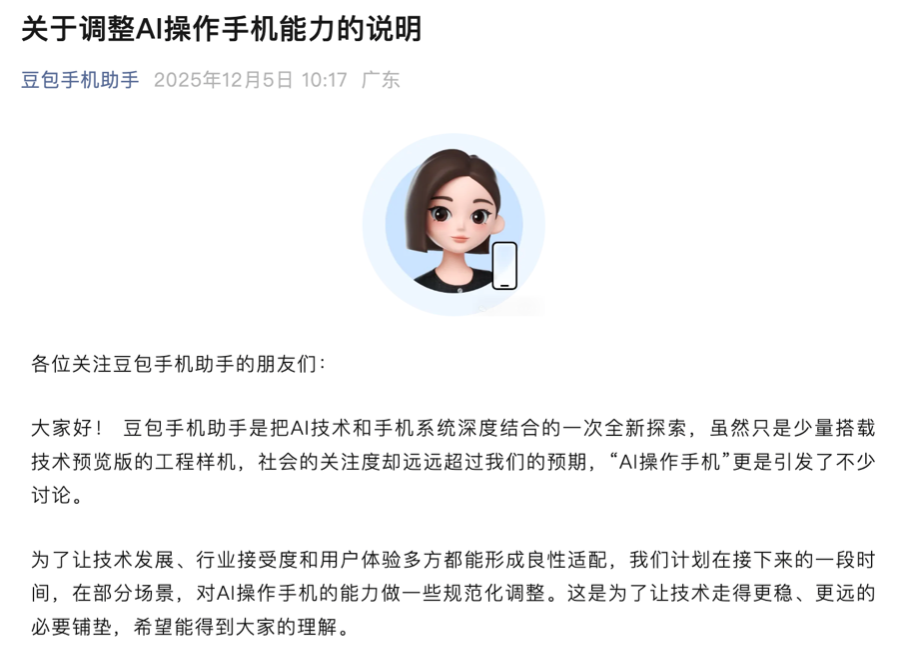
豆包搅动AI手机池水 厂商摸索数据、权限边界
2 1 Shi Ji Jing Ji Bao Dao· 2025-12-27 07:07
Core Insights - The launch of the Doubao mobile assistant in late 2025 has created significant waves in the smartphone industry, being recognized by users as a "truly AI phone" due to its autonomous cross-application operation capabilities [1][5] - However, the Doubao mobile assistant faced usage restrictions in multiple applications, leading to an official statement on December 5 regarding adjustments to its AI operation capabilities [1][3] - The challenges faced by Doubao reflect broader issues in the AI phone sector, particularly concerning user privacy and data rights, which require collaborative efforts from various stakeholders [3][7] Group 1: Technology and Development - The rapid improvement of domestic open-source large models has provided a solid foundation for the iterative development of AI phones, shifting focus from cloud-based models to offline capabilities [4][13] - The announcement of the open-sourcing of the AutoGLM model by Zhiyu on December 9 signifies a move towards "technological equality" in the mobile agent space, potentially lowering development barriers [3][12] - The evolution of AI phones is not just about technological advancements but also involves a complex interplay of patience, restraint, and ecosystem collaboration [4][17] Group 2: Market Dynamics and Competition - The Doubao mobile assistant's features are not significantly different from previously demonstrated smart applications by other manufacturers, indicating that the market is still in the early stages of realizing cross-application autonomous capabilities [5][6] - The competition in the AI phone market is fundamentally about ecosystem development, requiring a shift from traditional app models to a more integrated approach that allows for cross-application automation [17][21] - The emergence of AI agents is seen as a potential battleground for user engagement and control over data, with manufacturers needing to navigate the complexities of user habits and regulatory compliance [8][17] Group 3: Industry Challenges - The current landscape reveals a "standard vacuum" regarding user authorization and data rights, complicating the implementation of AI agents that require cross-application functionality [7][18] - The transition to AI agents necessitates a reevaluation of existing operational models, as traditional single-operation authorization methods are inadequate for the demands of AI-driven tasks [7][18] - The industry faces challenges related to memory and power consumption as the capabilities of end-side models expand, necessitating advancements in hardware to support these new demands [18][20] Group 4: Future Outlook - The AI phone competition is evolving from a focus on hardware specifications to a comprehensive race involving end-side capabilities, ecosystem openness, and user experience [21][22] - The integration of AI capabilities into hardware is expected to reshape traditional consumer electronics business models, moving towards subscription-based software services [20][22] - The developments surrounding the Doubao mobile assistant highlight the need for industry-wide collaboration to address the challenges of rights, interests, and standards in the evolving AI landscape [20][22]