
惩罚性关税

Search documents
特朗普关税战并未结束!做贸易必须要警惕新三大风险
第一财经· 2025-08-28 05:48
Group 1 - The core viewpoint of the article highlights that the Trump administration's tariff policies are a significant aspect of its governance, and these policies are likely to continue evolving during its "2.0 phase" [1] - Most economies lack the capability to maintain a "terrifying balance" with the United States, indicating that the threat of tariffs will persist without the announcement of "reciprocal tariffs" [1] - Experts in international law and trade suggest that risks should be mitigated in three areas: increased vertical industry investigations from the U.S., potential "anti-dumping" investigations from other countries affecting Chinese foreign trade enterprises, and unexpected additional tariffs such as secondary sanctions and punitive tariffs [1] Group 2 - A tax expert noted the current confusion surrounding U.S. tariff classifications, leading to uncertainty among foreign trade companies regarding how to report taxes on various product categories [1] - For instance, companies exporting steel furniture are unclear whether they will face tariffs on steel and aluminum first, followed by furniture tariffs, raising questions about the overall calculation of these tariffs [1]

综述|美对印惩罚性关税生效 印度多举措应对冲击
Xin Hua She· 2025-08-27 09:37
Group 1 - The U.S. government has imposed a 25% punitive tariff on goods imported from India, effective from August 7, 2023, due to India's import of Russian oil, bringing the total tariff rate on Indian products to 50% [1] - The tariffs are expected to reduce India's economic growth by 0.8 percentage points this year and next year, according to Capital Economics [1] - The Indian government estimates that the U.S. tariffs will impact $48.2 billion worth of Indian exports, with a projected trade volume of $128.8 billion between the U.S. and India in 2024 [1] Group 2 - The Indian engineering export promotion council predicts that exports may decline by 20% to 30% due to the new tariffs, as U.S. customers have stopped placing new orders [1] - In response to the tariffs, the Indian government plans to provide financial assistance to affected businesses and promote exports to nearly 50 countries, focusing on textiles, food processing, leather goods, and seafood [1] - The Indian government is seeking free trade agreements with major economies to diversify export markets [2] Group 3 - The Reserve Bank of India is prepared to protect the economy from the impact of high U.S. tariffs, with potential actions to increase credit and liquidity [2] - Indian Prime Minister Modi has emphasized the government's commitment to safeguarding the interests of small businesses, farmers, and livestock owners amid the tariff pressures [2] - The next round of U.S.-India trade negotiations has been postponed due to the cancellation of a U.S. trade delegation's visit to India [2]
【黄金etf持仓量】8月21日黄金ETF较上一交易日减少1.44吨
Jin Tou Wang· 2025-08-22 06:19
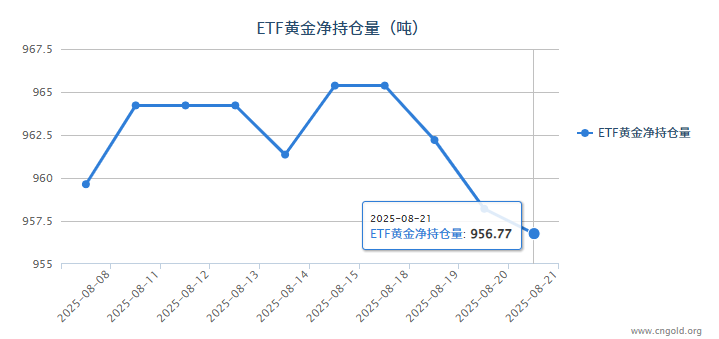
Group 1 - The largest gold ETF, iShares Silver Trust, reported a holding of 956.77 tons of gold as of August 21, a decrease of 1.44 tons from the previous trading day [1] - As of August 21, the spot gold price closed at $3,392.10 per ounce, with a daily increase of 0.25%, reaching a high of $3,352.37 and a low of $3,325.08 during the day [1] Group 2 - White House trade advisor Navarro criticized India's continued purchase of Russian oil, predicting a 50% punitive tariff on India to be implemented next week [3] - The Federal Reserve may schedule six rate cuts of 25 basis points each over the next 18 months, potentially lowering the federal funds rate to 3.0% by the end of 2026 [3] - The U.S. labor market has shown signs of slowing down, and inflation has significantly improved compared to three years ago [3]
宋雪涛:对等关税 未完待续
Jin Shi Shu Ju· 2025-08-20 05:43
Core Viewpoint - The core variable of U.S. trade policy remains Trump himself, with a highly controversial tariff strategy expected to be prevalent in the coming years, necessitating countries to become the "greatest common divisor" connecting different trade circles to gain future discourse power [2][23]. Group 1: Trump's Tariff System - Trump's tariff strategy has evolved from targeted "surgical strikes" during his first term to a more comprehensive approach in his second term, characterized by four main components: reciprocal tariffs, punitive tariffs for specific reasons, transshipment tariffs to combat tax avoidance, and industry barriers to protect domestic industries [4][8]. - The "reciprocal tariffs" framework establishes different tariff boundaries for countries, with core countries like the UK and Australia enjoying a baseline tax rate of 10%, while others face rates ranging from 15% to over 25% [5][6]. Group 2: Punitive Tariffs - Punitive tariffs are increasingly used as a core tool for handling diplomatic matters, with various justifications, including combating cross-border crime and exerting geopolitical pressure [8][9]. - The U.S. has raised tariffs on Canadian goods from 25% to 35% due to insufficient cooperation in drug trafficking control, while also imposing additional tariffs on Indian goods due to its purchase of Russian oil [8][9]. Group 3: Transshipment Tariffs - The U.S. has implemented transshipment tariffs to prevent circumvention of tariffs through third countries, imposing a 40% tax rate on goods attempting to bypass tariffs [10][12]. - The challenge lies in the ambiguous definition of "transshipment," which complicates enforcement and necessitates a collaborative regulatory framework with partner countries [12][13]. Group 4: Industry Tariffs - The U.S. has invoked the 232 clause of the Trade Expansion Act to impose high tariffs on strategic industries, aiming to reverse the trend of industrial hollowing and promote domestic manufacturing [16][17]. - Tariffs on steel and aluminum products have been set at 50%, with potential future tariffs on semiconductors and pharmaceuticals reaching as high as 300% [17][19]. Group 5: Trade Negotiation Dynamics - Tariffs serve as a preliminary tool in trade negotiations, with the Trump administration relying heavily on verbal agreements, leading to disputes over the interpretation of key terms [20][21]. - The lack of written agreements has resulted in confusion and disagreements in negotiations with countries like Japan and South Korea, affecting the finalization of trade deals [20][21]. Group 6: Economic Impact - The U.S. has entered a high-tariff era, with the average effective tariff rate rising to 18.6%, the highest level since the Great Depression [23]. - The implementation of tariffs has caused fluctuations in import data, with a significant spike in imports prior to tariff enforcement, followed by a decline as companies adjust to the new cost structure [25][28].
宋雪涛:对等关税 未完待续
雪涛宏观笔记· 2025-08-20 03:21
Core Viewpoint - The core variable of US trade policy remains Trump himself, and his controversial tariff strategy is expected to be prevalent in the next two to three years, with any country aiming to gain future discourse power needing to become the "greatest common divisor" connecting different trade circles [2][23]. Group 1: Trump's Tariff System 2.0 - During his first term, Trump initiated a trade revolution centered on "America First," using tariffs as a primary weapon, which ignited global trade disputes and altered the existing international trade landscape [4][5]. - In his second term, Trump's tariff tactics evolved into a more structured and comprehensive approach, consisting of four main components: reciprocal tariffs for trade balance, punitive tariffs for specific reasons, tariffs on transshipment to combat tax avoidance, and industry barriers to protect domestic industries [5][6]. Group 2: Reciprocal Tariffs - The "reciprocal tariffs" create a trade circle centered around the US, with countries like the UK and Australia enjoying a baseline tax rate of 10%, while others face higher rates based on their trade relations and concessions made to the US [6][7]. - As of August 29, 2023, new regulations require small packages valued at $800 or less to pay certain taxes upon entry, with specific rates based on the country of origin [7]. Group 3: Punitive Tariffs - Trump increasingly uses punitive tariffs as a core tool for handling diplomatic matters, with various justifications, including combating cross-border crime and exerting geopolitical pressure [9][10]. - The US has implemented significant tariffs on goods from Canada and Mexico, and additional tariffs on Chinese products, with the potential for further increases based on cooperation in drug trafficking issues [9][10]. Group 4: Transshipment Tariffs - To close potential loopholes in tariff policies, the Trump administration established a "transshipment" clause allowing customs to impose a 40% tariff on goods attempting to circumvent tariffs through third countries [11]. - The challenge lies in the ambiguous definition of "transshipment," which complicates enforcement and creates uncertainty for US customs [12][13]. Group 5: Industry Tariffs - The US has invoked the 1962 Trade Expansion Act's Section 232 to impose high tariffs on strategically important industries, aiming to reverse the trend of industrial hollowing and enhance domestic supply chain resilience [16][17]. - Tariffs have been applied to steel, aluminum, and are expected to extend to semiconductors and pharmaceuticals, with a notable exemption for companies investing in the US [16][17][18]. Group 6: Oral Agreements and Execution Discrepancies - Tariffs serve as a preliminary tool in trade negotiations, with the Trump administration relying heavily on oral agreements, leading to confusion and disputes over key terms [20][21]. - Discrepancies in the interpretation of agreements have hindered finalizing trade deals, as seen in negotiations with Japan and South Korea [20][21][22]. Group 7: Transition to Inventory Reduction Cycle - Following the implementation of high tariffs, the US has entered a phase of inventory reduction, with significant declines in inventory growth rates for durable and non-durable goods [28][29]. - The shift in import demand is attributed to the finalization of tariff policies and the completion of pre-tariff procurement, leading to a focus on inventory digestion and price adjustments [29][30]. Group 8: Global Trade Landscape Transformation - The global trade structure is undergoing a profound transformation towards a multipolar development, moving away from reliance on the US-China economic model to a more decentralized network of regional trade alliances [23][30]. - Countries aiming to secure future discourse power must position themselves as essential hubs within these diverse trade networks [23].
贸易专题分析报告:对等关税未完待续
SINOLINK SECURITIES· 2025-08-19 14:49
Group 1: Tariff Strategy - Tariffs are a key tool in Trump's economic policy, evolving from targeted strikes to a comprehensive strategy in his second term[2] - The tariff strategy consists of four main components: reciprocal tariffs, punitive tariffs, transshipment tariffs, and industry protection barriers[6] - The average effective tariff rate in the U.S. has increased by 16.2 percentage points, reaching 18.6%, the highest level since the Great Depression[29] Group 2: Trade Relations and Impact - The U.S. is transitioning to a more decentralized trade structure, moving away from reliance on the U.S.-China economic relationship[3] - The imposition of tariffs has led to a significant increase in import costs, with specific tariffs reaching as high as 50% on steel and aluminum products[21] - The U.S. government is using tariffs as a diplomatic tool, with punitive tariffs being applied to countries like Canada and Mexico, and targeting third-party nations involved in trade with adversaries[11] Group 3: Economic Consequences - Pre-tariff import surges led to a 4.67% month-on-month increase in imports in March, followed by a 1.39% year-on-year decline in June, indicating a demand pullback[29] - U.S. businesses are entering a de-inventory phase, with durable goods inventory growth slowing from 1.52% in March to 0.17% in June[29] - The uncertainty surrounding new tariff tools and potential trade negotiations post-midterm elections poses risks to global supply chains and capital markets[4]
美国50%关税下,印度哪些行业将受重创?
Huan Qiu Shi Bao· 2025-08-11 22:45
Economic Impact - India's exports to the US, which total approximately $87 billion, could become commercially unviable if the proposed 50% tariffs are implemented, significantly impacting the economy [4][3] - The textile, apparel, automotive parts, steel, and gemstone sectors are expected to be disproportionately affected, with the jewelry industry alone exporting around $9 billion annually [3][4] - A 25% tariff could lead to a GDP decline of 0.2% to 0.4%, potentially pushing India's economic growth rate below 6% for the year [4] Trade Relations - The US has become India's largest export market, accounting for 18% of total exports and 2.2% of GDP [4] - The imposition of high tariffs is seen as a significant setback for India's manufacturing ambitions and could reverse recent gains in attracting foreign investment [4][5] - India's response to the tariffs includes a cancellation of a defense minister's visit to the US, indicating rising tensions in trade negotiations [6] Strategic Shifts - Analysts suggest that the US actions may prompt India to reconsider its strategic partnerships, potentially deepening ties with Russia, China, and other nations [8] - The ongoing uncertainty created by US tariffs could hinder India's ability to attract both domestic and foreign investments [7]
新“对等关税”落地,除了关税,美国还开了这些条件
天天基金网· 2025-08-04 11:17
Core Viewpoint - The article discusses the implementation of reciprocal tariffs by the United States, detailing the changes in tariff rates and the broader implications for trade agreements with major economies [1][10]. Tariff Structure - A baseline tariff rate of 10% will apply to countries not specified in the administrative order, while differentiated rates ranging from 15% to 41% will be set based on trade deficits, negotiation outcomes, and geopolitical factors [4][6]. - A 40% penalty tariff will be imposed on goods rerouted through third countries to evade tariffs, and the exemption for international packages valued under $800 has been removed [4][6]. Specific Tariff Rates by Industry - Tariff rates vary significantly by industry, with solar products and semiconductor equipment facing the highest rates, while electric vehicles and automotive parts have lower rates [8]. Non-Tariff Requirements - The trade agreements with eight major economies include five categories of non-tariff requirements, such as market access, directed procurement commitments, and unified rules and standards [10][13]. - Specific commitments include significant investments in the U.S., increased defense spending, and the opening of markets for U.S. agricultural products [12][13].

欧元韧性彰显 市场押注特朗普30%关税终成“纸老虎”
智通财经网· 2025-07-14 11:17
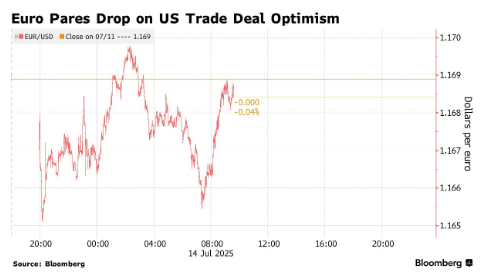
Group 1 - The market anticipates a trade agreement between the EU and the US to avoid the 30% punitive tariffs threatened by Trump, leading to resilience in the euro to dollar exchange rate, stabilizing around 1.1695 [1] - The euro initially dropped 0.3% to a three-week low of 1.1651 but later recovered all losses, indicating market volatility amid ongoing trade negotiations [1] - EU Commission President Ursula von der Leyen announced an extension of the trade countermeasure suspension period until August 1, allowing more room for negotiations [1] Group 2 - Market sentiment towards US tariff threats is diminishing, with investors confident that the Trump administration will make concessions, as seen in past policy reversals [3] - Financial leaders, including JPMorgan CEO Jamie Dimon, have warned against blind optimism in the market regarding trade negotiations [3] - The interest rate market has already priced in the impact of tariffs, with swap pricing indicating that the European Central Bank is expected to lower rates only once in the current cycle [3]
汽车早报|广汽预计上半年由盈转亏 特斯拉正式进军印度市场
Xin Lang Cai Jing· 2025-07-12 00:36
Group 1: Industry Insights - The China Automobile Industry Association is actively working to prevent "involution spillover" by promoting respect for local cultures and laws during overseas expansion, aiming for orderly growth [1] - The association has reported positive progress in anti-involution efforts, with mainstream industry players taking proactive measures to enhance self-discipline [1] Group 2: Company Performance - GAC Group expects a net loss of 1.82 billion to 2.6 billion yuan for the first half of 2025, compared to a net profit of 1.516 billion yuan in the same period last year, due to slow sales of new energy models and the impact of price wars [1] - XPeng Motors has officially communicated a commitment to a 60-day payment term to suppliers, marking a significant adjustment in its payment practices [1] Group 3: Market Developments - Volkswagen is reportedly planning to close its Nanjing factory by the end of this year, marking the first complete shutdown of a manufacturing plant in China, although SAIC Volkswagen claims operations are normal [2] - Tesla will open its first experience center in Mumbai, India, on July 15, showcasing popular models and providing test drives and consultations, indicating its entry into the Indian market [3] - Mercedes-Benz India reported a 10% year-on-year increase in retail sales for April to June, reaching 4,238 units, driven by demand for high-end models and a 157% increase in electric vehicle sales [4] Group 4: Regulatory Impact - Volkswagen has paused deliveries of an electric vehicle to the U.S. due to dissatisfaction with seat width and significant punitive tariffs imposed by the U.S. government, which have increased from 2.5% to 27.5% since April, potentially costing German manufacturers over 11 billion euros this year [5]



