
成长风格投资

Search documents
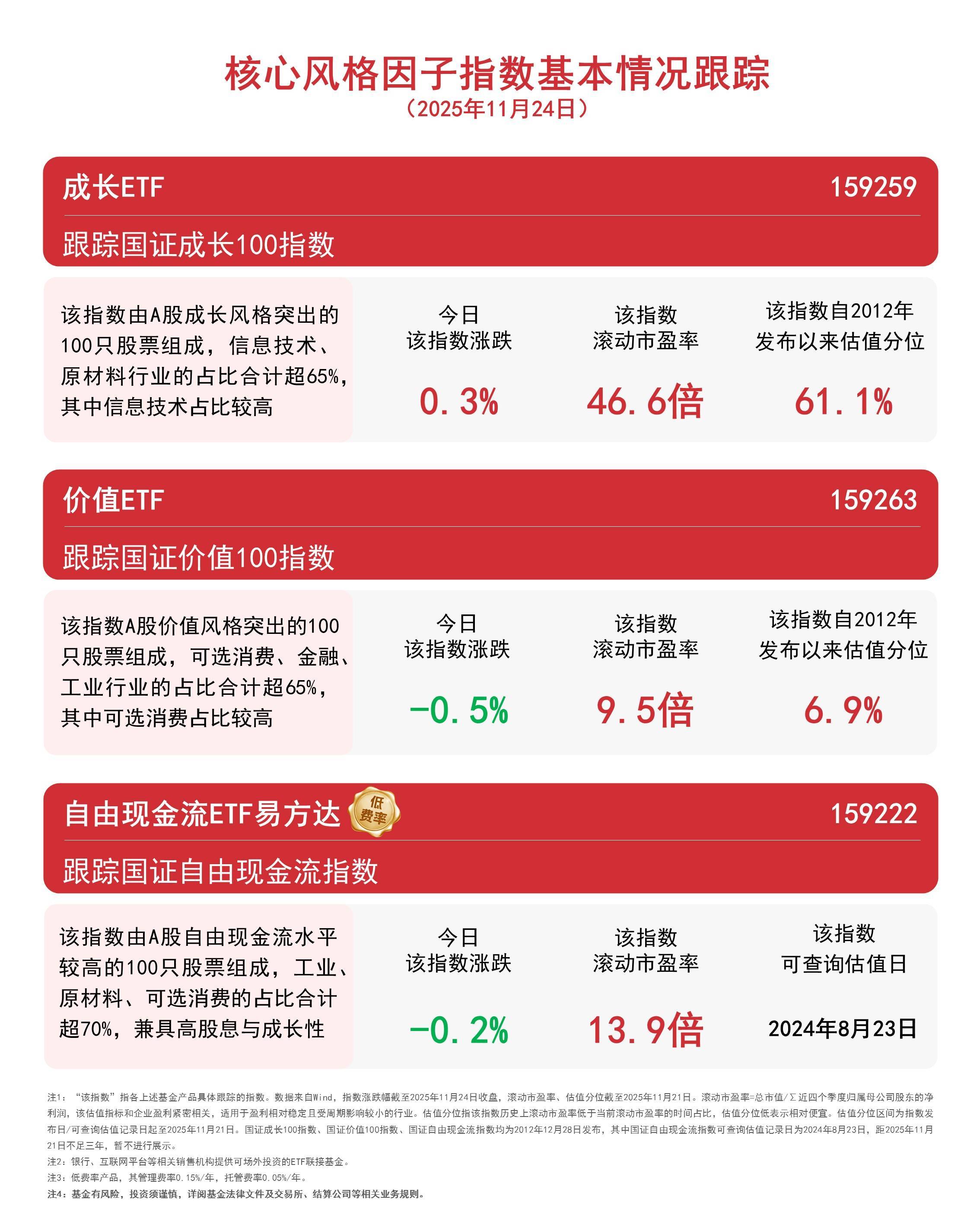
成长风格小幅收涨,成长ETF(159259)获资金持续布局
Sou Hu Cai Jing· 2025-11-24 12:20
Group 1 - The Guozheng Growth 100 Index increased by 0.3%, while the Guozheng Free Cash Flow Index decreased by 0.2%, and the Guozheng Value 100 Index fell by 0.5% [1] - The Growth ETF (159259) saw a net subscription of 10 million units throughout the day, marking a continuous net inflow of over 80 million yuan in the previous four trading days [1] - The Guozheng Growth 100 Index focuses on stocks with a strong growth style in the A-share market, particularly in high-prosperity sectors such as electronics, communications, and computers [1] Group 2 - The Growth ETF (159259) is the only product tracking the Guozheng Growth 100 Index, providing investors with opportunities to capitalize on growth-style investments [1]

聊几位值得关注的基金经理
雪球· 2025-11-20 07:54
Core Viewpoint - The article discusses several noteworthy fund managers and their performance, highlighting their unique investment styles and the potential for future tracking by investors [4]. Group 1: Yang Shijin - Xingquan Multi-Dimensional Value - Yang Shijin has been managing Xingquan Multi-Dimensional Value since July 16, 2021, demonstrating strong investment capabilities with an 18.02% increase in 2021 despite market downturns [5][6]. - The fund has shown resilience during bear markets in 2022 and 2023, maintaining a single-year decline of around 10% [6]. - Yang's investment strategy includes a concentrated position in the electronics sector, with long-term holdings in stocks like Haiguang Information and Tencent Holdings [10][11]. Group 2: Wu Yuanyi - GF Growth Navigator - Wu Yuanyi is recognized for his balanced industry allocation and impressive performance, with the GF Growth Navigator fund achieving a 143.14% increase year-to-date as of November 17 [12][14]. - The fund maintains a maximum industry allocation of 20%, showcasing a diversified approach that has led to strong returns without heavy reliance on specific sectors [14]. - Wu's ability to rotate stocks effectively has contributed to the fund's success, even amidst a challenging market environment [15]. Group 3: Shen Cheng - Huafu New Energy - Shen Cheng has managed Huafu New Energy since December 29, 2021, achieving consistent excess returns relative to its benchmark despite the sector's overall struggles [18][20]. - The fund's annual returns from 2022 to 2025 have outperformed its benchmark, with a notable 76.76% increase in the latest year [20]. - Shen's investment strategy includes holding industry leaders like Ningde Times while also actively trading to capitalize on short-term opportunities [21][22].

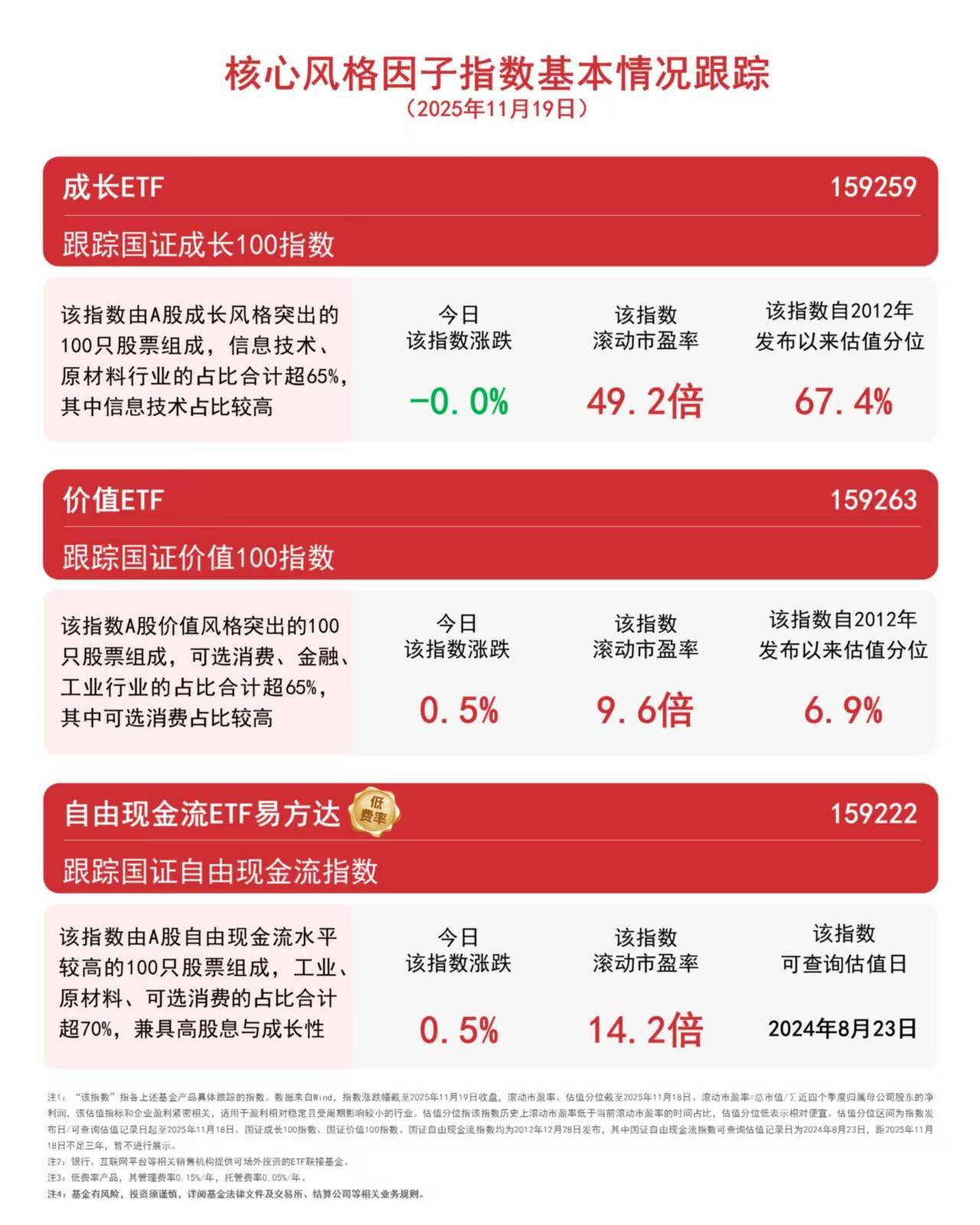
价值风格午后走强,价值ETF(159263)、自由现金流ETF易方达(159222)盘中均获资金加仓
Sou Hu Cai Jing· 2025-11-19 10:23
Core Insights - The National Securities Value 100 Index and the National Securities Free Cash Flow Index both increased by 0.5%, while the National Securities Growth 100 Index decreased by 0.02% [1] - Related ETFs saw significant inflows, with the Value ETF (159263) and the Free Cash Flow ETF (E Fund, 159222) experiencing net subscriptions of 2 million and 4 million units respectively [1] Group 1: Index Performance - The National Securities Value 100 Index employs a "high dividend + high free cash flow + low price-to-earnings ratio" screening system, focusing on value stocks with a stable historical performance [1] - The National Securities Free Cash Flow Index selects stocks based on free cash flow rates, combining high dividends with growth potential [1] Group 2: ETF Details - The Value ETF (159263) tracks the National Securities Value 100 Index, which consists of 100 stocks with a focus on value, primarily in the consumer discretionary, financial, and industrial sectors, which together account for over 65% of the index [3] - The Free Cash Flow ETF (E Fund, 159222) tracks the National Securities Free Cash Flow Index, comprising 100 stocks with high free cash flow levels, with over 70% of the index represented by industrials, materials, and consumer discretionary sectors [3]
瑞银证券中国股票策略分析师孟磊:预计2025年A股盈利同比增长6%
Zheng Quan Ri Bao Wang· 2025-11-04 07:11
Core Viewpoint - UBS Securities maintains a baseline forecast of 6% year-on-year growth in total A-share earnings for 2025 [1] Group 1: Market Outlook - The medium-term outlook for the market remains positive due to gradual earnings recovery, continuous net inflow of various off-market funds, and the supportive narrative of technology aiding valuation reconstruction [1] - The construction of a capital market focused on investors continues to be a driving force for the upward trend in the stock market [1] Group 2: Investment Strategy - Growth style is likely to remain the main investment theme, with the ChiNext board showing a favorable risk-reward ratio due to accelerating earnings and long-term resilience [1] - The valuation levels of the ChiNext board, both in absolute terms and relative to the CSI 300, are below long-term averages [1]
指数成分股前三季度整体利润同比翻倍,成长ETF(159259)盘中净申购达1000万份
Mei Ri Jing Ji Xin Wen· 2025-10-31 07:06
Core Viewpoint - The market experienced fluctuations today, with a pullback in growth style stocks, as evidenced by the 2.4% decline in the Guozheng Growth 100 Index. However, there was a counter-trend investment in growth ETFs, with a net subscription of 10 million units for ETF (159259) during the day [1]. Group 1: Index Performance - The Guozheng Growth 100 Index focuses on A-share stocks with strong growth characteristics, particularly in high-growth sectors such as electronics, communications, and computers. The index's constituent stocks reported a total net profit of 39.65 billion yuan for the first three quarters, reflecting a year-on-year increase of nearly 130%. Additionally, total operating revenue reached 467.74 billion yuan, with a year-on-year growth of over 20% [1]. - Historical performance shows that since the base date at the end of 2012, the index has achieved an annualized return of over 20%. Since the beginning of 2024, the return has approached 110%, and the year-to-date return exceeds 50%, outperforming similar style indices [1]. Group 2: Investment Strategy - According to Industrial Securities, the "14th Five-Year Plan" aims to boost confidence and consolidate consensus, suggesting a positive long-term narrative for the current market trend. The focus should remain on strategic layouts centered around the "14th Five-Year Plan," emphasizing the exploration of opportunities in the technology growth sector, supported by favorable industry trends and policies [1]. - The Growth ETF (159259) is currently the only ETF product tracking the Guozheng Growth 100 Index, providing investors with a means to capitalize on growth style investment opportunities [1].
成长风格相对强势,成长ETF(159259)标的指数冲击“三连阳”
Mei Ri Jing Ji Xin Wen· 2025-10-28 07:23
Core Viewpoint - The market showed strength in the morning, surpassing the 4000-point mark, but experienced a pullback in the afternoon, with the growth style performing relatively strong. The Guozheng Growth 100 Index rose by 0.5% as of 14:32, having increased nearly 7% over the previous two trading days [1] Group 1: Index Performance - The Guozheng Growth 100 Index focuses on stocks with prominent growth characteristics in the A-share market, with a projected net profit growth rate exceeding 100% for 2025 [1] - Historically, the index has shown an annualized return of over 20% since its base date at the end of 2012, with a return exceeding 110% since the beginning of 2024 and approximately 53% year-to-date, outperforming similar style indices [1] Group 2: Sector Allocation - The Guozheng Growth 100 Index currently has significant allocations in high-growth sectors such as electronics, non-ferrous metals, telecommunications, computers, and power equipment, with the top five industries accounting for over 70% of the index weight [1] Group 3: Investment Products - The Growth ETF (159259) is the only ETF product tracking the Guozheng Growth 100 Index, providing investors who prefer growth styles an opportunity to easily invest in quality growth stocks [1]
大A的荣耀不再属于“性价比”投资者
虎嗅APP· 2025-10-09 23:56
Core Viewpoint - The article discusses the performance of deep value fund managers during different market conditions, highlighting their underperformance in the current bull market compared to growth-style fund managers, particularly in sectors like technology and innovation [4][20]. Group 1: Performance Comparison - In the past three years of bear markets, deep value fund managers performed relatively well, with many managing over 10 billion in assets [5]. - As of September 24, 2023, mainstream deep value fund managers like Xu Yan and Jiang Cheng had annual returns below 20%, while the average return of the CSI Active Equity Fund Index reached 34.11% [6][12]. - The article notes that deep value fund managers typically focus on low-valuation, stable companies, which leads to lower returns in bull markets but better performance in bear markets [14][19]. Group 2: Investment Philosophy - Deep value fund managers invest from an owner's perspective, focusing on long-term intrinsic value rather than short-term market fluctuations [16]. - They emphasize "quality and price," seeking high-quality companies that are undervalued due to market sentiment [17]. - Safety margins are crucial in their investment decisions, as they aim to protect against errors and downside risks [17][18]. Group 3: Market Trends and Strategies - The current bull market has favored growth-style funds, particularly those heavily invested in technology, with some achieving over 200% annual returns [7]. - Deep value fund managers often hold significant positions in traditional sectors like finance and real estate, which have underperformed in the current market [14][19]. - The article suggests that deep value funds should be considered for core portfolio allocations, especially for conservative investors [23][24]. Group 4: Selection Criteria - Not all low-valuation stocks represent deep value; some may belong to contrarian or cyclical strategies [29]. - Investors should focus on the stability of deep value fund managers' styles, as many have shifted towards growth or other strategies over time [36][38]. - The article advises that deep value funds can serve as a bottom-layer allocation in a diversified portfolio, balancing risk and return [24][26].






东方红资产管理蒋娜:关注业绩兑现,聚焦成长产业爆发窗口
Zhong Guo Zheng Quan Bao· 2025-09-08 08:41
Core Viewpoint - The investment landscape in the AI sector is shifting, with fund managers adopting two distinct styles: one focusing on long-term potential in niche segments and the other emphasizing strict performance verification [1][5]. Group 1: Investment Style and Strategy - Fund manager Jiang Na from Dongfanghong Asset Management prioritizes companies in the "performance explosion" phase, focusing on financial data quality such as cash flow and balance sheets [2][4]. - Jiang Na emphasizes the importance of accurately identifying industry cycle positions, particularly favoring sectors transitioning from introduction to growth phases, which present richer investment opportunities [2][4]. - The investment approach is characterized by a "platform-type" strategy, leveraging team resources and insights to capture opportunities in rapidly changing industries [3]. Group 2: Stock Selection Criteria - Jiang Na employs a "three new" principle for selecting growth stocks: new cycle, new customers, and new products, with a focus on AI-driven demand as a clear new cycle [4][6]. - The selection process involves assessing the strength and authenticity of market demand, supported by three years of deep tracking and cross-validation of major industry trends [4][6]. Group 3: Market Outlook - The outlook for the market suggests a potential shift from value to growth style, with AI, gaming, and internet sectors being highlighted as key areas of interest [5][6]. - The gaming sector is expected to benefit from favorable policies such as normalized licensing and relaxed reviews, while top internet companies may have underestimated AI application potential [6]. - Companies expanding internationally, particularly in culturally rich sectors like gaming and new consumer brands, are also seen as promising investment opportunities [6].
东方红资产管理蒋娜:关注业绩兑现 聚焦成长产业爆发窗口
Zhong Guo Zheng Quan Bao· 2025-09-08 00:47
Group 1 - The article highlights the investment strategies of fund managers entering the AI sector, distinguishing between those focused on long-term potential and those with strict performance requirements [2] - The shift from value to growth investment styles is anticipated this year, with AI being a significant trend and other sectors like gaming and consumer also presenting investment opportunities [2][6] Group 2 - The investment approach emphasizes the importance of financial data, with a focus on companies in their "performance explosion" phase, ensuring that financial metrics are robust [3] - Identifying industries transitioning from introduction to growth phases is crucial, as these often present richer investment opportunities [3] Group 3 - The "three new" principles for selecting growth stocks include new cycles, new customers, and new products, with a strong emphasis on the authenticity and strength of market demand [5] - The PCB sector has shown strong performance due to AI-driven demand, with specific companies already being significant holdings in managed products [5] Group 4 - The outlook for the market suggests that equity assets may perform well under a moderately loose monetary policy, with a focus on concentrated industries and diversified individual stocks to manage risks [6] - Key sectors to watch include AI, gaming, and internet, with the latter benefiting from favorable policies and the potential of AI applications [6][7] Group 5 - Companies expanding internationally are gaining attention, particularly those in cultural sectors with lower trade friction risks, such as gaming and new consumer brands [7] - There is also interest in sectors like chemicals, new energy, and consumer goods that may experience a bottom reversal, highlighting the importance of independent judgment in volatile markets [7]

东方红资产管理蒋娜: 关注业绩兑现 聚焦成长产业爆发窗口
Zhong Guo Zheng Quan Bao· 2025-09-07 20:49
Core Viewpoint - The investment landscape in the AI sector is shifting, with a potential transition from value to growth style, highlighting significant long-term opportunities in AI and related industries [1][5]. Investment Style - Two distinct investment styles have emerged among fund managers entering the AI space: one focusing on long-term sector potential and the other emphasizing strict performance verification [1]. - The investment approach of the fund manager from Dongfanghong Asset Management, Jiang Na, is characterized by a high demand for financial data and a focus on companies in their "performance explosion" phase [2]. Financial Analysis - Jiang Na prioritizes companies with strong financial metrics, including cash flow and balance sheet quality, and regularly updates financial models for the companies in her portfolio [2]. - The investment strategy includes a keen assessment of industry cycles, particularly favoring sectors transitioning from low penetration to growth phases, which present richer investment opportunities [2]. Resource Integration - Jiang Na leverages her extensive experience and team collaboration to identify and capitalize on investment opportunities, emphasizing the importance of collective intelligence over individual efforts [3]. Stock Selection Criteria - The selection of stocks is guided by the "three new" principles: new cycle, new customers, and new products, with a focus on the AI-driven demand explosion in the PCB sector [4]. - The emphasis on customer perspective and management foresight in identifying strong companies is crucial for building competitive advantages [4]. Market Outlook - The outlook for the market suggests a favorable environment for equity assets, with a potential shift towards growth styles aligning with Jiang Na's investment focus [5][6]. - Key sectors to watch include AI, internet, gaming, and companies expanding internationally, particularly those with cultural attributes and lower trade friction risks [6]. - The chemical, new energy, and consumer sectors are also highlighted for potential bottom reversals, with a focus on maintaining independent judgment amid market consensus [6].