
智驾平权

Search documents
轻舟智航董事长于骞:公司辅助驾驶系统搭载量突破100万台 正式进入L4无人物流领域
Zhong Zheng Wang· 2026-01-25 03:27
Core Insights - The company Lightyear has officially entered the L4 unmanned logistics sector and has begun deployment operations in multiple locations, marking a new phase of large-scale implementation for its passenger vehicle assistance systems, which have surpassed 1 million units in deployment [1][2]. Group 1: Industry Trends - The evolution of autonomous driving technology is undergoing profound changes, transitioning from a "machine intelligence" phase to a "human-like intelligence" phase, with 2026 identified as a critical turning point for the industry [2]. - The introduction of end-to-end architecture and models like VLA and world models will drive a comprehensive understanding of the real world, allowing autonomous systems to surpass human driving capabilities [2]. - The next decade is expected to be a golden era for autonomous driving, with significant advancements in technology and market penetration anticipated [2]. Group 2: Product Development - Lightyear plans to launch its first end-to-end urban NOA solution based on a single journey 6M platform by April 2025, with the official vehicle integration occurring in January 2026 [3]. - The new generation "Lightyear Sailing 2.0" assistance solution will focus on safety and explainability, achieving a driving experience equivalent to 256 TOPS with only 128 TOPS of computing power [3]. - The company aims to promote high-level assistance driving solutions to the 100,000 yuan market by 2026, expanding its coverage from 80,000 to 400,000 yuan models [3]. Group 3: Future Deployment Plans - Lightyear has outlined a product evolution roadmap that includes the large-scale deployment of Robotaxi by 2027, supported by the Robo-X autonomous driving open platform [5]. - The Robo-X platform aims to become the "Android of the autonomous driving field," providing a universal technology base and comprehensive tools for various autonomous driving scenarios [5]. - Strategic partnerships, such as with Chery Commercial Vehicles, are being formed to create benchmark L4 logistics products and services [5].
2026智驾迎来“价值深化”新一年
Zhong Guo Qi Che Bao Wang· 2026-01-23 09:15
Core Insights - The automotive industry is increasingly focusing on intelligent assisted driving, with companies like BYD investing over 100 billion yuan and forming specialized teams to enhance their capabilities [2] - The shift in the industry is moving from scale and accessibility to user experience, emphasizing the importance of value creation in the competitive landscape [3][12] Investment and Development - BYD has established a team of over 5,000 for assisted driving and aims to deploy its "Tian Shen Zhi Yan" system in over 2.5 million vehicles by December 2025, generating over 150 million kilometers of effective driving data daily [3] - The establishment of new companies, such as the joint venture between BAIC and Horizon Robotics, indicates a growing trend towards collaboration in the intelligent driving sector [2][4] Technological Pathways - Companies are adopting full-stack self-research as a key strategy to deepen their understanding of technology and user needs, with BYD exemplifying this approach through significant investment and team size [3][5] - Open collaboration with third-party solution providers is also becoming a vital strategy, allowing companies to enhance their systems' performance and functionality through shared resources [4][5] User Experience and Market Trends - The concept of "intelligent driving equity" is emerging, indicating a shift towards making advanced driving features accessible in the mid-range vehicle market, particularly in the 100,000 to 150,000 yuan price range [12][14] - User feedback highlights the importance of stability in high-frequency scenarios, ease of use in interaction design, and the need for cost-effective solutions [13][14] Industry Dynamics - Suppliers are transitioning from providing single hardware products to offering integrated software and hardware solutions, becoming deep partners in the development of intelligent driving systems [6][8] - The competitive focus is shifting from merely having intelligent driving capabilities to ensuring their reliability, safety, and user-friendliness in complex driving environments [7][11] Future Outlook - The industry is expected to evolve towards a model where technology is not only usable but also provides a good user experience, ultimately leading to a sustainable business model [14] - As regulations and infrastructure improve, the Chinese intelligent driving industry is poised for high-quality development on a global scale, driven by technology and user experience [14]

智能化迈出“破冰”行动 汽车产销再创历史新高
Jing Ji Ri Bao· 2026-01-20 19:59
Core Insights - In 2025, China's automotive industry demonstrated remarkable resilience and vitality, achieving record production and sales figures of 34.53 million and 34.40 million vehicles, respectively, marking year-on-year growth of 10.4% and 9.4% [1] - The year marked a significant shift in the market, with new energy vehicles (NEVs) surpassing 50% of domestic new car sales, establishing themselves as the mainstream product in the automotive market [2][3] - The automotive export volume exceeded 7 million units, with NEV exports reaching 2.615 million units, reflecting a strong competitive edge in international markets [11] NEV Market Dominance - NEVs accounted for 50.8% of domestic new car sales in 2025, indicating that for every two new cars sold, one was an NEV [3] - NEV production and sales reached 16.626 million and 16.49 million units, respectively, with year-on-year growth of 29% and 28.2%, maintaining a global leadership position for 11 consecutive years [3] - The competitive landscape has shifted, with domestic brands capturing nearly 70% of the passenger car market share, reversing the dominance of joint venture brands [3][4] Technological and Policy Support - The growth of NEVs is attributed to supportive policies, technological advancements, and a robust supply chain, with over 11.5 million vehicles replaced under the trade-in policy, generating sales exceeding 1.6 trillion yuan [5] - Technological innovations have led to significant improvements in vehicle performance, such as a 30% reduction in battery costs and a 40% increase in battery lifespan [6] - The establishment of a comprehensive supply chain has positioned China as a leading supplier of battery materials and power batteries globally, with 70% and 60% market shares, respectively [6] Smart Driving Developments - The approval of the first L3-level conditional autonomous driving models in December 2025 marked a pivotal moment in China's autonomous driving industry, transitioning from technology validation to mass production [7] - The penetration rate of vehicles equipped with L2-level driving assistance features reached 64%, with a year-on-year growth of 21.2% in the first three quarters of 2025 [9] - The integration of AI technologies into smart driving systems has accelerated advancements, with new models emerging that enhance driving experiences and product forms [9][10] International Expansion and Localization - In response to intensified domestic competition, Chinese automakers are accelerating their international expansion, with exports reaching 7.098 million units in 2025, a 21.1% increase [11] - Localization strategies are being implemented in key markets such as Southeast Asia and Europe, with several Chinese brands establishing manufacturing bases to enhance competitiveness [12] - Collaborations with multinational companies are facilitating the entry of Chinese automotive supply chains into global markets, strengthening China's position in the global automotive value chain [12] Market Competition Restructuring - The introduction of compliance guidelines aims to curb price wars and establish a more orderly competitive environment in the automotive industry [13] - Measures to address "involution" in the market have begun to take effect, with a shift from price competition to a focus on technology, quality, and service [13][14] - The automotive industry is transitioning from a phase of scale expansion to one of quality enhancement, necessitating a comprehensive approach to market regulation and competition [15]

地平线副总裁、战略部&智驾产品规划与市场部负责人吕鹏:以算力、算法引领智驾“平权”革命
Zhong Guo Qi Che Bao Wang· 2026-01-19 03:31
Core Insights - The automotive industry in China has achieved global leadership in self-owned brands through electrification, laying a solid foundation for the next phase of intelligent driving [1] - Intelligent assisted driving is transitioning from a luxury feature exclusive to high-end models to a new generation of automatic driving that benefits all consumers, marking the beginning of an inclusive movement across all price ranges and scenarios [1][3] Industry Trends - Consumers across all price segments are increasingly prioritizing intelligent driving capabilities when purchasing vehicles, making this feature a key competitive element [3] - The value of assisted driving lies in addressing complex daily commuting scenarios, evolving from "usable" to "user-friendly," thus becoming a necessity for alleviating driving fatigue and enabling efficient travel [3] Technological Developments - Horizon Robotics proposes a solution to industry pain points with its "high computing power + high throughput" approach, utilizing the Journey 6 series chips to create a robust computational foundation for assisted driving [4] - The Journey 6 series includes various models, such as Journey 6P, Journey 6M, Journey 6E, and Journey 6B, each designed for different driving scenarios and market needs, achieving significant cost reductions without sacrificing performance [4] Product Innovations - The HSD all-scenario assisted driving system, built on the Journey 6P, is positioned as a "Chinese version of FSD," emphasizing human-like driving behavior and safety [5] - HSD has garnered recognition from over 10 automotive companies, with more than 20 models already in production, contributing to a milestone of over 10 million units shipped [5] Future Outlook - Horizon Robotics aims to enhance safety and user experience during the critical transition from assisted driving to autonomous driving over the next 3 to 5 years, promoting the widespread adoption of all-scenario assisted driving [6] - The company emphasizes collaboration with partners to empower the intelligent automotive industry and improve the quality of assisted driving experiences for a broader audience [6]
AI重构汽车!奇瑞AI之夜放大招:35款车搭猎鹰智驾 智驾平权杀向中端市场
Guo Ji Jin Rong Bao· 2026-01-18 13:49
Core Viewpoint - The Chinese automotive market is entering a new phase of competition defined by AI technology, transitioning from a differentiating selling point to a core survival element [2] Group 1: AI Strategy and Developments - Chery Automobile launched its AI strategy at the "AI Night" event, showcasing key AI technologies including the AI assistant "Xiao Qi," Falcon Intelligent Driving, Lingxi Smart Cabin, and other core AI achievements [2][4] - The AI strategy aims to address three major challenges: safety, legal and ethical issues, and quality management in AI development [5][6] Group 2: Intelligent Driving and Cabin Innovations - The Falcon Intelligent Driving system has been upgraded, introducing features like urban navigation assistance and supporting L3 and L4 level driving solutions [7] - The Lingxi Smart Cabin enhances user interaction with a refined UI and the AI assistant "Xiao Qi," ensuring high standards of privacy protection in compliance with GDPR [9] Group 3: Market Trends and Competitive Landscape - The Chinese automotive market is projected to reach 34.4 million units by 2025, with L2 and above autonomous driving configurations expected to reach 82.6% in new energy vehicles [11] - The market is characterized by a "three-fold competition" with Tesla dominating the high-end market, while local brands like Huawei and Li Auto are targeting the mid-range market [11] Group 4: Challenges and Future Outlook - Chery faces challenges such as competition in model scale and performance, the need to balance cost-effectiveness with reliability, and the pressure from competitors like Tesla and Huawei [12] - The automotive industry's AI transformation is shifting from "single-point breakthroughs" to "ecosystem collaboration," with Chery needing to enhance data integration and local iteration to maintain its competitive edge [12]
【回眸二〇二五】看见中国汽车业的向上力量
Jing Ji Ri Bao· 2026-01-17 23:13
Core Insights - In 2025, China's automotive industry demonstrated resilience and growth, achieving record production and sales figures, with production reaching 34.53 million vehicles and sales at 34.40 million, marking year-on-year increases of 10.4% and 9.4% respectively [1] - The year marked a significant shift in the market, with new energy vehicles (NEVs) accounting for over 50% of domestic new car sales, indicating a transition from niche to mainstream [2] - The automotive export sector also thrived, with exports surpassing 7 million vehicles, driven by technological innovation and a robust supply chain [10] New Energy Vehicles - NEVs achieved a domestic sales share of 50.8%, with production and sales figures of 16.63 million and 16.49 million respectively, reflecting year-on-year growth of 29% and 28.2% [2] - The competitive landscape shifted dramatically, with domestic brands capturing nearly 70% of the passenger car market, reversing the dominance of joint ventures [2][3] Technological Advancements - The automotive industry is undergoing a transformation driven by electrification and intelligent technology, with significant advancements in product performance and consumer acceptance [4][5] - Innovations in battery technology have led to a 30% reduction in battery costs and a 40% increase in lifespan, enhancing the competitiveness of Chinese automotive products [5] Intelligent Driving - The approval of L3-level conditional autonomous driving vehicles marks a pivotal moment in China's autonomous driving sector, transitioning from technical validation to mass production [6] - The penetration rate of vehicles equipped with Level 2 autonomous driving features reached 64%, with a year-on-year growth of 21.2% in the first three quarters of 2025 [8] Export Growth and Localization - China's automotive exports reached 7.1 million units in 2025, with NEV exports doubling to 2.615 million units, showcasing the global competitiveness of Chinese automotive products [10] - Localization strategies are being implemented, with over 20 Chinese automotive brands establishing manufacturing facilities in Thailand and other regions to enhance local production capabilities [11] Market Competition Dynamics - The introduction of compliance guidelines aims to curb price wars and establish a more orderly competitive environment, shifting the focus from price competition to quality and service [12] - The automotive industry is transitioning from a focus on volume to an emphasis on quality, with a profit margin of only 4.4% in the first eleven months of 2025, below the manufacturing industry average [12][13]
看见中国汽车业的向上力量
Jing Ji Ri Bao· 2026-01-17 21:59
Core Insights - In 2025, China's automotive industry achieved record production and sales figures, with 34.53 million vehicles produced and 34.40 million sold, marking year-on-year growth of 10.4% and 9.4% respectively, showcasing resilience and vitality in the sector [1] - The year marked a significant shift in the market, with new energy vehicles (NEVs) accounting for over 50% of domestic new car sales, indicating a transition from niche to mainstream [2][3] - The automotive export volume exceeded 7 million units, with NEV exports reaching 2.615 million units, reflecting a robust international market presence [11] New Energy Vehicles (NEVs) as Market Leaders - NEVs accounted for 50.8% of new car sales in 2025, with production and sales figures of 16.626 million and 16.49 million respectively, representing year-on-year growth of 29% and 28.2% [3] - The competitive landscape has shifted, with domestic brands capturing nearly 70% of the passenger car market share, reversing the dominance of joint venture brands [3][4] Technological Advancements and Policy Support - The growth of NEVs is attributed to supportive policies, technological innovations, and a robust supply chain, with over 11.5 million vehicles exchanged under the trade-in program, contributing to over 1.6 trillion yuan in new car sales [5] - Significant advancements in battery technology have led to a 30% reduction in battery costs and a 40% increase in battery lifespan, enhancing product competitiveness [6] Smart Driving Developments - The approval of the first L3-level conditional autonomous driving vehicles marks a pivotal moment in China's smart driving sector, transitioning from technology validation to mass production [7] - The penetration rate of L2-level vehicles with combined auxiliary driving functions reached 64% in the first three quarters of 2025, driven by decreasing costs and increased accessibility [9] Global Expansion and Localization - China's automotive exports reached 7.098 million units in 2025, with a 21.1% year-on-year increase, highlighting the importance of overseas markets as growth drivers [11] - Localization efforts are intensifying, with over 20 Chinese automotive brands establishing manufacturing facilities in Thailand and Brazil, enhancing local production capabilities [12] Market Competition and Regulation - The introduction of compliance guidelines aims to curb price wars and establish a more orderly competitive environment, shifting focus from price competition to quality and service [13] - The automotive industry is transitioning from a phase of scale expansion to one of quality enhancement, necessitating a comprehensive approach to regulate competition and promote sustainable growth [15]
AI重塑汽车产业:从CES 2026看智能化革命的深度演进
Zhong Guo Qi Che Bao Wang· 2026-01-15 06:23
Core Insights - The CES 2026 event highlighted the accelerated transformation of the automotive industry towards smart technology, with AI becoming a core element in redefining automotive products [1] - The concept of "smart driving equity" emerged as a key theme in 2025, with advanced driving systems becoming accessible across a wider range of vehicle price points [2] - The rapid proliferation of smart driving technology necessitates new requirements for vehicle after-sales service systems, leveraging AI for efficient diagnostics [3] - The commercialization of Robotaxi services is gaining momentum, with significant growth in revenue and operational scale in major Chinese cities [5] - The evolution of smart cockpits is transforming vehicles into personalized assistants, enhancing user interaction and experience [6] - AI-driven marketing services are reshaping automotive marketing from broad outreach to precision targeting [7] - The competitive landscape is shifting towards ecosystem collaboration among automotive companies and technology suppliers, fostering innovation and efficiency [9] - The future of the automotive industry will be defined by AI, with a focus on collaborative ecosystems and comprehensive digital transformation [10] Group 1: Smart Driving Technology - The introduction of advanced driving systems like BYD's "Heavenly Eye" and Xiaopeng's XNGP is making smart driving features available in lower-priced vehicles [2] - The VLA architecture enables a more human-like decision-making process in driving, significantly reducing reliance on real vehicle data for testing [2] - The cost reduction in high-level driving systems, such as the integration of solid-state LiDAR, is facilitating their adoption in more affordable models [2] Group 2: After-Sales Service Innovations - The establishment of an AI-driven diagnostic system has achieved a 98.1% accuracy rate in diagnosing electric vehicle systems, significantly improving service efficiency [3] - The AI system reduces the time to address individual faults to approximately 20 seconds, enhancing the overall after-sales service experience [3] Group 3: Commercialization of Robotaxi - Major cities in China are rapidly expanding Robotaxi operations, with Wuhan leading in testing mileage and population coverage [5] - Companies like Pony.ai and WeRide are reporting substantial revenue growth in their Robotaxi services, indicating a shift towards profitability [5] - The market for Robotaxi services is projected to grow significantly, with estimates reaching $4.7 billion by 2035 [5] Group 4: Smart Cockpit Developments - The integration of advanced AI models in vehicle cockpits is transforming them into intelligent assistants capable of understanding user emotions and preferences [6] - The trend towards end-to-end AI solutions in cockpits is expected to enhance user experience and interaction [6] Group 5: Marketing and Service Automation - AI-driven marketing tools are enabling automotive brands to identify high-intent customers and streamline communication processes [7] - The use of AI in customer outreach has led to improved engagement rates and more efficient service delivery [8] Group 6: Ecosystem Collaboration - Automotive companies are increasingly forming strategic partnerships with technology suppliers to enhance their capabilities and reduce R&D costs [9] - The collaborative model is leading to faster product iteration cycles and improved technology deployment [9] Group 7: Future Outlook - The automotive industry is entering a new era defined by AI, with a focus on collaborative ecosystems and comprehensive digital transformation [10] - The competition will center around the efficiency of ecosystem collaboration and the ability to innovate rapidly [10]
年终盘点2025汽车市场的“龙门一跃”:油退电进,全球登顶
3 6 Ke· 2026-01-12 10:37
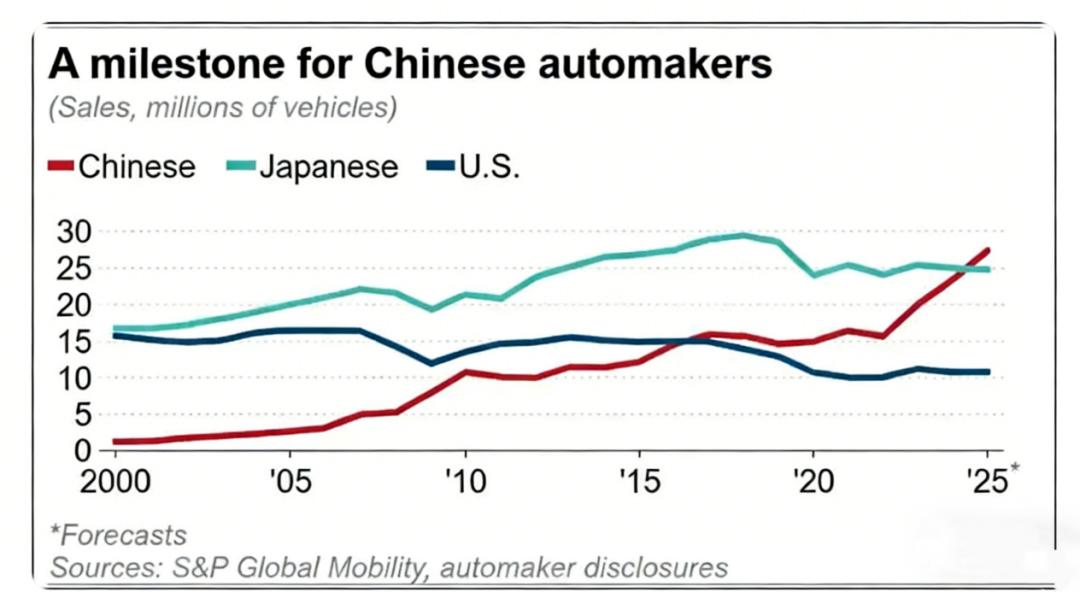
Core Insights - The penetration rate of new energy vehicles (NEVs) in China has surpassed 50%, marking a significant shift in the automotive market dynamics, transitioning from a "policy-driven" to a "product-driven" model [1][10] - The year 2025 is seen as a pivotal moment for the Chinese automotive industry, with the market experiencing a fundamental transformation akin to a "Nokia moment" [1] - The competition is evolving from price wars to value wars, emphasizing technology and product quality over mere volume [11] Industry Overview - In 2025, China's automotive manufacturers are projected to achieve global sales of 27 million vehicles, securing the top position in the global new car sales rankings for the first time [2] - China has overtaken Japan to become the world's largest automobile exporter, with NEVs accounting for a significant portion of this growth [4] - The domestic market's NEV sales are nearing 60%, reflecting a structural change in consumer preferences [4] Sales and Market Penetration - By November 2025, the retail penetration rate of NEVs reached 53.6%, with projections for the full year estimating a rate of 54.0% [6] - The rapid increase in NEV penetration is attributed to a combination of policy support, technological advancements, infrastructure development, and market demand [7] Policy and Technological Developments - The exit of purchase subsidies in 2023 has been offset by continued tax exemptions and various local incentives, which have helped maintain consumer interest in NEVs [7] - 2025 is expected to be a year of technological breakthroughs in NEVs, with advancements in high-voltage platforms, solid-state batteries, and smart driving technologies [8] Infrastructure and Consumer Experience - The expansion of charging infrastructure is crucial for alleviating consumer concerns about range anxiety, with projections of 20 million charging stations by the end of 2025 [9] - The cost advantages of NEVs are becoming increasingly apparent, with electric vehicles offering significantly lower operating costs compared to traditional fuel vehicles [9] Competitive Landscape - The shift from price competition to value competition is reshaping the industry, with companies focusing on technological innovation and profitability [11] - Some companies, like Leap Motor, have emerged as strong competitors, achieving significant sales growth and profitability [13] Global Expansion - In 2025, China's automotive exports are expected to exceed 7 million units, with NEV exports alone projected to reach 2.315 million units, marking a 102.9% increase [21] - Chinese automakers are transitioning to a "global + local" model, emphasizing localized production and R&D to better penetrate international markets [22] Challenges and Future Outlook - Despite rapid growth, challenges such as trade protectionism and compliance costs remain significant hurdles for Chinese automakers in global markets [24] - The automotive industry is expected to continue evolving, with a focus on sustainable growth and value creation as it navigates the transition from a subsidy-driven to a market-driven environment [25]




从“地大华魔”掉队,卓驭科技在智驾平权浪潮下另觅出路
第一财经网· 2026-01-12 10:24
Core Insights - The competitive landscape in China's intelligent driving sector is undergoing significant changes, with a clear polarization among suppliers as cost competition intensifies [1][2] Group 1: Market Dynamics - Momenta and Huawei HI together hold over 80% market share in the urban NOA third-party supplier segment for passenger cars in China by October 2025, leaving only 19.2% for other suppliers, including Zhuoyue Technology [1] - The penetration rate of intelligent driving in China's passenger vehicles has exceeded 68%, with high-level driving solutions being pushed down to the 100,000 to 150,000 yuan market segment [2] Group 2: Zhuoyue Technology's Position - Zhuoyue Technology, originally benefiting from low-cost advantages, is now showing signs of lagging behind competitors, with its main deployment still relying on fuel vehicles from Volkswagen [1][3] - The company has announced over 50 mass-produced cooperative models, but market performance varies significantly, with some models failing to boost sales [3] Group 3: Competitive Pressures - The competition in the low-cost intelligent driving sector is intensifying, with new entrants like BYD and Horizon aiming to offer high-level driving solutions at lower price points [4] - Zhuoyue Technology's reliance on Volkswagen is seen as a potential weakness, as the company needs to diversify its partnerships to scale its intelligent driving solutions [3] Group 4: Future Strategies - Zhuoyue Technology is exploring new business avenues, including heavy-duty trucks and unmanned logistics vehicles, to seek new growth points [6] - The company plans to launch heavy-duty trucks equipped with its high-speed NOA by mid-2026, collaborating with firms like XCMG and Shaanxi Automobile [6]