
油脂市场供需

Search documents
油脂周报:政策扰动较多,油脂有所分化-20250912
Yin He Qi Huo· 2025-09-12 12:58
Report Industry Investment Rating - Not provided in the content Core Viewpoints of the Report - In August, Malaysian palm oil production increased as expected and inventories accumulated. Production in September is expected to decline, while the spot prices in the producing areas remain stable. Soybean oil is affected by the expectations of the US biodiesel policy. The short - term market lacks obvious drivers, but the downside support for soybean oil is strong. Chinese rapeseed oil continues to see a marginal reduction in inventories, which supports the rapeseed oil price. There is still uncertainty in the policy as Canada is considering exempting or reducing tariffs on Chinese electric vehicles in exchange for China's relaxation of restrictions on Canadian rapeseed imports [5][29]. - The short - term oil market lacks obvious drivers and is in a bottom - grinding stage. It is advisable to consider buying on dips in batches after a pullback. For arbitrage and option strategies, it is recommended to wait and see [31]. Summary by Directory First Part: Weekly Core Points Analysis and Strategy Recommendation Recent Core Events and Market Review - MPOB's August palm oil supply - demand data shows that the ending inventory of Malaysian palm oil in August reached 2.2 million tons, production increased by 2% to 1.86 million tons, exports dropped to 1.32 million tons, and apparent consumption increased to 0.49 million tons. SPPOMA data indicates that the production of Malaysian palm oil in the first 10 days of September decreased by 3% month - on - month, and ITS estimates that exports in the same period decreased by 1% month - on - month [4][5]. - This week, the oil futures market showed differentiation. Soybean and palm oil mainly oscillated and declined, while rapeseed oil oscillated and rose slightly [5]. International Market - **Malaysian Palm Oil**: In August, Malaysian palm oil production increased by 2% to 1.86 million tons, and the ending inventory reached 2.2 million tons, a 4% increase month - on - month. Exports were lower than expected. SPPOMA data shows that production in the first 10 days of September decreased by 3% month - on - month, and it is expected to decline by about 4% in September. ITS estimates a 1% month - on - month decrease in exports in the first 10 days of September. The spot price of Malaysian CPO is oscillating strongly around 4,400 ringgit, and the overall spot price in the producing areas remains firm [11]. - **US Biodiesel Policy**: There were many rumors about the US SRE this week. The news is unfavorable to the supply of US biodiesel, resulting in weaker demand for soybean oil and a downward trend in US soybean oil. The production and blending profits of US biodiesel this year are poor, and the use of soybean oil in biodiesel is lower than last year. The D4 rins price has weakened recently and fell below $1 as of September 9th [14]. Domestic Market - **Palm Oil**: As of September 5, 2025, the commercial inventory of palm oil in key regions in China was 619,300 tons, a 1.51% increase from the previous week. The import profit margin was around - 200 yuan, and there was one near - month purchase this week. After the futures price decline, spot trading increased significantly, with a cumulative trading volume of about 14,000 tons. The short - term palm oil market lacks obvious drivers and will maintain an oscillating trend. It is advisable to consider buying on dips in batches as the negative factors are gradually decreasing [19]. - **Soybean Oil**: As of September 5, 2025, the commercial inventory of soybean oil in key regions in China was 1.2513 million tons, a 1.01% increase from the previous week. The basis in East China remained stable at 01 + 210. The soybean import volume in August was 12.28 million tons, and it is expected to decline to about 10 million tons in September. The soybean crush will gradually decline, and soybean oil inventory may start to decrease slightly. Affected by the US biodiesel policy, the short - term market lacks obvious drivers, but the downside support is strong. It is advisable to consider buying on dips [24]. - **Rapeseed Oil**: As of September 5, 2025, the coastal rapeseed oil inventory was 635,000 tons, a 4.37% decrease from the previous week. The European rapeseed oil FOB price declined, and the import profit margin narrowed to around - 400 yuan. There was a rumor of a rapeseed oil purchase from Dubai this week. The spot market was weak, but the basis and the monthly spread increased. The fundamentals of domestic rapeseed oil have not changed much. The entry of Australian rapeseed into the Chinese market is still uncertain. Continued marginal reduction in inventories supports the rapeseed oil price. It is necessary to continue to monitor rapeseed and rapeseed oil purchases and policy changes [27]. Second Part: Weekly Data Tracking - The content mainly includes various data charts of international and domestic palm oil, soybean oil, and rapeseed oil production, exports, inventories, consumption, and basis, etc., but no specific data analysis conclusions are provided in the text [34][40][45]
印度需求点燃出口热潮,棕榈油冲高后惊现回落,后市能否继续追高?
Jin Shi Shu Ju· 2025-08-18 10:09
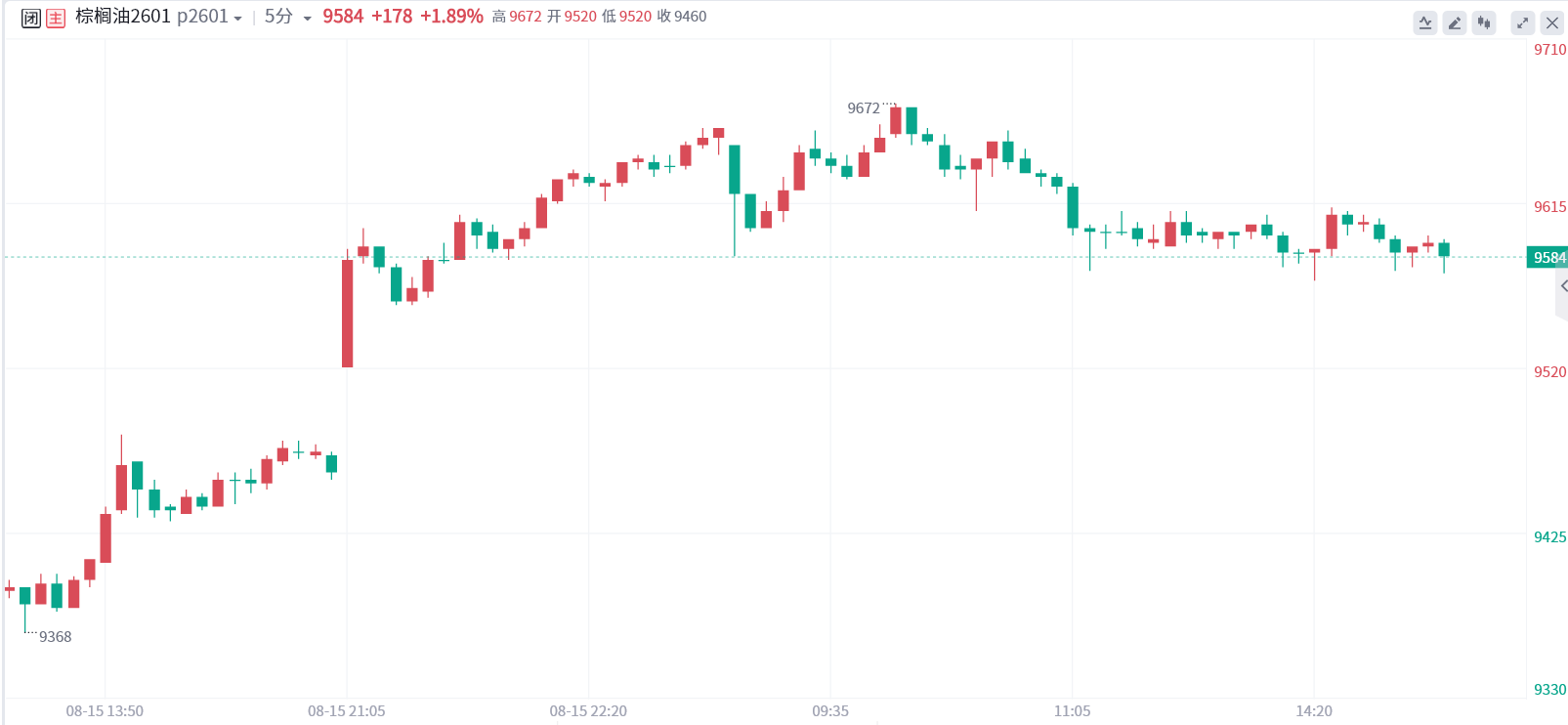
Core Viewpoint - The recent surge in palm oil prices is primarily driven by supply concerns from Indonesia due to government actions against illegal plantations, alongside positive export data from Malaysia fueled by demand for the Indian festival Diwali [3][4][5]. Group 1: Market Dynamics - On August 18, Dalian Commodity Exchange palm oil futures initially rose nearly 3% before closing with a gain of 1.89%, reaching a seven-month high of 9672 yuan/ton [1]. - Indonesia's military has seized 3.1 million hectares of illegal palm plantations, representing 20% of the country's official plantation area, leading to expectations of reduced palm oil production [3]. - The Indonesian government's crackdown may result in lower yields, impacting future palm oil production growth, with projections indicating that the increase in production may not meet consumption growth by 2025 [3]. Group 2: Export and Production Insights - Malaysia's palm oil exports from August 1-15 are estimated at 537,183 tons, a 34.5% increase from the same period last month, driven by demand for the Diwali festival [4]. - Data from SPPOMA indicates a slight decrease in palm oil yield but an increase in extraction rates, suggesting a mixed production outlook for Malaysia [4]. - The overall domestic supply and demand for palm oil in China remains relaxed, with limited procurement for September, indicating a broader market stability [3]. Group 3: Future Outlook - The Indonesian government's intensified actions against illegal plantations could significantly affect future supply, with an additional 3.7 million hectares under scrutiny [4]. - Domestic oil prices are expected to follow international trends, with potential for a phase of adjustment after recent price increases, suggesting a cautious approach to trading strategies [4][5]. - Analysts recommend maintaining low long positions while being cautious about chasing higher prices due to potential market fluctuations [5].

研客专栏 | 大涨的棕榈油发生了什么?
对冲研投· 2025-08-06 12:07
Core Viewpoint - The article discusses the fluctuations in palm oil prices, driven by various factors including weather conditions, export dynamics, and market demand, particularly from India and Indonesia [2][4][12]. Group 1: Market Dynamics - In late July, rumors of domestic companies exporting soybean oil to India led to a decrease in palm oil demand, causing prices to drop to a low of 8746 yuan/ton [4]. - However, by early August, reports of poor palm oil production in Indonesia led to a rebound in prices, surpassing 9000 yuan/ton with an increase of nearly 3% [4]. - The article notes that Indonesia's palm oil production is expected to face challenges due to lower rainfall and higher temperatures in July, which could affect fruit quality and yield [5][10]. Group 2: Production and Export Trends - In June, Indonesia's palm oil production was estimated to decrease by 7%-8% due to lower rainfall, with cumulative production reaching 27.69 million tons, an increase of 1.51 million tons compared to the same period in 2024 [10]. - The article highlights that Indonesia's palm oil exports in June reached 2.588 million tons, a month-on-month increase of 30.5% due to a decrease in export tariffs [10]. - As of mid-July, Indonesia's biodiesel consumption was approximately 7.42 billion liters, aligning closely with annual targets despite concerns about the implementation of B40 biodiesel blending [11]. Group 3: International Trade and Demand - India's palm oil imports in June rose to 960,000 tons, up from 590,000 tons in May, indicating a recovery in demand [16]. - However, in July, palm oil imports decreased to 855,000 tons, attributed to high domestic prices, while soybean oil imports increased to 495,000 tons [16]. - The article also mentions that South American soybean oil exports are expected to slow down, which may lead India to rely more on palm oil imports in the upcoming months [17]. Group 4: Future Outlook - The article suggests that palm oil prices may remain strong in the short term due to ongoing demand from India and biodiesel requirements in Indonesia [19]. - However, after the Diwali festival in October, palm oil imports may decline as inventories in Malaysia and Indonesia rise, potentially leading to a market shift towards weaker demand [19].

棕榈油:宏观情绪消退,基本面或有回踩,豆油:缺乏有效驱动,关注中美谈判结果
Guo Tai Jun An Qi Huo· 2025-07-27 07:33
Report Summary 1. Investment Rating No investment rating for the industry is provided in the report. 2. Core Views - **Palm Oil**: The current price of palm oil is pushed to a three - year high by positive domestic macro - sentiment, but the fundamentals may not support this high price. There is a chance of a price correction if inventory builds up more than expected in August - September, along with other negative factors. However, if the inventory fails to break through 230 million tons and the supply pressure in July - August does not form effective price pressure, the market may have digested the inventory high, and there may be limited major supply - side negatives later. It is advisable to continuously monitor opportunities to go long on palm oil at low levels [2][4]. - **Soybean Oil**: The domestic soybean oil market is in a situation of weak current reality but strong expectations. Its driving factors currently lie in the weather of US soybeans, the sustainability of soybean oil exports, and the results of Sino - US trade negotiations. It is recommended to follow the trend of the oil and fat sector for now and pay attention to the Sino - US trade results next week to see if a procurement agreement can be reached [5]. 3. Summary by Related Catalogs 3.1 Last Week's Views and Logic - **Palm Oil**: Positive domestic macro - sentiment pushed palm oil to a three - year high, but the fundamentals lacked strong drivers. Without strong supply themes, the high price needed strong downstream demand. With weak demand from India, the price at the high level was difficult to rise further. The palm oil 09 contract fell 0.31% last week [1]. - **Soybean Oil**: As the Sino - US trade negotiation approached, the tense sentiment in the soybean sector rose, which improved the weak reality of domestic soybean oil to some extent, but still could not provide a strong driving force for the price to rise. The soybean oil 09 contract fell 0.20% last week [1]. 3.2 This Week's Views and Logic - **Palm Oil**: After the bearish news of the slight increase in June inventory in the MPOB report was digested, the price rebounded. The market started to trade the de - stocking market in the second half of the year. It is estimated that Malaysia will continue to accumulate inventory in July, but conservatively, it will not exceed 220 million tons. In Indonesia, the price of palm oil is quite resistant to decline. The B50 rumor has a low correlation with the recent price increase. The production recovery in Indonesia may fall short of expectations again. With the US biodiesel policy reducing the supply of US soybean oil in the international market, the international oil and fat market may see a systematic upward trend. In the sales area, the import profit of crude palm oil is higher than that of crude soybean oil, and the reconstruction of channel inventory is underway. If the monthly import volume can be maintained above 80 million tons, it will be difficult for Malaysia's palm oil inventory to exceed 230 million tons. The soybean - palm oil price difference is not expected to return to parity this year. Attention should be paid to the risk of price correction if inventory builds up more than expected in August - September, as well as the potential for early de - stocking and bullish sentiment if production in July - August is lower than expected [2][3][4]. - **Soybean Oil**: The weather speculation of US soybeans is currently weak. Only positive news from Sino - US trade negotiations can potentially lead to a rebound in US soybeans. The domestic soybean oil market is in a state of weak current situation but strong expectations. The recent increase in port soybean inventory, high - level crushing operations, and poor提货 have led to a rapid build - up of soybean oil inventory. The export of large orders of domestic soybean oil to India may narrow the domestic soybean - palm oil price difference to the international level. If the purchase of US soybeans for the October shipment has not been made, there is room for the spread and Brazilian premium to rise, which may benefit soybean oil. It is advisable to follow the oil and fat sector for now and wait for potential opportunities to go long on soybean oil and narrow the spread between rapeseed oil and soybean oil [5]. 3.3 Market Data - **Futures Quotes**: The palm oil main - continuous contract closed at 8,936 yuan/ton, down 0.31%; the soybean oil main - continuous contract closed at 8,144 yuan/ton, down 0.20%; the rapeseed oil main - continuous contract closed at 9,457 yuan/ton, down 1.35%; the Malaysian palm oil main - continuous contract closed at 4,276 ringgit/ton, down 0.93%; the CBOT soybean oil main - continuous contract closed at 55.92 cents/pound, up 0.61% [8]. - **Volume and Open Interest**: The trading volume of the palm oil main - continuous contract was 3,475,013 lots, with an increase of 597,494 lots; the open interest was 456,448 lots, a decrease of 100,607 lots. The trading volume of the soybean oil main - continuous contract was 2,877,519 lots, an increase of 268,435 lots; the open interest was 504,638 lots, a decrease of 53,546 lots. The trading volume of the rapeseed oil main - continuous contract was 3,053,981 lots, a decrease of 153,613 lots; the open interest was 210,783 lots, a decrease of 36,060 lots [8]. - **Price Spreads**: The rapeseed - soybean 09 spread was 1,313 yuan/ton, down 7.92%; the soybean - palm 09 spread was - 792 yuan/ton, up 1.49%; the palm oil 9 - 1 spread was 8 yuan/ton, down 75.00%; the soybean oil 9 - 1 spread was 40 yuan/ton, down 4.76%; the rapeseed oil 9 - 1 spread was 56 yuan/ton, down 27.27% [8]. - **Warehouse Receipts**: The number of palm oil warehouse receipts was 0 lots, a decrease of 854 lots compared to last week; the number of soybean oil warehouse receipts was 21,495 lots, a decrease of 623 lots; the number of rapeseed oil warehouse receipts was 3,487 lots, unchanged from last week [8].
油脂市场:25/26年度供需收紧,短期高位震荡
Sou Hu Cai Jing· 2025-07-01 16:50
Group 1 - The core viewpoint indicates that the supply and demand dynamics for palm oil, soybean oil, and rapeseed oil are expected to fluctuate, with a general tightening in global vegetable oil supply and demand in the 2025/26 period, leading to potential price support [1] Group 2 - For palm oil, Malaysia's production is projected to be close to last year's levels at 19-19.5 million tons, with a slowdown in inventory accumulation expected until October [1] - Indonesia is anticipated to increase production by 2 million tons to 55 million tons, supported by the B40 policy and export demand, maintaining a tight balance in inventory for the second half of the year [1] - International palm oil prices are expected to experience fluctuations in Q3, with a potential strengthening in Q4 [1] Group 3 - In the soybean oil sector, South American soybean production is expected to increase in the 2024/25 season, alleviating supply pressure after July [1] - The U.S. soybean supply and demand are projected to tighten for the 2024/25 and 2025/26 seasons, with weather during critical growth periods posing risks [1] - Domestic soybean oil imports are expected to exceed 10 million tons in Q3, with high operating rates in oil mills leading to strong inventory accumulation expectations [1] Group 4 - For rapeseed oil, a slight increase in global rapeseed production is expected for the 2025/26 season, while export demand is anticipated to decline significantly [1] - The EU is projected to increase production, but prior drought conditions may lead to lower-than-expected yields, while Australian rapeseed production is expected to decrease significantly [1] - Domestic rapeseed imports may decline post-June due to anti-dumping concerns, leading to potential inventory depletion and tighter supply [1] Group 5 - The short-term outlook suggests that with weak crude oil prices and no immediate weather-related speculation for U.S. soybeans, domestic soybean and palm oil inventories are likely to accumulate, making it difficult for oil prices to rise [1] - However, the global vegetable oil supply and demand are expected to tighten in the 2025/26 period, providing strong support for oil prices, with the potential for a seasonal increase in Q4 [1] - Strategy recommendations include monitoring support levels for soybean, palm, and rapeseed oil contracts, with cautious buying near these support levels [1]
油脂日报:国产菜籽上市,油脂承压-20250624
Hua Tai Qi Huo· 2025-06-24 03:43
Group 1: Report Industry Investment Rating - The investment rating for the industry is neutral [4] Group 2: Core Viewpoints of the Report - The prices of the three major oils oscillated and declined yesterday. The concentrated listing of domestic rapeseed led to sufficient supply, putting pressure on the oil market [3] Group 3: Market Analysis Futures Prices - The closing price of the palm oil 2509 contract yesterday was 8,520 yuan/ton, with a环比 change of -16 yuan and a decline of -0.19% - The closing price of the soybean oil 2509 contract was 8,126 yuan/ton, with a环比 change of -30 yuan and a decline of -0.37% - The closing price of the rapeseed oil 2509 contract was 9,721 yuan/ton, with a环比 change of -5 yuan and a decline of -0.05% [1] Spot Prices - The spot price of palm oil in Guangdong was 8,620 yuan/ton, with a环比 change of -110 yuan and a decline of -1.26%. The spot basis was P09 + 100 yuan, with a环比 change of -94 yuan - The spot price of first - grade soybean oil in Tianjin was 8,280 yuan/ton, with a环比 change of -60 yuan and a decline of -0.72%. The spot basis was Y09 + 154 yuan, with a环比 change of -30 yuan - The spot price of fourth - grade rapeseed oil in Jiangsu was 9,900 yuan/ton, with a环比 change of -10 yuan and a decline of -0.10%. The spot basis was OI09 + 179 yuan, with a环比 change of -5 yuan [1] Market News - On January 9, the FOB price of Malaysian palm oil was 1,095 US dollars, down 15 US dollars from the previous day, and the CIF price was 1,125 US dollars, down 15 US dollars from the previous day - From June 1 - 20, 2025, the production of Malaysian palm oil increased by 2.5%环比 compared to the same period last month - India's soybean oil imports in June are expected to decline by 18%环比, reaching the lowest level in four months - About 50% of Malaysia's exports to Nigeria are palm oil, with an export value of 600 million US dollars in 2024 - The FOB price of new - crop Russian wheat with a protein content of 12.5% to be shipped before the end of July is 227 US dollars per ton, up 5 US dollars from the previous week. Consulting agency SovEcon estimates the new - crop wheat price to be 226 - 230 US dollars per ton, compared with 225 - 229 US dollars per ton the previous week [2]
产地棕油供需均增&中加关系缓和,菜棕价差回吐此前涨幅
Zheng Xin Qi Huo· 2025-06-09 12:51
1. Report Industry Investment Rating No relevant content provided. 2. Core Viewpoints of the Report - Last week, the prices of domestic and international soybean - related products moved slightly upward, while palm oil stopped rising and consolidated, and Zhengzhou rapeseed oil broke downward. The expected increase in production, exports, and inventory of Malaysian palm oil in May, along with the increase in production and exports at the beginning of June, and the supply - demand growth in Indonesia in March, indicate that the supply side pressure is gradually increasing. The demand side shows a significant increase in India's palm oil imports in May and continued improvement in exports in June. With the progress of China - Canada talks, the market sentiment has eased, and rapeseed oil has oscillated after a rapid decline. The supply and demand of palm oil in the producing areas are both increasing, lacking clear direction, and it is difficult for palm oil to rise or fall in the short term. The strength of rapeseed oil and palm oil has reversed in the short term, and the spread in September has significantly narrowed. It is advisable to hold the strategy of widening the spread cautiously [7]. 3. Summary by Relevant Catalogs 3.1 Main Views - Palm oil: Supply and demand in the palm - producing areas are both increasing, and with the easing of China - Canada relations, the spread between rapeseed oil and palm oil has given back its previous gains. In the producing areas, institutions expect a 3% increase in Malaysian palm oil production, a 17.9% increase in exports, and a 7.74% increase in inventory in May. At the beginning of June, production increased by 19% and exports by 3%. In Indonesia, the palm oil inventory at the end of March was 2.04 million tons. In the domestic market, the spot trading volume of soybean oil was average last week, while that of palm oil slightly increased. The supply increase led to the accumulation of soybean oil inventory to 750,000 tons and palm oil inventory to 360,000 tons. In terms of strategy, the sowing of new - season US soybeans is nearly complete with a high good - rate, and CBOT soybeans are trading around the 1050 mark. The supply side pressure is increasing as the producing areas are in the production - increasing cycle and will reach the production peak in the third quarter. The demand side shows that India's palm oil imports increased significantly in May, and the export situation in June has continued to improve. With the progress of China - Canada talks, the market sentiment has eased, and rapeseed oil has oscillated after a rapid decline. The supply and demand of palm oil in the producing areas are both increasing, and it is difficult for palm oil to rise or fall in the short term. The spread between rapeseed oil and palm oil has significantly narrowed, and it is advisable to hold the strategy of widening the spread cautiously [7]. 3.2 Market Review - Last week, the price centers of domestic and international soybean - related products moved slightly upward, domestic and international palm oil stopped rising and consolidated, and Zhengzhou rapeseed oil broke downward [8]. 3.3 Fundamental Analysis - **US Soybeans**: As of the week ending June 1, the US soybean sowing progress was 84% (market expectation: 86%, previous year: 77%, five - year average: 80%), the emergence rate was 63% (previous year: 53%, five - year average: 57%), and the good - rate was 67% (market expectation: 68%). As of the week ending June 3, about 16% of the US soybean - growing areas were affected by drought, down from 17% the previous week. The Brazilian soybean premium rebounded to around 70 cents per bushel at the beginning of June [11][12]. - **Malaysian Palm Oil**: In April, the production, exports, and inventory of Malaysian palm oil all increased. In May, institutions expect a 3% increase in production to 1.74 million tons, a 17.9% increase in exports to 1.3 million tons, and a 7.74% increase in inventory to 2.01 million tons. At the beginning of June, production increased by 19.09% and exports increased by 2.63%. [18][22]. - **Indonesian Palm Oil**: In March, Indonesia's palm oil production was 4.8 million tons, exports were 2.88 million tons, consumption was 2.1 million tons, and inventory decreased to 2.04 million tons. From January to April, Indonesia exported 6.41 million tons of crude and refined palm oil, a year - on - year decrease of 5.37% [23]. - **Indian Market**: In May, India's edible oil imports increased by 37% month - on - month to 1.18 million tons. Among them, palm oil imports increased by 87% to 600,000 tons. India has halved the basic import tariff on crude edible oil to 10% since May 31 [28][31]. - **Domestic Oilseed Pressing**: Last week, rapeseed oil broke downward, and the spot and futures crushing profits of imported rapeseed dropped below zero. The inversion of domestic palm oil import profits continued to narrow. The oil mill's soybean crushing capacity reached 2.2 - 2.3 million tons in late May and early June, the highest in the past three years. The soybean inventory was 5.6 - 5.9 million tons and is expected to continue rising. The rapeseed crushing capacity in late May was 90,000 tons, and the rapeseed inventory increased slightly to 230,000 tons [33][36][40]. - **Domestic Oil Inventory**: As of the end of May, soybean oil inventory increased to 750,000 tons, rapeseed oil inventory was stable at around 840,000 tons, palm oil inventory rebounded to 360,000 tons, and the total inventory of the three major oils increased to 1.81 million tons, compared with 1.7 million tons in the previous year [43]. - **Domestic Oil Spot Price and Trading Volume**: Last week, the spot prices of soybean oil and palm oil fluctuated within a narrow range, while rapeseed oil declined. As of June 6, the price of soybean oil was 7,998 yuan/ton, a slight increase of 0.57% from the previous week; the price of palm oil was 8,617 yuan/ton, a slight decrease of 0.14%; the price of rapeseed oil was 9,424 yuan/ton, a decrease of 1.46%. The trading volume of soybean oil decreased, while that of palm oil maintained a rigid demand. The trading volume of soybean oil was 59,000 tons (previous week: 75,200 tons), palm oil was 3,610 tons (previous week: 2,963 tons), and rapeseed oil was 1,000 tons (previous week: 5,000 tons) [46][48]. 3.4 Spread Tracking No relevant content provided other than the title.
建信期货油脂日报-20250606
Jian Xin Qi Huo· 2025-06-06 01:55
Report Information - Report Date: June 6, 2025 [2] - Industry: Oil and Fat [1] - Researcher: Yulanlan, Lin Zhenlei, Wang Haifeng, Hong Chenliang, Liu Youran [3] Investment Rating - Not provided Core View - The oil and fat sector lacks obvious drivers, mainly short - term speculation on news or high - frequency supply - demand data. Rapeseed oil fluctuates around 9000 yuan, and attention should be paid to the progress of China - Canada economic and trade negotiations. The market expects a significant increase in Malaysia's palm oil inventory at the end of May, which suppresses the upward movement of the market, but strong exports support the market, continuing the range - bound trend. Brazil's abundant soybean supply pressures the market, and attention should be paid to recent soybean imports and crushing. The improvement of the supply situation may put pressure on soybean oil and other oil and fat products. Selling soybean oil call options can be considered, with risks including weather, tariffs, and biodiesel policies of various countries [7] Section Summaries 1. Market Review and Operation Suggestions - **Quotes**: Dongguan rapeseed oil trader quotes: Dongguan triple - refined rapeseed oil 09 + 50 (June), first - grade rapeseed oil 09 + 250 (June). East China market soybean oil basis prices: first - grade soybean oil: 09 + 280 in early June, 09 + 260 from June to July, 09 + 270 from June to September, 01 + 330 from October to January. East China 24 - degree palm oil: P09 + 450 yuan/ton [7] - **Market Analysis**: The oil and fat sector lacks obvious drivers. Rapeseed oil fluctuates around 9000 yuan, and attention should be paid to China - Canada economic and trade negotiations and far - month ship purchases. Malaysia's palm oil inventory is expected to exceed 2 million tons in late May for the first time this year, suppressing the market, but strong exports support it. Brazil's abundant soybean supply pressures the market, and attention should be paid to soybean imports and crushing. Selling soybean oil call options can be considered [7] 2. Industry News - **Production**: Malaysia's palm oil production in May increased by 3.53% month - on - month, with fresh fruit bunch (FFB) yield increasing by 1.9% and oil extraction rate (OER) increasing by 0.3% month - on - month [8] - **Exports**: According to SGS, Malaysia's palm oil exports in May were 1,069,643 tons, a 29.6% increase from April. Exports to China were 131,900 tons, a 62,700 - ton increase from the previous month. According to ITS, exports were 1,320,914 tons, a 17.9% increase from April. According to AmSpec, exports were 1,230,787 tons, a 13.2% increase from April [8] 3. Data Overview - The report presents various data charts, including the spot prices of East China's third - grade rapeseed oil, fourth - grade soybean oil, South China's 24 - degree palm oil, palm oil basis changes, soybean oil basis changes, rapeseed oil basis changes, P1 - 5 spread, P5 - 9 spread, P9 - 1 spread, US dollar - Malaysian ringgit exchange rate, and US dollar - RMB exchange rate, with data sources from Wind and the Research and Development Department of CCB Futures [10][12][21]