
港股牛市

Search documents
ETF资金下半年加速净买入港股资产,港股通互联网ETF、香港证券ETF、港股通非银ETF强势吸金
Ge Long Hui· 2025-11-27 04:23
Group 1 - Southbound funds have significantly increased their net purchases of Hong Kong stocks, totaling 1.38 trillion HKD this year, marking a record high [1] - The Hang Seng Index has seen a year-to-date increase of nearly 30%, while the Hang Seng Tech Index has risen over 25% [1] - In the second half of the year, ETF funds have accelerated their net purchases of Hong Kong assets, with notable inflows into various ETFs, including over 350 million HKD into the Hong Kong Internet ETF and over 200 million HKD into the Hong Kong Securities ETF [1] Group 2 - Hong Kong stocks have unique advantages compared to A-shares, aligning well with current trends in AI, new consumption, and innovative pharmaceuticals [2] - Despite recent adjustments, the mid-term outlook for Hong Kong stocks remains bullish, supported by incremental capital inflows and the gathering of quality assets [2] - The AI-driven technology sector is expected to be the main theme in the Hong Kong market, with dividend-paying stocks benefiting from policy support and low interest rates [2] Group 3 - The "AI bubble" narrative in the US has led to mispricing of Chinese assets, particularly in the tech sector, where the valuation of Hong Kong tech stocks is about half that of the Nasdaq [3] - The adjustment in Hong Kong stocks has been significant, suggesting that the rebound potential may exceed that of A-shares [3] - A "barbell strategy" is recommended, focusing on high-dividend and turnaround assets to navigate market uncertainties while maintaining a long-term growth perspective [3]
港股开盘 | 恒指高开0.07% 万科企业跌超5%
智通财经网· 2025-11-27 01:36
Core Viewpoint - The Hong Kong stock market is experiencing adjustments, but the underlying bullish trend, particularly in technology stocks, is expected to continue over the next two to three years, with a potential shift to a broader bull market by 2026 [2][3][4]. Market Performance - The Hang Seng Index opened up by 0.07%, while the Hang Seng Tech Index fell by 0.1%. Notably, NIO dropped over 2%, and Baidu Group fell more than 1%, while the new stock Quantitative Party surged over 165% [1]. - Vanke Enterprises saw a decline of over 5% as the company plans to hold a meeting regarding the extension of its bond [1]. Investment Outlook - Analysts suggest that the current market volatility is primarily driven by liquidity, sentiment, and risk appetite, with a focus on core assets amid economic data concerns [3]. - Investment strategies should focus on three main areas: AI-driven industry trends, capacity cycle reversals, and sectors related to export and commodities influenced by external uncertainties [2]. - The Hong Kong market is viewed as a "valuation pit," with significant room for valuation recovery, especially in the context of low historical valuations compared to global indices [5][6]. Liquidity and Market Dynamics - The market's performance is largely influenced by liquidity conditions, with expectations of continued inflows from both domestic and foreign investors as the U.S. enters a rate-cutting phase [6]. - Historical data indicates that short-term market adjustments are normal, with average declines of 7% during minor corrections and 17% during significant liquidity tightening [2]. Sector-Specific Insights - The technology sector in Hong Kong is currently undergoing adjustments, but its long-term investment value is becoming increasingly apparent [4]. - The AI sector remains a focal point for investment, with expectations of continued growth despite recent market fluctuations [3][4].



港股科技50ETF(513980) 连续4日获得场外资金净申购!增量资金流入有望继续支撑港股牛市
Sou Hu Cai Jing· 2025-11-26 05:17
Core Viewpoint - The Hong Kong stock market opened with collective gains, particularly in the biopharmaceutical sector, driven by expectations of a potential interest rate cut by the Federal Reserve in December 2025, which may alleviate liquidity constraints affecting market performance [1] Group 1: Market Performance - As of 11:30 AM, the Hong Kong Technology 50 ETF (513980) rose by 0.93%, marking its fourth consecutive trading day of net subscriptions from external funds [1] - Notable individual stocks included Health Road, which increased by over 7%, Meituan-W rising over 5%, and both Sangfor Technologies and Kangfang Biotech gaining over 4% [1] Group 2: Federal Reserve Influence - A Federal Reserve board member advocated for a rate cut in December, leading to heightened market expectations for this move, which could ease previous liquidity pressures on the Hong Kong stock market [1] Group 3: Future Market Outlook - According to Guotai Junan Strategy, the combination of incremental capital inflows and the gathering of quality assets suggests that the bullish trend in the Hong Kong stock market is likely to continue [1] - If short-term factors that have been suppressing the market are resolved, the mid-term outlook remains positive with clear incremental capital and a concentration of scarce quality assets in China [1] Group 4: Investment Opportunities - The Hong Kong Technology 50 ETF (513980) closely tracks the CSI Hong Kong Stock Connect Technology Index, which includes major tech leaders like Alibaba [1] - Investors are encouraged to consider the Hong Kong Technology 50 ETF (513980) and its associated funds (Class A: 016495; Class C: 016496) to capitalize on quality assets in the Hong Kong market [1]
港股调整到哪一步了
Haitong Securities International· 2025-11-24 05:21
Core Conclusions - Since October, the Hong Kong stock market has entered a phase of adjustment, primarily due to significant prior gains, tight USD liquidity, and a decline in expectations for Federal Reserve rate cuts [2][5] - Market adjustments during a bull market are normal; historically, small pullbacks average a decline of 7%, while larger pullbacks average a decline of 17% [2][9] - USD liquidity is a short-term disturbance, and the ongoing AI wave suggests that the influx of new capital and the gathering of quality assets may continue to support the bull market in Hong Kong stocks [2][5] Investment Highlights - From a mid-term perspective, the influx of new capital and the gathering of quality assets in the Hong Kong stock market is expected to continue, especially if short-term factors suppressing the market are resolved [4][20] - Hong Kong stocks possess scarcity value, particularly in sectors aligned with the current industrial development trends, such as AI applications [4][20] - There is potential for continued inflow of southbound capital, driven by institutional forces, which may further propel the Hong Kong market upward [4][20] - The technology sector, driven by AI, remains a key focus for market performance, with Hong Kong stocks benefiting from favorable policies regarding dividends and low interest rates [4][21] Market Performance Overview - The Hong Kong stock market has shown strong performance this year, with the Hang Seng Index and Hang Seng Tech Index reaching new highs in early October, with maximum gains of 47% and 61% respectively [5][7] - However, since mid-October, the market has experienced adjustments, with the Hang Seng Index declining by a maximum of 5.1% and the Hang Seng Tech Index by 8.1% [6][7] - The adjustments are attributed to tight USD liquidity and concerns over AI sector bubbles, as well as significant prior gains in the market [7][8] Historical Context of Market Adjustments - In bull markets, adjustments can be categorized into two types: small pullbacks averaging a maximum decline of 7% and larger pullbacks averaging a maximum decline of 17% [9][13] - Historical data shows that small pullbacks typically do not exceed 30 trading days, while larger pullbacks average around 53 trading days [9][13] - The current market adjustment aligns with historical patterns, suggesting that the overall upward trend may remain intact despite short-term fluctuations [9][13]
资金面扰动渐消 机构指明港股三大确定性布局方向
Xin Lang Cai Jing· 2025-11-24 02:59
Core Viewpoint - The Hong Kong stock market has experienced significant fluctuations in 2023, with the Hang Seng Index and Hang Seng Tech Index reaching new highs in October, followed by a notable correction due to various factors including tightening dollar liquidity and concerns over AI valuations [1][3][4]. Market Performance - As of October, the Hang Seng Index had a maximum increase of 47% and the Hang Seng Tech Index had a maximum increase of 61% for the year. However, since mid-October, these indices have seen a maximum pullback of 8% and 20% respectively [1][3]. - The cumulative year-to-date gains for the Hang Seng Index and Hang Seng Tech Index have narrowed to 27.78% and 23.66% respectively [3]. Factors Behind Market Adjustment - The market correction is attributed to multiple factors: tightening dollar liquidity, a significant drop in expectations for Federal Reserve interest rate cuts, and a technical need for market pullbacks after substantial prior gains [3][4]. - The tightening of dollar liquidity was exacerbated by a government shutdown in the U.S., which led to a temporary halt in government spending and increased dollar liquidity pressure [3][13]. Historical Context of Market Adjustments - Historical data indicates that in bull markets, small pullbacks average a maximum decline of about 7%, while larger pullbacks average around 17%, often linked to liquidity tightening or external shocks [7][8]. - The average duration of small pullbacks in bull markets is typically less than 30 trading days, while larger pullbacks can last around 53 trading days [7][8]. Future Outlook - Despite the current adjustments, the bull market in Hong Kong stocks is expected to continue, supported by ongoing AI trends and the influx of quality assets [2][13]. - The potential for continued inflow of southbound capital is strong, with over 1.3 trillion yuan already invested this year, indicating a favorable outlook for the Hong Kong market [14]. - The technology sector, particularly those benefiting from AI advancements, is anticipated to remain a key driver of market performance moving forward [14].

11月24日ETF早知道
Xin Lang Ji Jin· 2025-11-24 01:40
Core Insights - The article discusses the performance of various ETFs and market sectors, highlighting significant inflows and outflows of capital in specific industries, as well as the overall market sentiment as of November 21, 2025 [4][6][7]. Market Performance - The Shanghai Composite Index, Shenzhen Component Index, and ChiNext Index have ten-year price-to-earnings (P/E) percentile values of 94.61%, 77.57%, and 35.6% respectively, indicating varying levels of valuation [4]. - The overall market temperature shows a decline, with the Shanghai Composite Index down by 4.02%, Shenzhen Component Index down by 2.45%, and ChiNext Index down by 3.41% [4]. Sector Performance - The top three sectors with capital inflows include Media with a net inflow of 1.326 billion, while the sectors with the highest outflows are Electronics (-20.274 billion), Electric Equipment (-16.143 billion), and Computers (-10.928 billion) [2][4]. - The food and beverage sector shows resilience, with notable sales growth for Moutai 1935, which has seen over 20% year-on-year growth in several markets [7]. ETF Performance - The Hong Kong Internet ETF has experienced a net inflow of 541.4 million over the past five days, with a total of 4.271 billion over the last 60 days, indicating strong investor interest despite recent market volatility [6][7]. - The performance of various ETFs over the past six months shows mixed results, with some ETFs like the Consumption Leader ETF showing a slight increase of 0.78% while others like the Food ETF decreased by 1.29% [4][8].

国泰海通 · 晨报1124|宏观、海外策略
国泰海通证券研究· 2025-11-23 13:47
Macro Analysis - The Federal Reserve exhibits significant internal disagreements regarding monetary policy direction [4] - Major economic indicators show mixed results, with U.S. non-farm payrolls exceeding expectations but unemployment rising to 4.4% [3][4] - Eurozone services PMI continues to decline, while manufacturing PMI falls below the growth line [4] Global Asset Performance - Most asset prices experienced notable declines during the week of November 17-23, 2025, with Brent crude oil futures down 2.8% and the S&P-Goldman commodity index down 2.2% [3] - The Hang Seng Index saw the largest drop at 5.1%, while the Shanghai Composite Index and Nikkei 225 fell by 3.9% and 3.5%, respectively [3] - The 10-year U.S. Treasury yield decreased by 8 basis points to 4.06% [3] Hong Kong Stock Market - The Hong Kong stock market has entered a phase of adjustment since October, with the Hang Seng Index and Hang Seng Tech Index reaching yearly highs before the downturn [8] - The adjustment is attributed to tighter U.S. dollar liquidity and concerns over AI market bubbles [8] - The market is expected to continue its bullish trend post-adjustment, supported by the ongoing AI industry cycle and potential easing of short-term pressures [9] Investment Opportunities - The Hong Kong market is characterized by unique asset advantages, particularly in AI, new consumption, and innovative pharmaceuticals, aligning with current industry trends [8][9] - There is potential for continued inflow of incremental capital into the Hong Kong market, driven by institutional investments and the scarcity of quality assets [9] - The AI-driven technology sector remains a key focus for market performance, with expectations for sustained growth in the coming periods [9]

港股开盘 | 恒指高开0.22% 蚂蚁入股耀才证券金融未达完成条件
智通财经网· 2025-11-12 01:41
Group 1 - The Hang Seng Index opened up by 0.22%, and the Hang Seng Tech Index rose by 0.26%, with notable gains in Xpeng Motors and NetEase, while Yaocai Securities fell over 4% due to unmet conditions for Ant Group's investment [1] - Guotai Junan Securities reported that the foundation for a bull market in Hong Kong stocks remains intact, but the evolution is likely to be characterized by "oscillating upward" rather than rapid increases, with a strong fundamental drive expected in November [1][2] - Wang Qian from Yongying Fund noted that recent adjustments in Hong Kong stocks were due to weakened momentum and increased uncertainties, leading some investors to take profits [1][2] Group 2 - Market focus will shift towards policy implementation and interest rate trends by year-end, with potential for a rebound in Hong Kong stocks if U.S. interest rates confirm a downward trend and domestic economic recovery signals become clearer [2] - The valuation of the Hang Seng Internet Technology Index is currently at a low historical level, with a PE ratio of 21.45, indicating significant valuation repair potential [2][3] - The core narrative of Hong Kong's internet sector is shifting from user growth to "AI empowerment," suggesting a new growth trajectory [2] Group 3 - Zhang Xia, Chief Strategy Analyst at招商证券, highlighted that the Hang Seng Tech Index is one of the few indices with a current PE ratio below historical averages, indicating substantial valuation recovery potential [3] - The Hong Kong market is primarily driven by liquidity, and uncertainties in external liquidity may lead to short-term oscillations, but medium to long-term prospects remain positive with expected inflows from southbound and foreign capital [3][4] - Guotai Haitong Securities emphasized that the current position of Hong Kong stocks is not high compared to historical levels, suggesting potential for upward movement and increased foreign capital inflows in the coming year [4][5] Group 4 - Morgan Stanley noted that the Hong Kong stock market is currently below the average PE ratio of the past decade, making it the cheapest market in the Asia-Pacific region outside of ASEAN [5] - Factors contributing to the strength of the Hong Kong stock market include renewed capital inflows, stabilization in the real estate market, robust retail sales, and a revival in IPO activities [5]
美元走强对港股意味着什么
2025-11-10 03:34
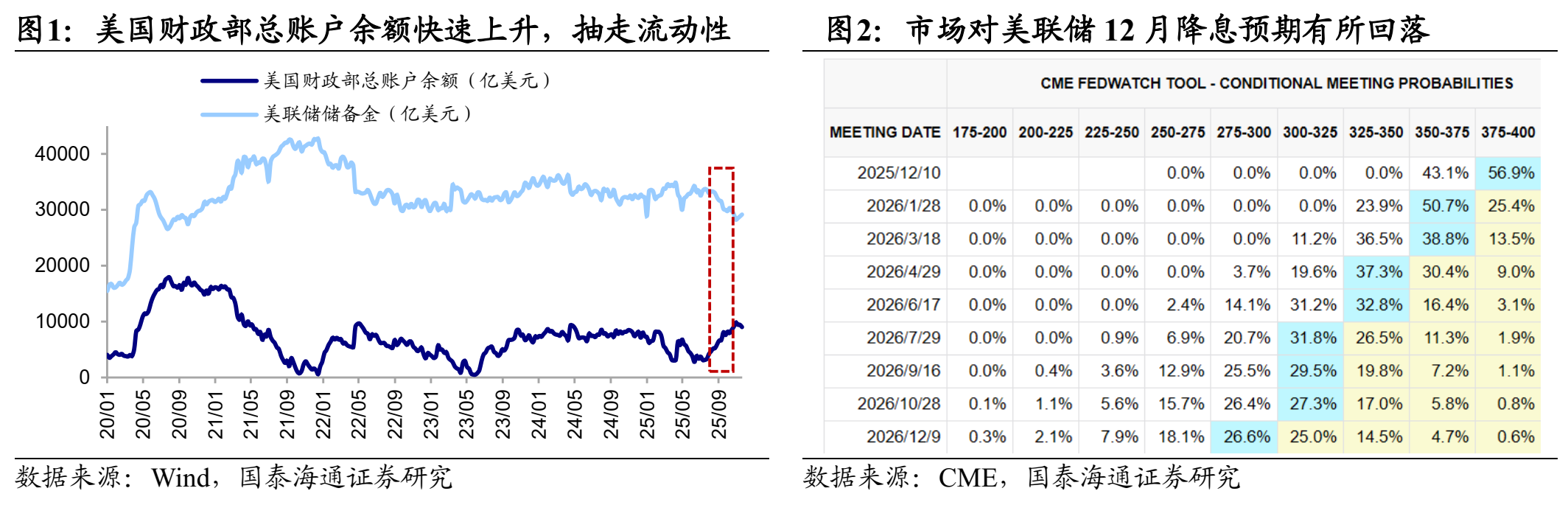
Summary of Conference Call Records Industry Overview - The discussion primarily revolves around the impact of a strong US dollar on the Hong Kong stock market (港股) and the broader implications for foreign investment and local liquidity [1][4]. Key Points and Arguments 1. **Reasons for Recent Dollar Strength**: - The US government shutdown has led to liquidity tightening, with the Treasury's account balance rising significantly, pulling approximately $700 billion in liquidity since June [2]. - The Federal Reserve's hawkish stance has cooled expectations for interest rate cuts, with the probability of a December rate cut dropping from nearly 100% to around 60% [2]. - The weakness of non-US currencies, particularly the Japanese yen, has also contributed to the strengthening of the dollar [2]. 2. **Impact on Hong Kong Stock Market**: - The Hong Kong stock market is heavily influenced by foreign capital, with foreign investment accounting for about 60% of the market [1][4]. - Historical data shows a strong correlation between foreign capital flows and the US dollar index, with significant outflows occurring during periods of rapid dollar appreciation [4]. - Since the end of September, flexible foreign capital has net exited the Hong Kong stock market by approximately HKD 75 billion [1][4]. 3. **Local Currency and Liquidity Dynamics**: - Hong Kong operates under a linked exchange rate system, where the Monetary Authority must withdraw liquidity when the HKD approaches the weak side of the peg at 7.85 [1][4]. - Despite the dollar's strength, the HKD has remained close to the strong side of the peg due to inflows from mainland China and reduced expectations for US rate cuts, meaning there is currently no need for liquidity withdrawal [1][4]. 4. **Market Outlook**: - Recent factors such as stabilizing US-China trade negotiations and potential resolution of the US government shutdown may alleviate pressure on the Hong Kong market [5]. - The current valuation of the Hong Kong stock market is considered reasonable, with potential for a bull market if suppressive factors are lifted and quality assets accumulate in sectors like internet, innovative pharmaceuticals, and new consumption [5][6]. - The technology sector, particularly AI leaders, innovative pharmaceuticals, and brokerage firms, are expected to lead market growth in the future [3][5][6]. Other Important Insights - The strong dollar has a direct impact on liquidity in the Hong Kong market, affecting both foreign and local investors [1][4]. - The potential for a bull market hinges on the resolution of current economic pressures and the influx of new capital into high-quality sectors [5][6].
港股开盘 | 恒指高开0.3% 科网股走强
智通财经网· 2025-11-10 01:40
Group 1 - The Hang Seng Index opened up 0.3%, with the Hang Seng Tech Index rising 0.36%, driven by strong performance in tech stocks like Alibaba and Tencent, both gaining over 1% [1] - According to GF Securities, the foundation for a bull market in Hong Kong stocks remains intact, but the evolution is likely to be characterized by "oscillating upward" rather than rapid increases, with a strong fundamental drive expected in November [1][2] - Wang Qian from Yongying Fund noted that recent adjustments in Hong Kong stocks were due to weakened upward momentum and increased uncertainties, leading some investors to take profits [1][2] Group 2 - Market focus will shift towards policy implementation and interest rate trends by year-end, with potential for a rebound in Hong Kong stocks if U.S. interest rates confirm a downward trend and domestic economic recovery signals become clearer [2] - Guotai Junan Securities highlighted that the valuation of the Hong Kong internet sector has become highly attractive, with the Hang Seng Internet Technology Index's latest PE at 21.45, placing it in the 16.09% historical low range [2][3] - The core narrative of Hong Kong internet stocks is shifting from user growth to "AI empowerment," indicating a fundamental change in growth drivers [2] Group 3 - Zhang Xia, Chief Strategy Analyst at招商证券, stated that the Hang Seng Tech Index remains at a historically low valuation compared to major global indices, indicating significant room for valuation recovery [3] - The current Hong Kong market is primarily driven by liquidity, with external liquidity uncertainties potentially leading to short-term oscillations, but medium to long-term prospects remain positive with expected inflows from southbound and foreign capital [3][4] - Guotai Haitong Securities noted that the current position of Hong Kong stocks is low compared to historical and overseas levels, suggesting potential for upward movement and increased foreign capital inflows exceeding 1.5 trillion yuan next year [4][5] Group 4 - Morgan Stanley attributed the strength of the Hong Kong stock market to factors such as capital inflows, stabilization in the real estate market, robust retail sales, and a revival in IPO activities [5]