
紧缩货币政策

Search documents
经济热点问答|下任主席提名揭晓 美联储货币政策将面临哪些变化
Xin Hua Wang· 2026-01-30 16:42
新华社记者陈斯达 美国总统特朗普30日提名美国联邦储备委员会前理事凯文·沃什为下任美联储主席。如果获得美国国会 参议院批准,沃什将接替任期将于今年5月结束的现任主席鲍威尔。沃什有过哪些任职经历?货币政策 主张是什么?会给美联储货币政策带来哪些变化? 沃什是谁 沃什出生于1970年,早期就职于摩根士丹利,专攻并购业务。2006年,沃什获美国前总统乔治·W·布什 提名进入美联储,担任美联储理事至2011年。他也是当时最年轻的美联储理事。 新华社北京1月30日电 经济热点问答|下任主席提名揭晓 美联储货币政策将面临哪些变化 沃什曾长期公开支持全球化和自由贸易。2011年,他在《华尔街日报》专栏文章中呼吁政策制定者"抵 制不断高涨的经济保护主义浪潮"。但他2024年曾暗示,需对不符合美国利益的国家采取更严厉的措 施。 沃什此前长期批评美联储自金融危机以来推行的宽松货币政策。但去年7月,他接受美国消费者新闻与 商业频道采访时表示,美联储拒绝降息是"一大失误",并称特朗普"公开向美联储施压是正确的"。特朗 普去年12月谈及沃什时也说:"他认为必须降低利率。" 据路透社报道,沃什如今公开表示倾向于较低的利率,同时呼吁对美联 ...
国际货币基金组织将巴西2026年GDP增长预期下调至1.6%
Shang Wu Bu Wang Zhan· 2026-01-28 17:11
(原标题:国际货币基金组织将巴西2026年GDP增长预期下调至1.6%) 巴西《经济价值报》1月19日消息,国际货币基金组织发布最新版《世界经济展望》报告,将巴西 2026年GDP增长预期从1.9%下调至1.6%。此次调整主要受巴西紧缩货币政策影响,预期水平低于巴财 政部和世界银行分别预测的2.4%和2%。 ...
俄罗斯央行宣布下调基准利率至16%
Zhong Guo Xin Wen Wang· 2025-12-19 22:50
Group 1 - The Central Bank of Russia has lowered the benchmark interest rate by 50 basis points to 16%, marking the fifth consecutive rate cut [1] - The Russian economy is returning to a balanced growth trajectory, with a decrease in persistent inflation indicators observed in November [1] - Future adjustments to the benchmark interest rate will depend on the sustainability of inflation slowdown and the dynamics of inflation expectations [1] Group 2 - The overall economic activity in Russia continues to show moderate growth, although growth rates vary across different sectors [2] - The monetary environment has generally loosened, supported by increases in household income, credit, and budget expenditures, which bolster domestic demand [2] - The labor market tightness is gradually easing, while the unemployment rate remains at historical lows, and wage growth continues to exceed productivity growth [2] Group 3 - The Central Bank of Russia will hold a board meeting on February 13, 2026, to review subsequent adjustments to the benchmark interest rate [3]
【环球财经】俄央行年内第五次降息 下调基准利率至16%
Xin Hua Cai Jing· 2025-12-19 15:32
Core Viewpoint - The Central Bank of Russia has lowered the benchmark interest rate by 50 basis points from 16.5% to 16%, marking the fifth consecutive rate cut [1] Group 1: Interest Rate Changes - The Central Bank of Russia initiated its first rate cut in nearly three years in June, reducing the rate from a historical high of 21% to 20% [1] - The most recent rate adjustment occurred in October, when the rate was lowered to 16.5% [1] Group 2: Monetary Policy Outlook - The Central Bank stated it will maintain a necessary tight monetary policy to restore the inflation rate to target levels [1] - Future decisions on the benchmark rate will depend on the sustainability of domestic inflation slowdown and the dynamics of inflation expectations [1] Group 3: Upcoming Meetings - The next meeting of the Central Bank's board is scheduled for February 13, 2026, where further adjustments to the benchmark rate will be reviewed [1]
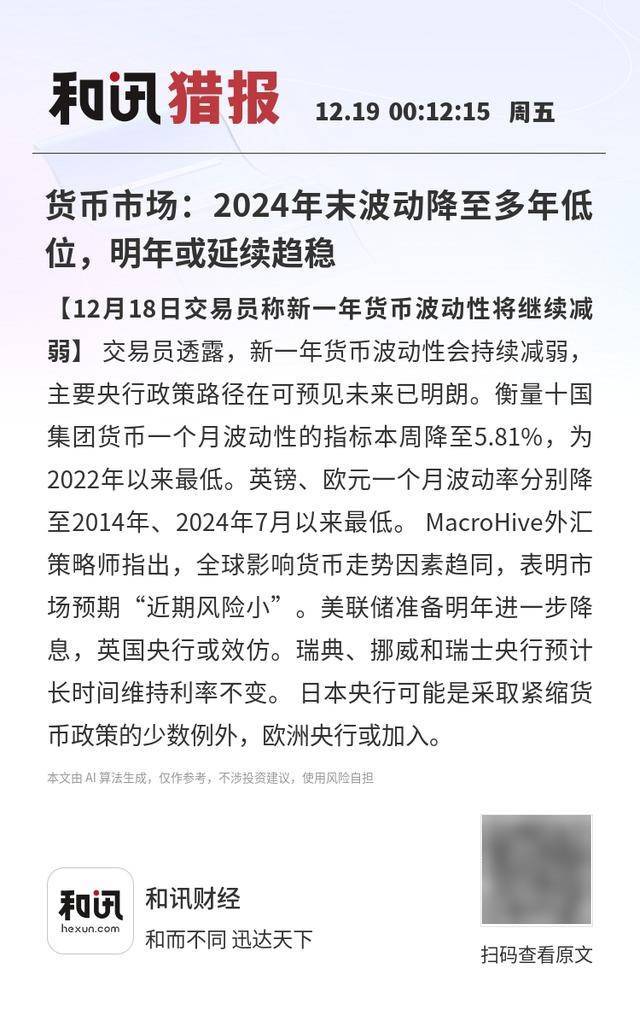
货币市场:2024年末波动降至多年低位,明年或延续趋稳
Sou Hu Cai Jing· 2025-12-18 22:41
Group 1 - The core viewpoint is that currency volatility is expected to continue decreasing in the upcoming year due to clear central bank policy paths [1][2] - The indicator measuring the one-month volatility of G10 currencies has dropped to 5.81%, the lowest since 2022 [1][2] - The one-month volatility rates for the British pound and euro have reached their lowest levels since 2014 and July 2024, respectively [1][2] Group 2 - MacroHive forex strategists indicate that global factors influencing currency movements are converging, suggesting market expectations of "low near-term risks" [1][2] - The Federal Reserve is preparing for further interest rate cuts next year, with the Bank of England likely to follow suit [1][2] - Central banks in Sweden, Norway, and Switzerland are expected to maintain interest rates for an extended period, while the Bank of Japan may be one of the few exceptions considering tightening monetary policy [1][2]

久加诺夫:固定资本投资同比下降3.1%,必须保证劳动者权益
Sou Hu Cai Jing· 2025-12-06 16:33
Core Viewpoint - The fixed capital investment in Russia is projected to decline by 3.1% in Q3 2025 compared to Q3 2024, with a modest growth of only 1.7% expected for the year 2025, indicating a significant slowdown in investment growth compared to previous years [1] Group 1: Investment Trends - Fixed capital investment growth rates were 9.8% in 2023, 7.4% in 2024, and are expected to be only 1.7% in 2025, highlighting a downward trend [1] - The decline in investment is attributed to tight monetary policies that hinder economic growth and technological advancement [1] Group 2: Implications of Investment Decline - The decrease in investment leads to a lack of new job creation [3] - Increased wear and tear on equipment is a consequence of reduced investment [3] - The technological gap is worsening due to insufficient investment in modernization [3] Group 3: Recommendations - It is suggested to halt high-interest rate policies that obstruct investment [4] - Measures should be taken to stop capital outflow and utilize raw material export revenues for national economic modernization and the development of emerging industries [4] - Restoring the right to decent work and confidence in the future for the populace is essential, particularly through labor law reforms [4]
凯投宏观:日本劳动力数据与东京CPI强化央行加息依据
Xin Hua Cai Jing· 2025-11-28 02:30
Core Viewpoint - The latest data indicates that Japan's labor market remains tight, with core inflation expected to stay above 3%, suggesting that the Bank of Japan may restart its interest rate hike cycle in the coming months [1] Labor Market - Employment growth accelerated year-on-year in October, but the expansion of the labor force kept the unemployment rate stable [1] - The Bank of Japan's latest short-term economic survey shows that the degree of labor shortages remains at its most severe level since the early 1990s [1] Inflation Outlook - Utility subsidies and the cancellation of gasoline surcharges may lead to overall inflation dropping below 2% early next year [1] - However, core inflation, excluding fresh food and energy, is expected to decline slowly [1] Monetary Policy - The conditions for implementing tight monetary policy remain intact [1]
机构:美联储会议纪要将揭示内部深度分歧
Sou Hu Cai Jing· 2025-11-19 16:49
Core Viewpoint - The Federal Reserve's October policy meeting minutes are expected to reveal clearer divisions among policymakers regarding monetary policy direction, particularly in light of conflicting market signals and the absence of official data due to the government shutdown [1] Group 1: Policy Decisions - The Federal Reserve decided to cut interest rates by 25 basis points with a 10-2 voting outcome, indicating a significant split in opinions among members [1] - Chairman Powell acknowledged "serious differences of opinion" during the press conference following the rate cut decision [1] Group 2: Data and Economic Signals - The absence of official economic data due to the government shutdown has left officials relying on alternative information, which may heighten their cautious sentiment towards further rate cuts [1] - Powell mentioned that "more and more members believe that a pause to observe for at least one cycle is warranted" [1] Group 3: Future Outlook - Although the release of government economic data is gradually resuming, the timeline for complete data availability remains uncertain, complicating the assessment ahead of the next Federal Reserve meeting in December [1]
刚刚宣布!一国降息100个基点
Sou Hu Cai Jing· 2025-10-23 13:26
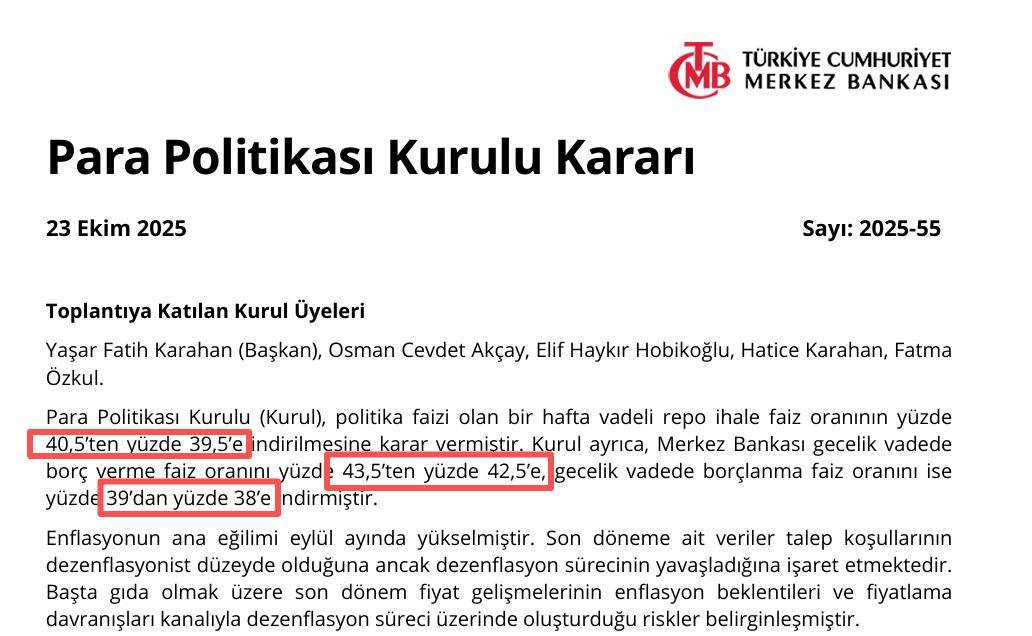
Group 1 - The Central Bank of Turkey announced a reduction in the policy interest rate from 40.5% to 39.5%, aligning with market expectations [4] - The Central Bank's statement highlighted an increase in the underlying trend of inflation in September, despite signs of deflationary pressure [4] - The consumer confidence index in Turkey fell to 83.6 points in October, the lowest since July, indicating a slight deterioration in households' assessment of their current financial situation [4] Group 2 - Foreign investors increased their holdings of Turkish government bonds by $151.1 million, while there was an outflow of $178 million from Turkish stocks [4] - The annual inflation rate in Turkey rose from 32.95% in August to 33.29% in September, marking the first increase in 16 months [4][5] - Recent monetary policy actions in other countries included the Bank of Korea maintaining its rate at 2.50% and the Central Bank of Ukraine keeping its key rate at 15.5% [5]
日本央行年底前加息概率被低估?鸽派首相或挡不住紧缩步伐
Jin Shi Shu Ju· 2025-10-22 06:10
Group 1 - A majority of economists expect the Bank of Japan to raise key interest rates in October or December, with nearly 96% predicting a minimum increase of 25 basis points by the end of March next year [1][2] - Among 75 economists surveyed, 60% anticipate the Bank of Japan will raise short-term rates from 0.50% to 0.75% within the current quarter [1] - The internal stance of the Bank of Japan's policy committee appears to favor an interest rate hike, despite potential delays due to domestic political and global economic uncertainties [2] Group 2 - Financial markets currently price in a 40% probability of an interest rate hike before the end of the year [3] - High City Sawa, the newly appointed Prime Minister, has committed to increasing government spending in key areas such as energy and economic security under a framework of "responsible and proactive fiscal policy" [3] - Among respondents, 67% expressed uncertainty about agreeing with High City Sawa's economic policies [3][4] Group 3 - Concerns about the impact of fiscal policies on financial health were raised by nearly two-thirds of respondents [4] - Market pressures, such as rising long-term bond yields, may constrain fiscal expansion efforts [5]