
经济增长目标

Search documents
地方两会系列(一):经济增长目标
East Money Securities· 2026-02-13 07:32
Economic Growth Targets - The weighted GDP growth target for 31 provinces in 2026 is set at 5.0%, down from 5.3% in 2025[21] - A total of 18 provinces have lowered their economic growth targets for 2026, accounting for approximately 60% of the total[23] - The average reduction in economic targets among the provinces that lowered their goals is 0.5%[23] Investment and Consumption Targets - The weighted investment target for 14 comparable regions is approximately 4.4%, down from 6.4% the previous year[21] - The weighted consumption target for 16 comparable regions is around 4.7%, lower than last year's target of 5.4%[21] CPI and Budget Revenue - The CPI target for most regions remains around 2%, consistent with the national target[21] - The overall target for general public budget revenue has been lowered, with 6 out of 21 regions adjusting their targets downward[21]
广发证券郭磊:抢占2026年先机,要紧盯这三大关键时间节点
2 1 Shi Ji Jing Ji Bao Dao· 2026-02-11 09:18
Group 1 - The first key time point is early March during the National People's Congress (NPC), where the annual economic growth target and major policy resource allocations will be clarified, particularly focusing on fiscal funding directions [2] - The second key time point is in mid to late March, when local investment conditions will start to become clear, coinciding with the traditional peak construction season, allowing for assessment of overall investment density and strength through key physical workload indicators [2] - The third key time point is the second quarter, which serves as an important window for observing consumer activity, as specific policy frameworks and benefits will be released following the NPC's direction to enhance consumption rates [3]

春节假期因素逐步显现 短期线材区间震荡思路对待
Jin Tou Wang· 2026-02-04 03:06
Group 1 - The domestic futures market for black metals showed significant gains, with rebar futures trading at 3471.00 yuan, up 0.26% [1] - As of late January 2026, social inventory of five major steel products in 21 cities reached 7.17 million tons, an increase of 80,000 tons or 1.1% month-on-month, but a decrease of 40,000 tons or 0.6% year-to-date, and down 170,000 tons or 2.3% year-on-year [2] - The Central Document No. 1 emphasizes expanding rural consumption through various measures, including support for new energy vehicles, smart home appliances, and green building materials [2] Group 2 - Economic growth targets for local governments are set around 5%, with the steel market absorbing external market fluctuations and showing a slowdown in trading activity due to the upcoming Spring Festival [3] - Inventory levels for major steel products have increased, but there is a divergence among product types, with hot-rolled coils continuing a trend of inventory reduction [3] - Iron ore and coking coal prices remain relatively strong, and future market conditions will depend on macroeconomic sentiment [3]
定了!上海GDP增长目标:5%左右!全年投资2550亿,加快建设崇明线、21号线、23号线等轨交线
Xin Lang Cai Jing· 2026-02-03 03:24
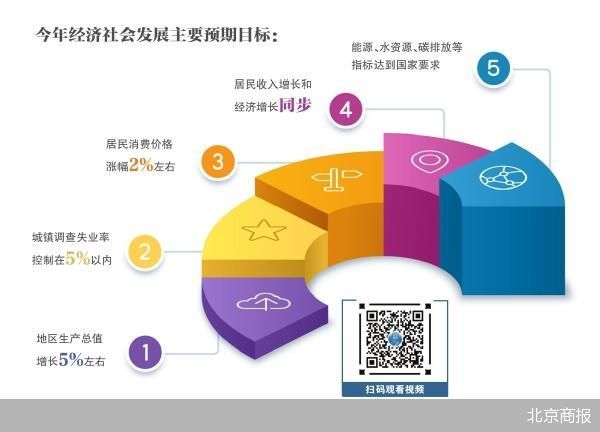
Economic Goals - The main expected economic growth target for the city is a GDP increase of around 5% [2] - Local general public budget revenue is projected to grow by 2% [2] - The proportion of total R&D expenditure relative to GDP is expected to reach approximately 4.6% [2] - The urban unemployment rate is targeted to remain within 5% [2] - Per capita disposable income for residents is expected to grow in line with economic growth [2] - The consumer price index is anticipated to rise by around 2% [2] Major Investments - A total investment of 255 billion yuan is planned for major engineering projects this year [2] - Construction will begin on the northern extension of the Jia-Min Line and accelerate the development of several other metro lines [2] - Key projects include the construction of the North-South Passage and the advancement of the second phase of the Hushang Railway and the Shanghai section of the Huchuoyong High-speed Railway [2]
大摩:经济“开门红”尚不明显
Datayes· 2026-02-02 12:10
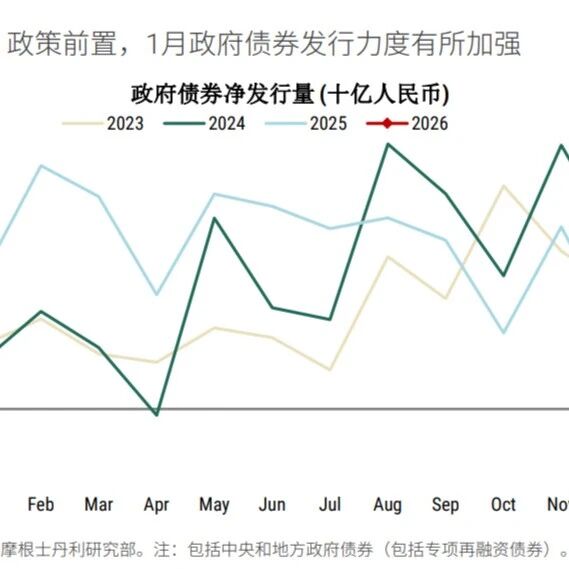
Group 1 - Local governments have lowered growth targets, reflecting a more pragmatic approach rather than a pessimistic sentiment, allowing for greater flexibility in balancing growth and quality [1] - The overall weighted average national growth target remains around 5.1%, indicating that a target of "around 5%" is still reasonable amidst more pragmatic local goals [2] - Even if the national target is set at 4.5%-5%, it does not imply a weakening of policy stance; rather, it alleviates pressure from relying on investment and supply-side policies [3] Group 2 - The narrative around real estate has become more relaxed, with reports indicating that property companies no longer need to report "three red lines" indicators monthly, suggesting a symbolic easing of constraints [3] - Future policies are expected to be small-scale attempts to prevent overshooting rather than aggressive stimulus measures, with targeted demand-side policies anticipated to manage the adjustment pace in real estate [4] - The economic fundamentals at the start of the year are stable but not strong, with significant government bond issuance and high rebar shipment volumes indicating a solid start [5] Group 3 - Export performance remains resilient, with container throughput stable, suggesting a steady export growth rate for January [10] - Consumer spending is lagging, with a notable decline in passenger car sales and weak year-on-year appliance sales, indicating limited support for consumption [12]

“遏制炒作“尚未结束,仍需远离“火场“
Hu Xiu· 2026-01-26 11:54
Group 1 - The ongoing efforts to "curb speculation" are not over, and it is advised to stay away from "fire zones" [3] - The market opened under pressure, with major indices experiencing declines despite a total trading volume exceeding 3.2 trillion yuan [3] - Regulatory scrutiny remains strong, as evidenced by a media report exposing the manipulation tactics of speculative investors [3] Group 2 - The report highlighted a prominent figure in speculative trading, revealing the mechanisms behind their operations [3] - This exposure serves as a warning to both speculative investors and uninformed retail investors, indicating that high-profile activities will attract regulatory attention [3]
北京市发改委详解2026年经济增长目标
Bei Jing Shang Bao· 2026-01-25 17:18
Group 1 - The core economic growth target for Beijing is set at approximately 5% for 2026, reflecting a balance between current needs and long-term goals [2] - The goal is part of a broader strategy to achieve significant progress in the "14th Five-Year Plan" period, aiming for a doubling of the economic total by 2035 compared to 2020, necessitating an average annual growth rate of around 4.5% over the next decade [2] - Employment quality, income stability, and increased government investment in public services and social security are highlighted as essential components requiring sustained economic growth [2] Group 2 - Over the past five years, Beijing's economy has crossed two trillion-yuan thresholds, with a projected growth of 5.4% in 2025, surpassing the national average by 0.4 percentage points, indicating a solid foundation for future development [3] - Key supporting conditions include deep integration of technological and industrial innovation, continuous market vitality from reforms, and a strong "Beijing Service" business environment [3] - In 2025, the industrial added value of Beijing is expected to grow by 6.5%, with total industrial output reaching 2.8 trillion yuan, while modern service sectors contribute significantly to GDP, accounting for 47.4%, an increase of 6.6 percentage points since 2020 [3] Group 3 - The central economic work conference emphasizes a focus on stability while seeking progress, enhancing quality and efficiency, and integrating existing and new policies to strengthen counter-cyclical and cross-cyclical adjustments [4] - The Beijing government has outlined seven initiatives to ensure the achievement of the economic growth target, aiming for a balance between ambitious yet realistic goals that can boost confidence and respect economic laws [4]
12月国民经济运行数据解读:2025年经济目标顺利完成
East Money Securities· 2026-01-25 08:09
Macroeconomic Data Review - The GDP for 2025 reached 14,018.79 billion yuan, growing by 5.0% year-on-year, with a fourth-quarter growth of 4.5% [1][4] - The overall economic performance in 2025 showed a trend of high growth at the beginning of the year followed by a decline, with external demand outpacing internal demand [4][6] - The fixed asset investment for the year decreased by 3.8% year-on-year, indicating a continued downward trend in investment [4][5] - The industrial added value for December increased by 5.2% year-on-year, with high-tech manufacturing maintaining robust growth [4][32] - The service sector production index grew by 5.0% year-on-year in December, reflecting an improving overall economic climate [4][38] Consumption Trends - The retail sales of consumer goods in December grew by 0.9% year-on-year, a decline of 0.4 percentage points from the previous month [4][19] - The performance of service retail was better than that of goods retail, with significant increases in categories such as cosmetics and sports entertainment [4][21] - The consumption growth rate for basic living goods showed a decline, while the "two new" products experienced a narrowing of the year-on-year decline [4][21] Investment Insights - Fixed asset investment saw a further decline, with December showing a continued decrease across all three major investment categories [4][5] - The construction and installation projects remained weak, while equipment and tool purchases continued to drive investment growth [4][24] Industrial Performance - The industrial sector showed stable growth, with the added value of industries above designated size increasing by 5.2% year-on-year in December [4][32] - High-tech manufacturing industries led the growth, with a year-on-year increase of 11% in December [4][32] Real Estate Market - The real estate sector continued to show weakness, with new construction, construction area, completion area, and sales area all declining [5][38] - The price index for new residential properties in 70 large and medium-sized cities fell by 3.0% year-on-year in December, indicating a widening decline [5][44] Outlook for 2026 - Several factors are expected to support a strong start for the economy in 2026, including proactive macro policies and the potential for significant project traction [6][11] - The upcoming local government elections may also contribute to improved economic performance, as historically, such years have seen better growth [6][11]
“跳一跳能够实现” 2026年经济增长目标是怎么来的?北京市发展改革委详解
Bei Jing Shang Bao· 2026-01-25 06:15
Core Viewpoint - Beijing has set a GDP growth target of around 5% for 2026, reflecting a balance between current needs and long-term goals, as emphasized by the city's government officials [3][4]. Group 1: Economic Growth Goals - The target for 2026 is part of a broader strategy to achieve significant progress during the "14th Five-Year Plan" period, aiming for a doubling of the economic output by 2035 compared to 2020 levels, necessitating an average annual growth rate of approximately 4.5% over the next decade [4]. - The economic growth target is designed to enhance employment quality, increase residents' income, and ensure government investment in public services and social security [4]. Group 2: Economic Development Context - Over the past five years, Beijing's economy has crossed two trillion-yuan thresholds, with a projected growth rate of 5.4% for 2025, which is 0.4 percentage points higher than the national average, indicating a solid foundation for future development [5]. - The integration of technological and industrial innovation, along with ongoing reforms, has significantly boosted market vitality, contributing to a favorable business environment in Beijing [7]. Group 3: Supporting Conditions - In 2025, the city's industrial output value is expected to grow by 6.5%, reaching a total of 2.8 trillion yuan, while modern service industries, including information services, finance, and technology services, are projected to account for 47.4% of the city's GDP, an increase of 6.6 percentage points since 2020 [7]. - These key sectors are anticipated to contribute over 70% to the city's economic growth, providing stable support for the upcoming years [7].

“跳一跳能实现”!2026年经济增长目标怎么定的?北京市发改委解读
Bei Jing Shang Bao· 2026-01-25 04:53
Core Viewpoint - The economic growth target for Beijing in 2026 is set at around 5%, reflecting a balance between ambitious and practical goals, while considering both current and long-term needs [2][4]. Group 1: Economic Growth Target - The target for Beijing's GDP growth in 2026 is approximately 5% [2]. - To achieve the goal of doubling the economic total by 2035 compared to 2020, an average annual growth rate of about 4.5% is required over the next decade [2]. Group 2: Supporting Factors - Over the past five years, Beijing's economy has crossed two trillion-yuan thresholds, with a growth rate of 5.4% in 2025, surpassing the national average by 0.4% [3]. - Key supporting conditions include the deep integration of technological and industrial innovation, continuous market vitality from reforms, and the strengthening of high-tech industries [3]. - In 2025, the industrial added value of Beijing's large-scale industries is expected to grow by 6.5%, with total industrial output reaching 2.8 trillion yuan [3]. Group 3: Policy and Implementation - The municipal government has outlined seven measures to ensure the achievement of the economic growth target for 2026 [4]. - The approach emphasizes a balance between confidence-boosting and adherence to economic principles, ensuring that goals are realistic and achievable [4].