
线材期货

Search documents
交易所连发公告!紧急调整
Sou Hu Cai Jing· 2026-02-10 07:20
Core Viewpoint - The Shanghai Futures Exchange and Shanghai Gold Exchange have announced adjustments to margin ratios and price limits for various futures contracts, as well as work arrangements for the 2026 Spring Festival period to mitigate market risks during this time [1][7][14]. Group 1: Margin Ratio and Price Limit Adjustments - The margin ratios and price limits for newly listed futures contracts such as copper, aluminum, lead, and zinc have been adjusted, with price limits set at 10% and margin ratios at 11% for hedged positions and 12% for general positions [4]. - For contracts like nickel and tin, the price limit is set at 12% with margin ratios of 13% for hedged positions and 14% for general positions [4]. - Gold contracts have a price limit of 17% and margin ratios of 18% for hedged positions and 19% for general positions, while silver contracts have a price limit of 20% and margin ratios of 21% for hedged positions and 22% for general positions [4]. - Other contracts, including rebar and hot-rolled coils, have a price limit of 7% and margin ratios of 8% for hedged positions and 9% for general positions [4]. Group 2: Spring Festival Work Arrangements - The Shanghai Futures Exchange will not conduct night trading on February 13, 2026, and will be closed from February 14 to February 23, 2026, resuming trading on February 24, 2026 [8][14]. - On February 24, 2026, all futures and options contracts will undergo a collective auction from 08:55 to 09:00, followed by the resumption of night trading [9]. Group 3: Risk Control Measures - The Shanghai Gold Exchange has implemented measures to adjust margin ratios and price limits for gold and silver contracts to prevent price fluctuations during the Spring Festival [16]. - Starting from the close on February 11, 2026, the margin ratio for gold contracts will increase from 18% to 21%, and the price limit will rise from 17% to 20% [16]. - For silver contracts, the margin ratio will increase from 24% to 27%, with the price limit changing from 23% to 26% [16].

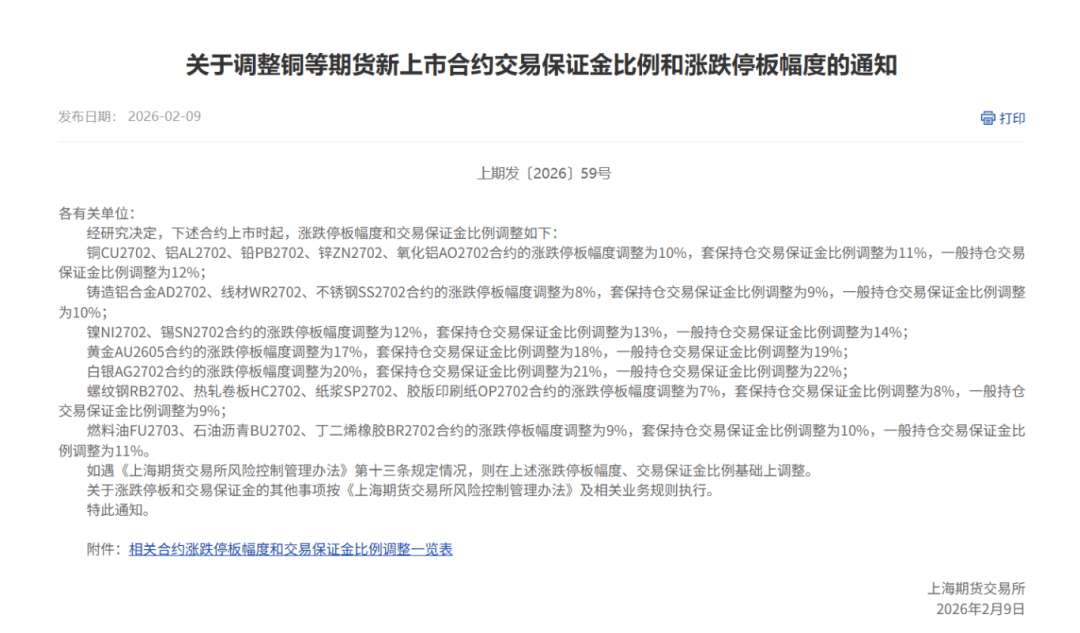
上期所、广期所公布春节假期风控安排
Qi Huo Ri Bao Wang· 2026-02-09 23:19
Core Viewpoint - The Shanghai Futures Exchange, Shanghai International Energy Exchange, and Guangzhou Futures Exchange have announced adjustments to the price limits and margin requirements for various futures contracts ahead of the 2026 Spring Festival [1] Group 1: Adjustments by Shanghai Futures Exchange - Starting from the settlement on February 12, 2026, the price limit for copper, aluminum, zinc, lead, and alumina futures will be adjusted to 13%, with margin requirements set at 14% for hedging and 15% for general positions [2] - Nickel and tin futures will have a price limit of 15%, with margin requirements of 16% for hedging and 17% for general positions [2] - Futures for casting aluminum alloy, wire rod, and stainless steel will see a price limit of 11%, with margin requirements of 12% for hedging and 13% for general positions [2] - Gold futures will have a price limit of 20%, with margin requirements of 21% for hedging and 22% for general positions [2] - Silver futures will have a price limit of 25%, with margin requirements of 26% for hedging and 27% for general positions [2] - Futures for rebar, hot-rolled coils, pulp, and printing paper will have a price limit of 10%, with margin requirements of 11% for hedging and 12% for general positions [2] - Futures for fuel oil, petroleum asphalt, butadiene rubber, and natural rubber will have a price limit of 12%, with margin requirements of 13% for hedging and 14% for general positions [2] Group 2: Adjustments by Shanghai International Energy Exchange - From February 12, 2026, the price limit for international copper futures will be set at 13%, with margin requirements of 14% for hedging and 15% for general positions [3] - Crude oil, low-sulfur fuel oil, and No. 20 rubber futures will have a price limit of 12%, with margin requirements of 13% for hedging and 14% for general positions [3] - The shipping index (European line) futures will have a price limit of 18%, with a margin requirement of 20% [3] Group 3: Adjustments by Guangzhou Futures Exchange - Starting from February 12, 2026, the price limit for industrial silicon futures will be adjusted to 11%, with speculative margin requirements set at 13% and hedging margin requirements at 12% [3] - The price limit for polysilicon futures will be adjusted to 12%, with margin requirements remaining unchanged for both speculative and hedging positions [3] - The price limit for lithium carbonate futures will be adjusted to 15%, with speculative margin requirements set at 17% and hedging margin requirements at 16% [3] - The price limit for platinum and palladium futures will be adjusted to 24%, with both speculative and hedging margin requirements set at 26% [3] Group 4: Resumption of Trading - Trading will resume on February 24, 2026, and the price limits and margin requirements for industrial silicon, polysilicon, platinum, and palladium futures will revert to pre-adjustment levels on the first trading day without price limits and continuous quotes [4] - The price limit for lithium carbonate futures will be adjusted to 13%, with speculative margin requirements set at 15% and hedging margin requirements at 14% [4]
上期所:2月24日8:55—9:00所有期货、期权合约进行集合竞价,当晚恢复夜盘交易
Sou Hu Cai Jing· 2026-02-09 13:15
Group 1 - The Shanghai Futures Exchange announced the trading arrangements for the Spring Festival in 2026, including a market closure from February 14 to February 23, with night trading resuming on February 24 [2] - The margin ratios and price fluctuation limits for various futures contracts will be adjusted starting from the market close on February 12, 2026, with specific percentages outlined for different commodities [2] - The price fluctuation limits and margin ratios will revert to their original levels after the first trading day without a one-sided market following February 24, 2026 [3] Group 2 - Specific adjustments include a 13% price fluctuation limit for copper, aluminum, zinc, and lead futures, with varying margin ratios for hedging and general positions [2] - Nickel and tin futures will have a 15% price fluctuation limit, with higher margin requirements for different types of positions [2] - Gold and silver futures will see significant adjustments, with price fluctuation limits set at 20% and 25% respectively, along with corresponding margin ratio changes [2]
关于调整铜、国际铜、甲醇等期货相关合约交易保证金标准和涨跌停板幅度的通知
Xin Lang Cai Jing· 2026-02-09 01:38
Group 1 - The company has announced adjustments to the margin requirements and price fluctuation limits for various futures contracts effective from February 9, 2026 [1][3][5] - The margin ratio for copper, aluminum, lead, zinc, and aluminum oxide futures is set to 22%, with a price fluctuation limit of 10% [1] - The margin ratio for cast aluminum alloy and stainless steel futures is adjusted to 18% with a fluctuation limit of 8% [1] - The margin ratio for wire rod futures is set at 19% with a fluctuation limit of 8% [1] - Nickel and tin futures will have a margin ratio of 26% and a fluctuation limit of 12% [1] - Gold futures will see a margin ratio of 29% with a fluctuation limit of 17% [1] - Silver futures will have a margin ratio of 39% and a fluctuation limit of 20% [1] - For methanol, paraxylene, PTA, short fiber, and bottle futures, the margin ratio is set to 20% with a fluctuation limit of 9% [5] Group 2 - Contracts with existing margin standards and fluctuation limits that exceed the new adjustments will continue to follow the original regulations [2][4][6]
上期所:再次对黄金、白银等期货品种提保扩板
Sou Hu Cai Jing· 2026-02-05 15:58
Core Viewpoint - The Shanghai Futures Exchange (SHFE) has announced an adjustment to the price limits and margin requirements for various futures contracts, including gold and silver, effective from February 9, 2026, in response to extreme market conditions [1][4]. Group 1: Adjustments to Futures Contracts - The price limit for gold futures contracts has been adjusted to 17%, with the margin requirement for hedging positions set at 18% and for general positions at 19% [2][3]. - The price limit for silver futures contracts has been increased to 20%, with the margin requirement for hedging positions at 21% and for general positions at 22% [2][3]. - For non-ferrous metals, the price limit for copper, aluminum, lead, and zinc has been set at 10%, with corresponding margin requirements of 11% for hedging and 12% for general positions [2][3]. - The price limit for aluminum alloy, wire, and stainless steel has been adjusted to 8%, with margin requirements of 9% for hedging and 10% for general positions [2][3]. - Nickel and tin futures contracts have a price limit of 12%, with margin requirements of 13% for hedging and 14% for general positions [2][3]. Group 2: Market Response and Implications - Industry experts indicate that the SHFE's decision to raise price limits and margin requirements is a timely and necessary measure to address current extreme market conditions, aiming to alleviate market pressure and reduce risks associated with high-leverage speculation [4]. - The adjustments are seen as a preventive measure to maintain overall market stability and to prevent risks from overseas market fluctuations, particularly in the context of heightened market sentiment in international precious metals [4]. - The measures reflect China's regulatory approach to prioritize stability in the commodity futures market, especially as the Spring Festival approaches and uncertainties in overseas markets increase [4]. Group 3: Market Performance - On February 5, domestic commodity futures saw significant declines, with silver dropping over 10% and other metals like copper and aluminum also experiencing declines of more than 2% [5]. - International precious metal prices continued to adjust, with spot silver experiencing a drop of over 17% at one point, and spot gold down by nearly 3% [5].
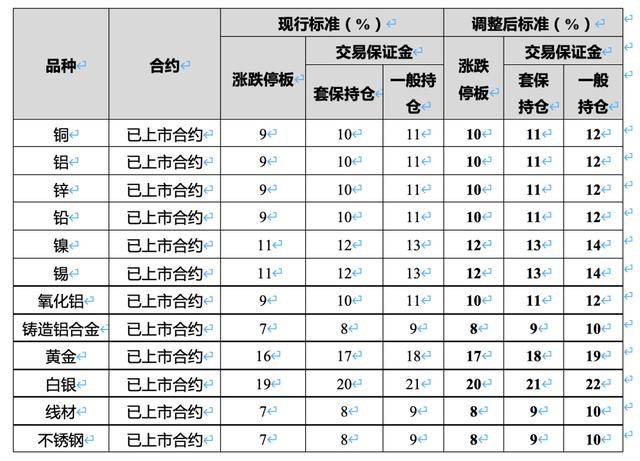
交易所再出手,调整!
Sou Hu Cai Jing· 2026-02-05 12:35
Core Viewpoint - The Shanghai Futures Exchange (SHFE) announced adjustments to the price fluctuation limits and margin requirements for various futures contracts, including gold and silver, effective from February 9, 2026 [1]. Group 1: Adjustments to Futures Contracts - The fluctuation limit for gold futures contracts will be adjusted to 17%, with the margin requirement for hedging positions set at 18% and for general positions at 19% [3][4]. - The fluctuation limit for silver futures contracts will be adjusted to 20%, with the margin requirement for hedging positions set at 21% and for general positions at 22% [3][4]. - For copper, aluminum, lead, zinc, and alumina futures contracts, the fluctuation limit will be adjusted to 10%, with margin requirements of 11% for hedging and 12% for general positions [3][4]. - The fluctuation limit for futures contracts of casting aluminum alloy, wire, and stainless steel will be adjusted to 8%, with margin requirements of 9% for hedging and 10% for general positions [3][4]. - Nickel and tin futures contracts will have their fluctuation limit adjusted to 12%, with margin requirements of 13% for hedging and 14% for general positions [3][4]. Group 2: Market Trends and Analysis - In January 2023, the gold and silver markets experienced significant volatility, with both assets seeing extreme price fluctuations [5][6]. - As of early February 2023, gold futures and spot prices have declined by over 1%, while silver futures have dropped by more than 7%, and silver spot prices have decreased by over 10% [6]. - Analysts from Galaxy Futures suggest that the gold and silver markets are currently in a phase of rebound and recovery following a sharp decline, with a favorable macroeconomic environment expected in the medium to long term, although caution is advised in the short term [6]. - Funi Futures indicates that due to ongoing global political and economic uncertainties, as well as pressures on U.S. fiscal sustainability, gold remains bullish in the medium term, but short-term price volatility may lead to a potential second bottom [6].
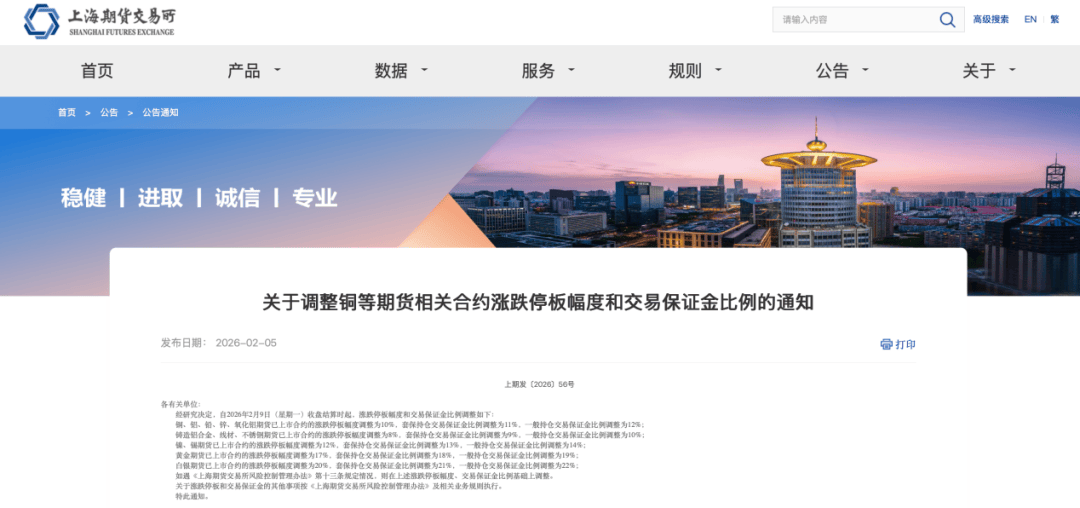
春节假期因素逐步显现 短期线材区间震荡思路对待
Jin Tou Wang· 2026-02-04 03:06
Group 1 - The domestic futures market for black metals showed significant gains, with rebar futures trading at 3471.00 yuan, up 0.26% [1] - As of late January 2026, social inventory of five major steel products in 21 cities reached 7.17 million tons, an increase of 80,000 tons or 1.1% month-on-month, but a decrease of 40,000 tons or 0.6% year-to-date, and down 170,000 tons or 2.3% year-on-year [2] - The Central Document No. 1 emphasizes expanding rural consumption through various measures, including support for new energy vehicles, smart home appliances, and green building materials [2] Group 2 - Economic growth targets for local governments are set around 5%, with the steel market absorbing external market fluctuations and showing a slowdown in trading activity due to the upcoming Spring Festival [3] - Inventory levels for major steel products have increased, but there is a divergence among product types, with hot-rolled coils continuing a trend of inventory reduction [3] - Iron ore and coking coal prices remain relatively strong, and future market conditions will depend on macroeconomic sentiment [3]
国内期货主力合约多数收涨 集运欧线涨近9%
Zheng Quan Shi Bao Wang· 2025-12-22 07:22
Group 1 - The majority of domestic futures main contracts experienced an increase, with the shipping European line rising nearly 9% [1] - Palladium and platinum saw a rise of 7%, while silver in Shanghai increased by 6% [1] - Nickel in Shanghai rose over 4%, and lithium carbonate also increased by 4% [1] Group 2 - Other commodities such as rebar, asphalt, low-sulfur fuel oil, crude oil, pulp, and gold in Shanghai rose by over 2% [1] - Conversely, plastics and polysilicon fell by over 2%, while glass and alumina dropped by over 1% [1]
南华商品指数:黑色板块上涨,贵金属板块领跌
Nan Hua Qi Huo· 2025-10-10 11:33
Group 1: Report Overview - The South China Commodity Index fell by -0.84% today based on the closing prices of adjacent trading days [1][3] - Among the sector indices, only the South China Black Index rose by 0.32%, while the rest declined. The South China Precious Metals Index had the largest decline of -1.15%, and the South China Metal Index had the smallest decline of -0.4% [1][3] - Among the theme indices, the Black Raw Materials Index had the largest increase of 0.49%, and the Economic Crops Index had the smallest increase of 0.38%. The Energy Index had the largest decline of -1.23%, and the Building Materials Index had the smallest decline of -0.15% [1][3] - Among the single - variety indices of commodity futures, the Wire Rod index had the largest increase of 3.01%, and the Egg index had the largest decline of -3.37% [1][3] Group 2: Index Data Details Comprehensive and Sector Indices | Index Name | Today Close | Pre. Close | Change Points | Change Rate | Annualized Return | Annualized Volatility | Sharpe Ratio | | --- | --- | --- | --- | --- | --- | --- | --- | | Comprehensive Index NHCI | 2572.47 | 2550.86 | -21.61 | -0.84% | 4.78% | 12.54% | 0.38 | | Precious Metals Index NHPMI | 1491.73 | 1474.58 | -17.15 | -1.15% | 16.66% | 2.89 | | Industrial Products Index NHII | 3573.12 | 3596.46 | -23.34 | -0.65% | -2.59% | 14.98% | -0.17 | | Metal Index NHMI | 6449.77 | 6475.78 | -26.01 | -0.40% | 4.47% | 13.55% | 0.33 | | Energy and Chemical Index NHECI | 1604.70 | 1618.24 | -13.54 | -0.84% | -9.45% | 17.51% | -0.54 | | Non - ferrous Metals Index NHNF | 1733.94 | 1749.24 | -15.29 | -0.87% | 4.91% | -2.37% | 19.83% | | Black Index NHFI | 2528.55 | 2520.44 | 8.11 | 0.32% | -0.12 | | Agricultural Products Index NHAI | 1060.79 | 1067.92 | -7.14 | -0.67% | -0.14% | 8.89% | -0.02 | | Mini Comprehensive Index NHCIMi | 1196.69 | 1186.06 | -10.63 | -0.89% | 0.74% | 0.07 | | Energy Index NHEI | 1023.68 | 1036.43 | -12.74 | -1.23% | -3.27% | 18.79% | -0.17 | | Petrochemical Index NHPCI | 904.04 | 912.67 | -8.63 | -0.95% | -3.10% | 8.19% | -0.38 | | Refined Chemical Index NHCCI | 970.75 | 974.73 | -3.98 | -0.41% | 4.06% | 7.84% | -0.52 | | Black Raw Materials Index NHFM | 1063.69 | 1058.55 | 5.14 | 0.49% | -0.36% | 18.46% | -0.02 | | Building Materials Index NHBMI | 727.40 | 728.50 | -1.10 | -0.15% | | Oil and Oilseeds Index NHOOI | 1251.56 | 1264.19 | -12.63 | -1.00% | 0.59% | 13.24% | 0.04 | | Economic Crops Index NHAECI | 901.50 | 898.06 | 3.44 | 0.38% | 7.18% | -0.02 | [3] Contribution of Single - variety Indices to Index Changes - For the South China Comprehensive Index, positive - contributing varieties include Iron Ore (14.40%), Methanol (2.66%), etc., and negative - contributing varieties include Palm Oil (-12.11%), Zinc (-19.34%), etc [3] - For the South China Mini Comprehensive Index, positive - contributing varieties include Iron Ore (5.13%), and negative - contributing varieties include PVC (-52.86%) [3] - For the South China Industrial Products Index, positive - contributing varieties include Iron Ore (7.52%), and negative - contributing varieties include Zinc (-19.34%) [3] - For the South China Metal Index, positive - contributing varieties include Coke (4.56%), and negative - contributing varieties include PVC (-3.51%) [3] - For the South China Energy and Chemical Index, positive - contributing varieties include Coke (5.84%), and negative - contributing varieties include Crude Oil (-3.86%) [3] - For the South China Agricultural Products Index, positive - contributing varieties include Apple (8.52%), and negative - contributing varieties include Palm Oil (-6.31%) [3] [6] Single - variety Index Changes in Some Sectors Energy and Chemical Sector - LPG rose by 0.35%, Crude Oil fell by -1.92%, Low - sulfur Fuel Oil fell by -1.87% [9] Black Sector - Coal fell by -1.84% [4] Agricultural Sector - Palm Oil fell by -1.38%, Rapeseed Oil fell by -1.82%, Rapeseed had a 0.02% increase, Live Pigs fell by -0.21%, Rapeseed Meal fell by -1.81% [6]
上期所发布2025年国庆节、中秋节期间有关工作安排
Sou Hu Cai Jing· 2025-09-24 12:27
Group 1 - The Shanghai Futures Exchange announced the trading schedule for the National Day and Mid-Autumn Festival in 2025, indicating no night trading on September 30, 2025, and a market closure from October 1 to October 8, 2025 [1][2] - Trading will resume on October 9, 2025, with a collection auction for all futures and options contracts from 08:55 to 09:00 [2] Group 2 - Starting from the settlement on September 29, 2025, margin ratios and price fluctuation limits for various futures contracts will be adjusted, with specific percentages outlined for different commodities [2] - For example, the price fluctuation limit for aluminum alloy futures will be adjusted to 7%, while for gold and silver futures, it will be set at 15% [2] Group 3 - On October 9, 2025, after trading, the price fluctuation limits and margin ratios will revert to their original levels following the first trading day without a one-sided market [3] - Other matters regarding price fluctuation limits and margin ratios will be governed by the Shanghai Futures Exchange's risk control management regulations [4]